

LOS ANGELES — Herbalife International thrived under founder Mark Hughes.
Handsome, young and buoyed by his rags-to-riches story, Hughes built a billion-dollar business over two decades by inspiring legions of people around the world to buy and sell his nutritional supplements and other health products.
But his death in 2000 from a drug and alcohol overdose sent the company reeling.
Sales lagged in the United States, Herbalife's biggest market, as the company tried to manage without Hughes through a shuffle of top management.
Five years later, Herbalife is in the throes of a dramatic turnaround that has seen it post record sales, double its stock price and gear up to conquer what could be its largest market yet — China.
"Management has turned this around in the last two years, but they really hit their stride in the last year," said Scott Van Winkle, managing director of investment bank Canaccord Adams in Boston.
People are also reading…
In the third quarter of 2005, the most recent period for which Herbalife has reported financial results, the company generated $401 million in net sales, a record quarter. Net income was $27.1 million, compared to $11.5 million in the same quarter of 2004.
CEO Michael Johnson and Greg Probert, president and chief operating officer, beefed up research to update Herbalife's product line from its staple of weight-management, nutrition and skin-care offerings to include items for fitness, endurance and children.
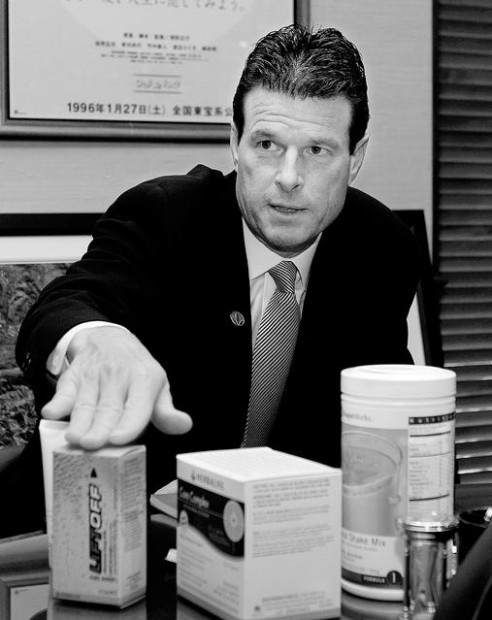
Herbalife has rolled out at least one new product every year. Last year, it began offering a drink called Liftoff aimed at the youth and energy-drink market. It also launched a heart health line called Niteworks and a skin-care product called NouriFusion.
To keep recruiting and retention of its distributors strong, the company plans to roll out a Web site later this year to let customers place orders directly, while still funneling the sales through distributors, who number 1 million in 60 nations.
Johnson, who has run triathlons, has also been keen on burnishing Herbalife's image by sponsoring athletic events such as the Michelob Ultra London Triathlon and the Nautica Malibu Triathlon.
Johnson and Probert, former Walt Disney Co. executives, were brought in by venture capital firms J.H. Whitney & Co. of Stamford, Conn., and Golden Gate Capital Inc. of San Francisco, which bought Herbalife in 2002 for about $685 million. The company's market capitalization is now $2.37 billion.
An initial public stock offering in December 2004 raised more than $200 million. The two buyout firms took out $400 million in a secondary stock offering a year later. Herbalife shares have traded in a 52-week range of $14.52 to $35.55 and closed at $35.15 on Wednesday.
Herbalife has had to fight some legal battles along the way, including claims that its products contained the stimulant ephedra, a shareholder lawsuit over Hughes' attempt to buy back the company in 2000, and a class-action suit filed by low-level Herbalife distributors accusing the company and high-ranking distributors of operating a pyramid scheme. Herbalife settled the suits.
Johnson waves off the notion that he's behind a sweeping change at Herbalife.
"You call it a turnaround; we call it a fixer-upper," said Johnson, 51.
Hughes launched Herbalife International in 1980 when he was just 24 but soon found himself on the defensive. He tussled against the California attorney general, who sued Herbalife, alleging the company used an illegal pyramid scheme and made false medical claims. The suit was settled in 1986.
Nevertheless, the company's business thrived as people became more concerned about eating healthily and losing weight.
Hughes was found dead at 44 in his $25 million Malibu home. The coroner's report said he died of an accidental overdose of alcohol and a prescription antidepressant — a blow to the image of healthy living Hughes had cultivated.
Before Johnson, two other chief executives tried to lead Herbalife, but the focus soon turned toward selling the company. Herbalife lost ground while other direct-sellers incorporated Internet technology and other advances.
"No capital investment, no real active management, no new product innovation or development, really nothing was being done for a few years," Van Winkle said.
The leadership vacuum brought infighting between high-ranking distributors, prompting some to leave, recalled Gabriel Sandoval, a 13-year veteran of Herbalife and one of its biggest U.S. distributors. "It was a really hard time for me, a really hard time for everybody," said Sandoval, 58. "Now, everything is in place. We believe again."