

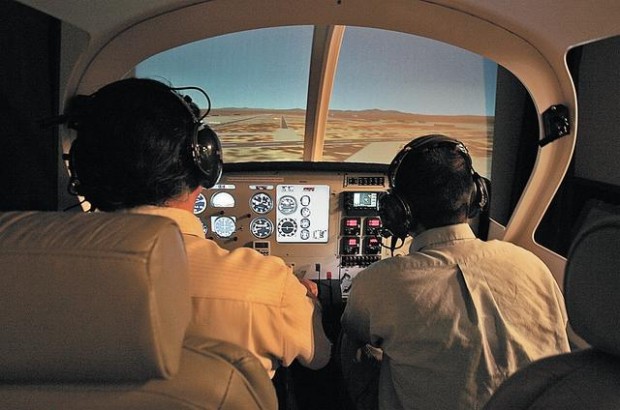
Jerry Williams is confident that when he flips an aircraft in midair or disables the cockpit instruments, his students can recover without careening to the ground.
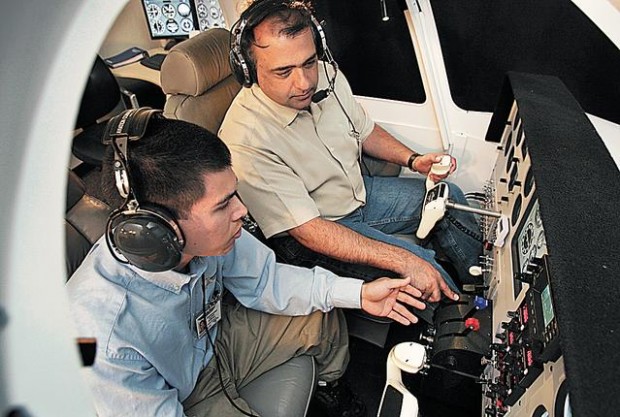
Rather than attempt dangerous maneuvers in the skies above Tucson, Williams instead offers a safer environment for part of the training — a computerized simulator.
His program at Sonoran Wings Flight Training Centre, 1961 E. Flightline Drive, began about a year ago and is part of an effort by Williams and other flight instructors to offer better training in less time.
"It's amazing how scared they get in there," said Williams, the owner of Sonoran Wings, referring to the initial fear students have when learning to fly. "How they behave in there is how they'll behave in the plane."
Williams and his team put about 3,000 hours of work into developing the program, which began after the Federal Aviation Administration contacted him in October 2005 to develop a new, combined curriculum. Instead of getting a private-pilot license and then later becoming certified to fly with instruments, Williams' new program combines both into one — a format that the FAA calls a first of its kind among certified flight schools in the state.
People are also reading…
With an almost gleeful demeanor, Williams likes to discuss the countless scenarios he throws at students inside the simulator.
Brett Johnson knows. As Williams' first student in the new program, Johnson, a software engineer, had to face a pilot's nightmare during one simulator session: His instruments failed — the ones that showed how fast the plane was going and whether the wings were level.
All would have been well, except Johnson was flying through clouds and couldn't see the horizon. Before he knew it, he said, Johnson drove the plane into the ground "faster than you would believe."
"I wasn't in a plane; I wasn't dying," Johnson said. "But my palms were sweating."
But real-life implications of such failures can be deadly. Williams said that many aviation fatalities can be blamed on pilot error due to unfamiliar situations.
"Why do accidents occur?" he said. It's because aviators can "make bad decisions."
Sonoran Wings has seen an increase in students during turbulent times in the Tucson flight-training industry as of late. Last week, International Airline Training Academy at Ryan Airfield filed for bankruptcy. And in February, Las Vegas-based Silver State Helicopters filed for Chapter 7 bankruptcy, leaving hundreds of students in Tucson and Phoenix without refunds, flight-training time, or both.
At the same time, the demand for pilots has grown. AIR Inc., a company that provides resources for aviation careers, projects about 14,279 airline jobs for this year, up from 13,157 in 2007.
So to meet that demand, using a simulator is "absolutely a way to do this more economically," said Rand Goldstein, the president of Wright Flyers Aviation Inc. in San Antonio. "I think you do make better pilots."
He said that the creation of emergency situations is more prudent in a simulator, and that the cost of running a simulator can be very inexpensive compared with the rising cost of fuel used by aircraft.
And simulators "work very well when you're teaching procedures and the simple use of equipment," said Bill Waldock, a professor of aviation science at Embry-Riddle Aeronautical University in Prescott.
"When combined with the actual flight experience, they're very effective," he said.
After some time in the simulator, a student gets into a plane at Tucson International Airport with an instructor and then flies to a nearby city, such as Benson.
Williams said that in the end, students spend about $13,000 for 70 hours of flight instruction, compared with more than $23,000 with about 115 to 120 hours in other combined private-pilot and instrument-rating programs.
"It's not just saving time," Williams said. "It's improving the capabilities of the students when they're done."