



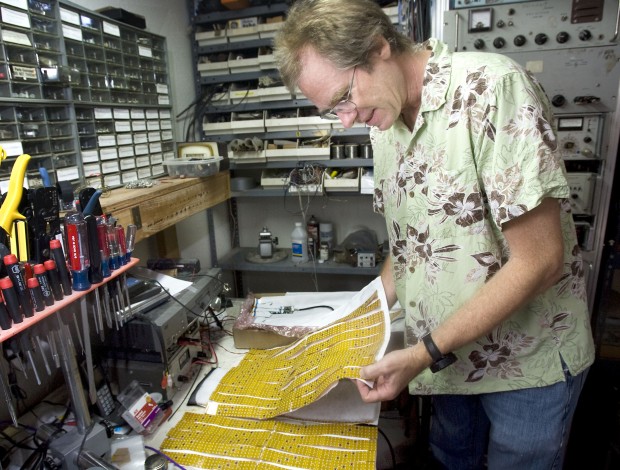
Tucsonan David Forbes' electronic inventions probably won't change the world, nor are they likely to make much money.
Forbes' projects - including a working TV built into a lab coat and watches made from vintage vacuum-tube numerical displays - are just plain cool.
For Forbes and other do-it-yourselfers - known as "hackers" or "makers" - just seeing a cool idea turned into reality is reason enough to do it.
"I don't do things for money - I do things for fun," said Forbes, who works part time at the University of Arizona building and maintaining radio-telescope equipment.
Forbes, 50, unveiled his Video Coat in late July at the Detroit Maker Faire, an expo sponsored by Make magazine.
The coat - already dismantled to create a new version - comprised flexible arrays of light-emitting diodes, or LEDs, arranged together to form a matrix that can display video images.
People are also reading…
Advancing a monochrome TV he made a couple of years ago with cheap LED modules, he sought to make a color version by clustering together different-colored LEDs to form pixels, or picture elements, that make up a video image.
A similar arrangement is used on electronic billboards, but Forbes - who attended the UA but went to work in electronics before graduating - aimed to bring it down to size and make it wearable.
Using profits from the sale of his wristwatches, he designed his own flexible circuit boards to get the right picture resolution and durability. The video coat - which displayed a wrap-around image even across its sleeves - has a resolution of 120 by 160 pixels.
Making the coat involved soldering some 60,000 integrated LEDs on flexible strips - work Forbes farmed out to a company that uses robotic soldering machines.
"This technology, the idea of putting LEDs close together and putting it on clothes - no one else is doing this," Forbes said, though he noted that electronics giant Philips demonstrated light-emitting textiles about five years ago.
The TV coat doesn't hold a lot of commercial promise, he said.
Forbes estimated that he spent about $20,000 on the video coat, much of it from profits from his nixie-tube watches.
"At this point, the only hope I have to recoup it would be if I took it to Hollywood, or to Las Vegas for someone who wanted to use it for promotions," he said.
The video coat is nothing if not an attention-grabber - prompting a thorough search by airport security on the way to Detroit.
"I put it on and I'm the center of attention - I'm a nerd magnet," Forbes said, recalling how he was mobbed at the Maker Faire.
He's now using components from the coat to make a vest version for the Burning Man arts and culture festival, coming up in Nevada at the end of the month.
And there's more in the works for Forbes, who started making audio gear as a teen and later got into radio - helping create a local pirate radio station in the 1990s.
At his home workshop near the UA, Forbes is working on a lightweight, powerful boombox system for bicycles, and clocks made from cathode-ray tube displays.
But his biggest hit is the vacuum-tube wristwatch.
The watches are made from nixie tubes, numerical vacuum-tube displays used on calculators and electronic counters from the 1950s to the 1970s.
He's sold about 400 of the watches at $400 each - thanks partly through the endorsement of Apple Computer co-founder Steve Wozniak.
"Woz" bought one of Forbes' nixie watches after spotting someone wearing one at the Computer History Museum in Mountain View, Calif.
Wozniak later bought several more and referred admirers, and he's shown off the watch during interviews and at conferences.
"If you're making a geek device, you can't have a better spokesman than Steve Wozniak," Forbes said.
He hopes to have more watches available by the end of the year, along with kits to allow people to build their own.
Though Forbes, like many do-it-yourselfers, works on his own, there's a growing community of hackers and makers.
Make magazine has a growing subscribership of 120,000 print and online subscribers, "maker in chief" Sherry Huss said.
"I think people have always been doing it," Huss said, adding that more people are collaborating in cooperative workspaces known as "hackerspaces."
"I think it's also a kind of backlash of people being on computers and looking for community."
A group of local do-it-yourselfers set up Tucson's first hackerspace, called Xerocraft, last fall at the Dry River Collective near downtown.
Still in its infancy, Xerocraft attracts about a half a dozen people but hopes to expand, said Josh Banno, one of the group's organizers.
"People are more and more interested (in getting together)," said Banno, 28. "I feel Tucson is a perfect place for a hackerspace."
Contact Assistant Business Editor David Wichner at dwichner@azstarnet.com or 573-4181.