

Editor's note: This story first appeared Sunday as an exclusive for our print readers.
Many home hunters won't even look at foreclosures, fearing holes in walls, ripped-out fixtures and other destruction wrought by former residents angry at losing their homes.
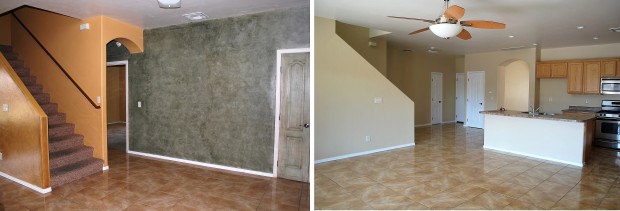
But potential homebuyers these days are surprised to find some bank-owned homes in move-in condition with new paint, carpeting and appliances.
When the circumstances are right, the banks themselves are willing to put down cash to spruce up a house, said David Kipling, an agent with Keller Williams Realty who's specialized in selling foreclosed properties for four years.
That doesn't mean a bank is going to renovate every house. There's no sense in fixing a property if the cost for repairs will price it out of the market - especially when those buying foreclosures are looking for deep discounts, said Sue Gutierrez, an agent with TucsonREO who also specializes in foreclosures.
People are also reading…
Mortgage holder Freddie Mac, which was taken over by the federal government in 2008, examines the cost of repairs and considers how much they will increase a property's value and marketability, Brad German, a Freddie Mac spokesman, said in an email.
Freddie Mac takes into account whether renovations are needed to preserve the property, the condition of competing listings and whether new-construction homes are on the market, German said.
"However, we are aware of our responsibility to the neighborhood and the negative impacts created by blight, so regardless of the cost/benefit analysis, we may repair a property in order to ensure that the property is up to the standard of other homes in the neighborhood," German said.
At a minimum, Freddie Mac's listing brokers are required to make sure the home is secure, any trash is removed and the yard is maintained, German said.
Rebecca Patsch, an agent with Long Realty who has several bank clients, said the decision to renovate also can vary depending on which lender has taken back the property. Wachovia Bank, now a subsidiary of Wells Fargo Bank, has fixed up its properties for the last several years, she said.
Wells Fargo recently began renovating older houses, Patsch said. Until about six months ago the bank focused more effort on its newer foreclosures, she said.
But when it comes to serious damage, there's only so much a bank can do. "They don't want to fix things and cover up other issues," Patsch said.
And some lenders, which Patsch declined to identify specifically, aren't interested in doing any renovations, even though they can increase the home's marketability.
A crucial factor influencing renovations is a home's appraisal and what repairs are required by the new lender, Kipling said.
"There's going to be certain requirements for them to get a loan on the property," Kipling said.
Homes in higher price ranges that don't attract cash buyers are more likely to get renovated, brokers say, because any new lender is going to require those repairs to have been made before underwriting a loan.
For those properties that require substantial repairs, banks usually aren't too interested in forking over significant amounts of cash. In those cases, lenders just offer property for sale "as is."
Banks don't seem to renovate more foreclosures in certain areas of town, brokers say. Patsch said she's seen high-end homes on the northwest side get significant repairs. But she's also seen a low-priced house that needed significant work get fixed up.
When it comes to buyers requesting additional repairs during the sale process, banks are most likely to respond to any issues that create a hazard.
"If it's a safety item or a lender-required item, most banks will address those almost immediately," Gutierrez said.
But lenders approach any expense on renovations cautiously because there's not much room for error. "They need to be able to substantiate the return on invested dollars," Gutierrez said.
Still, buyers have begun to take notice.
Dan Frizzell, an agent with Keller Williams who usually represents buyers, said since the housing market collapsed, buyers looking for a deal would start on bank-owned houses and then change their mind after checking out a couple.
"Oftentimes, they don't want what they typically find in a foreclosure because of the work that's required," Frizzell said.
But recently Frizzell said he's been surprised to find bank-owned homes that had been spruced up to the point where they look like they've been purchased by investors.
"The banks are seemingly wising up to the point where they're putting a little money in these things and making them nicer," Frizzell said.
Contact reporter Dale Quinn at dquinn@azstarnet.com or 573-4197.