


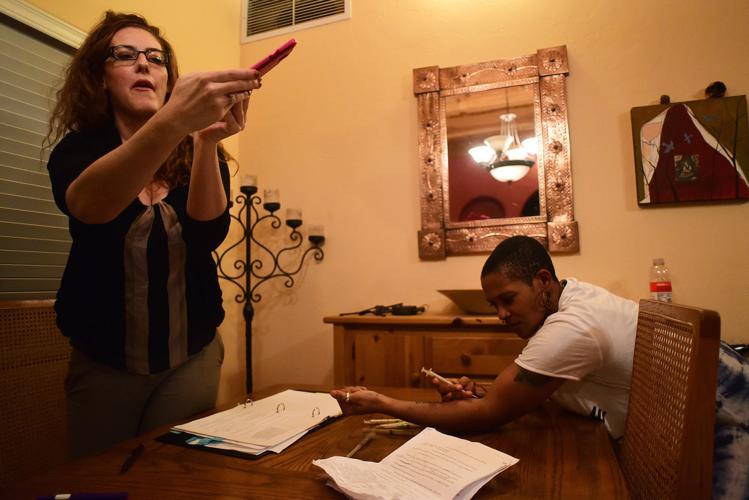

Pam Burris has lots to say.
Unfortunately, she is a playwright. What she has to say in her plays has little chance of being heard from the stage.
And she’s not alone: Only 22 percent of the plays produced this season by theaters in this country are by women, according to a Dramatists Guild/Lilly Awards study.
Not ones to stand by and bemoan the fact that women’s voices are few and quiet in theater, Burris and a group of fellow playwrights have done something about it. They recently founded Sheworxx, a women’s theatrical collective that will produce plays, mentor theater hopefuls, hold writing workshops, and foster new works by local playwrights.
“We wanted to give more voice to women writers in theater,” says Burris. “It’s about telling a different story in a different way.”
People are also reading…
Thursday, Nov. 12, Sheworxx opens “Gnawing the Bone,” seven short plays by female playwrights in Tucson.
Burris formed Sheworxx with Eugenia Woods, Kelly Hardesty and Leslie Powell.
The women first gathered together in December.
“Here in Tucson, I was hearing from my (theater) colleagues that the discourse was limiting to them,” says Woods. “The very nature of the language and the structure that the female playwrights were using were not fully understood or embraced.”
They felt that was a shame.
“We have an innovative, irreverent approach to storytelling in language that’s heightened and intimate and direct,” says Woods. “That sort of work is underappreciated and underserved.”
Now up to 16 members, the women have met weekly since February. The YWCA stepped up and offered the group performance space.
“We were seeking a really safe, inclusive environment where we could develop and share work and not feel we had to meet exacting standards in order to get work on its feet,” says Woods about Sheworxx.
The founders want the group to be an incubator for female theater artists. It is, its mission statement says, “an evolving community of theatre-makers building gender parity and sisterhood locally and globally through community engagement, mentoring, peer education and the production of works by female-identified and feminist artists.”
An organization such as Sheworxx is key to helping women reach parity in the theater, says Burris.
“We’ve been raised for centuries with a paternalistic model. This is what has suppressed women in general,” she says. “I’m a humanist, but recognize that without women’s equality, we can’t near humanism.”
Sheworxx launched its public face in May, with a benefit and reading of Tucsonan Elaine Romero’s play, “The Fat-Free Chicana and the Snow Cap Queen.” “Gnawing the Bone” is the group’s first attempt at mounting staged productions.
“This is a group of talented women who are aiming their energy at creating new works of art with playwrights, and other writers, who all have different amounts of experience,” says Sheworxx member Kim Lowry in an email.
“They are committed to empowering the voices of women in the arts, primarily theater, yet expandable to other crafts that can strengthen the confidence of women, and perhaps be woven into theater.”
Members of the collective, most of whom have been writing between 10 and 40 years, are not relegated to a single role, such as playwright, director or producer.
“We don’t want people to become overly specialized. We want to share roles,” says Woods.
“It helps to avoid burnouts, and helps with the appreciation of what goes into a production, gives us flexibility, and it really fleshes out our understanding of what it takes to bring a play to an audience.”
A few similar organizations have popped up around the country, and Woods expects more. But she sees what’s happening in Tucson as a national model.
“Tucson can be at the forefront in terms of addressing the parity issue,” she says. “I think we can be in a leadership position within two years. I’d like to put Tucson on the map. As a feminist and theater artist and one who calls Tucson home, nothing would make me happier.”