

Q Any information on the value of this decanter and glasses? They belonged to my mother.
— Phyllis, Benson
A First, do you know what you have? Once you know "what," determining "how much" is easier.
The 7 1/2-inch cobalt glass decanter with a clear blown ball stopper is set into a cut openwork chrome base at an angle. Hence it's called a tilt ball decanter. A clear handle of pulled glass has been hand-applied.
The decanter and glasses are pictured on Page 53 of "Elegant Glass: Early, Depression and Beyond: 3rd Edition" by Debbie and Randy Coe (Schiffer, $29.95). The book is an outstanding pictorial aid to identification. The pattern is Caprice, made by Cambridge Glass from 1936 to 1957, and produced in every form, from nut cups to candleholders, cruets and vases. Caprice is extremely popular with collectors. It also has been endlessly reproduced and flat-out faked.
People are also reading…
Made in several colors, authentic Caprice is most popular and pricey in cobalt. While footed tumblers exist, yours are the 2-ounce short, wide-base whiskey tumblers, pattern No. 188. The decanter is No. 187. Book price on the decanter in crystal is $175. In cobalt, it's $500. The glasses list at $175 each in cobalt. And you have six.
Remember that book price is just a ballpark figure. Variables such as authenticity and condition are critical. If you decide to sell, a serious collector will be found at local or regional glass shows. So many fakes show up online that eBay is not for the novice.
Q I want to sell my "bone shaker" bike. How do I find out its value?
— Vincent, Garland, Maine
A Photos show a classic 1800s metal bike with a big wheel in front, a high seat and a small wheel in back. The bicycles were generically called "bone shakers," because that's what the ride was like. They also were dubbed "bone breakers," because that's what often happened when someone fell from the seat. The original bone shakers were made of metal and steel in the mid-1800s.
But the padded leather saddle and rubber block pedals, plus serial information naming Cleveland, identify it as a replica bike made by Rideable Bicycle Replicas, www.hiwheel.com. The company is now in Alameda, Calif. Company President Greg Barron told us that exact dating is tricky, but if your wheel has 72 spokes, the bike was made before 1974. The model corresponds to the Standard Hiwheel, currently selling with a 48-inch big wheel for $899.
Barron said the model, used and in good condition, sells on eBay for $600 to $650. Or perhaps a local auction that handles toys and the unusual will sell it for you as a replica.
Q Any value on a canister set from Germany with the contents words in German?
— Janet, Browning, Ind.
A Decorated often with florals, ceramic kitchen canister sets from Germany were a kitchen staple in the 1920s through the 1940s. Many were marked with the name of the condiment or spice inside. Czech canisters of the period tended toward brighter colors.
Larger canisters typically held oatmeal, flour, rice, sugar, tea or coffee. Smaller boxes held everything from allspice to cloves. Decanters and a wall-hanging saltbox completed large sets. Some sets involved up to 15 pieces. The ceramics were not of high quality, and many were broken in use. The containers were not large: By today's standards, a 7 1/2-inch flour canister is puny.
Imported by boatloads, the kitchen sets were common. Today, pieces are collected as curiosities and accents. Too small to be functional, sets or individual pieces are bought for a distinctive period "look." A large set, in excellent condition and highly decorated in art deco style, might retail at less than $100. If it's in excellent condition, this set, done in florals and gold, might retail for about $50.
Q Any information on my painted metal figures of Snow White and the Seven Dwarfs?
— Carolyn, Tulsa, Okla.
A Serious money goes to Snow White memorabilia from 1938, when the movie was first released. The earliest figures were bisque, composition or celluloid. Clay and plastics came later.
Your task is to date (approximately) those figures and try to determine a maker. You may never positively ID the maker, but search online and in books for similar examples. Metal figures were not made in the 1940s due to wartime need, so the figures are most likely '50s or later.
The Smart Collector
By Danielle Arnet
» AUCTION ACTION
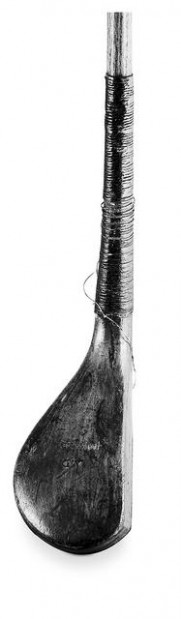
A long-nosed 18th-century putter inscribed "A.D." that sold for $181,000 at Sotheby's recently is attributed to Andrew Dickson, a Scottish maker who is thought to have lived from 1665 to 1753. Only four stamped examples are known to exist. Also marked with a later owner's stamp, the putter has an early replacement sheepskin grip on a thick ash shaft. Hickory shafts came in by the 1800s. The putter was part of a fine antique golf memorabilia collection that brought $2.1 million.