

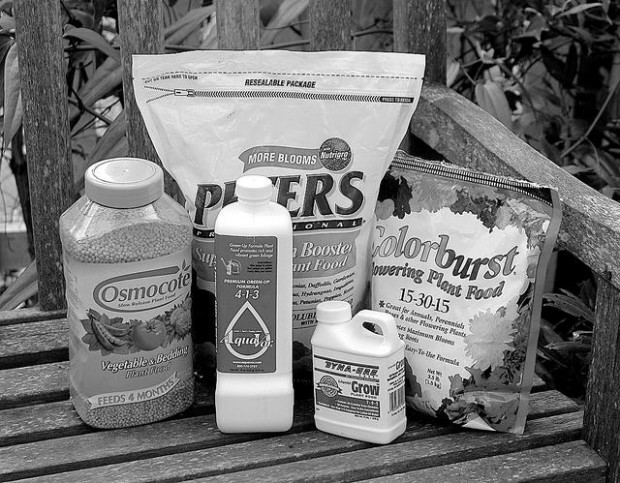
Whenever you see a fertilizer product, it will have three numbers prominently listed on the package, usually on the front. These numbers are very important and tell a great deal about what this fertilizer will do.
Nitrogen, phosphorus and potassium (N, P, K) are what the numbers refer to. They are always listed in this order. It is the percentage within that package of each component.
For example, a common type of all-purpose fertilizer is referred to as 10-10-10. This is a balanced blend of equal portions of nitrogen, phosphorus and potassium. If you purchased a 50-pound bag, 5 pounds (or 10 percent) would be nitrogen, 5 pounds would be phosphorus and 5 pounds would be potassium. The remaining 70 percent is simply filler, or inert ingredients, mostly there to help disperse the chemicals.
A common way of describing the purpose behind each chemical is to think "up, down and all around."
People are also reading…
Applying this simple phrase will help you remember that nitrogen, the first chemical listed, helps with plant growth above ground. Nitrogen promotes the green leafy growth of foliage and provides the necessary ingredients to produce lush green lawns. Lawn fertilizers frequently have a high first number for this purpose.
Phosphorus, the middle number, is very effective at establishing growth below ground, in the form of healthy root systems. It is also the component most responsible for flower blooms and fruit production. You'll notice that fertilizers designed for flower production, or starter-type fertilizers for your lawn, have a high middle number.
Potassium, the last number, is important for overall plant health. This is primarily due to its ability to help build strong cells within the plant tissue. In turn, the plants withstand various stresses, such as heat, cold, pests and diseases.
When shopping for fertilizers, be mindful of their intended use. Fertilizers that have equal numbers can generally be used as an all-purpose fertilizer. If you had only one product to work with, 10-10-10 would be my recommendation.
To promote good fruit or flower production, look for a middle number that is higher than the first. Otherwise, your plants will be stimulated to put out lots of nice green foliage, often at the expense of fruit or flower production. Instead, you want the energy and nutrition of the plant to go toward flowers or fruit, so a higher middle number is a better choice.
To toughen up your plants or lawn for environmental stresses, you'll want a fertilizer that promotes the last number, possibly as well as a high middle number.
Finally, whenever you apply fertilizers, don't assume that more is better. You can burn plants by over-fertilizing and damage the surrounding soil as well. Instead, err on the side of "less is better."
● Joe Lamp'l is a master gardener.