

Federal agents questioned people about political operative Maurice L. Garner, a longtime ally of Buffalo Mayor Byron W. Brown, in the days surrounding their raid of a City Hall office earlier this month.
Two people who spoke to The Buffalo News on condition of anonymity said they were questioned by the FBI about Garner, the founder of the Grassroots political club.
A local businessman whose company was in line to get federal funds said the FBI asked about work Garner did under a retainer agreement with his firm.
"The FBI asked what he was paid to do, what he did," the businessman said.
Garner, who does lobbying and public relations work, provided "community relations in the minority community," the businessman said, adding: "It's good to have someone on the team" with those contacts.
People are also reading…
The businessman said his company was asked by the FBI to provide additional information, beyond what was discussed in their interview.
We "are in the process of doing so," the businessman said.
The second person who spoke to The News about being interviewed by the FBI about Garner declined to provide details, citing the sensitive nature of the discussion.
Asked about the FBI probe, Garner referred questions to his attorney, Patrick J. Brown.
"Maurice has not been contacted by the FBI or any investigators on behalf of the government," Brown said. "He does not feel he has done anything wrong."
Mayor: 'No knowledge' about investigation
While it is not known why the FBI is refocusing on Garner, this most recent search warrant appears at least partially related to a subpoena the federal agency served on City Hall in 2017 for documents connected to seven different companies doing business with the city.
The search warrant also likely indicates an uptick in the FBI interest in Garner and possibly others since the subpoena.
Obtaining the 2017 subpoena required federal investigators to show that documents being sought were needed for an ongoing investigation. Obtaining the 2019 search warrant, in contrast, required investigators to convince a judge that there's probable cause a crime occurred.
Also, while a subpoena directs an agency holding the documents to compile the requested material for the FBI, the search warrant allows the FBI to gather the documents – without any advance notice to the agency holding the information.
"When I serve a subpoena on you or whomever, there is a modicum of trust that you are going to give that to me in unvarnished form. If I have some sort of suspicion that you are messing around, I am coming with a search warrant," said attorney Anthony M. Bruce, a former federal prosecutor with no involvement in the FBI's current case. "With a subpoena, I cannot go in your files. If I have a search warrant, I can look through, and you have to stand aside."
City officials declined comment, or said they were unaware of the FBI's renewed interest in Garner.
"I have no knowledge of what they are investigating at all," Mayor Brown said. He and other city officials have, however, said they are fully cooperating with the FBI probe.
The FBI, which has confirmed the City Hall search, has not identified what documents were taken or any targets of the search.
Link to 2015 searches
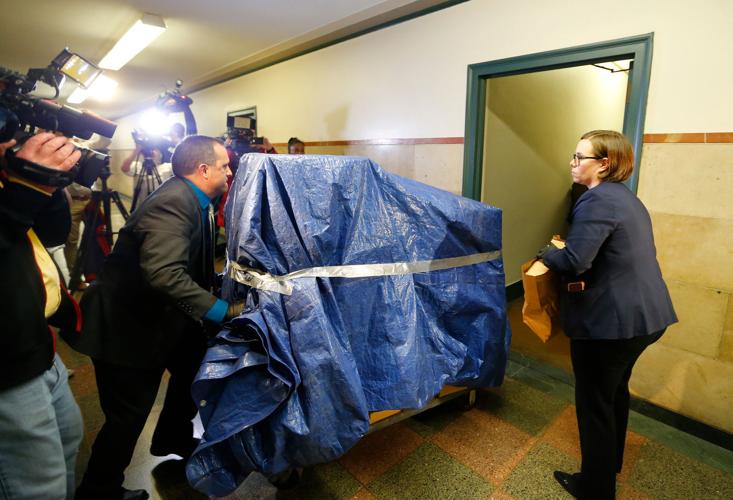
The FBI on Nov. 6 conducted a series of early-morning interviews, including one held at the house of Brendan R. Mehaffy, the Buffalo Urban Renewal Agency vice chair who is also executive director of the city's Office of Strategic Planning. FBI agents then arrived at City Hall along with the IRS as well as the U.S. Department of Housing and Urban Development's Inspector General. The agents began sifting through documents in BURA's third-floor housing division office.
The investigators left City Hall at the end of the day with two cartloads of boxes filled with BURA documents.
The search is believed to be linked to a larger public corruption probe that began in 2015, when agents raided the homes of former Erie County Democratic County Chairman G. Steven Pigeon as well as two political operatives, former Deputy Mayor Steven M. Casey and Christopher M. Grant, a Republican working at the time for then-U.S. Rep. Chris Collins. Pigeon is awaiting sentencing on a bribery conviction, and is said to be cooperating with investigators. The other two were not charged with any crimes, but sources have told The Buffalo News that Casey has been cooperating with federal authorities.
Two years after those 2015 raids, using information that grew out of that probe, the FBI obtained search warrants for Garner's Buffalo home as well as the Grassroots headquarters on Genesee Street and the Urban Chamber of Commerce on Main Street, which Garner also helped found. The FBI a month later, in July 2017, obtained the subpoena for City Hall documents that appear tied to the recent search warrant.
Garner was not arrested, or charged with any crime as a result of the 2017 search warrant or subpoena.
He has, however, remained on the FBI's radar.
In 2017, around the time of the search warrant and subpoena, the FBI interviewed another businessman whose company had Garner on retainer while working on a federally subsidized project. That businessman also spoke to The Buffalo News last week on the condition of anonymity.
Garner was hired to do community advocacy in the minority community, the second businessman said.
"He knows the land," the businessman said of Garner. "He can help effect things," such as setting up a meeting with residents, he said.
More recently, Garner's name came up in the FBI probe of Community Action Organization of Western New York. Agents investigating the anti-poverty agency's financial operations earlier this year asked about connections between the CAO and Grassroots, three people told The News. Garner once served as a CAO board member and, for three years, ending in 2006, as director of neighborhood services.
Garner has said he is no longer involved with CAO, and no longer has a leadership role with Grassroots.
Garner's background
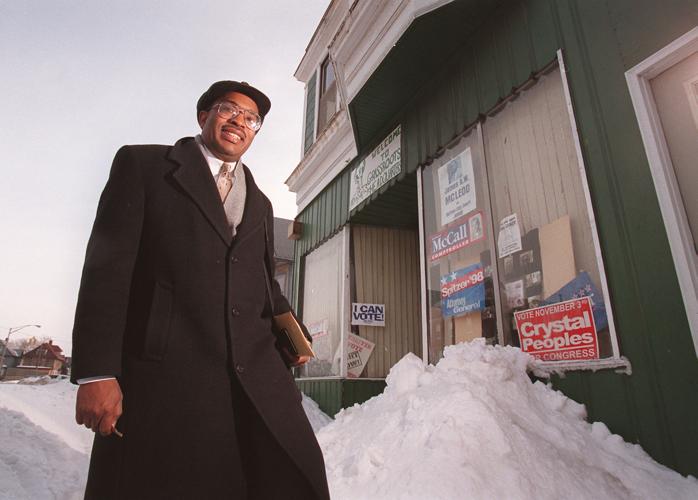
Garner, 61, is a longtime ally of the Buffalo mayor, going back to their days working for former Erie County Executive Dennis T. Gorski. The Grassroots political club that Garner founded decades ago became the springboard for several local politicians, including Brown.
Garner's last government job was as deputy comptroller in City Hall in the early 2000s, a position that many thought was linked to his political allegiance at the time to Pigeon. He left that post to take the CAO position.
Over the subsequent years, Garner has worked as an Albany lobbyist, and also formed two consulting firms, Garner Associates and Urban Vision for Tomorrow.
Garner's firms over the years have done work for political candidates, including Brown, as well as private companies.
In the early 2000s, his Urban Vision for Tomorrow was doing community relations work for the $1 billion schools construction project that was overseen by LPCiminelli. Garner's company was one of several working on the project cited for failing to meet women and minority recruitment goals.
Buffalo News reporters Dan Herbeck and Matthew Spina contributed to this report.


