NEW YORK — The historic hush-money trial of Donald Trump got underway Monday with the arduous process of selecting a jury to hear the case charging the former president with falsifying business records in order to stifle stories about his sex life.

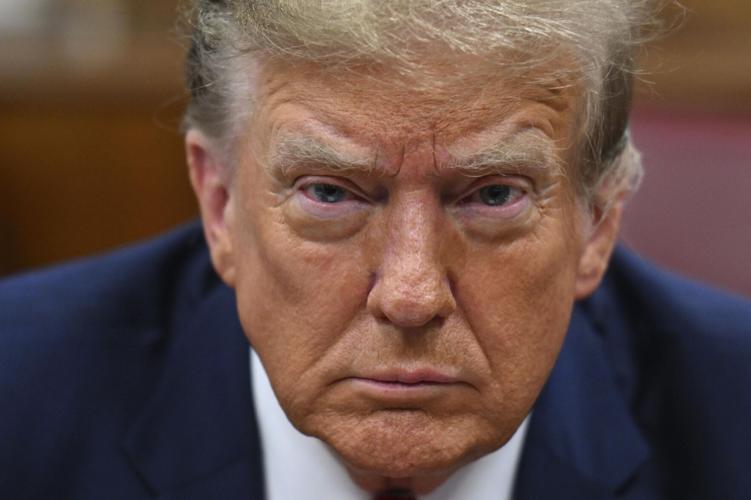
Former President Donald Trump attends the first day of his criminal trial Monday at Manhattan Criminal Court in New York City.
The day ended without any jurors being seated. The selection process was scheduled to resume Tuesday.
The first criminal trial of any former U.S. president began as Trump vies to reclaim the White House, creating a remarkable split-screen spectacle of the presumptive Republican nominee spending his days as a criminal defendant while simultaneously campaigning for office. He's blended those roles over the last year by presenting himself to supporters, on the campaign trail and on social media, as a target of politically motivated prosecutions designed to derail his candidacy.
People are also reading…
“It’s a scam. It’s a political witch hunt. It continues, and it continues forever,” Trump said after exiting the courtroom, where he sat at the defense table with his lawyers.
After a norm-shattering presidency shadowed by years of investigations, the trial amounts to a courtroom reckoning for Trump, who faces four indictments charging him with crimes ranging from hoarding classified documents to plotting to overturn an election.

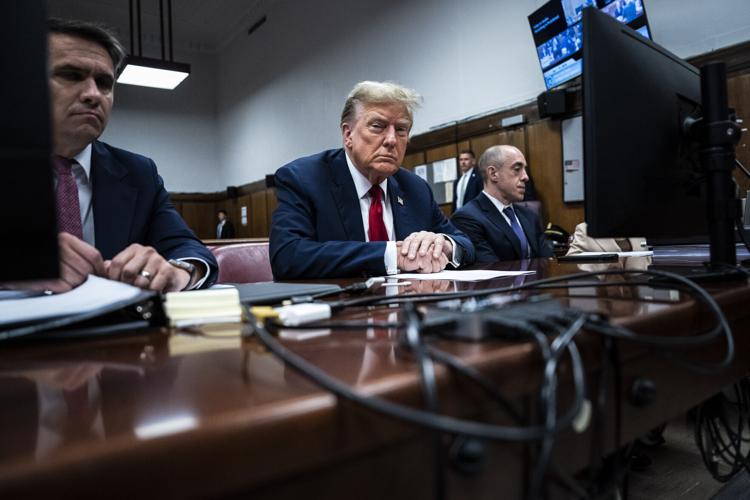
Former President Donald Trump sits in criminal court Monday with his legal team ahead of the start of jury selection in New York.
Yet the political stakes are less clear because a conviction would not preclude him from becoming president and because the allegations in this case date back years and are seen as less grievous than the conduct behind the three other indictments.
The day began with hours of pretrial arguments — including over a potential fine for Trump — before moving into the start of jury selection. The first members of the jury pool — 96 in all — were summoned into the courtroom, where the parties will decide who among them might be picked to decide the legal fate of the former, and potentially future, American president.
Trump craned his neck to look back at the pool, whispering to his lawyer as they entered the jury box.
“You are about to participate in a trial by jury. The system of trial by jury is one of the cornerstones of our judicial system,” Judge Juan Merchan told the jurors. “The name of this case is the People of the State of New York vs. Donald Trump.”
Trump’s notoriety would make the process of picking 12 jurors and six alternates a near-herculean task in any year, but it’s likely to be especially challenging now, unfolding in a closely contested presidential election in the heavily Democratic city where Trump grew up and catapulted to celebrity status decades before winning the White House.
Underscoring the difficulty, only about a third of the 96 people in the first panel of potential jurors remained after the judge excused some members of the jury pool. More than half of the group was excused after telling the judge they could not be fair and impartial. At least nine more prospective jurors were excused after raising their hands when Merchan asked if they could not serve for any other reason.
A female juror was excused after saying she had strong opinions about Trump. Earlier in the questionnaire, the woman, a Harlem resident, indicated she could be neutral in deciding the case. But when asked whether she had strong opinions about the former president, the woman answered matter-of-factly: “Yes.”
When Merchan asked her to repeat the response, she replied: “Yeah, I said yes.” She was dismissed.
Merchan has written that the key is “whether the prospective juror can assure us that they will set aside any personal feelings or biases and render a decision that is based on the evidence and the law.”
No matter the outcome, Trump is determined to benefit from the proceedings, casting the case, and his indictments elsewhere, as a broad “weaponization of law enforcement” by Democratic prosecutors and officials. He maintains they are orchestrating sham charges in hopes of impeding his presidential run.
He’s lambasted judges and prosecutors for years, a pattern of attacks that continued up to the moment he entered court Monday when he called the case an “assault on America” and said: ’“This is political persecution. This is a persecution like never before.”
Earlier Monday, the judge denied a defense request to recuse from the case after Trump's lawyers claimed he had a conflict of interest. He also said prosecutors could not play for the jury the 2005 “Access Hollywood” recording in which Trump was captured discussing grabbing women sexually without their permission.

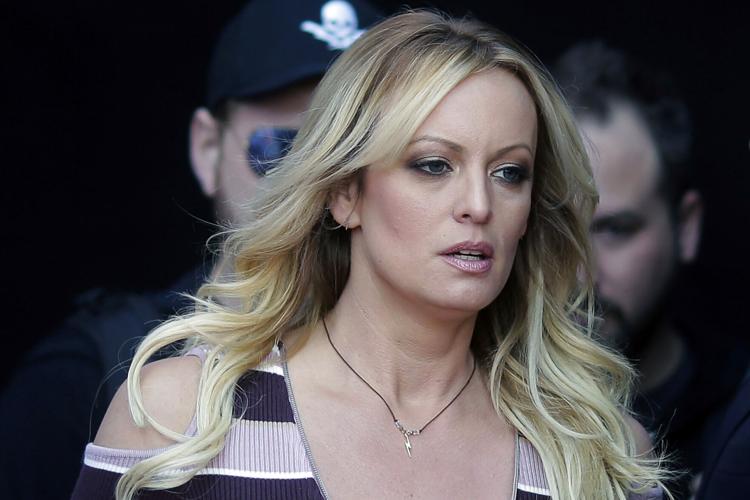
Adult film actress Stormy Daniels arrives at an event in Berlin, on Oct. 11, 2018.
However, prosecutors will be allowed to question witnesses about the recording, which became public in the final weeks of the 2016 campaign.
Prosecutors with the Manhattan district attorney's office also asked for Merchan to fine Trump $3,000 over social media posts they said violated the judge's gag order barring him from attacking witnesses. Last week, he used his Truth Social platform to call his former lawyer Michael Cohen and the adult film actor Stormy Daniels “two sleaze bags who have, with their lies and misrepresentations, cost our Country dearly!”
Trump lawyer Todd Blanche maintained Trump was simply responding to the witnesses' statements.
“It's not as if President Trump is going out and targeting individuals. He is responding to salacious, repeated vehement attacks by these witnesses,” Blanche said.
Merchan did not rule on the request immediately, instead setting a hearing for next week.
Trump has pleaded not guilty to 34 felony counts of falsifying business records. Prosecutors say the alleged fraud was part of an effort to keep salacious — and, Trump says, bogus — stories about his sex life from emerging during his 2016 campaign.
The charges center on $130,000 in payments that Trump’s company made to Cohen. He paid that sum on Trump’s behalf to keep Daniels from going public, a month before the election, with her claims of a sexual encounter with the married mogul a decade earlier.
Prosecutors say the payments to Cohen were falsely logged as legal fees in order to cloak their actual purpose. Trump's lawyers say the disbursements indeed were legal expenses, not a cover-up.
After decades of fielding and initiating lawsuits, the businessman-turned-politician now faces a trial that could result in up to four years in prison if he’s convicted, though a no-jail sentence also would be possible. Trump would also be expected to appeal any conviction.
Trump's attorneys lost a bid to get the hush-money case dismissed and have since repeatedly sought to delay it, prompting a flurry of last-minute appeals court hearings last week.
Among other things, Trump's lawyers maintain that the jury pool in overwhelmingly Democratic Manhattan has been tainted by negative publicity about Trump and that the case should be moved elsewhere.
An appeals judge turned down an emergency request to delay the trial while the change-of-venue request goes to a group of appellate judges, who are set to consider it in the coming weeks.

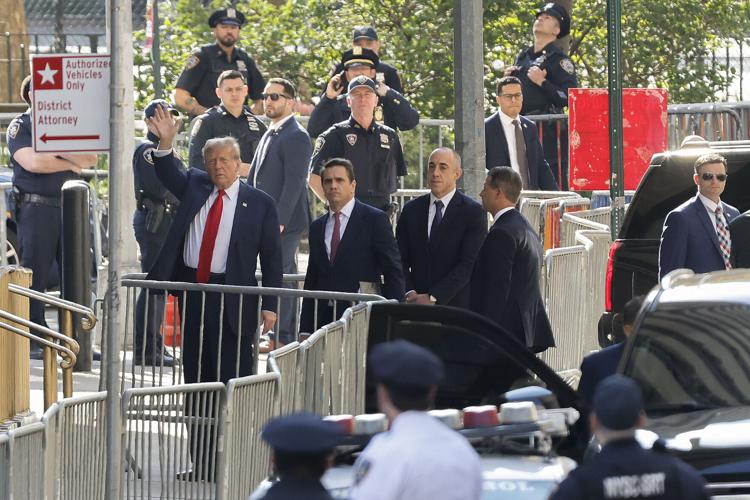
Former President Donald Trump arrives at Manhattan criminal court with his legal team Monday in New York.
Manhattan prosecutors have countered that a lot of the publicity stems from Trump’s own comments and that questioning will tease out whether prospective jurors can put aside any preconceptions they may have. There’s no reason, prosecutors said, to think that 12 fair and impartial people can’t be found amid Manhattan’s roughly 1.4 million adult residents.
The prospective jurors will be known only by number, as the judge has ordered that their names be kept secret from everyone except prosecutors, Trump and their legal teams. The 42 preapproved, sometimes multi-pronged queries include background basics but also reflect the uniqueness of the case.
They're being asked, among other questions, about their hobbies and news habits, if they hold strong beliefs about Trump that would prevent them being impartial and about attendance at Trump or anti-Trump rallies.
Based on the answers, the attorneys can ask a judge to eliminate people “for cause” if they meet certain criteria for being unable to serve or be unbiased. The lawyers also can use “peremptory challenges” to nix 10 potential jurors and two prospective alternates without giving a reason.
“If you're going to strike everybody who's either a Republican or a Democrat,” the judge observed at a February hearing, “you're going to run out of peremptory challenges very quickly.”
Read more:
Where each Trump case stands
Classified documents case

Pictured: Boxes of records stored in a bathroom and shower in the Lake Room at Trump's Mar-a-Lago estate in Palm Beach, Fla.
Special counsel Jack Smith has been leading two federal probes related to Trump, both of which have resulted in charges against the former president.
The first charges to result from those investigations came in June when Trump was indicted for mishandling top secret documents at his Florida estate. The indictment alleges that Trump repeatedly enlisted aides and lawyers to help him hide records demanded by investigators and cavalierly showed off a Pentagon “plan of attack” and classified map.
A superseding indictment issued in July added charges accusing Trump of asking for surveillance footage at his Mar-a-Lago estate to be deleted after FBI and Justice Department investigators visited in June 2022 to collect classified documents he took with him after leaving the White House. The new indictment also charges him with illegally holding onto a document he’s alleged to have shown off to visitors in New Jersey.
In all, Trump faces 40 felony charges in the classified documents case. The most serious charge carries a penalty of up to 20 years in prison.
U.S. District Judge Aileen Cannon on May 7 canceled the May 20 trial date in the case, postponing it indefinitely. She struck a paragraph from the indictment June 10 but denied a defense request to dismiss some of the charges. The paragraph concerns allegations that Trump, in 2021 and while no longer president, showed a classified map of a foreign country to a representative of his political action committee while discussing a military operation that he said was not going well. Defense lawyers said the paragraph was prejudicial because it was not connected to any crime charged in the indictment
Walt Nauta, a valet for Trump, and Carlos De Oliveira, the property manager at Trump’s Florida estate, have also been charged in the case with scheming to conceal surveillance footage from federal investigators and lying about it.
Trump, Nauta and De Oliveira have pleaded not guilty. Lawyers for Nauta and De Oliveira asked U.S. District Judge Aileen Cannon in April to throw out the charges they face. The judge did not immediately rule.
Election interference

Pictured: Supporters of former President Donald Trump protest Jan. 6, 2023, outside of the Supreme Court on the second anniversary of the riot at the U.S. Capitol in Washington.
Special counsel Jack Smith’s second case against Trump was unveiled in August when the former president was indicted in Washington on felony charges for working to overturn the results of the 2020 election in the run-up to the violent riot by his supporters at the U.S. Capitol on Jan. 6, 2021.
The four-count indictment includes charges of conspiracy to defraud the United States government and conspiracy to obstruct an official proceeding: the congressional certification of Joe Biden’s victory. It says that Trump repeatedly told supporters and others that he had won the election, despite knowing that was false, and describes how he tried to persuade state officials, then-Vice President Mike Pence and finally Congress to overturn the legitimate results.
After a weekslong campaign of lies about the election results, prosecutors allege, Trump sought to exploit the violence at the Capitol by pointing to it as a reason to further delay the counting of votes that sealed his defeat.
In their charging documents, prosecutors referenced a half-dozen unindicted co-conspirators, including lawyers inside and outside of government who they said had worked with Trump to undo the election results and advanced legally dubious schemes to enlist slates of fake electors in battleground states won by Biden.
The Trump campaign called the charges “fake” and asked why it took two and a half years to bring them. He has pleaded not guilty.
The case had been set for trial on March 4 in federal court in Washington. But that date was canceled amid an appeal by Trump on the legally untested question of whether a former president is immune from prosecution for official acts taken in the White House.
The Supreme Court injected fresh uncertainty into the trial date, saying Wednesday that it would hear arguments in late April. That leaves it unclear whether a trial can be completed before the November election.
Hush-money scheme

Pictured: Former President Donald Trump speaks before entering the courtroom Feb. 15, 2024, at Manhattan criminal court, where he faces state charges stemming from hush money payments made during the 2016 presidential campaign to bury allegations of extramarital sexual encounters.
Trump became the first former U.S. president in history to face criminal charges when he was indicted in New York in March on state charges stemming from hush money payments made during the 2016 presidential campaign to bury allegations of extramarital sexual encounters.
Originally set to proceed to trial March 25, Manhattan Judge Juan Manuel Merchan agreed to a 30-day delay starting March 15 until April as he sought answers about a last-minute evidence dump that the former president's lawyers said hampered their ability to prepare their defense. The trial kicked off with jury selection April 15. A full jury was seated April 18.
Trump has already pleaded not guilty to 34 felony counts of falsifying business records. Each count is punishable by up to four years in prison, though it’s not clear if a judge would impose any prison time if Trump were convicted.
The counts are linked to a series of checks that were written to his lawyer Michael Cohen to reimburse him for his role in paying off porn actor Stormy Daniels, who alleged a sexual encounter with Trump in 2006, not long after Melania Trump gave birth to son Barron. Those payments were recorded in various internal company documents as being for a legal retainer that prosecutors say didn’t exist.
Opening statements provided a clear roadmap of how prosecutors will try to make the case that Trump broke the law, and how the defense plans to fight the charges on multiple fronts.
Lawyers presented dueling narratives as jurors got their first glimpse into the prosecution. Still to come are weeks of what's likely to be dramatic and embarrassing testimony about the presumptive Republican presidential nominee's personal life as he simultaneously campaigns to return to the White House in November.
Georgia election indictment

Pictured: People watch as the motorcade with former President Donald Trump travels to the Fulton County Jail Aug. 24, 2023, in Atlanta.
Trump is charged alongside 18 other people — including former New York Mayor Rudy Giuliani and former White House chief of staff Mark Meadows — with violating the state’s anti-racketeering law by scheming to illegally overturn his 2020 election loss.
The indictment, handed up in August, accuses Trump or his allies of suggesting Georgia’s Republican secretary of state could “find” enough votes for him to win the battleground state; of harassing an election worker who faced false claims of fraud; an, attempting to persuade Georgia lawmakers to ignore the will of voters and appoint a new slate of Electoral College electors favorable to Trump.
In the months since, several of the defendants, including lawyers Sidney Powell and Kenneth Chesebro, have pleaded guilty.
An appeals court on June 5, 2024, halted the case while it reviews the lower court judge's ruling allowing Fulton County District Attorney Fani Willis to remain on the case.
The Georgia Court of Appeals' order prevents Fulton County Superior Court Judge Scott McAfee from moving forward with pretrial motions as he had planned while the appeal is pending. While it was already unlikely that the case would go to trial before the November general election, when Trump is expected to be the Republican nominee for president, this makes that even more certain.
The appeals court docketed the appeals filed by Trump and eight others and said that “if oral argument is requested and granted” it is tentatively scheduled for Oct. 4. The court will then have until mid-March to rule, and the losing side will be able to appeal to the Georgia Supreme Court.
Trump and eight other defendants had tried to get Willis and her office removed from the case, arguing that a romantic relationship she had with special prosecutor Nathan Wade created a conflict of interest. McAfee in March found that no conflict of interest existed that should force Willis off the case, but he granted a request from Trump and the other defendants to seek an appeal of his ruling from the state Court of Appeals.
Special prosecutor Nathan Wade formally withdrew March 15, 2024, after a judge ruled he had to leave or Willis couldn't continue to pursue the charges. His resignation allows Willis to remain on the most sprawling of four criminal cases against the presumptive Republican nominee in the 2024 presidential election.
Arizona election indictment

Pictured: Former New York Mayor of New York Rudy Giuliani speaks Dec. 15, 2023, outside the federal courthouse in Washington. Guiliani, a lawyer for former President Donald Trump, was among those indicted April 24, 2024, in an Arizona election interference case.
An Arizona grand jury on April 24, 2024, indicted former President Donald Trump 's chief of staff Mark Meadows, lawyer Rudy Giuliani and 16 others for their efforts to use so-called fake electors to try to overturn Trump’s loss to Joe Biden in the 2020 presidential election.
The indictment names 11 Republicans who submitted a document to Congress falsely declaring that Trump won Arizona in 2020, including the former state party chair, a 2022 U.S. Senate candidate and two sitting state lawmakers. They're charged with nine counts each of conspiracy, fraud and forgery. The identities of seven other defendants, including Giuliani and Meadows, were not immediately released because they had not yet been served with the charges.
Trump, who is described in the indictment as an unindicted co-conspirator, has argued that he can’t be prosecuted for acts he committed while serving as president. The U.S. Supreme Court on Thursday will hear arguments on his bid to avoid federal prosecution over his efforts to reverse his loss.
With the indictments, Arizona becomes the fourth state where allies of the former president have been charged with using false or unproven claims about voter fraud related to the election. Heading into a likely November rematch with Biden, Trump continues to spread lies about the last election that are echoed by many of his supporters.
Descriptions of other unnamed defendants point to Mike Roman, who was Trump’s director of Election Day operations; John Eastman, a lawyer who devised a strategy to try to persuade Congress not to certify the election; and Christina Bobb, a lawyer who worked with Giuliani. Eastman and Bobb did not respond to text messages seeking comment, nor did a lawyer who is representing Roman in a case in Georgia.
The 11 people who had been nominated to be Arizona’s Republican electors met in Phoenix on Dec. 14, 2020, to sign a certificate saying they were “duly elected and qualified” electors and claiming that Trump carried the state. A one-minute video of the signing ceremony was posted on social media by the Arizona Republican Party at the time. The document was later sent to Congress and the National Archives, where it was ignored.
Biden won Arizona by more than 10,000 votes. Of the eight lawsuits that unsuccessfully challenged Biden’s victory in the state, one was filed by the 11 Republicans who would later sign the certificate declaring Trump as the winner.
Their lawsuit asked a judge to de-certify the results that gave Biden his victory in Arizona and block the state from sending them to the Electoral College. In dismissing the case, U.S. District Judge Diane Humetewa said the Republicans lacked legal standing, waited too long to bring their case and “failed to provide the court with factual support for their extraordinary claims.”
Days after that lawsuit was dismissed, the 11 Republicans participated in the certificate signing.
The Arizona charges come after a string of indictments against fake electors in other states.
The Republicans facing charges are Kelli Ward, the state GOP’s chair from 2019 until early 2023; state Sen. Jake Hoffman; Tyler Bowyer, an executive of the conservative youth organization Turning Point USA who serves on the Republican National Committee; state Sen. Anthony Kern, who was photographed in restricted areas outside the U.S. Capitol during the Jan. 6 attack and is now a candidate in Arizona’s 8th Congressional District; Greg Safsten, a former executive director of the Arizona Republican Party; energy industry executive James Lamon, who lost a 2022 Republican primary for a U.S. Senate seat; Robert Montgomery, chairman of the Cochise County Republican Committee in 2020; Samuel Moorhead, a Republican precinct committee member in Gila County; Nancy Cottle, who in 2020 was the first vice president of the Arizona Federation of Republican Women; Loraine Pellegrino, past president of the Ahwatukee Republican Women; and Michael Ward, an osteopathic physician who is married to Kelli Ward.
Civil cases

Pictured: Former U.S. President Donald Trump, with lawyers Christopher Kise and Alina Habba, attends the closing arguments in the Trump Organization civil fraud trial at New York State Supreme Court on Jan. 11, 2024, in the Manhattan borough of New York.
Beyond the criminal cases, Trump has also been the subject of a civil proceeding in New York City. The state's attorney general, Letitia James, argued that Trump and his companies engaged in a yearslong scheme to dupe banks and others with financial statements that inflated his wealth.
A judge has ordered Trump and his companies to pay $355 million as a penalty in the case. Trump won’t have to pay out the money immediately as an appeals process plays out, but the verdict still is a stunning setback for the former president.
New York state lawyers and an attorney for Trump settled their differences in April over a $175 million bond that Trump posted to block a large civil fraud judgment while he pursues appeals.
The agreement cut short a potential court hearing in Manhattan that was to feature witnesses.
The bond stops the state from potentially seizing Trump’s assets to satisfy the more than $454 million that he owes after losing a court case brought by the Democratic attorney general. She had alleged that Trump, along with his company and key executives, defrauded bankers and insurers by lying about his wealth.
If he’s ultimately forced to pay, the magnitude of the penalty, on top of earlier judgments, could dramatically diminish his financial resources. And it undermines the image of a successful businessman that he’s carefully tailored to power his unlikely rise from a reality television star to a onetime — and perhaps future — president.
That ruling comes on top of the $83.3 million Trump was ordered to pay to E. Jean Carroll in January for his continued social media attacks against the longtime advice columnist over her claims that he sexually assaulted her in a Manhattan department store. He was already the subject of a $5 million sexual assault and defamation verdict last year from another jury in the case.