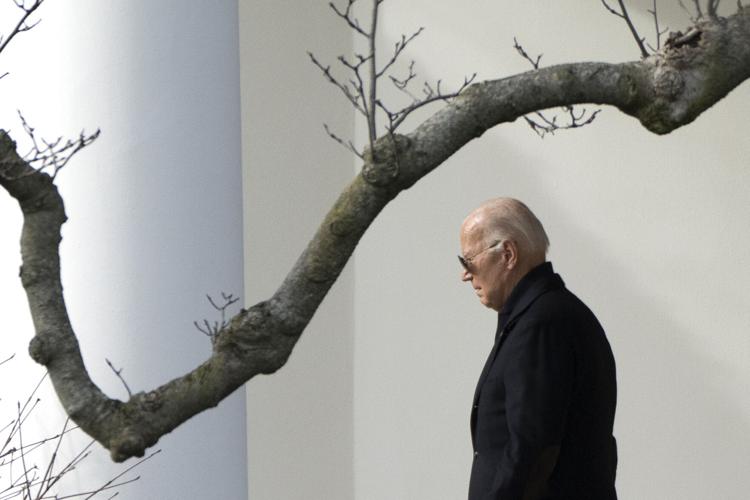
WASHINGTON — How it began: President Joe Biden was urgently seeking more money from Congress to aid Ukraine and Israel. He took a gamble by seizing on GOP demands to simultaneously address one of his biggest political liabilities — illegal migration at the U.S.-Mexico border.
How it ended: Biden came close to succeeding, before it all fell apart spectacularly. Now the president is trying to make the best of it after a major congressional deal was scuttled once Republican front-runner Donald Trump got involved. And Biden is intent on showing that the former president and his “Make America Great Again" Republican acolytes in Congress aren't really interested in solutions.

President Joe Biden walks out of the White House on Jan. 12 to board Marine One on the South Lawn in Washington.
In between: There is a story of a president willing to anger his own party’s activist class in an election year, rare hope for bipartisan progress on one of the third rails of American politics, and a sudden, stunning collapse publicly engineered by Trump that Biden's team now sees as a political gift.
People are also reading…
This account of Biden's big gamble is based on interviews with more than a dozen White House aides, lawmakers, Biden administration officials and congressional aides, some of whom spoke to The Associated Press on condition of anonymity to discuss the back and forth over the collapsed deal, and what happens next.
The bipartisan legislative deal announced Sunday evening was the culmination of more than four months of negotiations that started with Senate Democrats and Republicans, and later included top Biden aides and Cabinet officials. It came after Republicans, led by then-House Speaker Kevin McCarthy, backed a temporary spending deal that kept the government operating but delivered no new funding for Ukraine.
McCarthy had insisted to the White House that any effort to continue U.S. funding for Ukraine needed to be linked to significant steps to secure the U.S.-Mexico border, long a GOP priority. Senate Minority Leader Mitch McConnell, Biden's most valuable Republican ally when it came to Ukraine aid, also began appealing to senior administration officials for the spending measure to include border provisions.
Inside the White House, there was no shortage of grumbling that Republicans were insisting on unrelated policy changes and holding up badly needed money for the Ukrainian armed forces.

House Speaker Mike Johnson speaks Jan. 17 outside the West Wing of the White House.
But Biden and his advisers saw a potential upside as well, at a time when the president's handling of immigration was one of his biggest political vulnerabilities and there were chaotic scenes at the border and in major Democratic-run cities where migrants are sleeping in police station foyers, bus stations and hotels.
Before long McCarthy was ousted and it took weeks to elect a replacement. New House Speaker Mike Johnson, elected Oct. 25, made clear that he, too, wanted to pair border security with any new Ukraine funding.
While the House was in disarray, a group of bipartisan senators quietly got to work.
The White House kept its distance until senior officials felt it was the right time to get directly involved, but there was also pressure from Republicans for them to join the talks. GOP lawmakers insisted it was necessary for Biden to expend some political capital and embrace a border compromise that could be unpopular with parts of his own party.
On Dec. 12, the White House dispatched senior officials, including Homeland Security Secretary Alejandro Mayorkas, to join the negotiations. The idea was to underscore Biden’s seriousness about cutting a deal with Republicans.
“Immediately after the Republicans demanded that the administration show up, they showed up,” said Sen. Chris Murphy, D-Conn., one the negotiators.
Difficult negotiations stretched into 2024. But there were signs of progress and Biden was optimistic. So much so that on Jan. 18, he said he didn't think there were any sticking points left.
In an effort to push the bill forward, Biden even adopted Trump’s own language saying he’d “shut down the border” if given the power — a stunning admission from a Democrat that was quickly and loudly condemned by activists in his own party.
The deal that emerged would have overhauled the asylum system to provide faster and tougher immigration enforcement, as well as given presidents new powers to immediately expel migrants if authorities become overwhelmed with the number of people applying for asylum. It also would have added $20 billion in funding, a huge influx of cash.

It was never entirely clear what the White House strategy was to advance the border compromise in the House should it make it out of the Senate.
House Armed Services Committee Chairman Mike Rogers, R-Ala., said it was a mistake that the White House didn’t negotiate with House Republicans directly, but that even so, if the deal "actually sealed the border, it could’ve sailed through.”
Enter the former president. At a rally in Nevada on Jan. 27 — after solidifying his position as the far and away GOP front-runner — Trump said his piece: “As the leader of our party, there is zero chance I will support this horrible open borders betrayal of America. I’ll fight it all the way.”
“A lot of the senators are trying to say, respectfully, they’re blaming it on me,” Trump added, followed by the 10 words that made Biden aides light up: “I say, that’s OK. Please blame it on me. Please.”
It’s far from assured that Biden’s efforts to pin the blame on Trump will stick.
Biden, though, has his plan: “Every day between now and November, the American people are going to know that the only reason the border is not secure is Donald Trump and his MAGA Republican friends."
Americas reeling as flow of migrants reaches historic levels

A migrant who crossed into the U.S. from Mexico is pulled under concertina wire along the Rio Grande river Sept. 21, 2023, in Eagle Pass, Texas. Countries in the Americas are reeling as the flow of migrants reaches historic levels, but international “funds simply aren’t there” for humanitarian needs. Global crises — among them the war in Ukraine, conflict in Sudan, Morocco’s earthquake — have pulled global funds away, said Ugochi Daniels, deputy director of operations for the International Organization for Migration.

Migrants who crossed the Rio Grande river to the U.S. from Mexico seek direction from a guardsman Sept. 22, 2023, in Eagle Pass, Texas. A growing number of countries like Panama and Costa Rica are pleading for international aid in handling the flood of migrants passing through the Americas.

Migrants who crossed the Rio Grande and entered the U.S. from Mexico head to be processed by U.S. Customs and Border Protection Sept. 23, 2023, in Eagle Pass, Texas. As more than 7.2 million people have fled the South American nation's economic and political turmoil, the mass migration has received pennies on the dollar in aid compared to other global migration crises like Syria's.

A woman carries her child after she and other migrants crossed the Rio Grande and entered the U.S. from Mexico, to be processed by U.S. Customs and Border Protection Sept. 23 in Eagle Pass, Texas.

A young girl watches as she and other migrants who crossed the Rio Grande and entered the U.S. from Mexico are lined up for processing by U.S. Customs and Border Protection Sept. 23, 2023, in Eagle Pass, Texas. An emergency was declared when several thousand migrants crossed into Eagle Pass, Texas, over a few days.

Migrants sit atop a northbound freight train, in Irapuato, Mexico on Sept. 23, 2023.

Migrants sleep outside a train station as they wait for the arrival of a northbound freight train, in Irapuato, Mexico, on Sept. 22, 2023.

Migrants travel on a freight train, arriving in Ciudad Juarez, Mexico, on Sept. 28, 2023. Despite violence from drug cartels and the dangers that come with riding atop the train cars, such freight trains — known collectively as “The Beast” — have long been used by migrants to travel north.

A migrant man watches as a northbound freight train pulls into Irapuato, Mexico, on Sept. 23, 2023.

Guardsmen encourage migrants waiting on a sandbar to turn around as they attempt cross the Rio Grande from Mexico into the U.S. on Sept. 23, 2023, in Eagle Pass, Texas.

A U.S. Border Patrol agent in a vehicle watches a group of asylum-seekers at a camp after they crossed the nearby border with Mexico, on Sept. 26, 2023, near Jacumba Hot Springs, Calif. Migrants continue to arrive to desert campsites along California's border with Mexico, as they await processing.

Migrants walk beside a freight train they rode to Ciudad Juarez, Mexico, on Sept. 28, 2023. So many migrants are climbing aboard trains that Mexico’s largest railway company said it was suspending 60 freight train runs because of safety concerns, citing a series of injuries and deaths.

Migrants travel on a freight train, arriving in Ciudad Juarez, Mexico, on Sept. 28, 2023. A vast smuggling network can now get migrants from Venezuela to central Mexico in as little as just over two weeks, an odyssey that once could take months. Detentions along the U.S.-Mexico border soared 33% from June to July, according to U.S. government figures, reversing a plunge after new asylum restrictions were introduced in May.

Migrants travel on a freight train, arriving in Ciudad Juarez, Mexico, on Sept. 28, 2023.

Migrants walk beside a freight train that brought them to Ciudad Juarez, Mexico, on Sept. 28, 2023.

Migrants travel on a freight train, arriving in Ciudad Juarez, Mexico, on Sept. 28, 2023.