BROOKLINE, Mass. — Kitty Dukakis, the wife of former Massachusetts governor and Democratic presidential candidate Michael Dukakis who spoke openly about her struggles with depression and addiction, died at age 88.
Dukakis died Friday night surrounded by her family, her son, John Dukakis, said Saturday by telephone. She fought to make the world better, “sharing her vulnerabilities to help others face theirs,” her family said in a statement.
“She was loving, feisty and fun, and had a keen sensitivity to people from all walks of life,” the family said. “She and our dad, Michael Dukakis, shared an enviable partnership for over 60 years and loved each other deeply.”
Dukakis won high marks as a political campaigner during her husband's 1988 presidential efforts, stumping tirelessly for him. She was called a key influence in his decision to seek the presidency.
She even figured in the opening question of a 1988 presidential debate, when her husband was asked: "Governor, if Kitty Dukakis were raped and murdered, would you favor an irrevocable death penalty for the killer?" Dukakis said he would not, and his unemotional response was widely criticized.

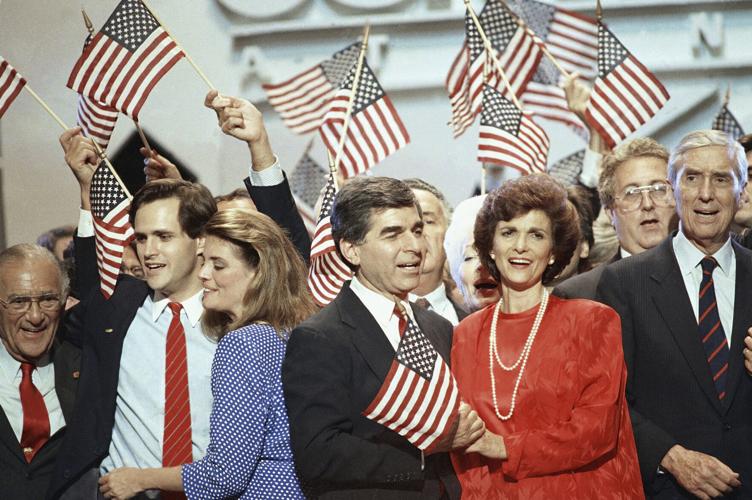
Then-Massachusetts Gov. Michael Dukakis and his wife, Kitty, wave the American flag as they are cheered by delegates July 21, 1988, after Dukakis accepted the nomination as the presidential candidate at the Democratic National Convention in Atlanta.
Earlier in the campaign, in 1987, Dukakis revealed she overcame a 26-year addiction to amphetamines five years earlier after receiving treatment. She said she started taking diet pills at age 19.
Her husband made anti-drug efforts a major issue and she became prominent in the effort to educate youngsters against the perils of drug and alcohol abuse.
A few months after Michael Dukakis lost the election to Vice President George H.W. Bush, Kitty Dukakis entered a 60-day treatment program for alcoholism. Several months later she suffered a relapse and was hospitalized after drinking rubbing alcohol.
In her 1990 autobiography, "Now You Know," she blamed her mother for much of her alcohol and drug addiction and a long history of low self-esteem.
In 2006, she wrote another book, "Shock," which credits the electroconvulsive therapy she began in 2001 for relieving the depression she suffered for years. The treatment, she wrote, "opened a new reality for me."
Current Massachusetts Gov. Maura Healey called Dukakis “a force for good in public life and behind the scenes,” a leader in the effort to ensure that the Holocaust is never forgotten, and an advocate for children, women and refugees.
"She spoke courageously about her struggles with substance use disorder and mental health, which serves as an inspiration to us all to break down stigma and seek help,” Healey said in a statement.
Dukakis used her personal pain to help others, Massachusetts Attorney General Andrea Joy Campbell said in a statement on social media on Saturday.
"Her legacy will live on in the policies she helped shape and the people she inspired to speak their own truths,” Campbell said.

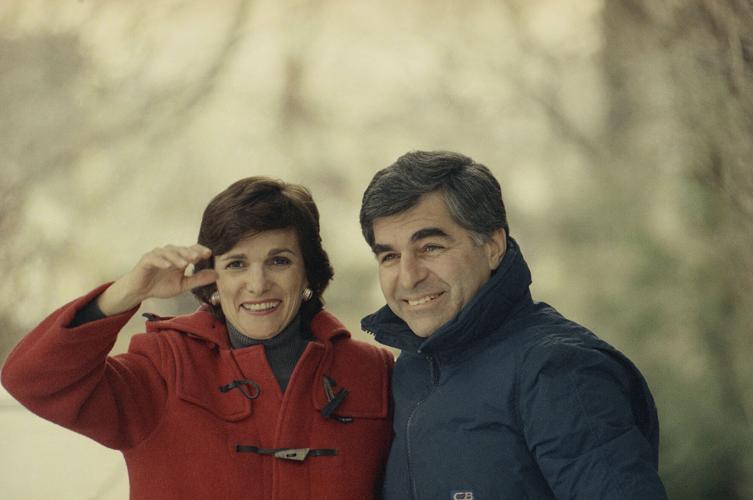
Kitty Dukakis, left, and Massachusetts Gov. Michael S. Dukakis are seen March 7, 1989, outside their home in Brookline, Massachusetts.
Dukakis broke ground by speaking openly about her struggles and championed support for the homeless and political refugees, said Maria Ivanova, director of Northeastern University’s Policy School, which hosts the Kitty and Michael Dukakis Center for Urban and Regional Policy.
“Kitty Dukakis brought honesty, compassion, and strength to public life,” Ivanova said in a statement. “Her legacy is one of service, resilience, and truth-telling.”
Kitty Dukakis inspired many to engage in activism and was a “deeply devoted spiritual companion” to her husband, center Director Ted Landsmark said in a statement.
“They have been truly effective change-makers on behalf of those in need of care and support,” he said.
Michael Dukakis served as a distinguished professor of political science at the university. He retired, but returns to campus for events and student consultations, Landsmark said.
Dukakis and her future husband met while attending high school in Brookline, Massachusetts, a Boston suburb. He was dull and frugal; she was dramatic and fancy. He is Greek Orthodox; she was Jewish.
Kitty Dukakis, who was divorced and had a 3-year-old son, married Michael Dukakis in 1963, and they had two children, Andrea and Kara.
Dukakis, whose late father, Harry Ellis Dickson, was associate conductor of the Boston Symphony Orchestra, earned degrees in modern dance and broadcasting.
She served on the President's Commission on the Holocaust in 1979 and on the board of directors of the Refugee Policy Group. In 1989, Bush appointed her to be a member of the United States Holocaust Memorial Council. She also was a member of the Task Force on Cambodian Children.
By the late 1990s, Dukakis and her husband divided their time between Massachusetts and California, where she was a social worker and he was a professor for part of the year at the University of California, Los Angeles.
History-making moments from presidential debates
That old age question (again)

Pictured: President Ronald Reagan, left, and his Democratic challenger Walter Mondale, shake hands before debating in Kansas City, Mo., Oct. 22, 1984. (Ron Edmonds, Associated Press)
When everyone knows a sensitive question is coming yet you make the answer sound spontaneous, you're having a good debate. Republican President Ronald Reagan landed a line for the ages in the second presidential debate of 1984 after an underwhelming opening matchup.
Reagan was 73 and seeking a second term in his race against Democratic challenger Walter Mondale, then 56. In the first debate, Reagan struggled to remember facts and occasionally looked befuddled.
One of his top advisers, Nevada Sen. Paul Laxalt, suggested afterward that aides “filled his head with so many facts and figures that he lost his spontaneity."
So Reagan's team took a more hands-off approach toward his second faceoff with Mondale. And, when Reagan got a question about his mental and physical stamina that he had to know was coming, he was ready enough to make the response feel unplanned.
“You already are the oldest president in history,” moderator Henry Trewhitt said before asking whether Reagan might not be able to handle a challenge like the Cuban missile crisis.
“Not at all,” Reagan responded in defense of his crisis management smarts. He smoothly continued, “I want you to know that, also, I will not make age an issue of this campaign. I am not going to exploit, for political purposes, my opponent’s youth and inexperience.”
Then, capitalizing on years of Hollywood-honed comedic training, the president took a sip of water, giving the audience and even Mondale, who himself cracked up, more time to laugh. Finally, he grinned and left little doubt that he'd rehearsed a response, adding, "It was Seneca, or it was Cicero, I don’t know which, that said, ‘If it was not for the elders correcting the mistakes of the young, there would be no state.’”
Years later, Mondale said that while TV viewers saw him laughing, “I think, if you come in close, you’ll see some tears coming down, because I knew he had gotten me there. That was really the end of my campaign that night."
Reagan thereby proved that even at his age, a candidate could get better over time. And with this year's race pitting 81-year-old Biden against 78-year-old Trump, 73 doesn't seem so old anymore.
Reagan is also remembered for using a light touch to neutralize criticisms from Democratic President Jimmy Carter in a 1980 debate.
When Carter accused him of wanting to cut Medicare, Reagan scolded, “There you go again.” The line worked so well he turned it into something of a trademark rejoinder going forward.
Gaffes galore

Pictured: Jimmy Carter, left, and Gerald Ford, right, shake hands before the third presidential debate, Oct. 22, 1976, in Williamsburg, Va. (Associated Press
In 1976, Republican President Gerald Ford had a notable moment during his second debate against Carter — and not in a good way. The president declared that there is “no Soviet domination of Eastern Europe and there never will be under a Ford administration.”
With Moscow controlling much of that part of the world, moderator Max Frankel responded, “I'm sorry, wha ..?” and asked if he'd understood correctly. Ford stood by his answer, then spent days on the campaign trail trying to explain it away. He lost that November.
“The closer the election, the more zingers and important debate lines can matter,” said Aaron Kall, director of the debate program at the University of Michigan. “Not just on who won, or who lost, but how does it affect fundraising, how does it impact the media cycle in coming days and weeks.”
Not all slips of the lip have a devastating impact.
Then-Sen. Barack Obama, in a 2008 Democratic presidential primary debate, dismissively told Hillary Clinton, “You’re likable enough, Hillary.” That haughty answer drew a backlash but Obama recovered.
The same couldn’t be said for the short-lived 2012 Republican White House bid of then-Texas Gov. Rick Perry. Despite repeated attempts and excruciatingly long pauses, Perry could not remember the third of the three federal agencies he’d promised to shutter if elected.
Finally, he sheepishly muttered, “Oops.”
The Energy Department is what slipped his mind.
Getting personal

Pictured: Sen. Lloyd Bentsen, D-Texas, left, shakes hands with Sen. Dan Quayle, R-Ind., before the start of their vice presidential debate at the Omaha Civic Auditorium, Omaha, Neb., Oct. 5, 1988. (AP Photo/Ron Edmonds, Associated Press)
Another damaging moment opened the second presidential debate in 1988, when CNN anchor Bernard Shaw pressed Democrat Michael Dukakis, the governor of Massachusetts, about his opposition to capital punishment with a question that evoked the candidate's wife.
“If Kitty Dukakis were raped and murdered, would you favor an irrevocable death penalty for the killer?” Shaw asked. Dukakis showed little emotion as he responded, “I don’t see any evidence that it’s a deterrent.”
Dukakis later said he wished he'd said that his wife "is the most precious thing, she and my family, that I have in this world."
That year's vice presidential debate featured one of the best-remembered, pre-planned one-liners.
When Dan Quayle, the Republican vice presidential nominee and Indiana senator, compared himself to John F. Kennedy while debating Texas Sen. Lloyd Bentsen, the Democrat was ready. He'd studied Quayle's campaigning and seen him invoke Kennedy in the past.
“Senator, I served with Jack Kennedy. I knew Jack Kennedy,” Bentsen began slowly and deliberately, drawing out the moment. “Jack Kennedy was a friend of mine. Senator, you’re no Jack Kennedy.”
The audience erupted in applause and laughter. Quayle was left to stare straight ahead.
Blunders without words

Pictured: President George H.W. Bush looks at his watch during the 1992 presidential campaign debate with other candidates, Independent Ross Perot, top, and Democrat Bill Clinton, not shown, at the University of Richmond, Va., Oct. 15, 1992. (AP Photo/Ron Edmonds, Associated Press)
Quayle and George H.W. Bush still easily won the 1988 election. But they lost in 1992 after then-President Bush was caught on camera looking at his watch while Democrat Bill Clinton talked to an audience member during a town hall debate. Some thought it made Bush look bored and aloof.
In another instance of a nonverbal debate miscue, then-Democratic Vice President Al Gore was criticized for a subpar opening 2000 debate performance with Republican George W. Bush in which he repeatedly and very audibly sighed.
During their second, town hall-style debate, Gore moved so close to Bush while the Republican answered one question that Bush finally looked over and offered a confident nod, drawing laughter from the audience.
A similar moment occurred in 2016, as Hillary Clinton faced the audience to answer questions during her second debate with Trump. The Republican candidate moved in close behind her, narrowed his eyes and glowered.
Clinton offered no visible reaction then, but later wrote of the incident, "He was literally breathing down my neck. My skin crawled.”
Biden-Trump redux

Pictured: President Donald Trump and Democratic presidential candidate and former Vice President Joe Biden participate in the final presidential debate at Belmont University, Oct. 22, 2020, in Nashville, Tenn. (Patrick Semansky, Associated Press)
June 26’s faceoff is the first time a current president debates a former.
Historically, incumbents sometimes struggle during opening debates. They're used to being surrounded by White House advisers who offer little pushback. In 2012, then-President Obama’s seemingly detached first debate performance against Mitt Romney allowed the Republican to gain momentum.
Romney, though, had an awkward moment during the second debate.
Answering a question about gender pay equity, the former Massachusetts governor talked about going to women's groups to get help finding qualified female applicants for top state posts.
"They brought us whole binders full of women,” he declared. Obama turned that into an attack line at subsequent rallies, gleefully saying, “We don't have to collect a bunch of binders to find qualified, talented, driven young women.”
If Biden's debate skills are rusty this time, his opponent's might be as well. Trump skipped all the GOP primary debates this time, meaning he’s not done one since squaring off with Biden twice in 2020.
Trump interrupted so frequently when they first debated four years ago that Biden eventually cried out, “Will you shut up, man?” — a visceral moment if there ever was one. Trump is remembered that night for instructing members of the far-right Proud Boys group from the stage to “stand back and stand by.” Some members of the extremist group took it as a sign of encouragement.
The second Biden-Trump debate of 2020 saw producers cut the mics to discourage interrupting, making it less chaotic. It featured Biden wistfully declaring, “I am anxious to have this race. I’m anxious to see this take place.”
It did. And now it's happening again.