WASHINGTON — House Speaker Kevin McCarthy pledged on Monday to pass legislation to raise the nation’s debt ceiling — but only on condition of capping future federal spending increases at 1% — as he lashed out at President Joe Biden for refusing to engage in budget-cutting negotiations to prevent a debt crisis.
In a high-profile speech at the New York Stock Exchange, the Republican said the nation’s debt load is a “ticking time bomb” and Biden is “missing in action” as the deadline nears to raise the debt limit.
“Since the president continues to hide, House Republicans will take action,” McCarthy said.
The White House hit back, accusing McCarthy of “dangerous economic hostage taking.” Administration officials boosted Biden’s pressure on the Republican leader to approve a debt ceiling increase with no strings attached.
People are also reading…
McCarthy’s Wall Street address came as Washington heads toward a potential fiscal crisis over the need to raise the nation’s debt limit, now at $31 trillion, to avert a federal default. The Treasury Department said it is taking “extraordinary measures” to continue paying its bills, but money will run short this summer.

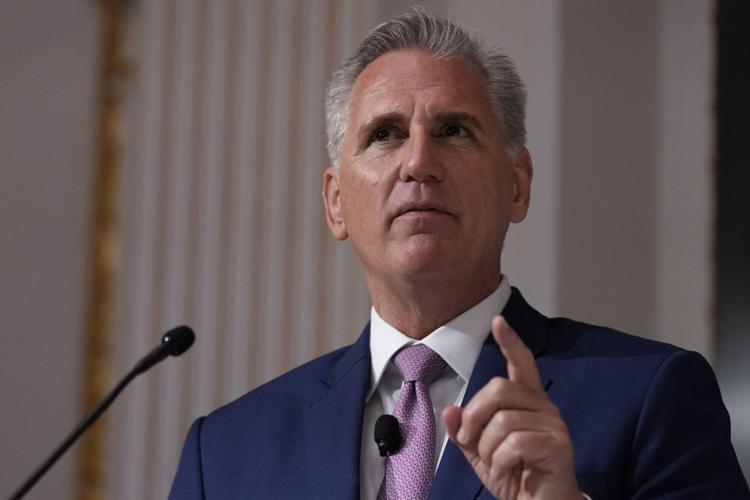
Speaker of the House Kevin McCarthy speaks Monday during an event at the New York Stock Exchange in New York.
While vowing that “defaulting on our debt is not an option,” McCarthy faces his own challenges.
With his slim majority and less-than-strong grip on power, he has been unable to rally Republicans around a budget-cutting proposal that he could offer the White House as a starting point in negotiations. The outline of conditions he proposed Monday is considered dead on arrival in the Democratic-controlled Senate.
McCarthy seeks to shift blame for the standoff and draw the White House back into talks. “The longer President Biden waits to be sensible to find an agreement, the more likely it becomes that this administration will bumble into the first default in our nation’s history,” he said.
White House deputy press secretary Andrew Bates called McCarthy’s conditions a “MAGA wish list that will increase costs for hard-working families,” a reference to former President Donald Trump’s Make America Great Again slogan.
“A speech isn’t a plan, but it did showcase House Republicans’ priorities,” Bates said.
Senate Majority Leader Chuck Schumer said it’s McCarthy who “continues to bumble our country toward a catastrophic default.”
“President Biden and I are happy to meet with the speaker when he has something to talk about,” Schumer said. “He went all the way to Wall Street and gave us no more detail. No more facts, no new information at all.”
Nevertheless, McCarthy was upbeat and defiant as he vowed to pass a bill through the House that would raise the nation’s debt limit into next year — putting the issue squarely in the 2024 presidential election — coupling it with a plan to roll back federal spending to fiscal 2022 levels and cap future spending at no more than 1% a year over the next decade.
Republicans, he said, also want to attach policy priorities, including imposing work requirements to recipients of government aid that would result in cuts to benefit programs in the federal safety net for poorer Americans.
McCarthy said the House Republicans also want to tack on H.R. 1, an expansive energy bill that would favor oil, gas and coal production — and ease permitting regulations — to undo many of Biden’s climate change-fighting initiatives.
Senate Republican leader Mitch McConnell said the president can’t simply put his fingers in his ears. “The White House needs to stop wasting time and start negotiating” with the speaker, he said.

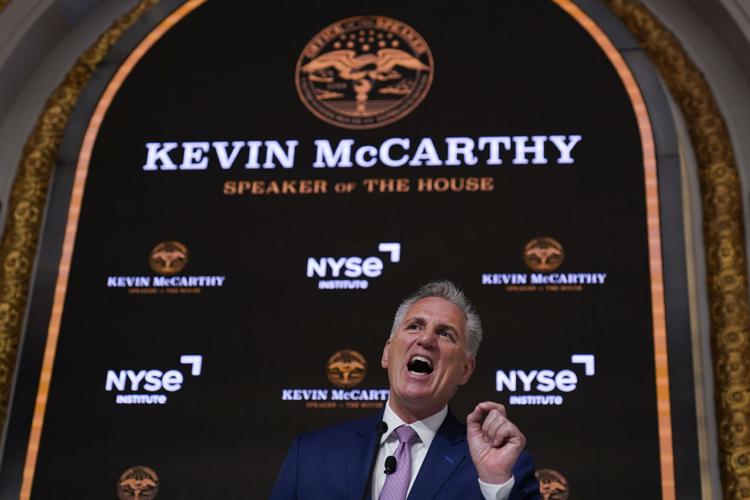
Speaker of the House Kevin McCarthy speaks Monday during an event at the New York Stock Exchange in New York.
Economists suggested it may take a stock market selloff to force an agreement, but McCarthy said during a question period that he wasn’t gauging market reaction for guidance.
“The markets go up and down,” he said.
Legislation raising the nation’s debt limit to continue paying already accrued bills has become a political weapon wielded particularly by Republicans as leverage for policy priorities.
McCarthy is working to unite the “five families” — the various caucuses including the Freedom Caucus, Republican Study Committee and others within the House Republican majority — around a plan that could be presented to Biden to kickstart negotiations.
Federal spending skyrocketed during the COVID-19 pandemic, rising to $7.4 trillion in 2021, before sliding back to $6.2 trillion in fiscal 2022, according to Treasury Department data. The nation’s debt load doubled in the George W. Bush administration with the 9/11-era wars and spiked again during the Obama administration as spending rose and tax revenue plummeted during the Great Recession.
The nation runs more than $1 trillion in annual deficits, and the last time the federal budget balanced was 2001.
The cuts the House Republicans want to make are not “draconian,” McCarthy said. He pledged not to touch the Medicare and Social Security programs.
The White House and Democrats in Congress have been unwilling to engage in talks with the Republicans, saying Congress must simply raise the debt limit without conditions.
Biden has been here before as vice president during the 2011 fiscal standoff that sent jitters through the economy as the Republicans demanded steep spending cuts.
Social Security and Medicare: Here's where things stand for the 2 popular programs
Intro

WASHINGTON (AP) — It seems no one wants to cut Social Security or Medicare benefits.
Not President Joe Biden, who is already telling voters his upcoming federal budget proposal will "defend and strengthen" the programs. Not Republican House Speaker Kevin McCarthy, who has declared cuts to the programs off the table in negotiations to raise the federal debt limit.
There's just one glitch with these declarations: Social Security won't be able to pay out its promised benefits in about a dozen years, while Medicare won't be able to do so in just five years. Economists have done the projections and say both programs will drive the national debt higher in the decades to come, forcing teeth-gritting choices for the next generation of lawmakers.
Here's a breakdown of the dilemma, the potential fixes and the harsh politics around Social Security and Medicare:
The challenge

It's a math problem that requires a political solution.
Payroll taxes largely fund Social Security and Medicare. They generally get deducted from workers' paychecks, which is why Biden, a Democrat, says people are merely getting back what they've already paid into the system.
But as more baby boomers age and retire, there are more beneficiaries and not enough tax revenue to fund the programs. Payroll taxes are expected to generate $1.56 trillion this year, but the combined costs of Social Security and Medicare are likely to be $2.16 trillion, according to a Congressional Budget Office report last week. The office warned in its report that Social Security benefits may need to be cut even earlier than past projections, beginning in 2032.
CBO Director Phillip Swagel said Friday at a Bipartisan Policy Center event that "benefits today are being paid in full as promised, drawing down on the Social Security trust fund." But when the government is unable to pay full benefits, "that's a challenge," he said.
The number of people enrolled in Medicare has more than tripled to roughly 65 million since its inception in 1966. More than 10 million new retirees and disabled people joined in just the past decade, according to data from the Centers for Medicaid and Medicare Services.
The shortfall in tax revenues combined with a rising number of recipients would eventually lead to Social Security's trust fund being unable to fully pay benefits in 2035, a Social Security and Medicare trustees report predicted last June, though the CBO said it could happen sooner. Medicare's trust fund would be unable to pay full benefits starting in 2028.
This forces the inevitable choice of whether to shore up the trust funds' finances or reduce people's benefits. Continued delays by Congress and the president in addressing this math problem could narrow the number of potential fixes.
What are the solutions?

There is basically some combination of four options:
— Raise taxes.
— Change benefits such as the eligibility age.
— Cut costs.
— Rely more on general revenues to cover the gap, which could mean higher budget deficits or cuts to other programs.
Biden took a step last year with his Inflation Reduction Act, which would allow Medicare to negotiate lower prices on a handful of drugs and charge drug companies when they raise the price of drugs faster than inflation. The law also makes vaccines free, caps monthly out-of-pocket insulin costs at $35 and limits out-of-pocket drug expenses at $2,000 starting in 2025.
The CBO said the prescription drug components of the law would save $237 billion over 10 years, prompting some Republican lawmakers to say it was a spending cut that would dig into pharmaceutical companies' profits, forcing them to limit how much they spend developing new treatments. But the law aims to lower the cost people pay for medication, rather than ax benefits.
Democrats are also trying to rein in spending on the increasingly popular -– and expensive -– Medicare Advantage program, a network of private insurance plans that are reimbursed by the government. Recently, 70 Democrats signed a letter to the president asking his administration to crack down on scams and wasteful spending in the program, which federal investigators say has cost taxpayers billions of dollars.
Sen. Mitt Romney, R-Utah, has pushed legislation that would create bipartisan committees to look at ways to salvage the Social Security and Medicare trust funds. The bill has gone nowhere but has limited bipartisan support, including from Senate Democrats Joe Manchin of West Virginia and Mark Warner of Virginia.
Payroll taxes were capped last year at $147,000 — meaning no one paid the taxes after surpassing that threshold. In 2019, Rep. John Larson, D-Conn., proposed a bill that would reinstitute the payroll tax at earnings above $400,000.
Last year, members of the House Republican Study Committee proposed raising the age at which someone could qualify for Social Security and Medicare. Right now, people can access their full Social Security benefits at 67, an age minimum that's increased by two years since the program was first established nearly 90 years ago. You must be at least 65 to access Medicare.
Last year, Sen. Rick Scott (pictured), R-Fla., laid out a plan to require Congress to reconsider all federal laws every five years — leading to criticism by Biden that Social Security and Medicare would be cut. That idea has received an ice-cold reception with Senate Minority Leader Mitch McConnell, R-Ky, saying it will "not be part of our agenda."
After several months of flak, Scott on Friday revised his plan to specifically exclude Social Security and Medicare.
The CBO has also laid out nearly 60 policy options that could save the federal government billions of dollars on Medicare, including higher monthly premiums for some older and disabled adults.
The politics are toxic

In his State of the Union address, Biden got boos from GOP lawmakers when he said that some Republicans want to cut spending for the programs. It led to an improvised standing ovation for seniors as both parties on the spot committed to avoiding any cuts to Social Security and Medicare.
Put simply, voters like low taxes and generous benefits. This means it can be politically suicidal to overhaul either program. Any change can be used against a lawmaker seeking reelection, especially as 2024 looms. For the past two weeks, Biden has been giving speeches in key states such as Wisconsin and Florida in which he warned that some Republicans would gut the programs, despite the GOP denials.
Why are the politics so bad?
It's because of the composition of the electorate. AP VoteCast found that nearly six in 10 voters in last year's midterms were older than 50. Of that group, three in 10 were 65 or older. This means that a dominant bloc of voters already benefit from these programs or are on the verge of doing so.
Reform is possible

Go back 40 years to 1983.
President Ronald Reagan, a Republican, and House Speaker Tip O'Neill, a Democrat, struck a deal to extend the life of Social Security, which was facing insolvency. The amendments to the program raised the retirement age, delayed the cost-of-living adjustment by six months and mandated that government employees start paying into Social Security, among other changes.
When Reagan signed the law on April 20, 1983, he said: "This bill demonstrates for all time our nation's ironclad commitment to Social Security. It assures the elderly that America will always keep the promises made in troubled times a half a century ago. It assures those who are still working that they, too, have a pact with the future."
In the 1984 elections, there was little political fallout. Reagan won a second term in a landslide, while Democrats held onto the House.
This is a global problem

It's not just the U.S. There's pushback in other countries amid efforts to restrain costs tied to an aging population.
There have been repeated protests in France over French President Emanuel Macron's plans to raise the minimum retirement age for a full state pension from 62 to 64. Nearly 1 million people marched in Paris, Nice, Marseille, Toulouse, Nantes and other cities on Feb. 11, with Parisian police officers saying they arrested eight people for violations that included vandalism and possession of a firearm.
In the Chinese city of Wuhan last week, seniors belted out the communist anthem "The Internationale" in protest of the government cutting health care benefits.
In a recent analysis for the International Monetary Fund, Harvard University's David Bloom, an economics professor, and Leo Zucker, a research assistant, said that aging worldwide creates "a colossal set of health, social, and economic challenges in the coming decades." They warned about the costs of inaction if there are not enough workers to fund health care benefits for older people, leading to more disease and a lower quality of life.
Treasury reporter Fatima Hussein in Washington contributed to this report.