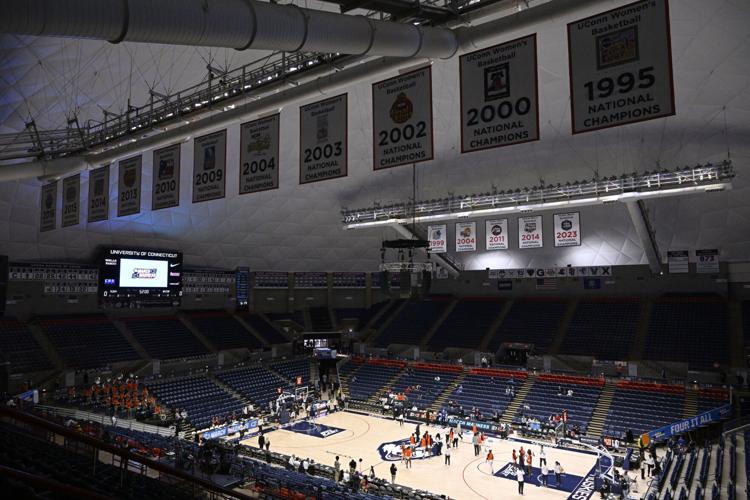
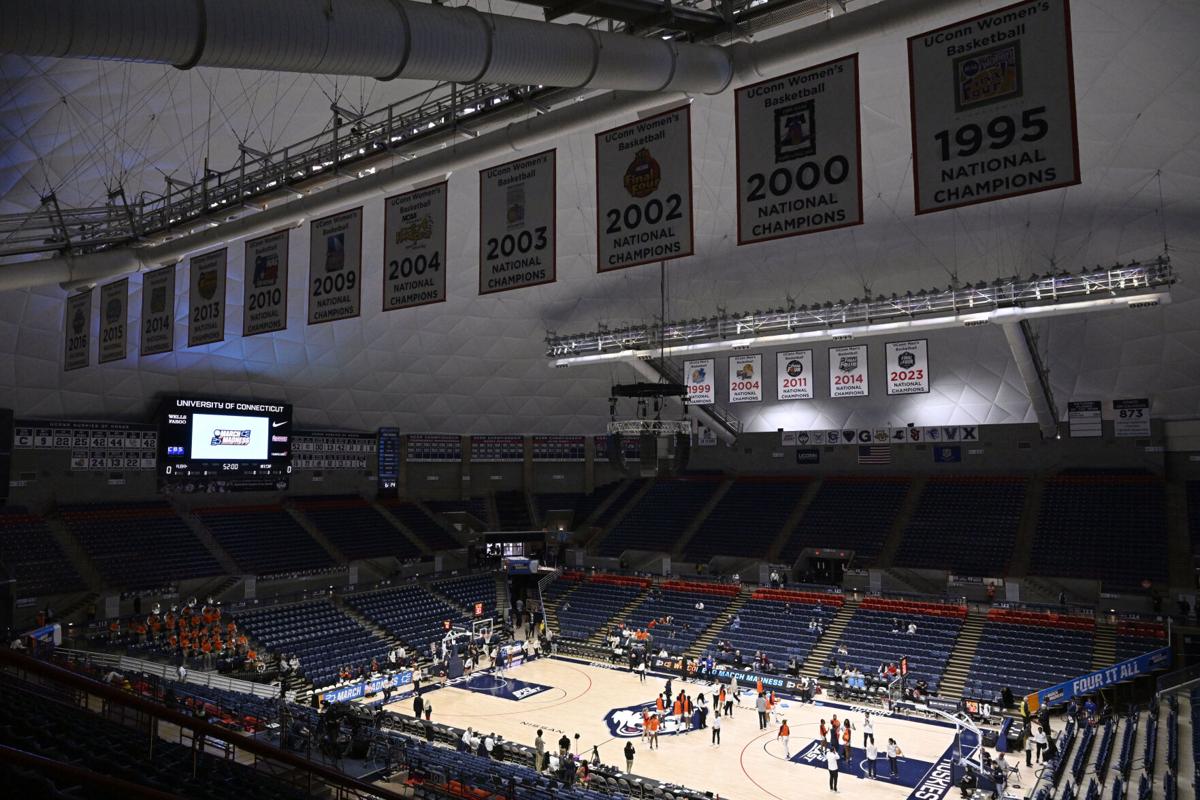
STORRS, Conn. — Walking into the dome-like structure of Gampel Pavilion and down to the court, the intimacy of the arena is striking.
In fact, it could almost be any gym on any campus in the nation, except for one thing: the 16 national championship banners that hang from the rafters: 11 for the women’s team and five for the men’s team.
In the house that UConn coach Geno Auriemma has made his own, the likes of Sue Bird, Diana Taurasi, Breanna Stewart, Maya Moore and so many other great players made their mark in creating the sport’s most dominant dynasty.
For such hallowed grounds, the facility is somewhat quaint, which also fits the campus. Around 32,000 attend school in this small-ish community of Storrs, Connecticut. Home to roughly 16,000 people, Storrs is about 25 miles east of Hartford, Connecticut, and 50 miles or so west of Providence, Rhode Island; Gampel itself seats 10,167 for basketball.
People are also reading…
And if Tuesday’s encounter with students is any indication, some don’t even know there is a basketball arena, who plays there or that their team is one of the true bluebloods in all of women’s college sports.

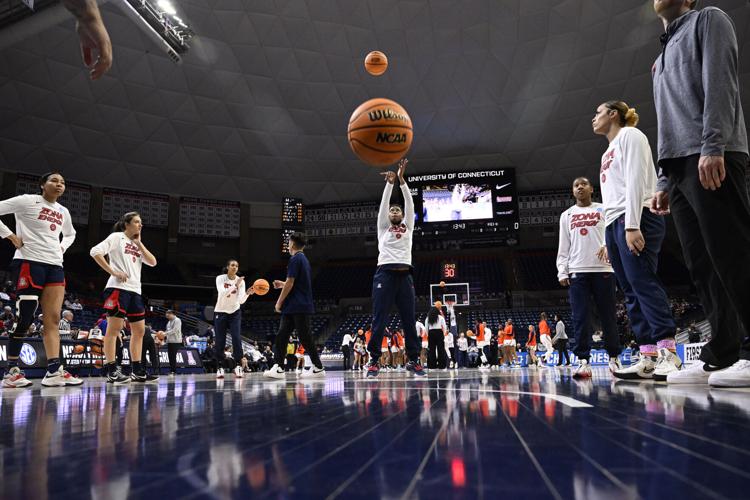
Arizona warms up Thursday at Gampel Pavilion on UConn’s campus.
On one hand, it seems logical that it isn’t grand or oversized. On the other hand, right next to Gampel is the Werth Family UConn Basketball Champions Center — a training facility for both men’s and women’s teams that has all the bells and whistles. There are two identical courts, training centers, sports medicine treatment rooms, locker rooms, film rooms — you name it. That’s also where the Huskies’ Hall of Champions can be found, which houses the 16 combined National Championship trophies.
With the Arizona Wildcats in the building, a 17th championship banner is noticeably missing from the Gampel ceiling; that would-be banner could have marked a 2021 women’s hoops national title.
The Huskies faced the Wildcats in the Final Four in San Antonio that year. But due to a great gameplan and great UA execution in the national semifinal, Arizona was the one that ended up advancing to the championship game that season.
The Arizona-UConn matchup went down as one of the most important games in Wildcat history. That season led to the UA hoisting its own banner in the McKale Center rafters that season, marking Arizona’s own first Final Four appearance in the history of the program.

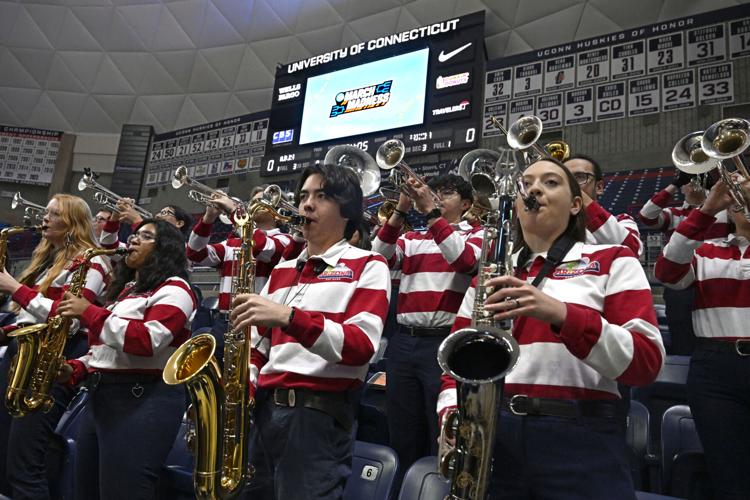
The University of Arizona Pep Band plays Thursday as doors open at Gampel Pavilion on the campus of the University of Connecticut.
Top-down support
UA leadership attended both of Arizona’s men’s and women’s NCAA Tournament games on Thursday. Athletic Director Desireé Reed-Francois traveled with the men to Salt Lake City for the win over Long Beach State, while university President Robert Robbins traveled with the women for the Wildcats’ First Four game against Auburn in Connecticut.
In addition, UA executive senior associate director of athletics Erika Barnes, the Arizona athletic department’s senior woman administrator, was sitting courtside for the matchup against Auburn.
Pluses and minuses
With the perfect storm of NIL alongside the freedom of movement for players to now transfer from one school to another without having to sit out a year, modern college basketball has been referred to by many as the Wild, Wild West.
Some coaches are even retiring early because the goal line, or metaphorical basket in other cases, seems to have been moved on how to build a roster. With lawsuits pending and possible additional federal or state legislation, the environment will surely keep changing.
Wildcats fans don’t have to worry about is Adia Barnes being one of those coaches hanging it up.
“I’m too young to retire,” Barnes said.
Barnes said that Wednesday afternoon in Storrs, ahead of the Wildcats’ NCAA opener; by Thursday morning, Miami coach Katie Meier announced her retirement.
Meier becomes the first power-conference coach to retire this season, but multiple mid-major coaches have also hung up their whistles.
In Barnes’ case, the Wildcats have benefitted greatly from transfers over the years, including program cornerstones Aari McDonald, Dominique McBryde, Tee Tee Starks, Amari Carter, Shaina Pellington, Trinity Baptiste, Jade Loville and Esmery Martinez.
And there have been some misses, too; Nothing is a perfect science, after all.
Barnes said the big thing now is how fast things move. For example, within a few days of the transfer portal’s 45-day window opening on Monday, around 500 players had already put their names in the portal.
That means that teams that don’t strike fast — that may include some still playing in postseason tournaments — may lose out on a potential incoming player.
The quickness is even a trickier balance when a coach is trying to bring in players who fit the culture of their program.
Barnes said that this has taken its toll on lower-level schools.
“I think it’s killing mid-major programs because you can develop a kid — maybe she was a diamond in the rough; you got her, you developed her — and then a big Power 5 school comes in and says, ‘I’m going to give you $50,000,’” Barnes said. “But the mid-major school has no money to pay NIL.”
VIDEO: Gampel Pavilion, UConn's basketball temple, is hosting the Arizona women's basketball program and other teams in town this week to play in the First Four and first and second rounds of the NCAA Women's Basketball Tournament. The arena may be somewhat understated, though it does sport 16 combined men's and women's NCAA Division I championship banners. (PJ Brown, Arizona Daily Star)
VIDEO: Gampel Pavilion, UConn's basketball temple, is hosting the Arizona women's basketball program and other teams in town this week to play in the First Four and first and second rounds of the NCAA Women's Basketball Tournament. The arena may be somewhat understated, though it does sport 16 combined men's and women's NCAA Division I championship banners. (PJ Brown, Arizona Daily Star)