Editor’s note: This continues the Star’s ongoing “Big 12 Blitz” series, where we introduce U of A fans to the on- and off-field need-to-know details surrounding each member of the 16-team Big 12 Conference. Today: a special double edition, touching on rivalry shared by ASU Sun Devils and the hometown U of A Wildcats.
The Star's Big 12 Blitz is presented by Tucson Appliance Company.


Tucson Appliance Company has something for everyone! We specialize in new, reconditioned, scratch-and-dent, and high-end appliances. Known for…
Picture it (if you dare): Mike Candrea, legendary former coach of the Arizona softball team — the eight-time NCAA champion atop the Wildcat mountain — donning a gold polo shirt and maroon visor and coaching third base for the Sun Devils.
Could have been, as he tells the story. But not really, right?
People are also reading…

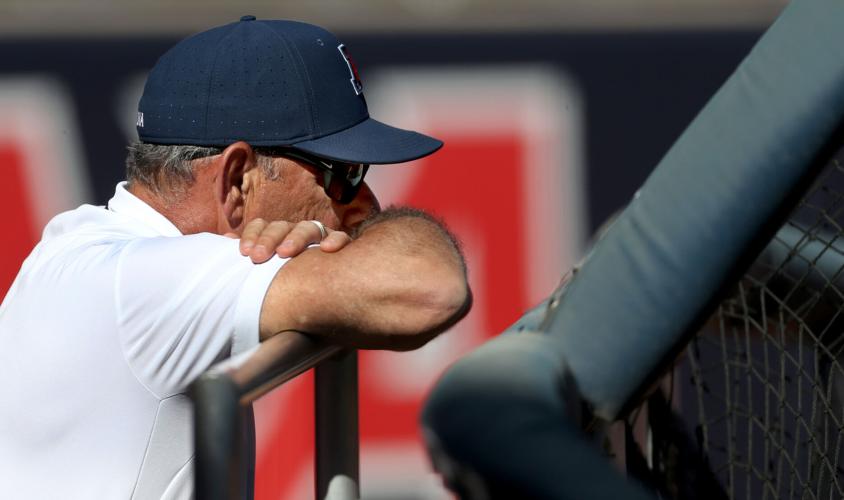
Few have had as close of a look at the Arizona-ASU rivalry than longtime former UA softball coach Mike Candrea (pictured watching his Wildcats take pre-game batting practice before they face the rival Sun Devils at Hillenbrand Stadium in March 2019 in Tucson). His personal connection to both universities goes back to his days as a student; he received both his bachelor’s and master’s degrees from ASU. He’d later become Arizona’s head softball coach, serving from Tucson as one of his sport’s global pioneers from 1986 to 2021.
Or maybe?
But Candrea actually was a Sun Devil before he was a Wildcat; that much is certain.

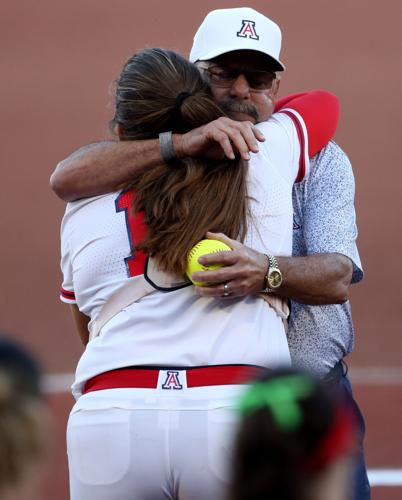
Former Arizona coach Mike Candrea gets a hug from UA catcher Izzy Pacho (15) after he threw out the ceremonial first pitch before the Wildcats’ game against rival Arizona State in the first-ever Pac 12 Softball Tournament game on May 10, 2023 at Hillenbrand Stadium in Tucson.
Candrea was born in New Orleans — his father a jazz musician — and the family moved to the Phoenix when Mike was 7. He’d eventually attend Phoenix’s Sunnyslope High School, and ultimately enroll at Central Arizona College, where he played second base on the baseball team in 1973-74. After that, he’d transfer to Arizona State to complete his bachelor’s degree.
That, and a master’s degree later, and Candrea arrived back to CAC to teach and be an assistant baseball coach.
And it was a few years into that run when he says he was talked into taking over the CAC softball program. He’d do that for a few years — win a couple junior college national titles even — before finally taking the job of a lifetime — his lifetime, to be sure — in Tucson.
Over 36 years at Arizona, Candrea would become the NCAA’s career coaching wins leader (1,674) while building the Wildcats into a national brand; he’d have a first-hand view as other NCAA programs near and far — ASU included — followed suit and grew into softball dynamos themselves at one time or another.

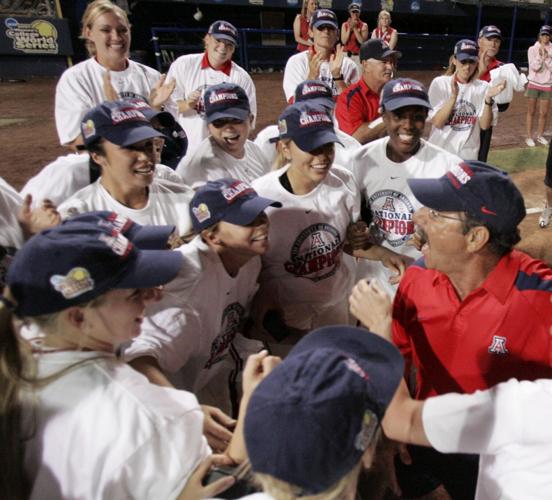
Then-UA head coach Mike Candrea, in red, cheers with his team after the Wildcats beat Tennessee in the final game the 2007 Women’s College World Series. Arizona is tied for second all-time with eight softball titles (1991, 1993, 1994, 1996, 1997, 2001, 2006, 2007), while rival ASU is tied for fourth with two (2008, 2011).
Prior to the current football season, with Arizona and ASU, together, side-by-side, finally, officially starting their Big 12 journeys, the Star's Greg Hansen and Brett Fera had a chance to chat with Candrea in August and discuss his time as an ASU student, how that parlayed into his illustrious coaching career in Tucson, and how it went down when the Sun Devils actually tried (maybe even more than once) to hire him away from the Wildcats.
Here’s a portion of that conversation, which has been lightly edited:
These two schools (Arizona and ASU) are once again are making a conference jump together. And that's sort of been their history. … But as we've seen with other rivalries, be it Oklahoma-Oklahoma State, Texas-Texas A&M, that isn't always the case around the country.
A: “I always think that ASU and U of A weren’t going to go anywhere unless they’re going to go together. That was always the story I heard, and I think that’s a good thing.
“I go way back at ASU. I went to school there, and battled against them, and used to sit on the hill and watch Frank Kush’s football teams play, and Bobby Winkles’ (baseball) teams.”
“The school has gotten quite big since I was there. … So I think it’s they’re a valuable asset.”
“I kind of like that we’re going to still have the rivalry together. That’s the one thing I think a lot of us are missing with the Pac-12 dismantling is some built-in rivalries that we really have had, with UCLA, and then not being able to go up to Cal and Stanford, it’s going to be different. But I think it’s going to be good.”
“Brett Yormark, he left the train station very quickly, and is very aggressive. And I really like a lot of the stuff they’re doing right now. And I’m hoping that the Big 12 becomes a member of the ‘big two.’ I listen to people talk about the SEC and the Big Ten, and I think Brett Yormark is going to make the Big 12 something that’s pretty special.”
Coming out of (Sunnyslope) high school (in Phoenix), did you ever have a chance to go to U of A?
A: “When I went to Central Arizona College I had written some letters to (UA baseball coaches) Jerry Kindall and Jim Wing, and I always threw it back in their faces that they didn’t give me a chance. We had a lot of people from Sunnyslope High School that went to the U of A. Living in Phoenix, kind of growing up around the ASU atmosphere and watching college athletics there, I just kind of felt like that was the place to go for me.”
“And I never really dreamed of being at the U of A to be honest with you. I mean, I never saw myself living in Tucson and working for the U of A. But thank the good lord that had happened because, well, you know, I’ve had a very blessed life in Tucson … We’ll never leave Tucson. It’s my home.”
“You look back at how you get to certain places … how I even got into softball was by accident. And so you never know where your career path is going to take you.”
“I think George Young (a four-time Olympian runner and former CAC athletic director) was the guy that talked me into taking over the (softball) program at Central.
"And I said … ‘If I go find a pitcher, I can win this thing.’ I recruited Connie Clark (to CAC), and Connie (who became the longtime head coach at Texas) is being inducted this year into the (National Fastpitch Coaches’ Association) Hall of Fame.”

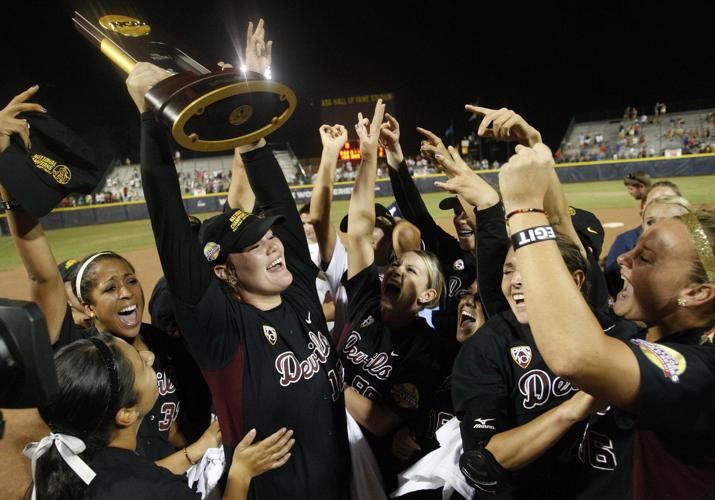
Arizona State pitcher Dallas Escobedo, center, holds the 2011 Division I National Championship trophy in the air after Arizona State defeated Florida 7-2 in the final game of the Women’s College World Series Oklahoma City, Tuesday on June 7, 2011. Softball is one of five sports — along with baseball, men’s golf, women’s golf and men’s swimming — where both Arizona and ASU have won at least one NCAA national championship apiece over the years. ASU has two NCAA titles, while Arizona has eight.
As an alum of ASU, what was the rivalry like those early years when you were at U of A ... and how has it grown since?
A: I always knew that ASU had a really rich tradition in baseball and football, and other than that, if you thought about basketball, you always thought about the U of A. But, to be honest with you, when I first got into the game, ASU was — I didn’t even consider them a rival.
“They weren't on the same level as we were in the early 90s. And it wasn't for a while until they kind of upped the ante and started to get, like, (former ASU coach) Clint Meyers in there. And that was the first time that I had to really work hard to beat ASU. But for a long time, there we were pretty much dominating them.
“But the game has changed. The game has grown.
“When I first got here, softball was — I mean, we had a wrecked field, basically. I had to wait for the PE class to get off of it. I drug my own field. I'm thinking to myself, 'why did I take this job?' I left a tenured teaching position in junior college to take this opportunity, but I had a feeling that it was going to grow.
“And I think that ESPN is probably the thing that helped the sport grow, getting more eyeballs on it.
“And then facilities started being built. People were putting their football monies into softball to build nice facilities. And if you look at it today, I really believe that it's probably one of the top three or four sports that we have going right now.
A: Did ASU seriously make a bid for you at one point (as head coach)?
“A couple of them, yeah. They have a booster, Nap Lawrence, a cotton farmer in Casa Grande. I’ve known him for a long time. And he made a couple of attempts for me to come to ASU, and I did go up there, I think one time, for an interview.
“Just by that time, I just couldn’t leave the U of A. I mean, it was just engrained in me. And you know, I’m a pretty loyal guy. And I really felt like I had everything that I needed to be successful at the U of A, so why would I take a gamble on going up to ASU.
“The other thing I always liked about Tucson was it was a college town.
“The U of A was it. You go up to Tempe and you’ve got a lot of things going on. I think we have a lot of things to be thankful for — the community that we have, the support that we have. The money was not a factor back then. I mean I could have gone to China and coach for lots of money if I really wanted to, so it wasn’t a money thing.
“So I had some opportunities to leave and every time I came back and I just had to look at the Catalina Mountains, and look at the golf course at La Paloma and go ‘why am I leaving here?’”
People around the world care deeply about their being an alum of an institution, yet your professional career grew at the biggest rival to that institution. … how do you wrestle the component that there's probably parts of the ASU connection that do mean something to you, but when the rivalry comes in to play...
A: “Oh absolutely. I think if you cut my wrist right now it would bleed red and blue. There’s no doubt about that. But on the other hand, I still get the ASU Alumni magazine they send to me, and I still get calls about donating.”