


Here in Arizona, the monsoon rains will trigger another burst of fresh vegetation in summer, and with it many new species of Insects will emerge.
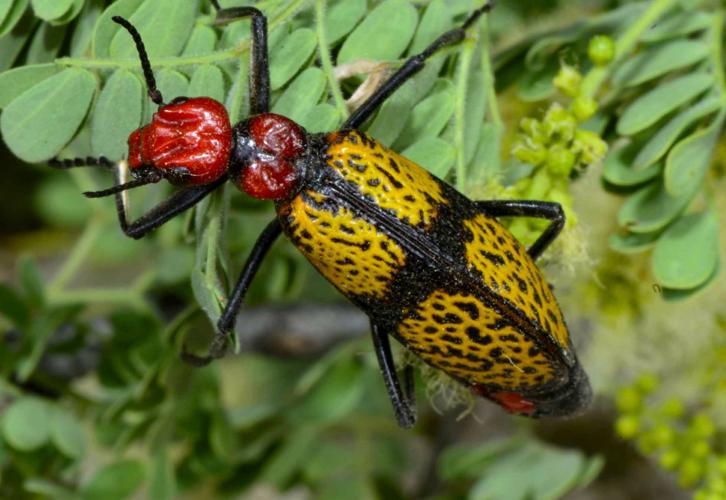
The Iron Cross Beetle, Tegrodera aloga
These flashy beetles make appearances in Arizona in late spring and early summer. They often occur in large feeding and mating aggregations. While handling Iron Cross Blister Beetles would probably not result in bites, scratches, or stings, there is a very good chance it might result in blisters since the beetles secrete a blistering agent known as cantharidin, a compound toxic to mammals, which the beetles use to deter potential predators. It is also the legendary Spanish fly, the aphrodisiac made from ground Blister Beetles.
These large, colorful beetles range throughout much of the Sonoran Desert in Arizona. They feed readily on alfalfa where agriculture encroaches on natural lands. There has been concern about the threat that Tegrodera-contaminated alfalfa hay poses to livestock, especially horses.
When threatened, they suddenly elevate the elytra, which exposes the brilliant red abdomen. These bright colors are a warning to potential predators called aposematic coloration.
Noun, plural elytra - the wing cases; especially the hardened sheath-like forewings of Beetles.
Noun, aposematic coloration - conspicuous coloration or markings of an animal serving to warn off predators;
Noun, hemolymph (the circulatory fluid of various invertebrate animals that is functionally comparable to the blood and lymph of vertebrates)
Another Beetle Beauty!
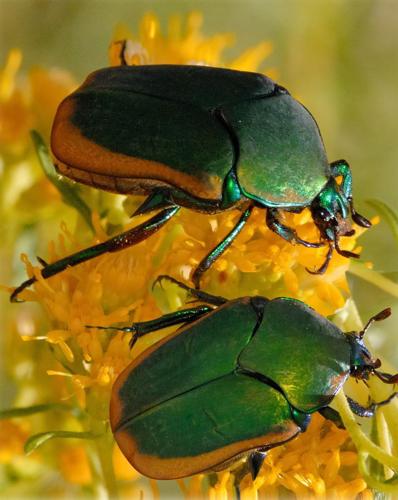
Green fruit beetle—Cotinis mutabilis
The adult fruit beetle is a large metallic beetle (1.25 inch long) with a scarab shape. The larval stage is a C-shaped, creamy white grub, which feeds on decaying organic material in the soil.
Fig beetles (Cotinis mutabilis) appear through the lower parts of foothills and canyons of the Sonoran Desert and occasionally on your fruit trees here in SaddleBrooke. Adult beetles emerge in summer and feed on ripe fruit, such as tomatoes, peaches, plums, figs, and apricots. They are day-active, compact, big, noisy strong fliers. Seen up close they impress you with the velvety green of their elytra and the shiny, metallic colors of their legs and underside. There is a questionable tradition of children tying strings to the beetles and tossing them into the air to fly.
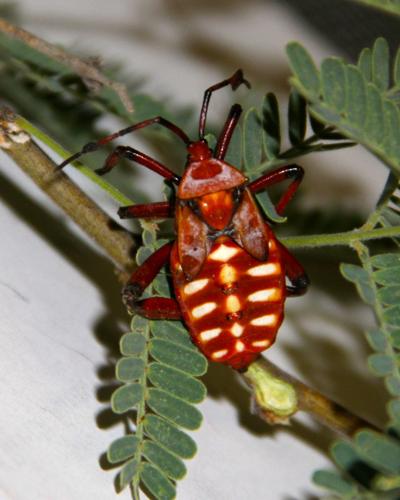
Have you seen this pretty bug?
It’s the Giant Mesquite Bug! Often found on mesquite trees this time of the year. Remember bright colors are a warning. Like “I don’t taste good.” Pretty to look at, but you probably won’t like the taste.
By the way do you know the difference between a bug and a beetle?
Do you care?
Have questions? I have answers. E-mail jecloer@aol.com
 Tucson to get a Teso Life store


