
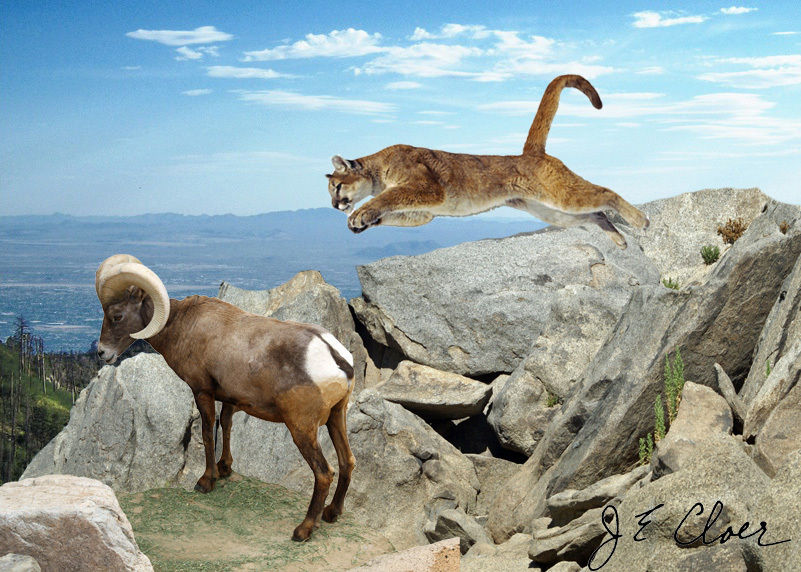
Key Idea: Bighorn sheep live in small mountaintop populations. Populations are groups of the same species that live and breed together. They are different genetically and geographically.
As humanity spreads out over the globe, finding ever more clever ways to domesticate wild landscapes and harness natural processes to its will, many species of wildlife find their natural distributions becoming fragmented. Iconic North American species, such as Bighorn sheep, today inhabit only small fractions of the ranges they occupied only 100 years ago. A result of this fragmentation is that many individuals exist in small, isolated populations. In these populations, a curious phenomenon often emerges, one that can only be understood in light of some basic evolutionary theory. That phenomenon is known as inbreeding depression, and it refers to the decline in average fitness of individuals in a shrinking population.
Inbreeding depression is essentially a result of individuals in small, isolated populations being more likely to mate with close relatives. It’s well-known that mating with close relatives produces less fit offspring, and the aggregate effect in natural populations is seen as low average fitness and an ensuing low population growth rate. This can be a serious problem in populations subject to conservation efforts because even after protective measures have been taken (removing threats, restoring habitat), recovery can be hindered by inbreeding depression.
Of course by now you have heard plenty of news about the Mountain lions and the Bighorn Sheep re-introduction program. Nevertheless I will try to give you my view of the situation.
Tucson’s human population in 1920 was 20,000. In 1950 the population had reached 120,000 and with the introduction of home “air conditioning” by 1960 it doubled to 220,000. Now Pima County has a population of more than 995,000. What has that got to do with Bighorn Sheep-you ask?
A survey in 1926 estimated the bighorn population in the Catalina’s at 200 plus. In 1994 the population had decreased to less than 20. Later surveys in the late 90’s showed no bighorn sheep.
The population decline has been attributed to human activities including the development of roads and trails, housing and resorts, hiking, dogs and fire suppression. Fire suppression effectively has altered vegetation so parts of the range are not suitable for bighorn sheep. Human encroachment into the remaining areas has been too severe for the population to increase. Disease, predation, and hunting may have contributed to the recent decline but their influence has not been evaluated.
All of these things certainly have had an effect. One important factor that seems not to be mentioned is genetics.
In a perfect situation a male offspring would often be driven off by the dominant ram. In this case it would wander off to a new mountain range looking for mates. Of course it had to cross the desert between the mountain ranges. The hazards were many; lack of water, predators and indigenous hunters. Having survived these dangers, it would arrive in and have a chance to mate with ewes with a different genetic background.
But what has changed? Of course with the increase in human population, several things have changed. A big one is development: new highways, more traffic, developments like Oro Valley, Catalina and SaddleBrooke, people, dogs, noise etc.; so as difficult a journey this was 100 years ago, it is virtually impossible today.
So, no new genes!
As a result we have: Inbreeding depression
Inbreeding is reproduction from the mating of pairs who are closely related genetically. Inbreeding results in an increase of the chances of offspring being affected by recessive or deleterious traits. This generally leads to a decreased fitness of a population.
All life forms have errors in some of their genes. The gene may be less functional than it should be or completely broken. Luckily we inherit two copies of every gene, one from each parent. So it rarely matters if some of your genes are broken - as long as the other copies are healthy and functional.
In the case of inbreeding, the parents are genetically very similar and therefore carry the same genetic defects, but without knowing it since they both have a healthy copy. If their inbred child inherits two broken copies of the same gene, that child may be born with serious defects - depending on how crucial the gene is. Genetic defects will accumulate with every generation of inbreeding. Some royal families developed nasty family diseases through generations of intercousin marriages meant to 'keep the blood pure.'
I'll just add that falling in love with a cousin and marrying him/her is not necessarily a problem. But if your children and grandchildren do the same thing, then your grand-grand-children are bound for trouble.
Survival of lambs in the population of bighorn sheep (Ovis canadensis) on the National Bison Range, Montana, was less than 25 percent during 1983 and 1984. Sixty-seven percent of lamb mortality occurred within three days of birth; ewe behavior and recovered remains indicated that coyotes likely accounted for most of the mortality. Herd history, calculated inbreeding coefficients, and the observation of several small, weak lambs implied that inbreeding depression may have predisposed some lambs to predation. (Sausman 1984)
So what happened?
Overview: Officers of the Game and Fish Department, using helicopters and net guns, captured the 31 bighorns in mountains near Yuma Nov. 16 and 17. The animals were released into the Catalina Mountains from Catalina State Park north of Tucson Nov. 18 — the first step in an effort to rebuild a bighorn herd that died out in the 1990s.
Guess what? Mountain lions started eating the sheep! Wow, who would have guessed?
Mark Hart, spokesman for the Arizona Game and Fish Department. “Game officials were not surprised this happened so quickly after the sheep were released in the Catalina’s. Until a viable bighorn population is established there, any mountain lion that eats a sheep will be killed, in an attempt to re-establish the natural order of things,”
My view
- Netting 31 bighorn sheep from helicopters might have been somewhat traumatic and confusing for the sheep.
- Now let’s transport them across the state in some manner-also stressful.
- Let’s turn them loose in completely unfamiliar area where they have no idea where there is food, water or shelter.
- As they run away in a panic, they may attract some attention by things like mountain lions.
- The so-called “overpopulation” of mountain lions does not seem to affect the mule deer population.
- If I put ice cream in front of my grandchildren wouldn’t they eat it?
- Should I punish them if they did?
Questions, comments or advice contact me Jim Cloer 520-818-3545 jecloer@aol.com.
 Japanese company invests in mine near Mount Lemmon

