
Say, what? Hold on a sec! Photography depends on light to create an image. How do we take a photo if there is no light?
Well, you are correct! You do need light to take a photo. But, in our natural environment, there is always some light, and nearly always enough light to make a photograph. Light can come from natural sources, such as the stars and the Moon or it can come from man-made sources like street lights, headlights and, perhaps closer to home, landscape lighting or flashlights!
The big differentiating factor between daylight and night photography is that light levels at night tend to be much lower than daytime. This means that exposure times will be much longer than in daylight settings, often on the order of 1/10 to 1/20 of a second. For astrophotography, exposures will typically run much longer – typically 30 seconds or more. These really long exposures, and the need for a tripod, are beyond the capabilities of SmartPhone cameras.
At these shutter speeds, the opportunity for blurred images from camera or subject movement becomes more problematic (See my article in last month’s Saddlebag Notes for info on “Curing the Blurs”). The best way to avoid this problem with blur is to use a camera with fully-adjustable settings, but since this column is primarily intended to support photo enthusiasts with SmartPhone cameras, rest assured you can take some great night-time photos. Here’s an example:
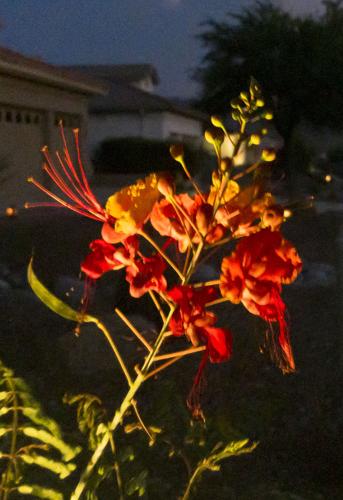
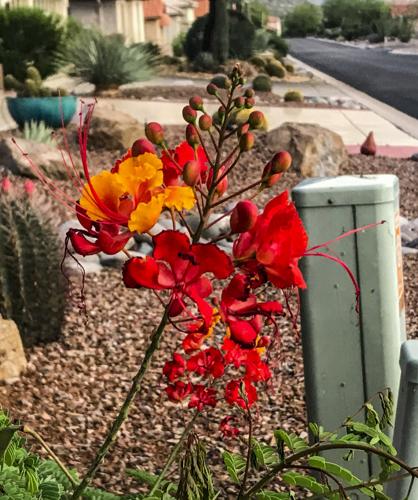
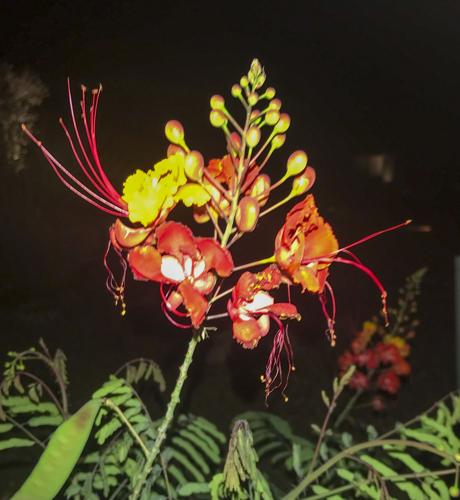
Recently while out for an evening walk, I returned home just as full darkness set in. I noticed that a Mexican Bird of Paradise bloom was nicely illuminated from below by one of our landscape lights. I also had a nice dark background that isolated the bloom.
Using my trusty iPhone 7+ I took several exposures as a trial and reviewed the results. Sure enough, the shutter speed was down to 1/20th second but most of the results were good. In this case, the biggest problem was subject movement due to a very light breeze. Also, there were a lot more distracting light areas in the background than I had anticipated.
To solve the movement problem, I took about two-dozen exposures and ended up with about 15 that had no discernible subject movement. I also varied my viewpoint to try to minimize the distracting lights. A simple photo editing program would let me take out the light points in the background, but even without any editing, the results were not too bad!
Is night time photography something you will use often? Probably not, but you can take some very dramatic photos. During the Christmas holidays, definitely try taking some photos of outdoor decorations. This often works best before full darkness sets in, as you will be able to see details in the background in addition to the lights. As always, experiment a bit. I think you will be pleased with the results!
Space constraints make it difficult to include detailed information in these articles. If you want more info on any of the topics covered in this column, have general questions or comments, or an idea for a future column, please send me an email at PhotographyForEveryone@hagedon.net. And don’t forget to visit the “Saddlebag Notes” photography web page on their website. (www.saddlebagnotes.com/photography).
Jim has a Fine Arts degree with a major in Photography and over 50 years experience in a wide range of photographic disciplines.


