
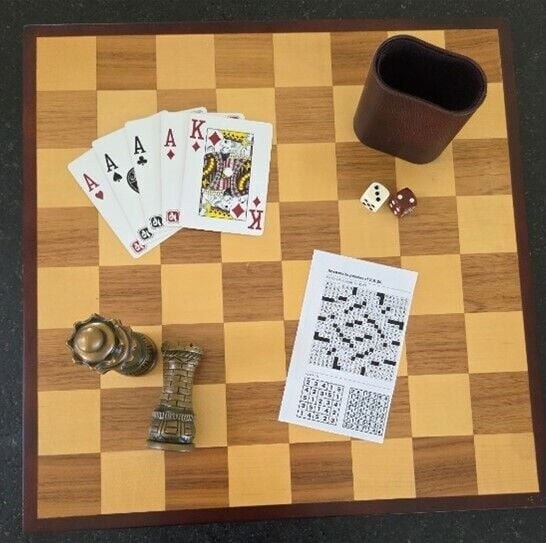
On any given day in our SaddleBrooke communities there are people playing games – whether a person is sitting at a table calling out Mahjong, sinking a 30-foot putt, completing a crossword puzzle, saying game/set/match, chasing down a ball on a pickleball court, or laying down a royal flush, thousands of residents here love their games. Frankly, isn’t this why we all moved into “an active adult community?”
On the surface it might seem a bit self-indulgent. But, actually, playing games – mental and physical games – is excellent for many reasons. Consider these facts.
WHY STAY PHYSICALLY ACTIVE?
It is widely known that keeping physically active as a senior is essential to maintain independence, prevent chronic diseases and improve quality of life. It also helps to strengthen our bones and muscles and, as well, reduces the risk of falls. Physical activity can also help with cognitive function – in particular, to help delay dementia and improve mental acuity. Staying physically active can also help to reduce anxiety and depression, thereby improving our mental health.
For seniors, physical activity includes: aerobic, strength and balance; it is recommended that seniors should aim for a combination of these physical activities.
A corollary of the above facts is that physical activity helps to improve our sleep quality, which is vitally important as we age. In addition, physical activity helps to keep our blood pressure AND our weight in check.
KEEPING THE BRAIN STRONG
It is also essential that seniors participate in brain exercises. But, is there a magic bullet to help with brain exercise as a senior? Well, yes, there is. As an example, consider this. What do games such as crossword puzzles, card games and other puzzles (i.e., Sudoku), and board games (i.e., Scrabble, Chess and Trivial Pursuit) have in common? The answer is that these are forms of brain exercises: crossword puzzles and Scrabble – word recall, chess – problem-solving skills, Trivial Pursuit – being able to remember previously learned/known facts. The bottom line – your brain needs exercise! But why?
It’s called “neuroplasticity” – the ability to rewire, form new neural connections and strengthen brain cells. Our brain’s systems are “highly modifiable,” and these systems can be rewired by physical exercise AND mental exercise.
PHYSICAL EXERCISE
Physical activity stimulates the release of growth factors that support neuron survival, strengthens connections and boosts brain blood flow. And, according to *Mind Crowd, increasing neuroplasticity could help us avoid the loss of cognitive skills, such as learning, remembering and decision-making, as we age. Exercise is vital for keeping our brains sharp as we grow older.
*Mind Crowd is a massive online research study focused on understanding how the human brain ages and how to prevent memory loss, Alzheimer’s and dementia.
MENTAL ACTIVITY
Conversely, playing games also promotes neuroplasticity by making the brain adapt to new, fast-pace and complex stimuli. And, of course, playing games enhances cognitive functions like attention, memory and executive control.
THE BOTTOM LINE
According to the Alzheimer’s Society, Regular physical activity is one of the best things that you can do to reduce your risk of developing dementia.
And, the Aging Extension of Utah State University reports that if brain cells are not used, or do not communicate with other cells, the brain cell loses its function.
So, let the games begin – and continue – here in SaddleBrooke!


