

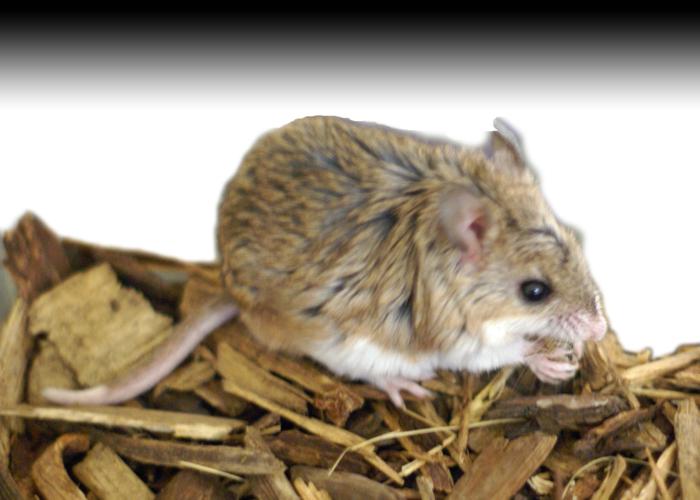
There is a predatory beast that lives right here in SaddleBrooke. At night it sneaks up on its prey like a lion, grabs it with long, sharp claws and kills it with swift bites from its long teeth. It howls to let others know of its territory and will kill and eat members of its own species should they wander into its territory. Such a fearsome beast, yet very few of you are aware of its presence. Why? Probably because it is only 5 inches long and weighs in at 1 ounce. We are taking about the Grasshopper mouse. It reminded me of the 1959 movie with Peter Sellers and Jean Seberg “The Mouse that Roared.”
The Grasshopper Mouse, which is comprised of two species of carnivorous mice, can be found in Western North America. The two species are the northern grasshopper mouse (Onychomys leucogaster) and the southern grasshopper mouse, or scorpion mouse (Onyychomys arenicola). SaddleBrooke is included in the range maps of both species.
Grasshopper mice have a thick body and short tail, which is white underneath and at the tip. Its fur is reddish brown or gray on top, and white underneath. It is nocturnal, lives in dry, sandy areas and likes to take 'sand baths.' Mated pairs do not tolerate other grasshopper mice in their territory and will warn others away with short barking sounds, or sometimes a high-pitched howl. The sound is a high, sustained whistle that pierces the desert night. It is as if the rodent is imitating a wolf at a miniature scale; the grasshopper mouse even stands on its hind legs and throws its head back during the shrill call.
Grasshopper mice have been described as the wolves of the mouse world. Unlike their seed-eating relatives, they are insectivorous and carnivorous - that is, insect-eating and meat-eating. Although insects may form their principal food, grasshopper mice also eat spiders, scorpions, and lizards, and are legendary for killing and eating other mice. At times when these foods are scarce, grasshopper mice will also eat seeds.
This species is monogamous and both parents care for the young. In appearance, grasshopper mice are difficult to distinguish from other mice, having a typically small build, gray-brown fur, and large ears. When captured, however, they emit a distinctive, almost skunk-like smell.
Like other carnivores, they roam relatively large territories but have low population densities – a swath of habitat can only support so many hunters.
 U of A president declines to sign shared governance contract with faculty


