Arizona’s public universities are required by state law to make decisions collaboratively between administration, faculty and staff, but faculty leaders say University of Arizona President Suresh Garimella has declined to sign a memorandum of understanding providing more detail on how that should work.
Garimella is the first UA president “who has refused to enter into a memorandum of understanding with the faculty governance structure,” said Mona Hymel, chair of the UA Shared Governance Review Committee.
“If you don’t sign anything, you can’t be held to account,” Hymel said, adding, “It has absolutely hindered shared governance” not to have a document signed by Garimella, “because decisions, which used to be made together, are being made unilaterally.”
UA Faculty Chair Leila Hudson said Garimella’s first year as president led to some dissatisfaction among professors because he did not have elected faculty leadership participate in high-level hiring decisions.
People are also reading…
Mitch Zak, UA spokesperson, said Garimella and the university decline to comment on questions from the Star about Garimella’s reasons for not signing the memorandum, how important he thinks shared governance is to the functioning of a public university, and if he thinks memorandums such as this are necessary to practicing shared governance.
According to faculty leaders, Garimella declined to sign the Shared Governance Review Committee’s memorandum for the first time shortly after he started at the UA on Oct. 1, 2024, but didn’t give them anything in writing to state his refusal or his reasons. Since then, faculty leaders said Garimella’s administrators, including Provost Patricia Prelock and his former chief of staff Francisco Garcia, have reiterated his refusal.

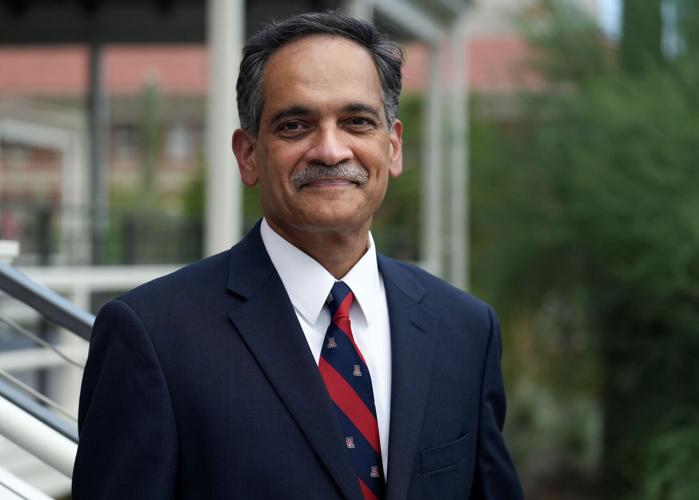
UA President Suresh Garimella
The existing memorandum, signed previously by former UA President Robert Robbins but not by Garimella, was last worked on between 2020 and 2022. Hudson said the UA’s tradition has been to review the document every time a new president comes in.
The one signed by Robbins is “quite good and we have seen the (Garimella) administration, the provost even, following some of the suggestions in the memorandum,” but not all of its commitments, Hymel said.
“Basically, we have a statute that says you shall govern together,” Hymel said of the state law. “That doesn’t give us much detail, so we work together again in our shared governance committee to draft, in essence, to negotiate the boundaries of who is going to do what and how we’re going to do it.”
“The agreement typically spells out a lot of the processes and procedures that we agree to follow in hiring, in searches, in grievances, in all kinds of areas, and it delineates who will do that,” Hymel said.

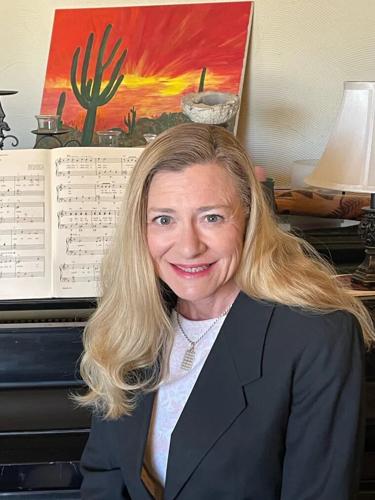
Mona Hymel, chair of the UA Shared Governance Review Committee.
She gave this example: “If we hire vice presidents, there needs to be three (faculty) senators chosen by the faculty chair on that committee.”
'Checks and balances on executive power'
The faculty governance law passed by the Arizona Legislature in 1992, ARS 15-1601B, for the state’s three public universities, including UA, says in part:
“Subject to the responsibilities and powers of the Board (of Regents) and the University Presidents, the faculty members of the Universities, through their elected faculty representatives, shall share responsibility for academic and education activities and matters related to faculty personnel. The faculty members of each University, through their elected faculty representatives, shall participate in the governance of their respective Universities and shall actively participate in the development of University policy.”
UA guidelines for shared governance, written in 2005, say, “In an era of significant education change, the success of the University and the positive morale of the faculty and administration are dependent upon continued use of the collective intelligence of the University community in planning and decision-making.”
UA faculty leaders list multiple examples of what shared governance stands for, including involving faculty in creating new programs and degrees and in hiring administrators.
“Shared governance, as I keep saying, is a feature, not a bug, and it’s one of the distinguishing features of this university, both within the state and in the national landscape,” Hudson said. “Ultimately, what faculty governance does in this day and age is to provide checks and balances on executive power.”
Hudson said having elected-faculty participation in top-level hiring decisions is one of the points in the memorandum that isn’t being followed and has created unhappiness among faculty with Garimella’s administration.

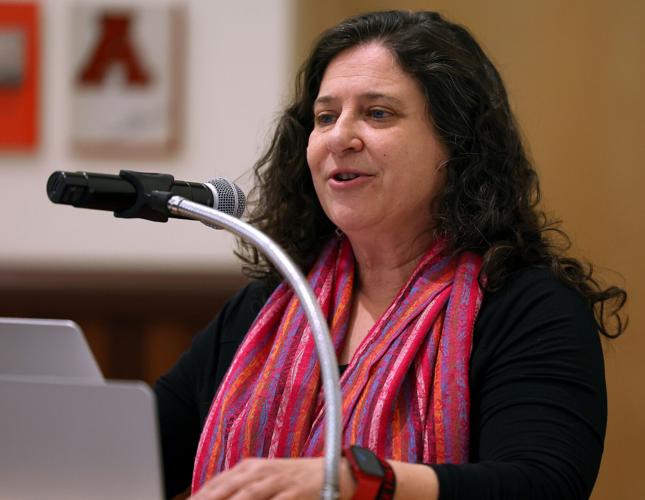
UA Faculty Chair Leila Hudson
By contrast, she and Hymel said, the administration did listen to faculty when deciding to reject the White House’s “higher education compact” last year, and their input was valuable. The White House offered nine universities, including the UA, preferential federal funding in return for committing to the Trump administration’s ideological, political and financial agendas for universities.
Garimella declined to sign the White House compact after weeks of faculty and student reactions as well as community feedback urging him to reject it.
When the UA was faced with the compact, “an unprecedented challenge to the university’s independence and values, in the heat of the moment, President Garimella certainly turned to and sought the counsel of elected faculty leadership,” said Hudson. “And so, even without the MOU (memorandum of understanding), when the heat was really on and the stakes were very high, President Garimella acknowledged, if only in practice, not by announcing it or signing on the dotted line, that we need shared governance.”
Hymel said Garimella incorporated a significant number of suggestions made by faculty in his response to the White House. “I believe it made an enormous difference. I believe it lifted the morale of the faculty” to be so involved, she said.
Hymel said the hallmark of higher education is that it’s faculty-run because of the faculty investment in the institution. She said it’s her 31st year at the UA, and she has seen many university presidents come and go while faculty hold steady.
Really good shared governance requires trust, Faculty Chair Hudson said, adding that the UA as a public university, which still gets “a sizable portion of our operating funds from the taxpayers of the state of Arizona,” is subject to the public’s scrutiny.
Shared governance is a watchdog of that, she said.
Reporter Prerana Sannappanavar covers higher education for the Arizona Daily Star and Tucson.com. Contact her at psannappa1@tucson.com or DM her on Twitter.

Prerana Sannappanavar
Higher Education Reporter