

Starting in early March, I get asked this question several times a day. I usually remind them that they are in Arizona and any warm sunny day they may be outside their burrow warming up or waiting for a meal to wander by.
Snakes are active during warm weather, which in Arizona means a season that lasts from April through October. However, during the hottest summer months, the snakes are less active during the day. Come September, when temperatures become more tolerable and mornings are cooler, the snakes increase their daytime activity and this is a time when you are most likely to see them.
Snakes are reptiles and reptiles are Ectotherms. Ectotherms are animals that primarily gains heat through the environment and they have internal temperatures that generally vary with environmental temperature. Many species are capable of achieving a homoeothermic state by using behavioral mechanisms such as hibernating during the cold and coming out to sun on a warm day but then retreating into a cool burrow when it gets to warm. Snakes hibernate in any climate where temperatures drop below freezing for long time periods. In warmer places like Arizona, snakes don't hibernate as long as they do in colder climates, but they also go into summer hibernation to protect themselves from extreme heat.
Where They Hibernate
Snakes find dens in hollow tree stumps or, especially in the Arizona desert, where land is often open and sparse, in holes in the ground or underneath rock piles. In SaddleBrooke we quite often find them in garages, usually when homeowners are re-arranging things or moving boxes to get out the Holiday decorations.
Common SaddleBrooke Snakes
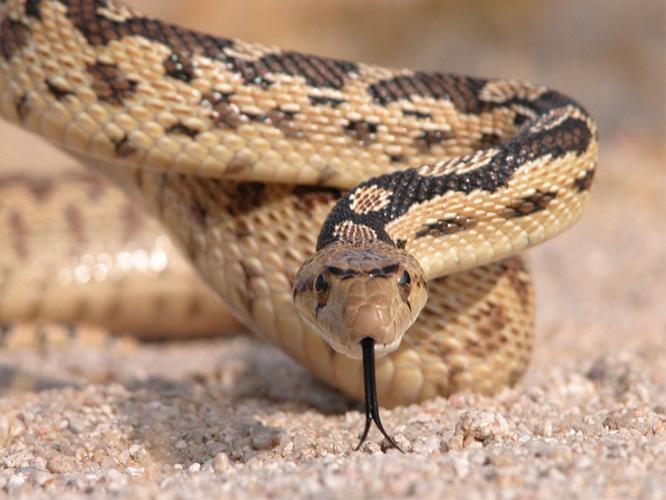
The Sonoran Gophersnake (Pituophis catenifer affinis) is a great snake for your yard. They feed primarily on small rodents such as mice and packrats.
The common, large, gopher snake is usually between 36 and 96 inches long. Gopher snakes range in color from cream-yellow to green-gray to tan, with large black, brown or reddish blotches on their back.
Slow-moving, the gopher snake investigates burrows, rocky crevices and even climbs trees in search of prey. Prey is killed by constriction and suffocation. Alerted to danger, the snake coils up, vibrates its tail and hisses a warning (Pituophis means "phlegm serpent" in reference to this loud hiss).
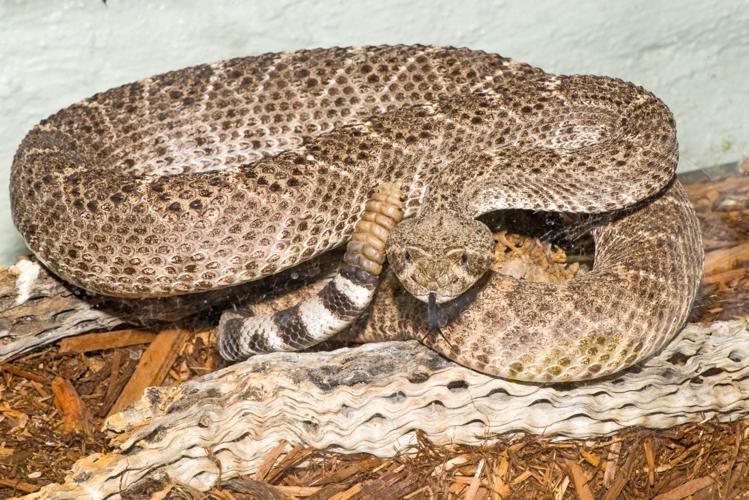
The Gopher snake can also spread and flatten its head, thereby resembling a rattler even more. An unsure predator mistakes this behavior and the somewhat triangular head of the Gopher snake for a rattlesnake and backs off from its pursuit. Unfortunately this often results in people mistaking it for a rattlesnake and killing this valuable “Packrat hunter”.
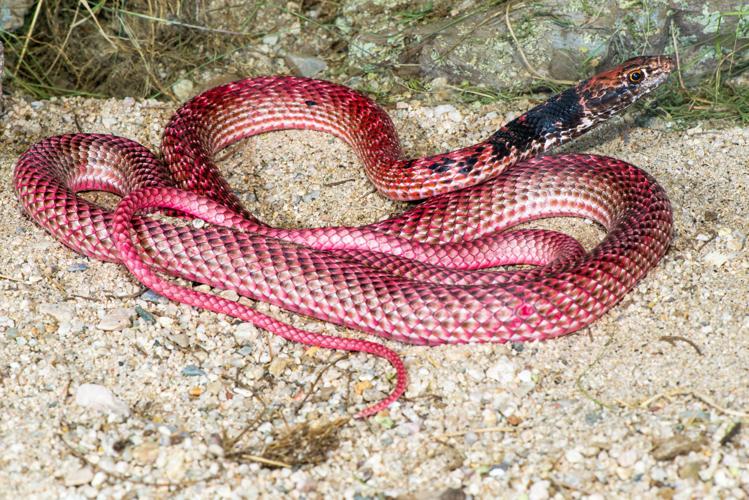
Coachwhip Snake (Masticophis flagellum), is referred to by me as the Blink Snake because it is so fast, it disappears in the “blink of an eye.” If cornered on a smooth surface it will sometimes rise up its head and come toward you which seems to be fairly effective in getting people to retreat.
The Coachwhip has a somewhat angular head with large eyes and circular pupils. One of the quickest snakes, the Coachwhip moves sinuously over the ground and through low-lying vegetation with its head elevated. An able climber, it can slither quickly up cacti, shrubs and trees to hunt prey. It feeds on small rodents, birds, bird eggs, reptiles (including venomous snakes) and insects.
The Common Kingsnake (Lampropeltis getula)— this is the one you really want in your yard! Colors and patterns are usually Black with yellow rings however this can vary occasionally with individual specimens.
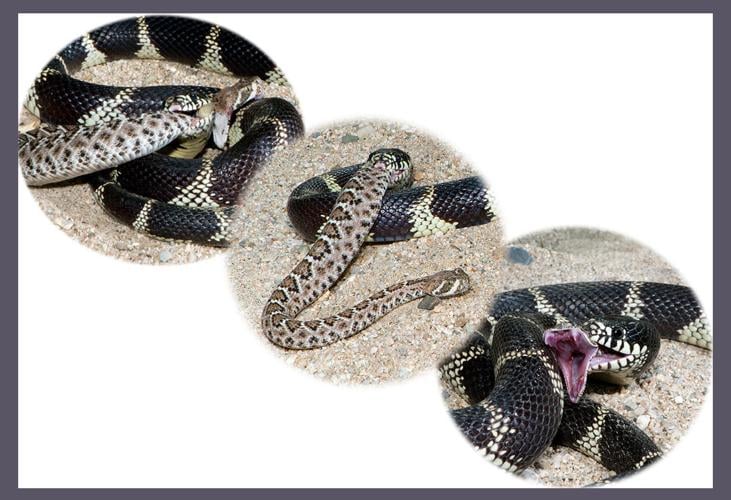
Typically, this snake ranges from two to four feet in length. Its skin is smooth and glossy, giving rise to the scientific species name "lampropeltis," which means "shiny skin.” The Kingsnake will prey on just about any creature that it can overpower with its constricting coils. It feeds on other snakes as well as on lizards, birds and small mammals. It also eats the eggs of reptiles and birds. Kingsnakes are immune to the venom from other snakes and it will eat rattlesnakes.
Oops! Kingsnake grabs Rattlesnake from wrong end
Usually the Kingsnake swallows its prey headfirst. Not a problem. Even though the rattlesnake continued to bite the Kingsnake the Kingsnake continued its meal and suffered no ill effects.
 Lake Mead's drops raise prospect of unaffordable Hoover Dam electricity


