
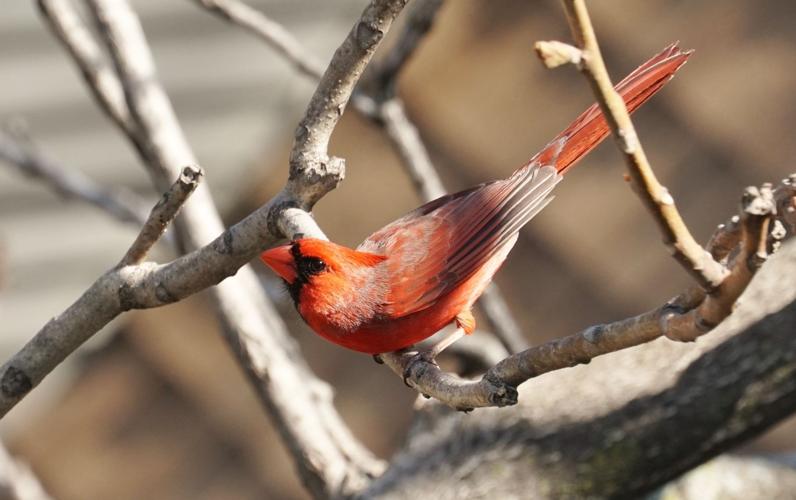
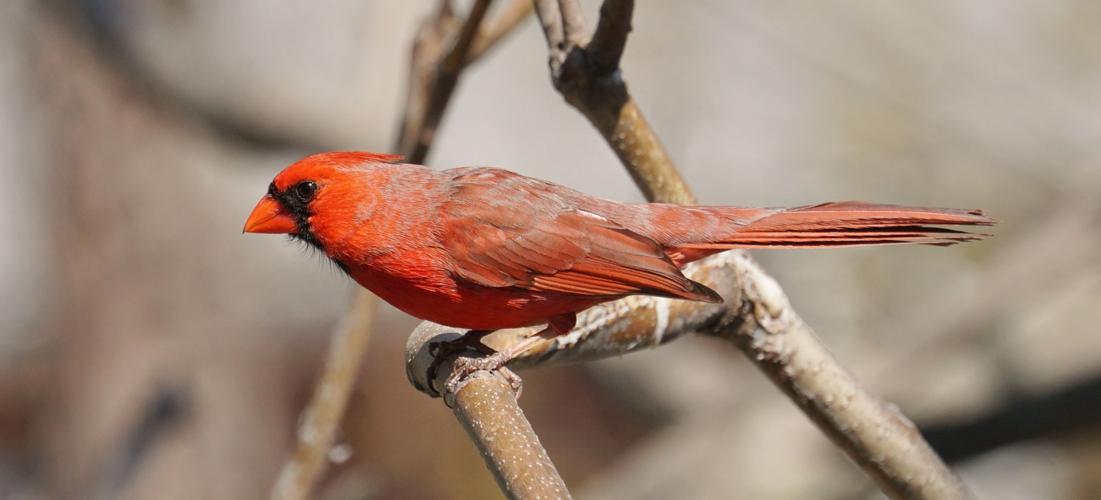
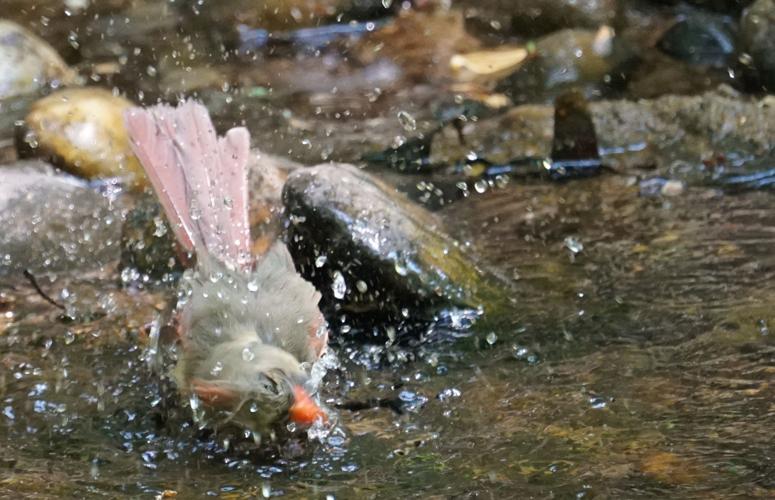
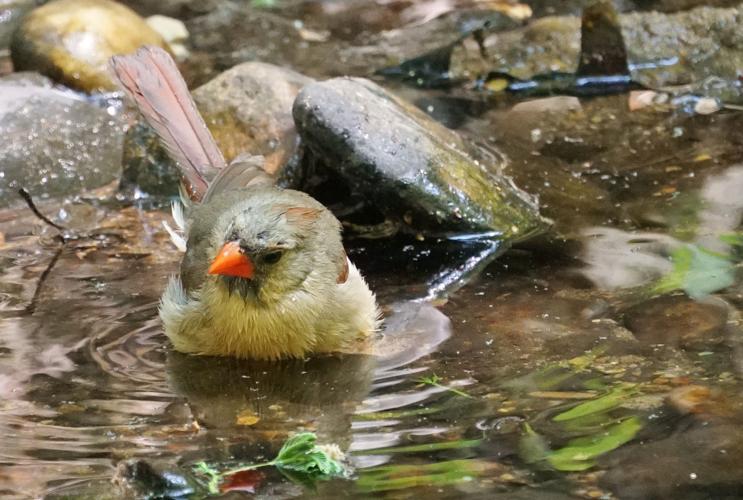

On February 26, 1926, the Kentucky General Assembly selected the Northern Cardinal as the United States’ first state bird. This step initiated a process that now includes all 50 states (Arizona’s state bird is the Cactus Wren.) You might think that every state would select a unique bird, but for a while, it looked like every state was prepared to follow Kentucky’s lead. Seven states eventually named the cardinal as their state bird, more than any other. The cardinal was a natural choice. The male is brilliantly red with a distinctive black face and large red-orange bill, and even the more subtly colored female draws attention. In addition, both males and females sing, a characteristic unusual to most species, and, except for the western mountain states, the birds are fairly common. We are lucky to have a healthy year-round population of cardinals in Arizona, the western-most state where they can be found.
The cardinal’s closest relative is the Pyrrhuloxia, a far rarer bird found only in three U.S. states, Arizona, New Mexico and Texas. Mixed flocks of Northern Cardinals and Pyrrhuloxia are often found together, especially in places such as Catalina State Park, and differentiating the females can be challenging. Cardinals have large triangular shaped red-orange bills, while Pyrrhuloxia have smaller parrot-like yellow bills. In addition, Pyrrhuloxia are more gray than the female cardinals, which tend to be more brown. Their songs are nearly identical.
Our Arizona cardinals are the same species as those birds found back east, but there is enough difference in their songs to notice, and the Arizona birds also have less black on their face, especially across the forehead. Cardinals are members of the family Cardinalidae, which includes most grosbeaks and buntings, as well as the Dickcissel. As might be expected from their bill shape, cardinals are primarily seed eaters, focusing on grains, fruit, flower buds and blossoms, although they do eat insects, and in fact feed their young only insects. Cardinals are also monogamous, and although both parents feed the young, female cardinals are solely responsible for nest-building and egg incubation. The males at least feed the females on the nests, allowing the females to remain close to the nest throughout incubation, which no doubt discourages cowbird parasitism.
You might expect a bird this strikingly beautiful to build a stunningly sound nest, but you would be wrong. The cardinal seems to care little about nest building, both as to structural integrity and location. Nests are tossed together collections of sticks and twigs, and they appear in multiple species of trees and shrubs. The birds apparently spend more time admiring themselves than housekeeping.
If you have questions or comments about SaddleBrooke’s birds, or to receive emailed information about bird walks led by Bob and Prudy, call (520) 825-9895 or email bobandpru@gmail.com. Previously published articles can be found at www.birdingthebrookeandbeyond.com.
 The Mount Rushmore of Arizona Wildcats men's basketball players


