
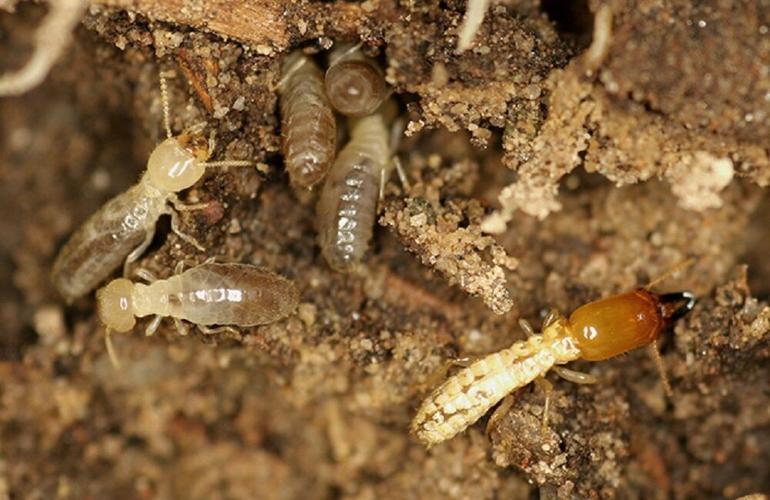

Subterranean termites are the most menacing of the 2,500 termite species. They live underground or in moist secluded areas with colony populations that can reach two million. Their destructive behavior causes billions of dollars of damage annually and makes them a SaddleBrooke homeowner’s worst nightmare, especially with the Arizona monsoon rain this time of year. The excess moisture from the rain will bring them to the surface.
These cream-colored or brown termites break down cellulose substances (cellulose is what wood is made of) in the environment, turning them into nutrient rich material. They build mud tubes to allow travel back and forth, maintaining moisture, protecting themselves from UV rays and predators, according to the National Pest Management Association and these tunnels may be one of the first signs of a pest problem in a home.
It is important for homeowners to be aware of the differences in behavioral characteristics of subterranean termites versus other types of wood destroying organisms (other pests can damage the structure). Familiarizing yourself with evidence of droppings, frass and pellets can prove to be helpful in identifying signs of a possible infestation, as well as knowing what to look out for and where.
Termites do not discriminate against home construction type and will eventually find their way inside any type of structure if the right conditions exist. Even homes constructed of concrete and block provide no match for a termite’s determination when attempting to invade your home. Although subterranean termites live below the soil, their tunneling capabilities allow them to weave and tunnel their way until they find an appropriate entry point.
There are several ways how subterranean termites can enter a home:
Mud Tunnels
Although the common way of entering the home is at ground level, subterranean termites also construct mud tunnels that allow them to reach entry points above the ground. These entry points can include even the smallest cracks and crevices in brick mortar and concrete slabs, (termites only need 1/64th of an inch) allowing them to travel through the interior of the foundational walls. The mud tunnels can be visible on interior and exterior stucco, drywall, brick, rock, adobe, ceilings, and most commonly foundation stem walls.
Wood-to-Ground
Structures that allow for wood-to-ground contact make the perfect roadway for termites to enter. Wooden support beams, viga beams, columns and posts, wooden decking/flooring, furniture and steps, window/door frames and more all provide ample opportunities for subterranean termites to find their way indoors. Additional wooden structures built onto the homes also provide possible entry points as homes built on concrete slabs are closer to the ground.
Expansion Joints
In-between the concrete slabs of your home and the beginning of the brick and mortar, there are joints that may sometimes expand, allowing for a small enough gap to allow termites to enter. In fact, many expansion joints are often separated by a type of cork material, termites have no problem moving through these.
Wall Fractures
Small fractures in the concrete foundation or brick mortar running throughout the perimeter of your home also provide the ideal entry point for termites to enter, feeding from the insulation and wooden framing on the interior of those walls.
To avoid problems with subterranean termites, the NPMA suggests maintaining a one-inch gap between the soil and wood portions of buildings, but residents need to be on the lookout for other signs of pest invasions.
When diagnosing the level of termite activity in your home, accurate identification of possible entry points from the exterior leading into the interior of your home is critical.
Often, a termite infestation begins with swarmers, or pests looking to develop a new colony. Upon first sight of these winged bugs, seeking out and determining how these termites are entering your home provides a good foundation on which a trained pest control professional can assist you in determining the severity of problem and next steps.
As I conclude this column, I just wanted to take a moment and thank everyone who has read my work over the last two years or called with questions. On Saturday, August 1, I became the manager of our North Tucson service office, and the person who will be taking my place writing columns beginning in September, Paul Opocensky, was promoted to manager of SaddleBrooke. It has TRULY been a pleasure providing you with my knowledge of pest control and I know you will enjoy Paul’s columns going forward!
(Tommy Gee, manager of Truly Nolen’s North Tucson service office, is the former Manager for Truly Nolen in SaddleBrooke. The SaddleBrooke service office can be reached at (520) 219-2494. Founded in 1938, Tucson-based Truly Nolen of America (visit www.trulynolen.com) is one of the largest family-owned pest control companies in the United States.)
 Historic bank vault now new Tucson speakeasy


