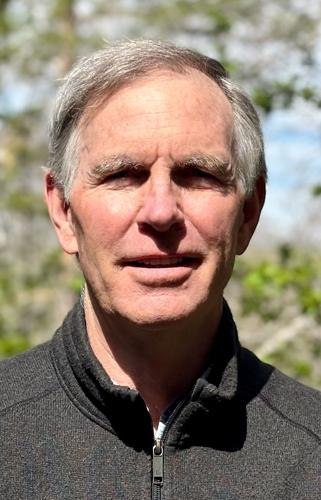
Tony Davis
Reporter
Out in the Avra Valley, about 30 miles northwest of Tucson, a wide swath of water pours down a fenced-off canal about 80 feet wide.
This is one of the few spots near Tucson to get a good look at the Central Arizona Project canal system that delivers drinking and irrigation water from the Colorado River to hundreds of thousands of area residents. Most of the multi-billion-dollar network of concrete aqueducts and pipelines either runs underground or is fenced off so far from the water that it's cut off from public view.
Now, this water lifeline is in danger of disappearing not only from public view, but from much or all of the drinking water supplies for Southern and Central Arizona.
The U.S. Bureau of Reclamation is considering a series of proposals that would cut deliveries of CAP water by anywhere from 32% to 98%. Under a separate "dead pool scenario" the bureau is also considering, all CAP water deliveries would be halted.
People are also reading…
One of the five alternatives, which would cut CAP by around 85%, is drawing a lot of attention because it's designed for the bureau to impose if the seven Colorado River Basin states can't reach agreement on their own water-saving plan — a scenario looking increasingly likely.
A consulting firm commissioned by CAP has produced a report forecasting economic calamity if the 85% or 100% cuts are adopted, with millions of jobs lost and trillions of dollars in economic benefits evaporating over the next 35 years.

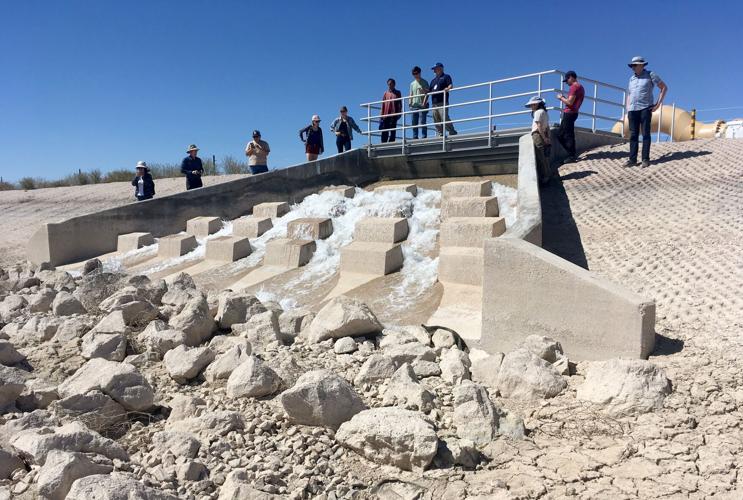
This is one of nine Central Arizona Project water recharge basins located in the Avra Valley. This photo was taken in 2019 at a time when Tucson Water left the basin dry deliberately. Now the image serves as a warning of what the basins would look like if CAP is cut off or significantly cut back.
But less clear is how CAP losses of this magnitude will affect the state's politics, its citizens' attitudes towards water, and its psyche.
Since CAP began delivering water to Phoenix 41 years ago and to Tucson, from 1992 to 1994, then resuming in 2001 after a shutdown, it has been more than a drinking and industrial water supply for residents and businesses of this region.
It has been a lifeline, a security blanket and a guarantor of seemingly endless population and economic growth.
Turn on the tap in Tucson and Phoenix, and you know water will come out, thanks mainly to CAP, even though we live in a desert with limited groundwater.
Subdividers and other homebuilders can count on CAP to ensure they meet a state requirement for a 100-year water supply to lay foundations for new homes.
Chambers of commerce and other promoters of economic development assured prospective employers across the U.S. and globally for decades that Arizona had enough water to serve them — thanks to CAP — despite the state's arid climate and its worsening extreme heat.
Environmentally, CAP's use helped stabilize the urban areas' aquifers, which had been plunging rapidly since the state's rapid growth started in the 1940s. That halt in the decline of groundwater levels also came thanks in part to the 1980 Arizona Groundwater Management Act, which for the first time laid down regulations requiring cuts in groundwater pumping.
But passage of that law, following decades of debate and political dodging of regulatory pressures, was made possible only because the federal government would have halted funding of the CAP's construction in midstream without it.
Now, if the state is unable to stave off drastic CAP cuts — which it will try to do by spending $3 million or more to fight them in court — what happens next?
Will Arizona fall back into its gluttonous ways of the post-World War II era, in which it was rapidly draining its underground aquifers, all the while hoping for an eventual bailout from CAP?
Will its pattern of limitless growth continue based on groundwater use only, or combined with desalination plants, purification of wastewater to drinking quality and other augmentation schemes that could double, triple or even quadruple residents' water bills?
Or will it enter a new era of water limits with increased emphasis on water conservation and an eye toward growth limits?
Visions of city trees, parks, gardens
Arizona's watershed moment has been coming for decades.
Authorized by Congress in 1968, the Central Arizona Project has roots dating back 40 or more years earlier. The first efforts to build CAP were started in the 1920s by two promoters who saw it as a vehicle to foster farming in Central Arizona.
The first real efforts at legislation to authorize construction of the CAP started in the 1940s, led by the state's senators Carl Hayden and Ernest McFarland. Then and now, it has been seen as an alternative to the massive, unregulated groundwater pumping that was draining the state's aquifers during the boom years after World War II.
A few days before Congress finally authorized the CAP in September 1968, Interior Secretary Stewart Udall, a former Arizona congressman, called it "landmark legislation which constitutes an historic breakthrough in the water thinking of the West."
"It initiates a new brand of water resource development, bold and broad-gauged. And it marks the opening of a new era, replacing the bitter rivalries of he past," Udall said in a speech.
While many backers primarily saw the project as a vehicle for economic development, Udall said his own crystal ball "shows us lovely city streets, with trees nourished by CAP water; cool, green public parks; gardens of colorful flowers; hundreds of men and women employed in project construction and operation, and also in project-related business and industry; happy people enjoying the carefree outdoor life in the sunny Southwest, people who could not migrate to the area without the water supply provided by the CAP."
On one level, Udall's sunny prophecies panned out. Arizona's population rose nearly 5 times from 1968 to today, Maricopa County's population more than quintupled to nearly 5 million, and Pima County's population more than tripled to nearly 1.1 million.

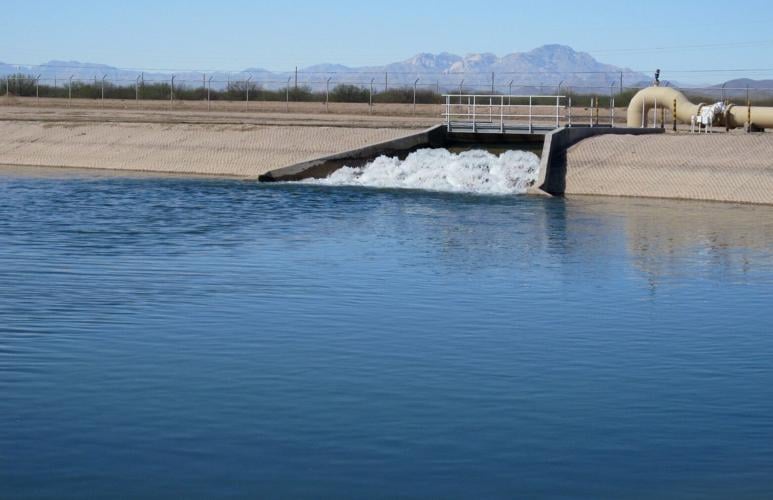
One of the nine Central Arizona Project water recharge basins located at Tucson Water's 226-acre Southern Avra Valley Recovery Project site. The photo shows water being delivered into the basin to be recharged into the aquifer. The U.S. Bureau of Reclamation is considering a series of proposals that would cut deliveries of CAP water by anywhere from 32% to 98%.
But since Udall's day, the vision of having outside water nurture a garden-like atmosphere of lawns and fruit trees has given way to the sobering reality that even with CAP, the state lacked enough water to turn Phoenix and Tucson into replicas of Ohio and Michigan.
First in Tucson and eventually in Phoenix on a smaller scale, lawns and non-native mulberry and ash trees have given way to cacti and mesquite. Both metro areas have trimmed individual households' water use considerably since 1968. Overall water use statewide has not risen since the 1950s, although much of the reason is that many thirsty farms have been replaced by lower-water-use subdivisions.
But the state's relentless growth, its water management reforms and its conservation efforts have been accompanied by frequent though often ignored warnings that even with CAP, the water supply wouldn't be adequate and that CAP supplies would eventually run short. During the 2000s and 2010s, state and federal officials began to pay heed to these warnings and enacted modest cuts in CAP use.
But now, those efforts have also proven inadequate, due to a warming and drying climate that has reduced Colorado River flows by up to 25% since 1990 and even faster since 2020.
And this year, record-setting warm wintertime temperatures have raised the very real possibility that spring and summer runoff of melting mountain snows into the Colorado River and its tributaries into Lake Powell at the Arizona-Utah border will reach their lowest level on record. That is very bad news for Arizona water users because Lake Powell controls the flow of river water downstream through the Grand Canyon to Lake Mead, where water is stored for delivery to Arizona, California and Nevada.
'Created a myth' of water independence, sustainability
Brad Udall, for one, has no doubts.
"I think large cuts to CAP will have an enormous and lasting impact on Arizona. It will affect Arizona water users and uses, Arizona politics, Arizona growth, and Arizona’s sense of itself," said Udall — Stewart Udall's nephew — who now is a water researcher at Colorado State University.
His reasoning: The cuts in water deliveries that will result from the ongoing, seven-state river negotiations will not be one-time cuts but the beginning of the end of reliable CAP supplies.
"This winter, unfortunately, is the kind of winter that is likely to become more and more common due to human-caused climate change. Deep down, water experts know this and fear it. And without CAP, much of Arizona’s water reliability and sustainability will be called in question," said Udall.

Brad Udall
Today, more and more Arizona cities are, like Tucson, not using CAP water directly from a treatment plant. They're recharging it into nearby aquifers and pumping it out later for people to use in their homes and businesses.
But in the eyes of Brad Udall, that use of CAP simply "backstops" much of what is otherwise considered "mining" of groundwater.
"Yes, places like Tucson have stored significant CAP supplies in aquifers but those are not a permanent solution. They only buy time," he said. "If CAP is cut, it needs to be replaced, likely with something very expensive and very slow to acquire and/or build."
Udall was one of the first water experts in the Southwest to warn in the early 2000s that hotter weather triggered by human-caused climate change threatened to reduce the flows in the Colorado River that supplies CAP.
Ironically, his late father, U.S. Rep. Mo Udall helped push through CAP's authorization and financing while representing Tucson in Congress for about 30 years.
Brad Udall, a Tucson native, recalled, "As a kid knowing nothing about water at all other than Tucson had some mysterious source of water that allowed it to exist in the dry desert, my siblings and I always thought CAP was some kind of unnecessary boondoggle, despite our father working non-stop from 1961 on to get CAP built."
He and his siblings "were completely naive about where our water came from and I think assumed that whatever source there was, it was infinite and plenty. Little did we know that Tucson’s groundwater was finite and precious," he said.
And as the environmental movement gained steam in the late 1960s and early '70s, "I think we thought that big dams and massive water infrastructure projects were not necessary, were wasteful, would harm the environment, and would lead to unsustainable outcomes. We had no idea that Tucson was already unsustainable, relying on its large but ultimately limited groundwater supplies."
But as an adult working 20 and 30 years later as a water researcher, Brad Udall began to see CAP through a different lens. If Arizona wanted to be water-sustainable, CAP was needed, he decided, although he never foresaw the state's nonstop growth resulting from CAP that made Phoenix the country's fifth-largest city.

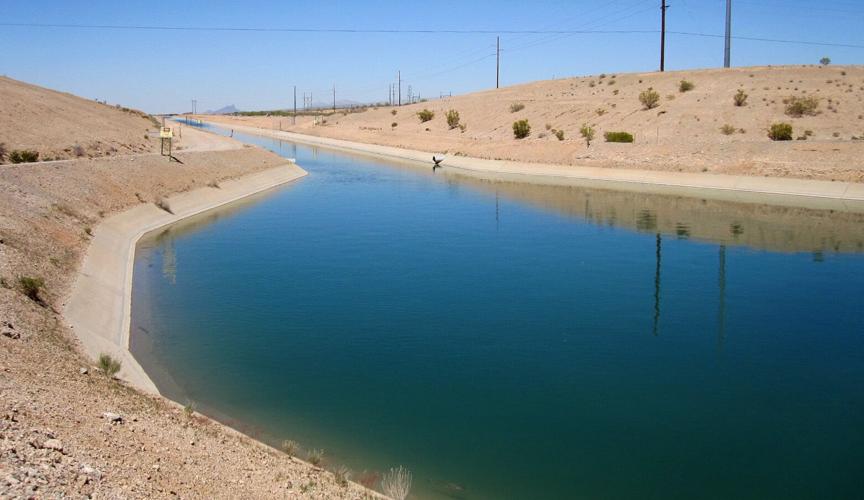
Central Arizona Project water flowing from the CAP concrete canal into the Twin Peaks Pumping Plant on Tucson's northwest side. The plant pumps water uphill so it can flow downhill by gravity back into the canal downstream.
"Much like I did as a kid, I think most Arizonans have no idea where their water comes from, how much there is, who is using it, and especially how important CAP is," he said. "This is about to change overnight if large CAP cuts are imposed."
CAP's presence created a myth that allowed everyone to believe Arizona was now water independent and sustainable, he said.
Now, he says Arizona must take a hard look at its 1980 groundwater law to see what is and isn't working. The use of limited groundwater supplies for agriculture needs to be phased out, he said. Any farm water use that's not valuable, economically productive and efficient definitely should go, he said.
"Without CAP the state cannot go back to mining groundwater, although there will be enormous pressure to ignore reasonable limits on pumping," Udall said. He sees Arizona beginning to seriously pursue Gulf of California desalination, despite its enormous cost.
Such a plant likely would produce maybe 200,000 acre-feet a year, the equivalent of only 12% of the 1.6 million acre-feet that CAP could deliver before river water shortages began four years ago.
"But 200,000 acre-feet is still a good chunk of water," he said.
Looking ahead, he can envision a future in which a year of CAP cuts followed by a very snowy winter might relieve some of the pressures that would drive Arizonans to get a handle on water use.
"But I think Arizona is way too smart for this (future complacency) to happen," Udall said. "Just one occurrence of this (hot, dry winter) should put the fear of God in every Arizonan about the lack of reliability of their water supply as currently structured."
He added he hopes "this moment" for the Colorado River will prompt far more serious national action toward solving human-caused climate change.
"The climate crisis is real, affects all of us, and water is often at the center of the problem," he said.
'This could be a shock to the system'
Several other water experts and water agency officials agree Arizonans will change their attitudes and behavior regarding water use if these Colorado River cuts become reality, because then they will have no choice.
"In the short run it might be hard for people to make adjustment in how they use water. Over time, and I don’t mean a long period of time, it has to bring about changes. This could be a shock to the system," said Sharon Megdal, director of the University of Arizona's Water Resources Research Center.
Megdal said she doesn't think anyone active in water management saw the Colorado's conditions would deteriorate as much and as quickly as they have. As an example, the federal forecast for how much river water will flow into Lake Powell this spring and early summer has dropped by half just since Jan. 1.

Sharon Megdal
"I don’t think we planned for this. Now we have to plan with different assumptions and scenarios," said Megdal, a CAP board member from 2008 to 2020. "It’s incumbent on all water planners to get serious and get real."
Megdal thinks the public now will be asking more questions about water supplies and management, and so will elected officials.
"I think the government agencies, particularly in this case, ADWR (the Arizona Department of Water Resources), are going to have to look at things differently," she said.
She doesn't see how, in the long run, it would be possible for Arizonans to ignore water scarcity and not act to change water policy.
About two years ago, a family member of hers made the decision not to move to Phoenix or Las Vegas from northern Florida because of uncertainties surrounding Arizona's water supply, she said.
"I think there will be more people questioning whether they should move here," Megdal said. "Property values will decline. It will affect all of us and our economy will have to readjust."
Cities may have to force conservation
Megdal's counterpart in Phoenix, Sarah Porter of Arizona State University, said a lot of people in the state already understand they need to help and "change what they're doing with water use."
"I am asked all the time by people who are concerned and want to know what they can do in their homes and businesses," said Porter, director of ASU's Kyl Center for Water Policy. "I was even contacted by an incarcerated individual who felt that the state prisons could do more to conserve water."
While "we can’t conserve our way out of this problem" by itself, some cities are going to have to step up the amount of conservation that occurs, she said.
"They have limited options, and the one I know they don’t want to do is curtailments; but if the CAP cuts are really deep, they may have to do that. Some cities, not all, may find they just have to tell people to do curtailment. It could be something as mild as limiting the days you water in your yard, or they could be something more severe."
But Arizona also needs to work on backfilling Colorado River supplies with other sources over the long term to meet people's demands, Porter added.
At this point, there hasn’t been an opportunity to invest in new water supplies to be "shovel ready" when CAP cuts start to make a difference here, she said. The state's Water Infrastructure Finance Authority is taking steps in that direction by carefully reviewing seven proposals to build desalination plants and other water augmentation projects in the U.S. and Mexico. Phoenix-area cities are also working with the water utility Salt River Project and the Bureau of Reclamation to study the possibility of raising the Bartlett Dam on the Verde River so it can store more water, she said.
Warren Tenney, director of a water users group representing 10 Phoenix-area cities, agreed the state is ready to change how it uses and manages its water.
"I think water is going to become a major focus. It is existential to everything we do here. It is the foundation for our communities, for our economy to thrive," said Tenney, director of the Arizona Municipal Water Users Association. "I believe that the cities recognize that using the aquifer is not a long-term solution. We can’t deplete our aquifer. That would place us back to where we were in the 1960s and '70s. We can’t go back there."
Many Phoenix-area cities, like Tucson, have stored lots of Colorado River water underground, and if the big cuts happen could recover it by pumping it out, or by using that water as legal credits to allow them to pump other groundwater elsewhere, he said. But again, they know that those credits aren't a long-term solution because they only have stored a few years' worth.
In the end, they'll have to conserve more and pay to obtain other more expensive water sources. Until now, those cities have opted for voluntary conservation, under the theory that voluntary conservation leads to more long-term water-saving and is a more efficient tool than mandatory cuts.
Now, with unprecedented CAP cuts looming, cities will be looking more at stronger "demand management" actions that could include mandatory conservation, depending on the size of the cuts, he said.
Tucson will work to find new supplies
But as Tucson's lead water attorney Chris Avery sees it, the 85%-and-up cuts that the bureau is looking at for CAP would be so severe that he believes they'll never happen because the consequences would be so dire.
"The way that the river should work is that everybody chips in, and this is a plan that puts the burden of Colorado River hydrology directly on CAP and it violates the terms of the Colorado River Compact," said Avery, who has represented Tucson Water as an assistant city attorney for 28 years. "The most important thing to say about this is that it’s not acceptable." The 1922 compact divided the river water among the seven states.
If the bureau adopts a plan for massive CAP cuts, he said, "it essentially would be a clear sign that the bureau is going to prioritize the growing of alfalfa over national security and semiconductor production and the new AI economy," all of which Arizona officials have said would be hurt under large-scale cuts to CAP.

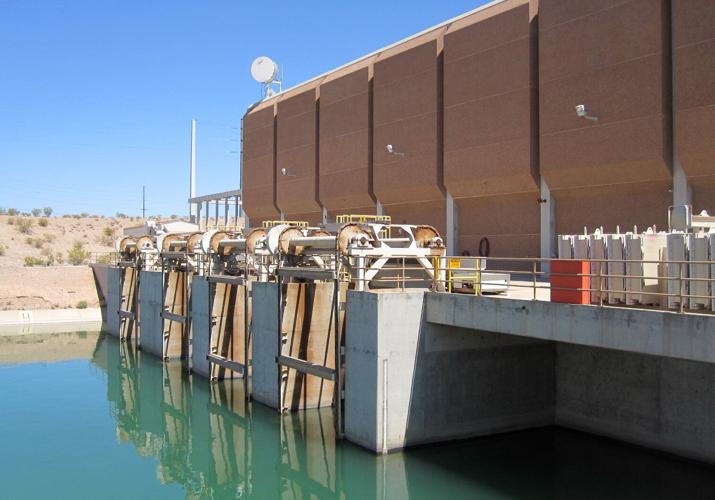
Central Arizona Project water from the Colorado River flows into intake structures of CAP’s Twin Peaks Pumping Plant on Tucson's northwest side. Since CAP began delivering water to Phoenix and Tucson, it has been more than a drinking and industrial water supply for residents and businesses. It has been a guarantor of seemingly endless population and economic growth.
It would be acting "in favor of using low-cost, almost free water, to grow crops," said Avery, referring to the very low prices farmers along the Colorado currently pay for access to river water — 10 times less than Arizona cities pay to buy CAP water after it's been delivered from the river to the CAP canal. The CAP itself, however, pays the bureau only 25 cents an acre-foot for river water, about the same as many irrigation districts pay.
If the big cuts do go through, Tucson will continue to work on finding new supplies, as it has done by obtaining an $86 million grant to build an "advanced water purification" plant to treat wastewater for drinking purposes. It will also continue to encourage conservation, but mainly voluntary conservation, after the city has reduced its per-person and overall water use substantially that way since the 1980s, he said.
"What we’ve seen so far in Tucson is that city customers have responded well, and historically used less water and respond more quickly to water shortages than other customers elsewhere," Avery said.
Advocate: Cities will use up their groundwater
Environmental activist John Weisheit was raised in the Phoenix area and stayed there from the 1960s to the late 1980s. He left as CAP water was arriving to serve his neighborhood, because he felt Phoenix was getting too big and the state in general would run out of water.
Today, living in Moab, Utah and running a river protection group, Weisheit is far less hopeful than many local officials and researchers that Arizona leaders and residents will change their water use and policies if CAP is heavily cut back.
"I think you are going to use all your groundwater up" in the urban areas, said Weisheit, director of the group Living Rivers.
He said he believes Arizona leaders will fail to respond adequately to major CAP cuts because they've failed to respond to a lot of other warnings that the river's flows would greatly diminish due to climate change.
The federal government developed long-range operating criteria for the river back in 1970 that set goals to protect the river's ecosystem and water supply, but it wasn't adequately followed, he said.
"You've had 56 years to do this, and you haven't," said Weisheit. "What makes you think the next 56 years will be any different?'
He noted that four years ago, then-assistant Interior Secretary Tanya Trujillo said the department would be cutting river water deliveries to Arizona, Nevada and California the following year to "avoid a catastrophic collapse of the Colorado River system."
Today, Weisheit believes such a collapse is inevitable.
"The water managers can't read the writing on the wall," he said. "Now, climate change is going to change everything on the river and it already has."
Extraordinary leadership 'might not exist'
Kathleen Ferris is an attorney and former Arizona Department of Water Resources director who has been active in water issues for nearly half a century.
Brett Fleck, who until recently was a water resource manager for the Phoenix suburb of Peoria, previously worked for Ferris when she was director of a Phoenix-based water users group.
They, too, are skeptical that CAP cuts will usher in a new era of water policy and management in Arizona.
Ferris bases her skepticism in part on having watched ADWR officials try hard to curtail excessive groundwater use both in cities and in some farming areas, including the Willcox Basin, but seeing other entities make far less progress in learning how to live with less water.
"Scientists have long warned that estimates of the Colorado River's long-term supply were overly optimistic and dangerously inflated. Ignoring those serious truths, policymakers have continued to allow massive growth relying on finite groundwater supplies, making Arizona's situation even worse," said Ferris, who is also a researcher for ASU's Kyl Center.
"While a majority of Arizonans recognize our water limits and want a sustainable future, Arizona's legislature is dominated by interests relentlessly pushing for unchecked growth and expansion at the worst possible time.
"Addressing the much drier future coming our way will require commitment, bipartisan cooperation and extraordinary leadership, which might not exist in our fractured society," Ferris said.

Kathleen Ferris
Fleck agreed. "I would have thought our attitude would have readjusted over the last 26 years" to match the decline in river flows. "Our lakes are falling, but the attitude hasn’t changed much," he said, referring to the steady decline in water levels at Lakes Mead and Powell.
"Optimism, that’s the definition of Arizona. Optimism in the face of adversity. To expect Arizona not to be Arizona is probably not reasonable," said Fleck, who recently left to take a job in Minnesota.
By now, Fleck would have expected to see a response from Arizona cities a little bit closer to what Las Vegas has done in conservation measures over the past few years.
Las Vegas-area cities and suburbs and in some cases the state of Nevada have adopted a slew of conservation measures, including outdoor watering restrictions, mandatory landscape watering schedules, water waste fees and conservation-based water rates, along with other incentive programs and policies.
A few such measures have been adopted in Arizona, including a 2023 ban in Tucson on installing ornamental turf in commercial, industrial and apartment developments, but nothing compared to Las Vegas.
Generally, Fleck doesn't think leaders in Arizona really believed that what’s going on right now would ever come to fruition.
"Why? That is a million-dollar question," he said. "I think every person has a different reason. For some, it’s the belief that growth can’t stop or even slow down. For some, it’s disbelief in climate change.
"For some, it’s a belief in perhaps that we have a stronger legal position than perhaps we might be in" if the seven-state dispute over Colorado River cuts goes to court. "And for some, we're just too economically important for something like this to happen to us."
For her part, Ferris cited a recent example of what she sees as a possible backward step in state water management. A pending bill in the Arizona House would allow owners of artificial lakes to add other water, including drinking water to the lakes, which now can be filled only with treated sewage effluent.
She also cited court efforts by Phoenix-area homebuilders to overturn a 2023 ADWR decision that forbade the state from issuing certificates that developers there have 100-year water supplies based on groundwater use.
"It’s one thing after another. It doesn’t feel like there is an acknowledgement that we are past a crisis stage," said Ferris. "We are in the stage where we have to figure out a path forward.
"A crisis is something that comes along and passes. This isn’t going to pass."
Tony Davis graduated from Northwestern University and started at the Arizona Daily Star in 1997. He has mostly covered environmental stories since 2005, focusing on water supplies, climate change, the Rosemont Mine and the endangered jaguar. Tony and David talk about the award winning journalism Tony has worked on, his journey into journalism, Arizona environmental issues and how covering the beat comes with both rewards and struggles. Video by Pascal Albright/Arizona Daily Star
Tony Davis graduated from Northwestern University and started at the Arizona Daily Star in 1997. He has mostly covered environmental stories since 2005, focusing on water supplies, climate change, the Rosemont Mine and the endangered jaguar. Tony and David talk about the award winning journalism Tony has worked on, his journey into journalism, Arizona environmental issues and how covering the beat comes with both rewards and struggles. Video by Pascal Albright/Arizona Daily Star
Tony Davis graduated from Northwestern University and started at the Arizona Daily Star in 1997. He has mostly covered environmental stories since 2005, focusing on water supplies, climate change, the Rosemont Mine and the endangered jaguar. Tony and David talk about the award winning journalism Tony has worked on, his journey into journalism, Arizona environmental issues and how covering the beat comes with both rewards and struggles. Video by Pascal Albright/Arizona Daily Star
Contact Tony Davis at 520-349-0350 or tdavis@tucson.com. Follow Davis on Twitter@tonydavis987.
Tony Davis
Reporter


 Is Tucson's 47 years' worth of groundwater enough if CAP is slashed?