

Looking for a way to leave your mark?
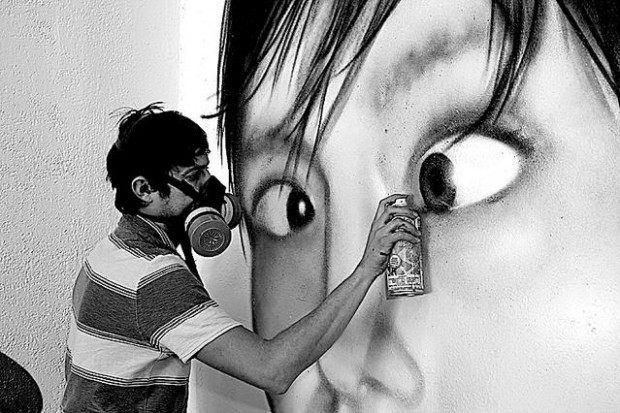
Local spray-painters will compete to see who has the best can control this Saturday at the Winta Fresh Graffiti and B-boy Competition.
Each artist will paint a 4-foot-by-8-foot section of a wall in the city parking lot behind the Tucson Water Department at 310 W. Alameda St. The resulting mural will be kept for one year.
There will also be a breakdancing competition, with teams of two competing head-to-head.
Graffiti is a nuisance for many business owners and communities when buildings and signs are tagged with unwanted spray paint. It's also an increasingly popular art form.
Rocky Martinez, aka Cyfi, is a local graffiti artist who has turned his hobby into a career. His work includes several murals for Downtown businesses and the large heart atop the now-closed Coffee Vein at 1545 N. Stone Ave.
People are also reading…
He teaches kids aerosol art as part of a city-sponsored afterschool program called Art in Reality (AIR).
"AIR is cutting edge," Martinez says. "Kids learn belly dancing, breakdancing, capoeira, DJ skills — the list goes on and on."
Tucson Parks and Recreation supervisor Margaret Loquasto-Jaquay says the kids who take part in the AIR program are learning about art.
"They're learning technique," she says. "And they only work on walls that have been given us to work on."
Martinez also created Winta Fresh and will help judge the graffiti competition, along with California artist Jason Williams, aka Revok. Over 30 people are signed up to compete in the competition.
Martinez recently told Caliente about what it's like tagging in Tucson.
How big is the Tucson graffiti scene?
"The scene is really small, but there are some artists out here that hold their weight. As far as New York and LA, it's not comparable. But it is a strong scene."
When did you start doing graffiti art?
"When I was 13 or 14 years old. It was with the street kids. I didn't really know what I was doing. I started spray-painting my alias on washes and city walls. I used a different alias back then. I don't even remember what it was. I've been through so many over the years."
Do you have a recognizable tag?
"Yeah, but I'm not going to go there."
Where would you tag growing up?
"I would tag city walls, tunnels, little platform areas that people would see when they were driving by. We had a couple of walls that were donated to us by Hamilton Furniture. . . . It doesn't exist anymore. As long as we would do some promotion for the business, we could paint the walls."
How did your graffiti evolve?
"We started doing walls that we now call production walls, where we choose a theme and incorporate our letters or logos. Some of us started getting really good at it, and people would come up and ask us how much we charge to paint walls. That's when we realized we could make money at it."
Do you still tag?
"I've got a business now. I'm getting older. I have a son. I don't have time for it anymore. Occasionally, I might go out and paint a train. But it's not to destroy things. It's to add to the landscape."
How do your friends feel about your going pro?
"Before it would be considered selling out to do merchandising, to sell graffiti in general. Even now I get hated on. If you market yourself you've become a part of the system, because now you're getting paid."
Where do you sell your art?
"I had a little gallery shop off of Congress, Art Terrain, but due to the economy right now I kind of pulled out for a little bit. I think maybe I'll get into a different location, possibly on Fourth Avenue, maybe in January."
What else are you working on, besides the competition?
"I'm trying to get the city to donate a piece of land with big walls where kids can go and paint."
Do you think having walls designated for graffiti would stop illegal taggers?
"No matter what, graffiti is never going to stop. There's still going to be the bombing factor, where kids are going to want to paint public stuff, but I want to give them another, safer, option.
"When I was young, we would go paint washes, and that's dangerous. You can't imagine how many encounters we've had where bums have pulled knives on us."
• Where: Parking lot next to Tucson Water Department, 310 W. Alameda St., at North Grenada Avenue and West Paseo Redondo.
• When: 9 a.m. Saturday.
• Cost: $7 for spectators. $5 for graffiti contestants and $7 for breakdancing contestants. Graffiti artists must supply their own paint.
• More: Competitors register the day of the event. Graffiti artists should arrive by 9 a.m., while break dancers should be there by noon. There will be food and drink vendors at the event.