

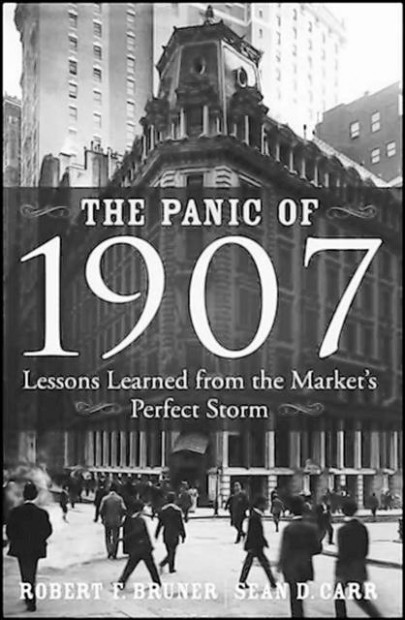
"The Panic of 1907" by Robert F. Bruner and Sean D. Carr; John Wiley & Sons Inc.; 258 pages ($29.95)
Put part of the blame for the financial crisis of 1907 on a woman known as Mame.
According the lyrics of a song lip-synced by actress Rita Hayworth in the 1946 movie "Gilda," one night, Mame "started to shim and shake. And that brought on the Frisco quake."
Mame, of course, was a figment of the combined imaginations of songwriters Doris Fisher and Allan Roberts. But the earthquake that devastated San Francisco was a grim reality that sent economic shock waves across the nation and around the world.
In their new book, "The Panic of 1907," University of Virginia corporate finance experts Robert F. Bruner and Sean D. Carr assert that the 1906 San Francisco earthquake triggered a "global liquidity" crisis that reached its climax the following year.
People are also reading…
"The strains from the catastrophe in California rippled instantly through the global financial system. At the time, San Francisco was the financial center of the West and home to the Western branch of the U.S. Mint, so anything that disrupted business in San Francisco threatened the entire Western region economically," write Bruner and Carr.
News of the earthquake, they point out, led to massive sell-offs of stock on the New York and London stock exchanges, strains and huge losses for domestic and foreign insurance companies and serious depletion of British and American gold reserves.
Relief shipments of gold to the West, say Bruner and Carr, caused a scarcity of capital in New York. They were occurring at time when the U.S. agricultural cycle required credit for harvesting and shipment of crops.
But the San Francisco earthquake was only one ingredient of the "perfect storm" that battered the American economy from September 1906 to November 1907. In fact it was only one of two "real shocks" to the financial system that occurred at the time. The other real shock, say Bruner and Carr, was the Bank of England's decision in the summer of 1907 to curtail acceptance of American finance bills.
This is a well-written, reader-friendly tome that many will find entertaining as well as informative. That is particularly true of the suspense-filled narration of J.P. Morgan's effort to keep the roof of the financial world from collapsing.
About the book
"The Panic of 1907" by Robert F. Bruner and Sean D. Carr; John Wiley & Sons Inc.; 258 pages ($29.95)