

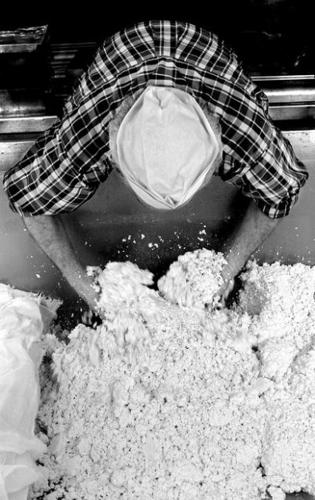
ROCKPORT, Maine — Franklin Peluso uses his hands to squeeze and press heaping mounds of curds and whey to get the moisture content and texture just right as he makes up a batch of his brie-like cheese in a region best known for its cheddars.
Peluso is making a soft, tangy specialty cheese called teleme, which is sold at cheese shops and restaurants in California and the Northeast.
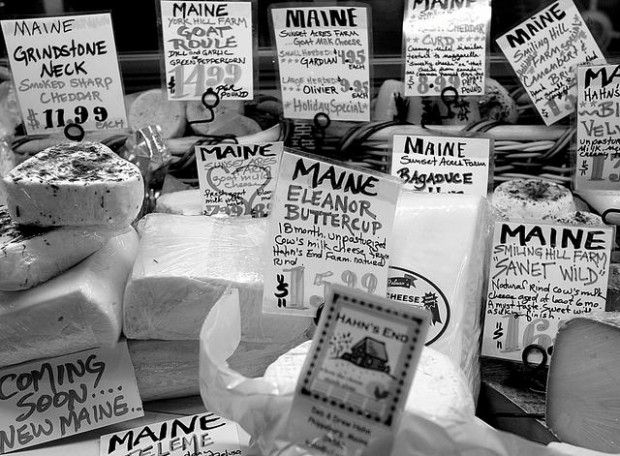
A decade ago, just a handful of people made cheese in Maine. These days, the state has more than 20 cheese makers crafting varieties such as French and Tuscan herbed curd, Camembert, chèvre in olive oil, and dill and garlic goat roulé, in addition to traditional cheddars and Monterey Jacks.
The growth isn't just in Maine.
Artisanal cheese makers are popping up nationwide, making hand-crafted cheese for consumers who are demanding more than Velveeta and cheese squirted from a can.
People are also reading…
Not long ago, it was difficult to find even a simple goat cheese in most stores, said Peluso, who is 60 and a third-generation cheese maker. He started the Mid-Coast Cheese company last October after moving to Maine from California.
"There's been a tremendous change in the past 15 to 20 years. It's a crowded field with specialty cheeses now," he said. "Some of these stores remind me of Paris with huge piles of cheeses."
U.S. cheese consumption grew from 11 to 31 pounds per person between 1970 and 2004, according to the U.S. Department of Agriculture.
Besides eating more cheese, Americans are eating more types of cheese. And they're willing to pay a premium for it: Specialty cheeses can cost $10 to $20 a pound or more, a far cry from the $3 or $4 consumers pay for a package of American cheese slices at a supermarket.
Offerings at the Appleton Creamery, for example, include chèvre, feta, sheep milk cheese and Caprino di Vino, a wheel of aged cheese soaked in Maine blueberry wine.
With Americans well-traveled and better-educated about food, the national palate has become more refined, said Caitlin Hunter, Appleton's owner and president of the Maine Cheese Guild.
"People are getting more sophisticated about the foods they eat," Hunter said. "It's reflected in artisan breads and artisan beers and artisan wines. Twenty years ago, there weren't artisan breweries or vineyards or lovely local bakeries like there are now."
In Maine, at least five cheese makers have opened for business in the past year, and a large plant under construction at Pineland Farms in New Gloucester plans to begin production this spring with a capacity of roughly 300,000 pounds a year.
Some of the cheese makers are seasonal and sell their products at farmers markets and shops, but others run year-round and distribute to restaurants as far away as California and to gourmet food stores.
At the Portland Public Market, K. Horton Specialty Foods has a refrigerated case filled with blocks, wedges and tubs of Maine-made cheeses.
On a recent afternoon, Faye Pertuis of Portland looked over the selection and explained how she thinks Maine cheeses stand up against those from Europe.
"It's nice that people are beginning to make traditional cheeses instead of cheese that is plastic-wrapped and single-sliced," Pertuis said.
Maine represents only a small slice of the market.
The biggest surge of specialty cheese making is happening in Wisconsin, California and Vermont, said Allison Hooper, owner of Vermont Butter and Cheese Co. in Websterville, Vt., and the president of the American Cheese Society.
The society has about 1,000 members, or nearly double what it had a couple of years ago, Hooper said.
If you had told Vermonters 20 years ago that they would be eating goat cheese instead of traditional cheddar, they would have laughed, Hooper said.
"But now there's such an interest in high-quality foods, the source of the ingredients, the integrity of the ingredients and eating well that specialty artisanal cheese fits in with that trend," she said.