

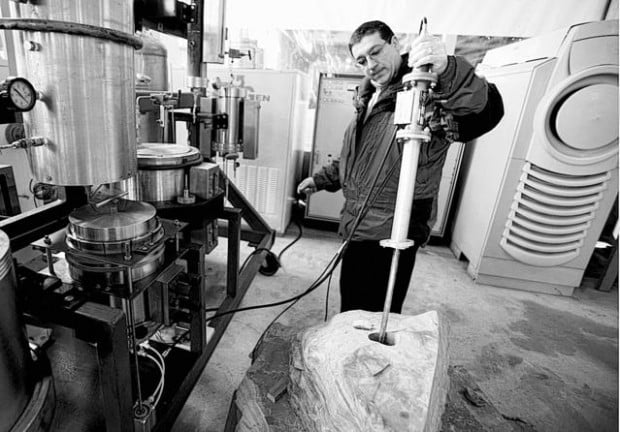
BOSTON — Defense contractor Raytheon Co. is selling technology to a large oil-field services company that hopes microwaves will someday become a key tool in unlocking the vast but hard-to-extract oil reserves in the West's underground shale deposits.
Much as a microwave oven heats food, Raytheon's technology relies on microwaves to generate underground heat and melt a waxy substance in the shale called kerogen so that it can be converted into oil. Carbon dioxide heated and pressurized into a liquid form then is used to extract the oil from the rock and carry it to a well.
The world's fifth-largest defense contractor isn't the only company focusing on microwaves or other heat-generating technologies to address an engineering challenge that oil companies have tried to crack for decades — so far with no efficient, environmentally sensitive method that's proved commercially viable, despite rising oil prices.
People are also reading…
In a deal announced Tuesday, oil-field services company Schlumberger Ltd. is buying technology that Tewksbury, Mass.-based Raytheon Integrated Defense Systems developed with Boston-based CF Technologies, which supplied expertise to extract oil using so-called "supercritical" liquid carbon dioxide.
Lee Silvestre, a Raytheon Integrated Defense Systems vice president, said Schlumberger was paying an undisclosed upfront fee along with royalties that could extend "multiple decades" for any revenue Schlumberger generates through the technology. Some of the proceeds would be shared with CF Technologies.
Rod Nelson, a Schlumberger vice president, said in a phone interview that Raytheon's technology shows potential to generate a more efficient return than other extraction methods, as measured by the amount of energy expended to produce oil.
Schlumberger, which plans to review other extraction technologies as well, hopes to move beyond the laboratory tests that Raytheon and CF Technologies already have conducted, and eventually try out the procedure at an underground oil shale deposit.
Raytheon and oil companies began exploring ways to extract oil from shale decades ago, but many efforts were shelved in the 1980s as oil prices and supplies stabilized. Some projects — including Raytheon's — were revived in recent years because of spiking prices, technological improvements, and hopes of decreasing U.S. dependency on foreign oil.
Most of the attention is focused on oil shale reserves scattered across federal lands in Colorado, Utah and southwest Wyoming — an area estimated to contain up to 1.8 trillion barrels of oil trapped in shale, or three times the proven reserves of Saudi Arabia. Of that, roughly 800 billion barrels is considered recoverable.
Raytheon — which invented microwaving food by accident in 1945 after a company engineer noticed waves from radar equipment had melted a chocolate bar in his pocket — isn't the only player using microwave technology to try to unlock the treasure.
West Berlin, N.J.-based Global Resource Corp. is taking a similar approach and in November announced a research agreement with a Pennsylvania State University professor to conduct research on commercializing its process.
Since 1996, Shell Frontier Oil & Gas Co. has conducted tests on private land in western Colorado. Those tests involve baking shale rock in the ground with electric heating rods, then pumping the melted oil to the surface. Shell said any commercial development of the technology is several years away.
Raytheon's technology also involves underground heating, but using microwaves beamed via transmitters lowered into shale.
Jim Bunger, chief executive of the Salt Lake City-based petroleum research firm James W. Bunger & Associates, said Raytheon's process could require large amounts of electricity to generate the microwaves. The process involves multiple steps of heat conversion, with some energy lost during each stage — a method he said is more complex than Shell's approach.
But John Cogliandro, who heads Raytheon's effort, said the company's expertise in radar and guidance systems proved valuable in fine-tuning the microwave frequencies in a way that enables the heat to target the shale rather than surrounding dirt and rock.
Raytheon claims it can retrieve four to five barrels of oil for every barrel of oil consumed in the process. Other methods have reported one and a half to three barrels for each one consumed.
Did you know...
Raytheon Missile Systems, a business unit of Waltham, Mass.-based Raytheon Co., is Southern Arizona's biggest employer, with more than 11,000 Tucson-area employees, according to the Star 200 survey of the region's major employers.