

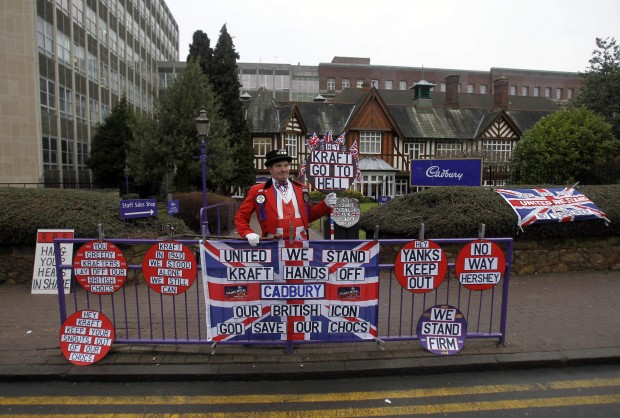
LONDON - After months of fierce resistance, Cadbury's about-face to accept a sweetened $19.5 billion takeover from Kraft Foods Inc. - forming the world's biggest candy company - has alarmed British unions, lawmakers and chocolate lovers.
With Cadbury shareholders expected to agree to the deal and a rival bid from the Hershey Co. looking less likely, opponents fear the U.S. multinational's impact on one of Britain's oldest and best-loved brands.
Just days after Cadbury declared its suitor a "low growth" company with a "long history of underperformance," the British maker of Dairy Milk chocolates and Dentyne gum capitulated to a raised bid of $13.78 per share.
The deal is a 9 percent premium to its previous offer and 50 percent higher than Cadbury's market value before Illinois-based Kraft went public with its approach in September.
People are also reading…
The combination of the pair would create the world's biggest confectionary company, replacing Mars Inc., and Kraft CEO Irene Rosenfeld tried to appease concerns about the loss of Cadbury's iconic status.
The company's roots go back to the grocery store opened in 1824 by John Cadbury in Birmingham, central England. A Quaker, Cadbury believed cocoa and drinking chocolate were healthy alternatives to alcohol, considered to add to the miseries of the working class.
The popular Dairy Milk bars were launched in 1905 as a challenge to dominant Swiss chocolate makers.
"We have great respect for Cadbury's brands, heritage and people," Rosenfeld said. "We believe they will thrive as part of Kraft Foods."
But unions are worried there were no clear guarantees from Kraft that it won't switch manufacturing of some of the 186-year-old company's chocolates to Eastern Europe, sacrificing thousands of British jobs.
"We have very real fears about how Kraft will repay its debt, particularly as it has ratcheted it up still further in order to purchase Cadbury," said Jennie Formby of the Unite union.
Four Labour Party lawmakers from Britain's manufacturing heartland said they were worried "about the kind of future that Cadbury's would have as part of this giant multinational."
The deal, one of the largest transnational takeovers since the credit crunch, is further sign that food companies are seeking to gain scale by combining, after Mars bought William Wrigley Jr. Co. in 2008 for $23 billion.
A Kraft-Cadbury combination will create a portfolio with more than 40 confectionary brands, each with annual sales in excess of $100 million.
Kraft sidestepped concerns from its own major shareholders by reducing the share portion of the deal below 20 percent - negating the need for it to be approved by shareholders.
Billionaire investor Warren Buffett, whose Berkshire Hathaway is Kraft's biggest shareholder, voted against Kraft's proposal earlier this month to issue more shares to fund the takeover bid. Kraft raised the cash portion of its offer by selling its North America pizza business to Nestle for $3.7 billion.
There was surprise at the overnight change in tune from Cadbury Chairman Roger Carr, who had led a spirited defense against Kraft. He told his shareholders Tuesday that the revised deal "represents good value."