

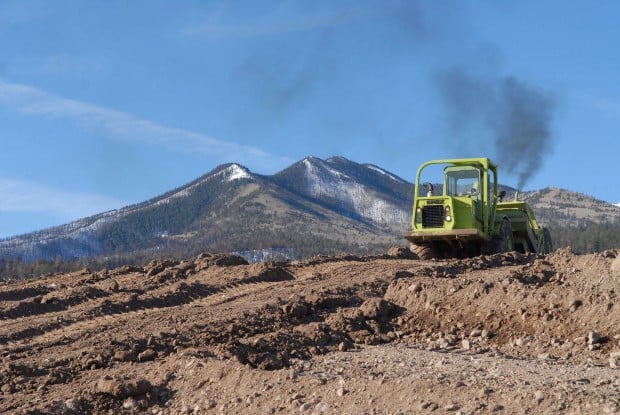
A Northern Arizona pumice mine that boomed when stone-washed jeans were in vogue is closing now, a decade after the government bought it out amid public pressure.
The White Vulcan Mine, on the eastern flank of the San Francisco Peaks, was disliked by area Indian tribes and environmentalists due to its location at the base of mountains that are held sacred.
The mine was a source of pumice, used in landscaping and industry, and for making 1980s denim appear to be faded.
Proposals from the owners to greatly expand the mine in the late 1990s triggered a historically significant backlash. The proposed expansion led to an environmental analysis and a campaign - partly waged on signed postcards made out of stone-washed denim - that ultimately put the peaks off-limits to many forms of mining for the next 20 years.
Then-Interior Secretary Bruce Babbitt of Flagstaff, who once referred to White Vulcan as a "sacrilegious scar," helped organize the government purchase of the mine.
People are also reading…
"Further destruction of the countryside in this sacred area so the fashion-conscious can wear pants which make them appear to have spent time outside is, to us, ludicrous," Yavapai-Apache Nation Chairman Vincent Randall wrote to the Forest Service in 1999.
Today, the open-pit mine is a fraction of its former size, the pumice has been hauled away, and three employees riding heavy equipment are filling in the rest.
"I'm glad to see the reclamation finally happening," said Leigh Kuwanwisiwma, director for the Hopi Cultural Preservation Office.
The pumice found at the White Vulcan Mine was formerly a lightweight frothy lava, and it now lies buried in deposits sometimes 140 feet underground.
This kind of rock is used in gas barbecues, industrial polishing, pesticides, non-skid coatings, tooth polish, masonry, landscaping, the garment industry and road construction.
Sales of pumice boomed worldwide from the 1980s until about 1990, when a cheaper method of making stone-washed jeans emerged.
Arizona Tufflite advertised the pumice as useful for retaining water in soil, making concrete and washing jeans, and its former vice president told The New York Times that the company had made up to $30 million over a decade selling it.
Tufflite would not comment for this story.
COURT BATTLES BEGIN, END
Tufflite and its predecessors ran the mine under a law dating from 1872 and went head to head with the Forest Service over which federal agency regulated it.
The Forest Service thought Tufflite should pay fees and submit plans for the mining.
Tufflite apparently thought otherwise.
This led to a battle in administrative court, where attorneys representing the Forest Service asserted Tufflite was mining "in clear defiance of Forest Service regulations" and trespassing.
One Coconino National Forest administrator after another wrote the company letters noting the alleged violations and sent bills for pumice, and sometimes archaeological damage, that Tufflite did not pay.
The amount in question was about $54,373, according to Forest Service documents.
This back-and-forth ended in the spring of 2001, when Tufflite received $1 million that Congress had approved by request of the Interior Department to buy out the company's mining rights.
The buyout came more than a decade after the garment industry had found another way to stone-wash jeans.
A couple of similar mines remain in the same area as White Vulcan, including one on private land along the road into Lockett Meadow that Flagstaff's Block-Lite company uses for sandy material to make blocks.
RECLAMATION PENDING
Today, the majority of the former pumice mine is filled in, and dried grass covers its treeless slopes.
"It'll be a little while before it's completely reclaimed," said Mike Elson, ranger for the Peaks and Mormon Lake districts.
There will be grass planted when the stockpiled soil is returned, and maybe trees planted.
The area will likely be re-opened to the public next year for the first time in decades if the wildfire closure ends, Elson said.
For the Hopis, the area surrounding the mine contains old routes used to visit the Peaks on foot. Sierra Club Field Organizer Andy Bessler began his job in Flagstaff with this issue, he remembers. He considers the mine's closure a victory.