
A recent missile-defense test involving multiple targets and defense systems was declared a success after systems hit four of five targets.
But the only "miss" during the Oct. 25 test - a whiff by an interceptor made by Tucson-based Raytheon Missile Systems - was an unwelcome setback to a major program that Raytheon only recently got back on track.
During the test in and around the Marshall Islands, five ballistic- and cruise-missile targets were launched nearly simultaneously for attempted intercepts by several missile-defense systems.
The test - an attempt to create a realistic "raid" scenario involving multiple, near-simultaneous attacks - involved the U.S. Missile Defense Agency, the Navy, Army and Air Force, with multiple ground- and sea-based weapon platforms, radars and sensors.
It's the kind of test that, if successful, could help mute critics who contend missile-defense tests have lacked real-world variables, including multipronged attacks and decoys.
People are also reading…
The ground-based Terminal High Altitude Area Defense (THAAD) system successfully intercepted its first medium-range ballistic target in the system's history, and a PATRIOT Advanced Capability-3 (PAC-3) system near simultaneously destroyed a short-range ballistic missile and a low-flying cruise missile target over water.
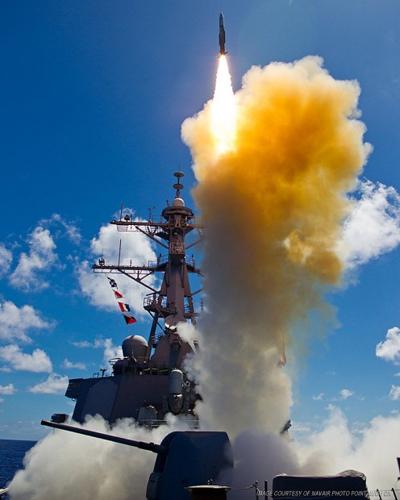
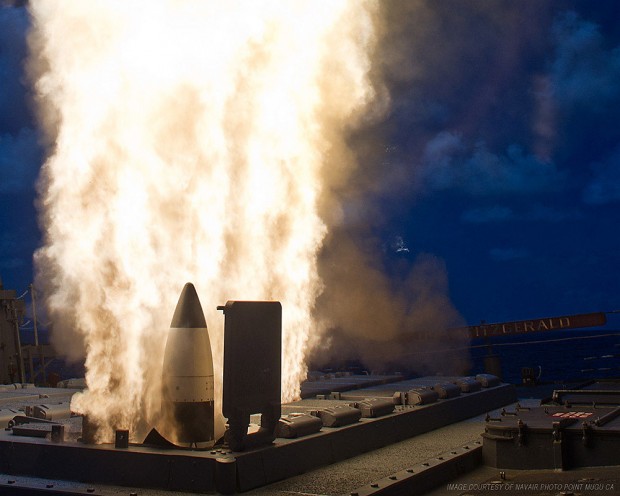
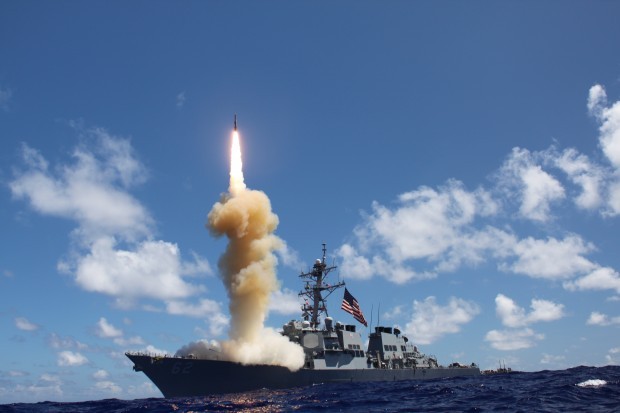
The U.S. Navy guided-missile destroyer USS Fitzgerald launched two Raytheon-made missiles at targets during the test, a Standard Missile-2 Block IIIA ship-defense missile and a SM-3 Block IA ballistic-missile interceptor.
The SM-2 successfully "engaged" its target, meaning it tracked it and got close enough to destroy the target - in this case a cruise-missile-like BQM-74 drone - had its blast-fragmentation warhead been live, said Pamela Rogers, a spokeswoman for the Missile Defense Agency.
The SM-3, fired at a proxy short-range ballistic missile target, didn't fare as well.
Despite indication of a "nominal" flight of the SM-3 Block IA interceptor, "there was no indication of an intercept," the missile agency said.
Raytheon said program officials are assessing data from the test, referring other questions to the U.S. agency.
The failure of the SM-3 is under review and no preliminary information is available, Rogers said.
The SM-3 is one of Raytheon Missile Systems' biggest and most important programs, accounting for $1.4 billion in contract bookings last year alone.
As part of the Aegis Ballistic Missile Defense system, the SM-3 also is a cornerstone of the Obama administration's "phased adaptive approach" to missile defense, which involves placing SM-3s aboard ships - and eventually, ashore - in Europe.
The failed test comes after two successful test intercepts by SM-3 Block IB this year that seemed to erase the memory of an intercept failure in September 2011. The Block IB features a two-color infrared seeker for better targeting and a new flight-control system.
The SM-3 Block IA is already deployed aboard at least one U.S. destroyer in Europe. Overall, the the missile agency says, the SM-3 has a record of 23 successful intercepts out of 29 attempts.
While the test gave little reason to cheer at Raytheon in Tucson, other business units of Waltham, Mass.-based Raytheon Co. got a boost.
Raytheon's Integrated Defense Systems (IDS) business unit provides the radar system and engineering and other support for the THAAD system. Raytheon IDS, based in Tewksbury, Mass., also is the original prime contractor on the PATRIOT (which actually stands for Phased Array Tracking Radar to Intercept on Target) system and is the system integrator on the latest, PAC-3 system.
Contact Assistant Business Editor David Wichner at dwichner@azstarnet.com or 573-4181.