

Torch lights more than cigarette; cancer cure quest; donated organs
- Updated
Odd and interesting news from the Midwest
- By GEOFF BURNS The Blade
- Updated
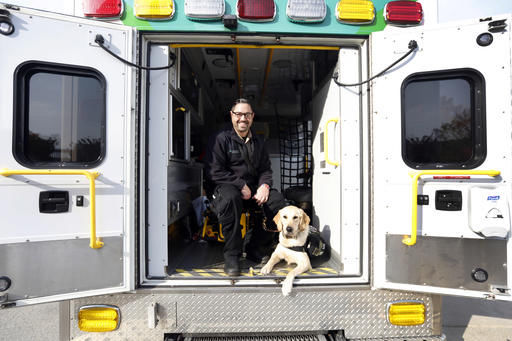
TOLEDO, Ohio (AP) — Louis Belluomini exited from a parked ambulance at ProMedica Flower Hospital in Sylvania as he held a leash and said "side." Less than a second later, Star, his service dog, went into a sitting position next to him and lay down.
"I don't like the idea of being on medication for the rest of my life," said Belluomini, who is a ProMedica Air and Mobile medic. "This was an opportunity to get off of those medications."
The 32-year-old was diagnosed with post-traumatic stress disorder — PTSD — in 2009 after his time stationed with U.S. Army in Iraq and Afghanistan. Completely unaware, it wasn't until he returned home when his friends and family noticed he was having issues, including not wanting to be at home alone and other "weird little things."
It was when he and his wife moved in together that he decided to take action.
"We realized, 'Hey, this is something that is starting to be more of a problem,' " Belluomini said. "That's when we decided to deal with it."
In September, he met Star, a 1-year-old Lab and golden retriever mix, while involved in a three-week program at K9s For Warriors in Florida. The organization focuses on providing service canines to "warriors" with PTSD, traumatic brain injury, or military sexual trauma as a result of military service post-9/?11. The program also provides service to those in active duty.
Brianna Ehrhart, education coordinator for K9s For Warriors, said the dogs are trained before the warriors meet them, and the program includes housing, more training, and meals. Eight warriors on average are enrolled in the three-week program each month, which is all funded by sponsors and donors. Ninety percent of the canines used for the program are rescued and shelter dogs.
Ehrhart said Belluomini had a "bubbly, outgoing" personality from the start, and he stays in touch with the organization through Facebook.
"By the time he left, he was incredibly happy to leave with Star and to have her accompany him in the world," Ehrhart said.
Since bringing Star back to his home in Findlay at the end of September, Belluomini immediately noticed the service dog's work.
During the second day at home, Star woke Belluomini up from nightmares several times throughout the night. Other times Star has prevented him from sleepwalking, as well as laying in front of him during times he feels uncomfortable next to people. Star keeps a close watch behind Belluomini where he can't see and will bark or alert him of anything suspicious.
Star goes to work with Belluomini and even rides with him in the ambulance.
She has her own area in the ambulance that he calls the "Doghouse," where she will sit with him and his partner. If patients feel uncomfortable with a dog around, Star will sit quietly in the front away from everyone. Although being on a helicopter is part of the job, Star will stay back at the hospital to wait for his return.
Dave Caris, director of operations for ProMedica Transportation Network Air and Mobile, has worked with Belluomini for about a year. He said Star is the second service dog, as the other belongs to a nurse at Toledo Hospital in the intensive care unit.
Caris said he hopes not only for Star to help Belluomini's treatment, but to also raise PTSD awareness to get more people talking about it as the two are seen driving in an ambulance throughout the local area.
He said having Star as an added member of the team will benefit patients, specifically for the children and the elderly.
"The dog can be very comforting for kids and sometimes puts a smile on elderly patients' face," Caris said.
While Star is still a puppy, Belluomini said she needs to have fun and exercise, but she still has to provide a service.
"When she is at work with me she is my tool, and when we're at home she's a family dog," Belluomini said. "She knows her job is first and foremost."
- Updated
NORTH PLATTE, Neb. (AP) — A Nebraska man who was fatally injured at work last month helped save three lives by donating his liver and kidneys.
The North Platte Telegraph reports (http://bit.ly/2esLFYj ) that the fact that Michael Nelson was able to save lives helped his daughter, Carly Nelson, deal with his death.
The 56-year-old had been working on rebuilding his life when he was injured. Previously, he had spent 12 years in prison.
Nelson was injured on Oct. 24 when a beam struck him in the head while he was helping install a conveyor system at Frenchman Valley Produce.
Carly Nelson said she and her dad had big dreams of flipping houses together, rebuilding a classic Jeep and taking hikes. Those will never happen.
But Carly, who is Buddhist, joked that her dad got a head start with reincarnation through the organ donation.
She said her dad used to joke that he would live forever — a never-say-die attitude he learned in the Marines.
"We lost everything, but three other people got something in return," she said. "It turns out, Dad didn't lie. He is immortal."
When Carly was 4, she and her brother lost their mother after she had a major seizure and fell. That led her to make dark jokes about how head injuries played a role in both her parents' deaths.
"There wasn't much my dad couldn't handle," she said. "Except, it turns out, being knocked in the head."
___
Information from: The North Platte Telegraph, http://www.nptelegraph.com
- Updated
EASTPOINTE, Mich. (AP) — The Michigan Supreme Court will hear arguments in the case of a man who sued after a national TV show mistakenly identified him as a criminal in suburban Detroit.
In 2011, Keith Todd was identified on an MSNBC show, "Caught on Camera: Dash Cam Diaries." But the person accused of stealing a limousine actually was another man with a similar name.
Todd didn't know until two years later when the show aired again. MSNBC eventually fixed the mistake, but Todd said he suffered emotional distress. So far, a Wayne County judge and the state appeals court have ruled against him.
The Supreme Court told lawyers to file briefs about whether the mistakes add up to "extreme and outrageous conduct," a key legal standard.
No date has been set for arguments.
- Updated
POINT LOOKOUT, Mo. (AP) — A small college in southwest Missouri is banning its students from drinking alcohol.
The Springfield News-Leader reports (http://j.mp/2fto8sM) that College of the Ozarks, a private Christian institution in Point Lookout, sent a recent email alerting students to a change in the college's "zero tolerance" alcohol and drug policy. The longstanding rule prohibits students from using alcohol or drugs.
But now the college, which has about 1,400 students, has clarified the rule to say that students legally allowed to drink alcohol if they are at least 21 aren't allowed to do so while they're a College of the Ozarks student. That rule is in effect even if they are not on campus.
College spokeswoman Valorie Coleman says the change was administrative and not prompted by any event.
___
Information from: Springfield News-Leader, http://www.news-leader.com
- Updated
HASTINGS, Neb. (AP) — A home in Hastings has sustained significant fire damage after a man used a butane torch to light a cigarette.
The Hastings Tribune reports (http://bit.ly/2fQZc0R ) the fire happened Saturday afternoon.
Hastings Fire and Rescue Chief Kent Gilbert says the home was engulfed in flames by the time firefighters arrived. The home was gutted by the blaze.
Gilbert said the man who started the fire escaped the house safely, but then was hurt trying to re-enter the home through a window. He says the injuries were likely caused by broken glass.
___
Information from: Hastings Tribune, http://www.hastingstribune.com
- Updated
WICHITA, Kan. (AP) — A Kansas militia group says it rejected two men who are accused of plotting to kill immigrants in western Kansas because they were "too extreme for us."
Those two men, Patrick Stein and Gavin Wright, have pleaded not guilty to a federal charge accusing them of conspiring with another man, Curtis Allen, in what federal prosecutors said was a domestic terrorism plot by members of a small militia group to attack Somali immigrants in Garden City.
The criminal complaint alleged that the defendants were key members of a militia group.
Attorneys for Wright and Stein declined to comment on the case. Allen's attorney did not respond to a request from the Kansas City Star (http://j.mp/2fvXWRp) for comment.
Stein's attorney, Ed Robinson, told a magistrate judge during an Oct. 21 detention hearing that the three men were not plotting an attack but accumulating weapons and ammunition as a means to defend themselves in case of a "massive social upheaval."
Miles Evans, state commander of the Kansas Flatlanders Militia, said Stein and Wright first contacted him about a week apart in July or August through social media. Evans said he had run into the two at militia training events but they belonged to another group.
"So I went to my second-in-command and spoke with him. He basically said all we can do is vet them, see what their outlook is and see what their intentions are," said Evans, of Wichita. He said about halfway through the process they rejected the men.
"They were just very extreme with the way they go about things," he said. "Too extreme for us."
Evans said his group is the biggest militia in Kansas and has about 30 members who are "like-minded, law-abiding citizens that all believe the same thing. And that is, our government is turning to (expletive)." Members are dedicated to serving their communities in times of natural and man-made disasters, he said.
"We're just ordinary citizens committed to the preservation of the American way with strict adherence to the Constitution of the United States and of Kansas, and to the Republic of the United States of America," he said.
He said Stein's responses to some questions were troubling.
"One of the deals he was talking about, if we ever had a fallout situation or anything, our bug-out locations, where they would be, what would we do, and how would we take that area and hold it for our own and stuff like that," Evans said. "And he just started talking about popping people. He was like, 'When it comes to things like that, I ain't even letting them go through the gate. Our numbers are going to be high enough; we need to defend what's ours and we need to keep the number low.' "
Evans said that was a red flag.
"We bounced him out of the chat," he said.
___
Information from: The Kansas City Star, http://www.kcstar.com
- Updated
FRANKLIN, Ohio (AP) — An Ohio city plans to honor three police officers and a dispatcher for the compassion they showed in response to a 7-year-old boy trying to sell a stuffed animal to buy food.
Police Chief Russell Whitman says officers Steve Dunham, Amanda Myers and Kyle O'Neal and dispatcher Lindsay Alvarez will receive the Police Exemplary Performance Award. The Hamilton-Middletown Journal-News reports (http://bit.ly/2eLXfid ) the presentation is planned Monday at the Franklin city council meeting.
The boy's parents are serving 180-day jail sentences after pleading guilty to child endangering charges.
The boy told Dunham in August he hadn't eaten for days, so the officer took him to a restaurant. He left him with Alvarez to join the other officers at the child's home, finding four older boys living amid garbage and cat urine.
- Updated
SPRINGFIELD, Ill. (AP) — The University of Illinois Springfield and the Illinois Department of Children and Family Services have announced the launch of a new training academy.
The Child Protection Training Academy, created through a partnership between the university and DCFS, will be the first of its kind in the country according to the State Journal-Register (http://bit.ly/2f6G8bq).
Director of CPTA Susan Evans said the academy will greatly improve training for child welfare investigators so they can better curb child abuse and neglect. All hires are required to complete simulation training, where trainees will interact with actors playing parents of a child in a simulated household where abuse was allege. The simulation lab is in a formerly vacant home on campus.
Investigators will also learn to improve their testimony by going through a mock courtroom experience.
"This gives them a much better sense of what the job is about and how to go out and accurately assess whether or not the department needs to be involved," said Evans, who is a 24-year veteran of DCFS.
Over 140 new DCFS investigators have gone through simulation training and mock courtroom training, Evans said. She added the academy's goal is to open up to other DCFS staff, law enforcement, first-responders and interested UIS students.
The CPTA started when former child investigator and current UIS Child Advocacy Studies program coordinator Betsy Goulet approached DCFS with the idea of a joint partnership, since she said she felt unprepared to do the job of an investigator the first time she was sent out.
The Child Advocacy program is expected to expand with two new grants, one through the U.S. Department of Health and Human Services and one through the Administrative Office of the Illinois Courts.
___
Information from: The State Journal-Register, http://www.sj-r.com
- Updated
PONTIAC, Mich. (AP) — The Michigan Supreme Court is interested in the case of a student who was rejected for admission at a Roman Catholic school in Oakland County.
Under Michigan legal precedent, courts have steered clear of certain decisions made by faith-based schools, saying it would be unconstitutional under the First Amendment.
But the Supreme Court last week told lawyers to file arguments about whether that 1994 ruling should be overturned. The order lists other issues, too. It's no guarantee that the court will take action.
The latest case involves a girl rejected by Notre Dame Preparatory High School in Pontiac after attending Marist Academy. Both are run by the Marist Fathers and Brothers.
The girl's family says she was illegally rejected because of a disability. The appeals court said courts can't intervene.
- By MIKE KILEN The Des Moines Register
- Updated
IOWA CITY, Iowa (AP) — Two mouse clicks in David Soll's University of Iowa biology lab is all it takes to understand.
The first click is a real horror film: 3-D images of the first-ever tracking of cancer cells' motion and accretion to tumors, which his lab released earlier this year. Globs of nasty cancer cells extend what looks like a probe, pulsing and reaching out to other cells to pull into a tumor.
The second click fights the horror: It's a group of images of cancer cells. But between them are gaps you could drive a busload of cells through. Monoclonal antibodies Soll has identified have essentially stopped the probing and formation of model tumors. Those gaps represent a world free of cancer.
"Unbelievable," Soll murmured.
He is the first to say it's a long way to any big claim — years of painstaking research may prove it all a bust. But this is his work now, day and night, trying to find a way to potentially stop the cause of a quarter of all U.S. deaths.
It's personal. Soll's wife Michele Morice died of cancer six years ago. In his ensuing grief, the acclaimed biologist changed the focus of his research from infectious fungi to cancer.
He had an advantage. Soll sits on the largest noncommercial hybridoma bank in the world. As director of the Developmental Studies Hybridoma Bank created by the National Institutes of Health in 1986, Soll's bank ships out dozens of antibodies every day that are housed at the University of Iowa for scientists across the world to use for research.
A quick science lesson: A hybridoma is formed when a B cell is combined with a cancer cell. The hybridoma secretes monoclonal antibodies that in recent years have excited cancer researchers. Find the right one and it may be able to stop cancer cells from growing and making tumors, according to the Des Moines Register (http://dmreg.co/2fyfqvR ).
Just like the one responsible for the healthy image on Soll's screen.
"Private companies are starting to come in for lunch and to sniff the air," he said.
Soll met Morice in the late 1980s. He was divorced from his first wife and driven in his work. He even pumped out chapters for college textbooks while sitting in the back of a bar and restaurant called The Mill in Iowa City, where Morice was a waitress.
"I loved to party, and I wasn't going to marry someone else," he said. "Then I met her. She saved me from my debauched lifestyle."
Soll, 74, grew up in the Italian Jewish ghetto of south Philadelphia with a prize-fighter father who loved boxing, reading and his wife but didn't much like his three sons, Soll said. Yet, he made them read books. That changed Soll's life.
Soll graduated from the notorious Boys Central High School in Philly to a pick of high-end colleges.
"But I loved the drinking in Wisconsin, so I went to the University of Wisconsin and got three degrees," he said.
He married, had a child, and set out making a name for himself, only sleeping an hour or two every night, while pioneering research on the vaginitis yeast Candida. He started companies and secured patents in agriculture areas, a whirlwind of fast-talking energy since he walked into the UI doors in 1972.
"My mom softened him up quite a bit," said Soll's daughter Samantha Soll, 34, a clinical psychologist in Chicago. "She was very much a loving human being and it was contagious for him.
"He is a tough guy. But he loved her in a way you should love somebody. He made sure everything was taken care of when she was sick. He was holding her hand all the time."
He didn't leave wife's bedside for four months, pulling his own bed next to hers and plopping his laptop up to work.
Cancer. He Googled every important bit of research about it for two months after his wife's death.
"It's bad luck, that's what it is, because it has to do with mutation," Soll said. "It's a crap shoot that it metastasizes and you die.
"So when she died I sat down with all my people and said, 'I don't want to find a cure for 1 percent of deaths (from specific infectious diseases). I want to find a cure for 25 percent.' And this is what this can be. One bullet that can stop tumorigenesis."
He shifted his passion. It's one thing he always told his three children: Find a passion and do it all the way.
He did it throughout his early career, writing a paper in 1970 showing that cell differentiation could be preprogrammed without protein synthesis that made him a wunderkind in the scientific community. He wrote a lead article on biological timers in Science magazine in the late 1980s, a rare honor that also overwhelmed his ability to emotionally "catch up to my career."
"Then I met the luck of my life," he said.
The relationship with Michele calmed him and he took over the role of director of the hybridoma bank, growing it from 100 to 4,400 hybridomas over the last 20 years.
"He took a small-potatoes operation and turned it into something that is global and really important," said Steve Alexander, a University of Missouri biology professor. "This is a big deal to get antibodies for research at prices that are reasonable, because scientists have a limited amount of money."
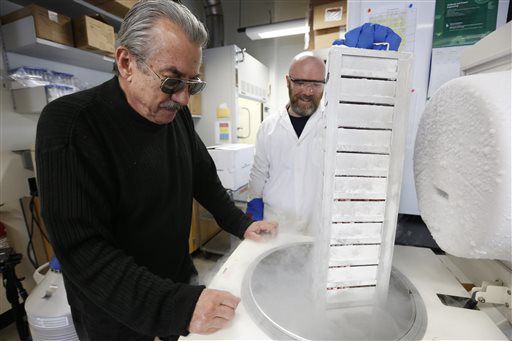
Soll said the monoclonal antibodies stored at UI are worth $250 million but are sold to 65,000 clients worldwide at a fraction of what commercial concerns sell them for. He pulls up trays from a single waist-high deep freeze holding the specimens — housed behind locked laboratory doors.
Few outside the scientific community in Iowa know about it, he says, but the only thing more famous here is the Iowa Writers' Workshop.
He can use the available antibodies with his lab's novel 3-D imaging that tracks tumor formations in real time, technology that created real excitement after his piece on it in the American Journal of Cancer Research.
"He's the smartest man I know," Alexander said. "He is coming at it from scratch, but he has novel ideas. There is nothing tangential about David Soll. Everything is creative and big picture."
Soll's work has identified two monoclonal antibodies that are showing promise in stopping tumor growth. But he said more research is needed before they can interest "deep pockets" from running with them.
His daughter views it as a noble, ethical quest.
"This isn't for personal gain," Samantha Soll said. "This is something to make the world a better place."
His wife, then.
"We were in love for 30 years," Soll said. "She was absolutely beautiful and one of the smartest people I met in my life, politically astute, a great mother, fantastic lover and wife. Everything. And I spent a lot of time window shopping, let me tell you. When I met her I was quitting, and that doesn't happen too often."
When she was dying, he didn't tell her that he would spend the rest of his life fighting against what killed her.
He knows she would have a question: Is it something you really love?
His answer now is urgent, so much so that he's tirelessly working only a couple months after back surgery.
"Time is getting short for me. Because of genetics and the history of my family, I still have 10 more years maximum to pull off what I think I can do, which is to find a generalized drug that can shut down all cancer formation. I've already found two but I think we were very, very lucky. I might actually pull this off."
If he's successful, David Soll said he will look up to his wife in heaven and tell her that he did it.
___
Information from: The Des Moines Register, http://www.desmoinesregister.com
An AP Member Exchange shared by the Des Moines Register.
- By TONY REID (Decatur) Herald & Review
- Updated
DECATUR, Ill. (AP) — The handwoven wicker baskets carried by our female ancestors had room for all kinds of stuff, including a stubborn streak of independence.
The surprising social significance of the humble basket was emptied out Oct. 16, in a presentation called "Handbaskets of the Home" at Decatur's Rock Springs Conservation Area.
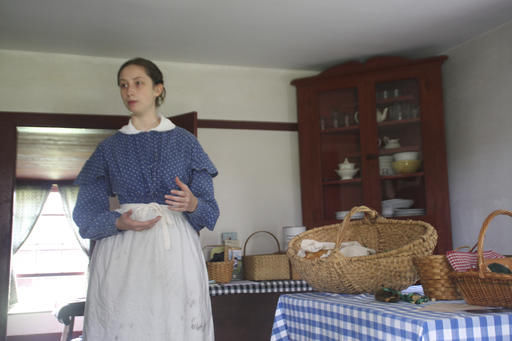
Framed by the pre-Civil War-era Trobaugh-Good farmhouse, historic sites intern Emily McInerney, in a full-length Victorian-era pioneer dress, said baskets were a 19th century woman's passport to freedom, at least a little bit. She pointed to a large basket filled with produce, the kind of items a woman would have picked up at the marketplace.
But just making that market trip, she argued, and exercising choice over the deployment of the home's precious resources, was a taste of feminine control in a world ruled by men.
Then McInerney moved on to a smaller sewing basket, filled with needles and crochet and whatever was needed to make the fabric of life. She said the act of visiting with friends and neighbors for sewing parties or quilting bees also broke women free of male control to swap news with their peers.
On that same theme was a third sample basket McInerney called the "visitation basket" which would be filled with precious cargo like letters and pictures. These were the talking points women took with them on purely social visits to update neighbors on family life and share stories from far away.
"A photograph in 1860 was still something fairly new, they were expensive," said McInerney. "If you had one, you would want to show it off. You were excited."
The baskets that hauled all these crucial payloads might have been handmade by the woman or her family for that purpose or, if you were well to do, could have been bought, something that became more common after the railroads reached Decatur in 1854. But McInerney explained to an attentive audience that it was the versatile basket, however you came by it, that often held the things that gave women a way to carry themselves into a wider world.
"So by these little acts they were able to get control over themselves, over their families and actually do something for themselves," she added.
Audience member Monica Richards said the talk was fascinating and shed a whole new light on the history of a simple woven receptacle with a handle. "Women were not very independent back then, and yet baskets helped make them independent," Richards said. "You wouldn't think of that, would you?"
___
Source: (Decatur) Herald & Review, http://bit.ly/2ebu3DR
___
Information from: Herald & Review, http://www.herald-review.com
This is an AP-Illinois Exchange story offered by the (Decatur) Herald & Review.
- By BOB GROSS The Times Herald
- Updated
NORTH STREET, Mich. (AP) — If you believe in omens, maybe Tim and Darla Volke weren't meant to be beekeepers.
Fortunately, they didn't let a little lightning stop them from pursuing a home hobby that culminated with recognition for the best white honey at the recent Michigan Beekeepers Fall Conference Oct. 21-22 in Flint.
They've only been keeping bees for about a year and a half, and the Flint conference was the first time they had entered their honey in any kind of competition.
"Mine was considered white honey," Tim Volke said. "I ended up taking first place, which was shocking to me."
The Volkes live out in the country in a house surrounded by wildflowers - literally acres of goldenrod in the late summer and early fall. Bees have a way of finding them.
"What really led to this whole thing, a number of years back, four years I'd say, we had a bee colony take up residence in our chimney," Tim Volke said.
He said he arranged to have a beekeeper come out to look at the situation, but nature intervened before that could happen.
"It was Memorial Day weekend," Volke said. "There was a storm and lightning struck the chimney - blew the chimney apart."
The beekeeper came out the next weekend, and he and the Volkes examined the wreckage of the chimney.
"There was a pile, thousands of bees in this pile," Darla Volke said. "They were all dead from the lightning."
That wasn't, however, the last of the Volkes' bee guests. Another swarm invaded the soffit of their home, prompting them to learn more about the insects and for Tim Volke to build a hive.
"The bees love our house," Darla Volke said.
But that colony didn't survive the winter in the soffit, The Times Herald (http://bwne.ws/2f5f9gv ) reported. The Volkes then ordered bees from California and started a hive in April 2015. That colony survived and split into a second colony that Tim Volke moved to another hive.
The Volkes said they were motivated more by honeybee deaths and hive losses throughout the world than by a taste for honey.
"That got us going," Tim Volke said. "We became more involved in helping the honey bees."
Honey bee colonies have been decimated in some cases by the parasitic varroa mite. Other suspected causes of honey bee mortality are pesticide use and genetically modified field crops.
"Just to have the bees living and thriving is the ultimate goal," Tim Volke said. "A lot of bees die during the winter, so just to survive the winter is the goal."
He said he avoids using any pesticides or herbicides around his hives - and he treads lightly in his yard when the bees are foraging on clover.
"When I cut the grass, I have to stop and wait for them," he said.
Darla Volke said they're calling the honey "North Street Gold."
"Keeping bees is very rewarding," Tim Volke said. "They're a fascinating insect."
"The more you know about them, and there's always more to learn," Darla Volke said.
___
Information from: Times Herald, http://www.thetimesherald.com
- By MARK JOHNSON Record Eagle
- Updated
TRAVERSE CITY, Mich. (AP) — Damon McCormick took a cool stroll along local Lake Michigan shorelines and found a chilling sight: fresh bird carcasses spread along the beach.
McCormick, a member of the nonprofit conservation group Common Coast, found an estimated 22 dead birds per mile over a two mile stretch of Christmas Cove Beach on Oct. 27, and another 14 along a 1-mile segment of Cathead Bay Beach. He blamed the upsetting sight on a Type E Botulism outbreak, a disease that has become a recurring threat in northern Lake Michigan.
"They were scattered on the beach, some were half buried," he said. "In past years, you could have as many as 100 birds per mile. When it's bad, it looks like you're in a war zone, but this was more sporadic."
The Record Eagle (http://bit.ly/2fmZEVe ) reports that the disease begins with a toxin released from bacteria that resides in lake sediments, explained Dan Ray, botulism monitoring project lead for Sleeping Bear Dunes National Lakeshore. The toxin is produced by the bacteria when the algae breaks down and creates anaerobic conditions. As the algae decays it takes oxygen out of the water and triggers the bacteria to create and release the toxin.
The toxin then rises up the food chain, starting with invertebrates, which are eaten by round goby and other fish, which are then eaten by different bird species, like common loons, long-tailed ducks and white-winged scoters, often migrating south from Canada, McCormick said. Some birds also eat the toxin-riddled invertebrates themselves.
Invasive zebra and quagga mussels increase the problem by filtering the water to allow sunlight to sink deeper and create more algae growth and more toxin release, Ray said.
The disease causes paralysis in the birds and makes it difficult for the birds to keep their heads up, said Tom Cooley, wildlife biologist and pathologist in the Department of Natural Resources wildlife disease lab. Deceased birds collected typically have fluid in their lungs resulting from their drowning death.
Waterfowl contract the disease at different hotspots at various Great Lakes locations and wash up on different shores. Cooley said some die in the middle of Lake Michigan during their southern migration and drift onto shorelines, depending on the wind direction, making it difficult to determine where they contracted the disease.
Ray said roughly 20 volunteers who monitor the park's beaches recorded large numbers of dead birds recently, with concentrations near Good Harbor Bay and Platte Bay.
McCormick said the birds he found were fresh, suggesting they died somewhere nearby. Loon species comprised about one-third of the total dead bird count, while long-tailed ducks and white-winged scoters rounded out the list, he said.
The numbers, while concerning, don't quite match up to past years when an estimated 4,000 to 7,000 deaths were recorded, Cooley said. It will take another two weeks, at least, before researchers will be able to determine the severity of the most recent outbreak.
Ray said there is no significant threat to the water itself.
"The beaches are still perfectly safe," he said. "It's a food web thing that remains fairly independent of water quality. It doesn't impact swimming or bathing."
With heavier southern winds expected during the next several days, a whole new wave of dead birds could soon wash ashore, McCormick said.
Anyone venturing to local beaches should keep their eyes peeled and report dead birds to McCormick at 906-202-0602 or call their local DNR offices.
"Most people on the beach are looking for Petoskey stones and it's easy for them to miss the dead birds," he said.
___
Information from: Traverse City Record-Eagle, http://www.record-eagle.com
- By KATHERINE LYMN and RORY LINNANE Post-Crescent
- Updated
APPLETON, Wis. (AP) — For Appleton East junior Hannah Ceccon, getting mental health help is finally easy. When she's at a low point, rather than turning to old habits of self-harm, she can walk down the school hallway to see her counselor.
"I've always had very thin skin. There were times I was low and I didn't know how to handle it," Ceccon said. "Now it's easier for me to go through anything I have to go through. I just feel like I have someone."
What Ceccon now has is rare in Wisconsin. Behind Texas, Wisconsin needs more mental health professionals than any other state to address chronic shortages. Throw insurance problems and transportation barriers into the mix, and it's a recipe for unaddressed mental illness. Wisconsin's teen suicide rate is higher than the national average and children here experience high rates of depression and other problems, but getting help can be difficult.
Ceccon sees a mental health counselor at her school once a week because of a United Way program called PATH (Providing Access to Healing). So unlike countless other students in Wisconsin, Ceccon is not stuck on a wait list or shut out based on ability to pay. Her mom doesn't have to get off work to take her to appointments. And she only misses a minimal amount of school that is perfectly synced with her schedule.
PATH is a model that could soon be replicated around Wisconsin, if state Superintendent Tony Evers has his way. He asked Department of Health Services officials to earmark funds for putting mental health clinics in schools in the next two-year budget, which will move through the Legislature next year.
"We have been having ongoing conversations with DHS," Evers said. "I don't know what will be the upshot of that but we're hopeful."
DHS officials were not available to comment on the proposal. A spokesperson said it was too early in the budget process to know whether there would be funding for clinics in schools.
Currently, PATH is limited in expanding because it relies on philanthropic funding. Many families are underinsured, and insurance payments only cover about half the cost of care. State funding to supplement insurance payments would allow the program to serve more students and remain sustainable, organizers say.
Evers' words were music to their ears — if a little overdue.
"We, for a long time, for a number of years, have been advocating for public support of some kind in order to sustain this program long-term," said Peter Kelly, president and CEO of United Way Fox Cities. "We cannot continue to invest in the level that we are unless we get additional support for the programming."
The PATH model has fans throughout the state, the Post-Crescent (http://post.cr/2fFyvME ) reported. Since the program started as a 2008 pilot in the Menasha Joint School District, it has expanded to 30 schools in nine districts. Schools in Superior, Waukesha, Racine and Sheboygan have their own programs modeled after PATH.
Some states, like Minnesota, have gone a step further and formalized a structure for direct financial support for school-based clinics. It is unclear what shape such funding could take in Wisconsin, but programs like PATH have shown they can work using a public-private approach with nonprofits, health care providers and school districts collaborating on a regional basis.
Mary Wisnet, a PATH expert at the United Way, said she has fielded calls from districts interested in the program from Marathon, Door, Brown, Dodge and Eau Claire counties. The model appeals to communities where kids are struggling to get to appointments because their parents can't take off work, they don't have reliable vehicles, or the families feel stigmatized when they pull their kids out of school.
"If we can't get the children to the appointments in the community, let's bring the appointments to them," Wisnet said, explaining the philosophy behind the program.
-----
Making a difference
Ceccon's counselor, Kristine Sack, is employed by Lutheran Social Services and spends two days a week at Appleton East. Catalpa Health and Family Services of Northeast Wisconsin also provide therapy in the schools through PATH.
As with traditional therapy, students usually start out meeting with Sack once a week, then wean off to twice a month, then monthly. The most common mental health challenges she sees in her patients are depression, anxiety and post-traumatic stress disorder stemming from childhood abuse.
Tucked away off a hallway on the way to the school's gym, Sack's space is private. She sometimes runs a noise machine to ensure passersby can't overhear conversations; an orange sheet of paper covers the lower half of the elongated door window required by the school in case of an evacuation.
The appointments are a dash shorter than typical, clocking in at 47 minutes — the length of a class period.
Unlike traditional therapy, Sack rarely has no-shows or cancellations. After all, if a client doesn't show up, she can call the secretary, who can call the student's teacher for that class period.
And to make sure the appointments don't interfere with academics, the therapy is scheduled at different times each week — so a student doesn't miss algebra week after week. It's so integrated, Sack said, students will ask her about changing their class schedule, and she'll have to remind them she's not an employee there.
Judy Baseman, assistant superintendent for school services at Appleton Area School District, knows principals would welcome more PATH time.
"They'd say yes in a heartbeat, there's no question, because the results that we're seeing in terms of student outcomes, both in terms of their attendance and their school performance, it's just been phenomenal, the difference it's made," she said.
Seventy-four percent of roughly 1,100 PATH students from 2008 through January saw reduced symptoms, according to therapist assessments, and 44 percent showed improved academic performance, according to school records.
-----
Uncertain funding
This month, United Way began meeting with stakeholders to talk about long-term funding options for PATH, and the state is one option on the table.
"While I can't tell you today for your story that yes, we're gonna be there for another five years or whatever, that is certainly our intent. But along with that is . we can't do it alone," Kelly said.
Elizabeth Hudson, director of the state Office of Children's Mental Health, said she supported the idea of expanding mental health clinics in schools, but she wouldn't say whether DHS should be chipping in funds.
"I won't speak to where funding should come from but the model of having mental health support in schools is a great opportunity," Hudson said. "Having support and services accessible in schools has the potential to really meet needs of kids and families that otherwise may not be able to access services and support."
Baseman said in addition to making appointments more convenient, having counselors in the schools has helped students and their families overcome stigma around mental health.
"We have seen so many positive outcomes for our students, and just the fact that they have been willing to participate in the therapy has sent a strong message to not only other students but also to their families that it's OK to ask for help," Baseman said. "It's OK to recognize that you have mental health challenges, and that there is hope for them."
Ceccon said while awareness is improving, stigma around mental health still exists at Appleton East. When she misses a class for counseling, sometimes she tells other students where she was; sometimes to avoid judgment she just says she was at an appointment. She hopes that talking publicly about her experience with PATH will make it a little easier for everyone to talk about.
"I wish there wasn't a stigma, and I could just be like, 'I had counseling,' and people wouldn't think, 'Oh, she's crazy,'" Ceccon said. "It's going to take time to change society's perspective."
___
Information from: Post-Crescent Media, http://www.postcrescent.com
An AP member exchange shared by the Post-Crescent.
- By Mike Anderson Rapid City Journal
- Updated
CANNON BALL, N.D. (AP) — The Pine Ridge Girls' School is embarking on a mission to prepare young Lakota women for a college education and a fruitful life beyond the borders of the Pine Ridge Indian Reservation.
The Porcupine-based school — the country's first non-denominational all-girls college prep school on a Native American reservation — had its grand opening on Sept. 23. And since then, the teachers have been bonding with their first class of sixth and seventh graders.
The girls — 11 in total in the inaugural class — will spend the rest of their K-12 educational careers at the school, and new classes will be brought on every year.
Apart from it being a school just for girls, it is also unique in its approach to Native American tradition, the Rapid City Journal (http://bit.ly/2eWjJjb ) reported. Every lesson at the fledgling school — be it science or U.S. history — is communicated to the girls through the lens of Lakota language and culture.
"We're trying to teach them to be proud of who they are," said the school's head, Cindy Giago.
The school's name in Lakota is Anpo Wicahpi, which translates to "Morning Star."
On a warm day in late September, Helene Gaddi led the day's science lesson into the overgrown wilderness behind the Pine Ridge Girls' School. Wading through knee-high prairie grass, the six girls in Gaddi's class turned and looked when she pointed and said "What kind of trees are these?"
"Chokecherry trees," one of the girls chimed in immediately.
Resourcefulness and a deep connection to the natural world: These are important qualities for Native American women, Gaddi said.
The privately funded college-preparatory school is designed to create a nurturing environment for young women on the reservation to learn in ways that suit them best. While taught through the lens of Lakota culture, the science in Gaddi's outdoors classroom is sound, practical, and like every subject taught at the school by the staff of three teachers, based on established curriculum, she said.
Earlier in the month, she taught the girls how to make lip balm from plant ingredients harvested in the greenery behind the school. Another day's lesson had to do with floral morphology and stream ecology, Gaddi said. As part of that, she guided the girls down deer paths to a creek winding beneath a formation rocky of bluffs, taking note of different herbs and a bleached cow bones on the way.
"We need more Native women scientists," Gaddi said.
Getting their hands dirty, being able to see, smell, hear and touch the subjects of their lessons; the girls learn better this way, the teacher said before leading her students back up to the school in time for math class. Once back, they learned about circumferences using a drawing of a sweat lodge, or "inipi," in preparation for building one themselves.
The meditative smoke and darkness of the sweat lodge are already familiar to the girls, as are many other Lakota rituals, all taught to them by the school's elders, Gene Giago — Cindy's husband — Rick Two Dogs, and Ethleen Iron Cloud Two Dogs.
Before eating a lunch of pasta with buffalo meat and corn-on-the-cob (homemade in the school's open-air kitchen), the quiet elders looked on as the girls gathered in a circle, smudged with sweet grass, and presented a small offering of food for the spirits. Then one of the girls took a plate to Gene, who smiled and nodded in thanks.
"In a spiritual sense, I watch over the girls," he said. "In a physical sense, I do the laundry and take out the dishes."
The girls refer to their spiritual instructors as "kaká" and "unci" respectively, the Lakota words for grandfather and grandmother. The intimate titles have arisen organically as a result of the serene and familial atmosphere that Cindy and her small band of teachers have created at the school.
"They treat each other like family," Cindy said of the girls.
"It makes me feel like home," said sixth-grader Breiana High Wolf, 12, while her classmates laughed and batted a volleyball between themselves during recess. "It makes me feel comfortable, that I can tell my teachers and classmates everything."
Like all of her fellow students, Breiana used to attend school elsewhere on or near the reservation. At her old school, Lakota language and culture were taught only during a single period in the day. At the Pine Ridge Girls' School, it is all around her.
"We get to learn to sing the songs and speak fluently," she said. "I'm learning our way of life."
Cindy and the teachers agree that immersion in the language and culture is essential to the learning process and is all too often deficient or altogether missing in schools like the one Breiana used to attend. At the Pine Ridge Girls' School, all of the students get their own Lakota names, granted to them during spiritual ceremonies. Pasted on each girl's locker is the name of a Native American woman significant in U.S. history: Winona LaDuke. Jodi Collette. Maria Tallchief. Buffalo Calf Road Woman. Nellie Red Owl. Marie Randall.
"We want to normalize being Lakota, where it's not separate in our minds," said Dusty Nelson, the school's Lakota language and writing teacher. "We are always Lakota. It's not something we do on the side. A lot of times when people think of academic rigor, they don't think it includes Lakota thought and philosophy."
On the dry-erase board in Nelson's classroom was a Lakota medicine wheel, often used as a sort of flow chart for organizing ideas and schedules. The room was brimming with Lakota books. While the girls wrote in their journals for the day, they bobbed their heads and hummed along to the Native pop music on Nelson's Bluetooth speaker.
"I love it. It's beautiful," Cindy said. "I don't want to go home; we're allowing them to create their own identities from what's inside them."
The girls have already gone on several field trips, including to Bear Butte near Sturgis and Fort Robinson, Nebraska, to learn how Tashunka Witko, the Lakota name for the war chief Crazy Horse, was captured and killed by U.S. soldiers. They are in the midst of planning another trip, this time to Cannon Ball, North Dakota, where a large group of Native American activists are camped in protest of the Dakota Access Pipeline.
The trip was the girls' idea, the teachers said.
"It's really amazing to see these girls; it's a miracle happening before our eyes," Nelson said. "They've bonded and they're being themselves and they're happy to learn about all this. These girls are really lucky. When I was younger, I feel like if I had a place to go like this, to be who I want to be and comfortable around other girls, I would have had a stronger foundation and I wouldn't have struggled so much."
An AP Exchange shared by the Rapid City Journal
- By GEOFF BURNS The Blade
TOLEDO, Ohio (AP) — Louis Belluomini exited from a parked ambulance at ProMedica Flower Hospital in Sylvania as he held a leash and said "side." Less than a second later, Star, his service dog, went into a sitting position next to him and lay down.
"I don't like the idea of being on medication for the rest of my life," said Belluomini, who is a ProMedica Air and Mobile medic. "This was an opportunity to get off of those medications."
The 32-year-old was diagnosed with post-traumatic stress disorder — PTSD — in 2009 after his time stationed with U.S. Army in Iraq and Afghanistan. Completely unaware, it wasn't until he returned home when his friends and family noticed he was having issues, including not wanting to be at home alone and other "weird little things."
It was when he and his wife moved in together that he decided to take action.
"We realized, 'Hey, this is something that is starting to be more of a problem,' " Belluomini said. "That's when we decided to deal with it."
In September, he met Star, a 1-year-old Lab and golden retriever mix, while involved in a three-week program at K9s For Warriors in Florida. The organization focuses on providing service canines to "warriors" with PTSD, traumatic brain injury, or military sexual trauma as a result of military service post-9/?11. The program also provides service to those in active duty.
Brianna Ehrhart, education coordinator for K9s For Warriors, said the dogs are trained before the warriors meet them, and the program includes housing, more training, and meals. Eight warriors on average are enrolled in the three-week program each month, which is all funded by sponsors and donors. Ninety percent of the canines used for the program are rescued and shelter dogs.
Ehrhart said Belluomini had a "bubbly, outgoing" personality from the start, and he stays in touch with the organization through Facebook.
"By the time he left, he was incredibly happy to leave with Star and to have her accompany him in the world," Ehrhart said.
Since bringing Star back to his home in Findlay at the end of September, Belluomini immediately noticed the service dog's work.
During the second day at home, Star woke Belluomini up from nightmares several times throughout the night. Other times Star has prevented him from sleepwalking, as well as laying in front of him during times he feels uncomfortable next to people. Star keeps a close watch behind Belluomini where he can't see and will bark or alert him of anything suspicious.
Star goes to work with Belluomini and even rides with him in the ambulance.
She has her own area in the ambulance that he calls the "Doghouse," where she will sit with him and his partner. If patients feel uncomfortable with a dog around, Star will sit quietly in the front away from everyone. Although being on a helicopter is part of the job, Star will stay back at the hospital to wait for his return.
Dave Caris, director of operations for ProMedica Transportation Network Air and Mobile, has worked with Belluomini for about a year. He said Star is the second service dog, as the other belongs to a nurse at Toledo Hospital in the intensive care unit.
Caris said he hopes not only for Star to help Belluomini's treatment, but to also raise PTSD awareness to get more people talking about it as the two are seen driving in an ambulance throughout the local area.
He said having Star as an added member of the team will benefit patients, specifically for the children and the elderly.
"The dog can be very comforting for kids and sometimes puts a smile on elderly patients' face," Caris said.
While Star is still a puppy, Belluomini said she needs to have fun and exercise, but she still has to provide a service.
"When she is at work with me she is my tool, and when we're at home she's a family dog," Belluomini said. "She knows her job is first and foremost."
NORTH PLATTE, Neb. (AP) — A Nebraska man who was fatally injured at work last month helped save three lives by donating his liver and kidneys.
The North Platte Telegraph reports (http://bit.ly/2esLFYj ) that the fact that Michael Nelson was able to save lives helped his daughter, Carly Nelson, deal with his death.
The 56-year-old had been working on rebuilding his life when he was injured. Previously, he had spent 12 years in prison.
Nelson was injured on Oct. 24 when a beam struck him in the head while he was helping install a conveyor system at Frenchman Valley Produce.
Carly Nelson said she and her dad had big dreams of flipping houses together, rebuilding a classic Jeep and taking hikes. Those will never happen.
But Carly, who is Buddhist, joked that her dad got a head start with reincarnation through the organ donation.
She said her dad used to joke that he would live forever — a never-say-die attitude he learned in the Marines.
"We lost everything, but three other people got something in return," she said. "It turns out, Dad didn't lie. He is immortal."
When Carly was 4, she and her brother lost their mother after she had a major seizure and fell. That led her to make dark jokes about how head injuries played a role in both her parents' deaths.
"There wasn't much my dad couldn't handle," she said. "Except, it turns out, being knocked in the head."
___
Information from: The North Platte Telegraph, http://www.nptelegraph.com
EASTPOINTE, Mich. (AP) — The Michigan Supreme Court will hear arguments in the case of a man who sued after a national TV show mistakenly identified him as a criminal in suburban Detroit.
In 2011, Keith Todd was identified on an MSNBC show, "Caught on Camera: Dash Cam Diaries." But the person accused of stealing a limousine actually was another man with a similar name.
Todd didn't know until two years later when the show aired again. MSNBC eventually fixed the mistake, but Todd said he suffered emotional distress. So far, a Wayne County judge and the state appeals court have ruled against him.
The Supreme Court told lawyers to file briefs about whether the mistakes add up to "extreme and outrageous conduct," a key legal standard.
No date has been set for arguments.
POINT LOOKOUT, Mo. (AP) — A small college in southwest Missouri is banning its students from drinking alcohol.
The Springfield News-Leader reports (http://j.mp/2fto8sM) that College of the Ozarks, a private Christian institution in Point Lookout, sent a recent email alerting students to a change in the college's "zero tolerance" alcohol and drug policy. The longstanding rule prohibits students from using alcohol or drugs.
But now the college, which has about 1,400 students, has clarified the rule to say that students legally allowed to drink alcohol if they are at least 21 aren't allowed to do so while they're a College of the Ozarks student. That rule is in effect even if they are not on campus.
College spokeswoman Valorie Coleman says the change was administrative and not prompted by any event.
___
Information from: Springfield News-Leader, http://www.news-leader.com
HASTINGS, Neb. (AP) — A home in Hastings has sustained significant fire damage after a man used a butane torch to light a cigarette.
The Hastings Tribune reports (http://bit.ly/2fQZc0R ) the fire happened Saturday afternoon.
Hastings Fire and Rescue Chief Kent Gilbert says the home was engulfed in flames by the time firefighters arrived. The home was gutted by the blaze.
Gilbert said the man who started the fire escaped the house safely, but then was hurt trying to re-enter the home through a window. He says the injuries were likely caused by broken glass.
___
Information from: Hastings Tribune, http://www.hastingstribune.com
WICHITA, Kan. (AP) — A Kansas militia group says it rejected two men who are accused of plotting to kill immigrants in western Kansas because they were "too extreme for us."
Those two men, Patrick Stein and Gavin Wright, have pleaded not guilty to a federal charge accusing them of conspiring with another man, Curtis Allen, in what federal prosecutors said was a domestic terrorism plot by members of a small militia group to attack Somali immigrants in Garden City.
The criminal complaint alleged that the defendants were key members of a militia group.
Attorneys for Wright and Stein declined to comment on the case. Allen's attorney did not respond to a request from the Kansas City Star (http://j.mp/2fvXWRp) for comment.
Stein's attorney, Ed Robinson, told a magistrate judge during an Oct. 21 detention hearing that the three men were not plotting an attack but accumulating weapons and ammunition as a means to defend themselves in case of a "massive social upheaval."
Miles Evans, state commander of the Kansas Flatlanders Militia, said Stein and Wright first contacted him about a week apart in July or August through social media. Evans said he had run into the two at militia training events but they belonged to another group.
"So I went to my second-in-command and spoke with him. He basically said all we can do is vet them, see what their outlook is and see what their intentions are," said Evans, of Wichita. He said about halfway through the process they rejected the men.
"They were just very extreme with the way they go about things," he said. "Too extreme for us."
Evans said his group is the biggest militia in Kansas and has about 30 members who are "like-minded, law-abiding citizens that all believe the same thing. And that is, our government is turning to (expletive)." Members are dedicated to serving their communities in times of natural and man-made disasters, he said.
"We're just ordinary citizens committed to the preservation of the American way with strict adherence to the Constitution of the United States and of Kansas, and to the Republic of the United States of America," he said.
He said Stein's responses to some questions were troubling.
"One of the deals he was talking about, if we ever had a fallout situation or anything, our bug-out locations, where they would be, what would we do, and how would we take that area and hold it for our own and stuff like that," Evans said. "And he just started talking about popping people. He was like, 'When it comes to things like that, I ain't even letting them go through the gate. Our numbers are going to be high enough; we need to defend what's ours and we need to keep the number low.' "
Evans said that was a red flag.
"We bounced him out of the chat," he said.
___
Information from: The Kansas City Star, http://www.kcstar.com
FRANKLIN, Ohio (AP) — An Ohio city plans to honor three police officers and a dispatcher for the compassion they showed in response to a 7-year-old boy trying to sell a stuffed animal to buy food.
Police Chief Russell Whitman says officers Steve Dunham, Amanda Myers and Kyle O'Neal and dispatcher Lindsay Alvarez will receive the Police Exemplary Performance Award. The Hamilton-Middletown Journal-News reports (http://bit.ly/2eLXfid ) the presentation is planned Monday at the Franklin city council meeting.
The boy's parents are serving 180-day jail sentences after pleading guilty to child endangering charges.
The boy told Dunham in August he hadn't eaten for days, so the officer took him to a restaurant. He left him with Alvarez to join the other officers at the child's home, finding four older boys living amid garbage and cat urine.
SPRINGFIELD, Ill. (AP) — The University of Illinois Springfield and the Illinois Department of Children and Family Services have announced the launch of a new training academy.
The Child Protection Training Academy, created through a partnership between the university and DCFS, will be the first of its kind in the country according to the State Journal-Register (http://bit.ly/2f6G8bq).
Director of CPTA Susan Evans said the academy will greatly improve training for child welfare investigators so they can better curb child abuse and neglect. All hires are required to complete simulation training, where trainees will interact with actors playing parents of a child in a simulated household where abuse was allege. The simulation lab is in a formerly vacant home on campus.
Investigators will also learn to improve their testimony by going through a mock courtroom experience.
"This gives them a much better sense of what the job is about and how to go out and accurately assess whether or not the department needs to be involved," said Evans, who is a 24-year veteran of DCFS.
Over 140 new DCFS investigators have gone through simulation training and mock courtroom training, Evans said. She added the academy's goal is to open up to other DCFS staff, law enforcement, first-responders and interested UIS students.
The CPTA started when former child investigator and current UIS Child Advocacy Studies program coordinator Betsy Goulet approached DCFS with the idea of a joint partnership, since she said she felt unprepared to do the job of an investigator the first time she was sent out.
The Child Advocacy program is expected to expand with two new grants, one through the U.S. Department of Health and Human Services and one through the Administrative Office of the Illinois Courts.
___
Information from: The State Journal-Register, http://www.sj-r.com
PONTIAC, Mich. (AP) — The Michigan Supreme Court is interested in the case of a student who was rejected for admission at a Roman Catholic school in Oakland County.
Under Michigan legal precedent, courts have steered clear of certain decisions made by faith-based schools, saying it would be unconstitutional under the First Amendment.
But the Supreme Court last week told lawyers to file arguments about whether that 1994 ruling should be overturned. The order lists other issues, too. It's no guarantee that the court will take action.
The latest case involves a girl rejected by Notre Dame Preparatory High School in Pontiac after attending Marist Academy. Both are run by the Marist Fathers and Brothers.
The girl's family says she was illegally rejected because of a disability. The appeals court said courts can't intervene.
- By MIKE KILEN The Des Moines Register
IOWA CITY, Iowa (AP) — Two mouse clicks in David Soll's University of Iowa biology lab is all it takes to understand.
The first click is a real horror film: 3-D images of the first-ever tracking of cancer cells' motion and accretion to tumors, which his lab released earlier this year. Globs of nasty cancer cells extend what looks like a probe, pulsing and reaching out to other cells to pull into a tumor.
The second click fights the horror: It's a group of images of cancer cells. But between them are gaps you could drive a busload of cells through. Monoclonal antibodies Soll has identified have essentially stopped the probing and formation of model tumors. Those gaps represent a world free of cancer.
"Unbelievable," Soll murmured.
He is the first to say it's a long way to any big claim — years of painstaking research may prove it all a bust. But this is his work now, day and night, trying to find a way to potentially stop the cause of a quarter of all U.S. deaths.
It's personal. Soll's wife Michele Morice died of cancer six years ago. In his ensuing grief, the acclaimed biologist changed the focus of his research from infectious fungi to cancer.
He had an advantage. Soll sits on the largest noncommercial hybridoma bank in the world. As director of the Developmental Studies Hybridoma Bank created by the National Institutes of Health in 1986, Soll's bank ships out dozens of antibodies every day that are housed at the University of Iowa for scientists across the world to use for research.
A quick science lesson: A hybridoma is formed when a B cell is combined with a cancer cell. The hybridoma secretes monoclonal antibodies that in recent years have excited cancer researchers. Find the right one and it may be able to stop cancer cells from growing and making tumors, according to the Des Moines Register (http://dmreg.co/2fyfqvR ).
Just like the one responsible for the healthy image on Soll's screen.
"Private companies are starting to come in for lunch and to sniff the air," he said.
Soll met Morice in the late 1980s. He was divorced from his first wife and driven in his work. He even pumped out chapters for college textbooks while sitting in the back of a bar and restaurant called The Mill in Iowa City, where Morice was a waitress.
"I loved to party, and I wasn't going to marry someone else," he said. "Then I met her. She saved me from my debauched lifestyle."
Soll, 74, grew up in the Italian Jewish ghetto of south Philadelphia with a prize-fighter father who loved boxing, reading and his wife but didn't much like his three sons, Soll said. Yet, he made them read books. That changed Soll's life.
Soll graduated from the notorious Boys Central High School in Philly to a pick of high-end colleges.
"But I loved the drinking in Wisconsin, so I went to the University of Wisconsin and got three degrees," he said.
He married, had a child, and set out making a name for himself, only sleeping an hour or two every night, while pioneering research on the vaginitis yeast Candida. He started companies and secured patents in agriculture areas, a whirlwind of fast-talking energy since he walked into the UI doors in 1972.
"My mom softened him up quite a bit," said Soll's daughter Samantha Soll, 34, a clinical psychologist in Chicago. "She was very much a loving human being and it was contagious for him.
"He is a tough guy. But he loved her in a way you should love somebody. He made sure everything was taken care of when she was sick. He was holding her hand all the time."
He didn't leave wife's bedside for four months, pulling his own bed next to hers and plopping his laptop up to work.
Cancer. He Googled every important bit of research about it for two months after his wife's death.
"It's bad luck, that's what it is, because it has to do with mutation," Soll said. "It's a crap shoot that it metastasizes and you die.
"So when she died I sat down with all my people and said, 'I don't want to find a cure for 1 percent of deaths (from specific infectious diseases). I want to find a cure for 25 percent.' And this is what this can be. One bullet that can stop tumorigenesis."
He shifted his passion. It's one thing he always told his three children: Find a passion and do it all the way.
He did it throughout his early career, writing a paper in 1970 showing that cell differentiation could be preprogrammed without protein synthesis that made him a wunderkind in the scientific community. He wrote a lead article on biological timers in Science magazine in the late 1980s, a rare honor that also overwhelmed his ability to emotionally "catch up to my career."
"Then I met the luck of my life," he said.
The relationship with Michele calmed him and he took over the role of director of the hybridoma bank, growing it from 100 to 4,400 hybridomas over the last 20 years.
"He took a small-potatoes operation and turned it into something that is global and really important," said Steve Alexander, a University of Missouri biology professor. "This is a big deal to get antibodies for research at prices that are reasonable, because scientists have a limited amount of money."
Soll said the monoclonal antibodies stored at UI are worth $250 million but are sold to 65,000 clients worldwide at a fraction of what commercial concerns sell them for. He pulls up trays from a single waist-high deep freeze holding the specimens — housed behind locked laboratory doors.
Few outside the scientific community in Iowa know about it, he says, but the only thing more famous here is the Iowa Writers' Workshop.
He can use the available antibodies with his lab's novel 3-D imaging that tracks tumor formations in real time, technology that created real excitement after his piece on it in the American Journal of Cancer Research.
"He's the smartest man I know," Alexander said. "He is coming at it from scratch, but he has novel ideas. There is nothing tangential about David Soll. Everything is creative and big picture."
Soll's work has identified two monoclonal antibodies that are showing promise in stopping tumor growth. But he said more research is needed before they can interest "deep pockets" from running with them.
His daughter views it as a noble, ethical quest.
"This isn't for personal gain," Samantha Soll said. "This is something to make the world a better place."
His wife, then.
"We were in love for 30 years," Soll said. "She was absolutely beautiful and one of the smartest people I met in my life, politically astute, a great mother, fantastic lover and wife. Everything. And I spent a lot of time window shopping, let me tell you. When I met her I was quitting, and that doesn't happen too often."
When she was dying, he didn't tell her that he would spend the rest of his life fighting against what killed her.
He knows she would have a question: Is it something you really love?
His answer now is urgent, so much so that he's tirelessly working only a couple months after back surgery.
"Time is getting short for me. Because of genetics and the history of my family, I still have 10 more years maximum to pull off what I think I can do, which is to find a generalized drug that can shut down all cancer formation. I've already found two but I think we were very, very lucky. I might actually pull this off."
If he's successful, David Soll said he will look up to his wife in heaven and tell her that he did it.
___
Information from: The Des Moines Register, http://www.desmoinesregister.com
An AP Member Exchange shared by the Des Moines Register.
- By TONY REID (Decatur) Herald & Review
DECATUR, Ill. (AP) — The handwoven wicker baskets carried by our female ancestors had room for all kinds of stuff, including a stubborn streak of independence.
The surprising social significance of the humble basket was emptied out Oct. 16, in a presentation called "Handbaskets of the Home" at Decatur's Rock Springs Conservation Area.
Framed by the pre-Civil War-era Trobaugh-Good farmhouse, historic sites intern Emily McInerney, in a full-length Victorian-era pioneer dress, said baskets were a 19th century woman's passport to freedom, at least a little bit. She pointed to a large basket filled with produce, the kind of items a woman would have picked up at the marketplace.
But just making that market trip, she argued, and exercising choice over the deployment of the home's precious resources, was a taste of feminine control in a world ruled by men.
Then McInerney moved on to a smaller sewing basket, filled with needles and crochet and whatever was needed to make the fabric of life. She said the act of visiting with friends and neighbors for sewing parties or quilting bees also broke women free of male control to swap news with their peers.
On that same theme was a third sample basket McInerney called the "visitation basket" which would be filled with precious cargo like letters and pictures. These were the talking points women took with them on purely social visits to update neighbors on family life and share stories from far away.
"A photograph in 1860 was still something fairly new, they were expensive," said McInerney. "If you had one, you would want to show it off. You were excited."
The baskets that hauled all these crucial payloads might have been handmade by the woman or her family for that purpose or, if you were well to do, could have been bought, something that became more common after the railroads reached Decatur in 1854. But McInerney explained to an attentive audience that it was the versatile basket, however you came by it, that often held the things that gave women a way to carry themselves into a wider world.
"So by these little acts they were able to get control over themselves, over their families and actually do something for themselves," she added.
Audience member Monica Richards said the talk was fascinating and shed a whole new light on the history of a simple woven receptacle with a handle. "Women were not very independent back then, and yet baskets helped make them independent," Richards said. "You wouldn't think of that, would you?"
___
Source: (Decatur) Herald & Review, http://bit.ly/2ebu3DR
___
Information from: Herald & Review, http://www.herald-review.com
This is an AP-Illinois Exchange story offered by the (Decatur) Herald & Review.
- By BOB GROSS The Times Herald
NORTH STREET, Mich. (AP) — If you believe in omens, maybe Tim and Darla Volke weren't meant to be beekeepers.
Fortunately, they didn't let a little lightning stop them from pursuing a home hobby that culminated with recognition for the best white honey at the recent Michigan Beekeepers Fall Conference Oct. 21-22 in Flint.
They've only been keeping bees for about a year and a half, and the Flint conference was the first time they had entered their honey in any kind of competition.
"Mine was considered white honey," Tim Volke said. "I ended up taking first place, which was shocking to me."
The Volkes live out in the country in a house surrounded by wildflowers - literally acres of goldenrod in the late summer and early fall. Bees have a way of finding them.
"What really led to this whole thing, a number of years back, four years I'd say, we had a bee colony take up residence in our chimney," Tim Volke said.
He said he arranged to have a beekeeper come out to look at the situation, but nature intervened before that could happen.
"It was Memorial Day weekend," Volke said. "There was a storm and lightning struck the chimney - blew the chimney apart."
The beekeeper came out the next weekend, and he and the Volkes examined the wreckage of the chimney.
"There was a pile, thousands of bees in this pile," Darla Volke said. "They were all dead from the lightning."
That wasn't, however, the last of the Volkes' bee guests. Another swarm invaded the soffit of their home, prompting them to learn more about the insects and for Tim Volke to build a hive.
"The bees love our house," Darla Volke said.
But that colony didn't survive the winter in the soffit, The Times Herald (http://bwne.ws/2f5f9gv ) reported. The Volkes then ordered bees from California and started a hive in April 2015. That colony survived and split into a second colony that Tim Volke moved to another hive.
The Volkes said they were motivated more by honeybee deaths and hive losses throughout the world than by a taste for honey.
"That got us going," Tim Volke said. "We became more involved in helping the honey bees."
Honey bee colonies have been decimated in some cases by the parasitic varroa mite. Other suspected causes of honey bee mortality are pesticide use and genetically modified field crops.
"Just to have the bees living and thriving is the ultimate goal," Tim Volke said. "A lot of bees die during the winter, so just to survive the winter is the goal."
He said he avoids using any pesticides or herbicides around his hives - and he treads lightly in his yard when the bees are foraging on clover.
"When I cut the grass, I have to stop and wait for them," he said.
Darla Volke said they're calling the honey "North Street Gold."
"Keeping bees is very rewarding," Tim Volke said. "They're a fascinating insect."
"The more you know about them, and there's always more to learn," Darla Volke said.
___
Information from: Times Herald, http://www.thetimesherald.com
- By MARK JOHNSON Record Eagle
TRAVERSE CITY, Mich. (AP) — Damon McCormick took a cool stroll along local Lake Michigan shorelines and found a chilling sight: fresh bird carcasses spread along the beach.
McCormick, a member of the nonprofit conservation group Common Coast, found an estimated 22 dead birds per mile over a two mile stretch of Christmas Cove Beach on Oct. 27, and another 14 along a 1-mile segment of Cathead Bay Beach. He blamed the upsetting sight on a Type E Botulism outbreak, a disease that has become a recurring threat in northern Lake Michigan.
"They were scattered on the beach, some were half buried," he said. "In past years, you could have as many as 100 birds per mile. When it's bad, it looks like you're in a war zone, but this was more sporadic."
The Record Eagle (http://bit.ly/2fmZEVe ) reports that the disease begins with a toxin released from bacteria that resides in lake sediments, explained Dan Ray, botulism monitoring project lead for Sleeping Bear Dunes National Lakeshore. The toxin is produced by the bacteria when the algae breaks down and creates anaerobic conditions. As the algae decays it takes oxygen out of the water and triggers the bacteria to create and release the toxin.
The toxin then rises up the food chain, starting with invertebrates, which are eaten by round goby and other fish, which are then eaten by different bird species, like common loons, long-tailed ducks and white-winged scoters, often migrating south from Canada, McCormick said. Some birds also eat the toxin-riddled invertebrates themselves.
Invasive zebra and quagga mussels increase the problem by filtering the water to allow sunlight to sink deeper and create more algae growth and more toxin release, Ray said.
The disease causes paralysis in the birds and makes it difficult for the birds to keep their heads up, said Tom Cooley, wildlife biologist and pathologist in the Department of Natural Resources wildlife disease lab. Deceased birds collected typically have fluid in their lungs resulting from their drowning death.
Waterfowl contract the disease at different hotspots at various Great Lakes locations and wash up on different shores. Cooley said some die in the middle of Lake Michigan during their southern migration and drift onto shorelines, depending on the wind direction, making it difficult to determine where they contracted the disease.
Ray said roughly 20 volunteers who monitor the park's beaches recorded large numbers of dead birds recently, with concentrations near Good Harbor Bay and Platte Bay.
McCormick said the birds he found were fresh, suggesting they died somewhere nearby. Loon species comprised about one-third of the total dead bird count, while long-tailed ducks and white-winged scoters rounded out the list, he said.
The numbers, while concerning, don't quite match up to past years when an estimated 4,000 to 7,000 deaths were recorded, Cooley said. It will take another two weeks, at least, before researchers will be able to determine the severity of the most recent outbreak.
Ray said there is no significant threat to the water itself.
"The beaches are still perfectly safe," he said. "It's a food web thing that remains fairly independent of water quality. It doesn't impact swimming or bathing."
With heavier southern winds expected during the next several days, a whole new wave of dead birds could soon wash ashore, McCormick said.
Anyone venturing to local beaches should keep their eyes peeled and report dead birds to McCormick at 906-202-0602 or call their local DNR offices.
"Most people on the beach are looking for Petoskey stones and it's easy for them to miss the dead birds," he said.
___
Information from: Traverse City Record-Eagle, http://www.record-eagle.com
- By KATHERINE LYMN and RORY LINNANE Post-Crescent
APPLETON, Wis. (AP) — For Appleton East junior Hannah Ceccon, getting mental health help is finally easy. When she's at a low point, rather than turning to old habits of self-harm, she can walk down the school hallway to see her counselor.
"I've always had very thin skin. There were times I was low and I didn't know how to handle it," Ceccon said. "Now it's easier for me to go through anything I have to go through. I just feel like I have someone."
What Ceccon now has is rare in Wisconsin. Behind Texas, Wisconsin needs more mental health professionals than any other state to address chronic shortages. Throw insurance problems and transportation barriers into the mix, and it's a recipe for unaddressed mental illness. Wisconsin's teen suicide rate is higher than the national average and children here experience high rates of depression and other problems, but getting help can be difficult.
Ceccon sees a mental health counselor at her school once a week because of a United Way program called PATH (Providing Access to Healing). So unlike countless other students in Wisconsin, Ceccon is not stuck on a wait list or shut out based on ability to pay. Her mom doesn't have to get off work to take her to appointments. And she only misses a minimal amount of school that is perfectly synced with her schedule.
PATH is a model that could soon be replicated around Wisconsin, if state Superintendent Tony Evers has his way. He asked Department of Health Services officials to earmark funds for putting mental health clinics in schools in the next two-year budget, which will move through the Legislature next year.
"We have been having ongoing conversations with DHS," Evers said. "I don't know what will be the upshot of that but we're hopeful."
DHS officials were not available to comment on the proposal. A spokesperson said it was too early in the budget process to know whether there would be funding for clinics in schools.
Currently, PATH is limited in expanding because it relies on philanthropic funding. Many families are underinsured, and insurance payments only cover about half the cost of care. State funding to supplement insurance payments would allow the program to serve more students and remain sustainable, organizers say.
Evers' words were music to their ears — if a little overdue.
"We, for a long time, for a number of years, have been advocating for public support of some kind in order to sustain this program long-term," said Peter Kelly, president and CEO of United Way Fox Cities. "We cannot continue to invest in the level that we are unless we get additional support for the programming."
The PATH model has fans throughout the state, the Post-Crescent (http://post.cr/2fFyvME ) reported. Since the program started as a 2008 pilot in the Menasha Joint School District, it has expanded to 30 schools in nine districts. Schools in Superior, Waukesha, Racine and Sheboygan have their own programs modeled after PATH.
Some states, like Minnesota, have gone a step further and formalized a structure for direct financial support for school-based clinics. It is unclear what shape such funding could take in Wisconsin, but programs like PATH have shown they can work using a public-private approach with nonprofits, health care providers and school districts collaborating on a regional basis.
Mary Wisnet, a PATH expert at the United Way, said she has fielded calls from districts interested in the program from Marathon, Door, Brown, Dodge and Eau Claire counties. The model appeals to communities where kids are struggling to get to appointments because their parents can't take off work, they don't have reliable vehicles, or the families feel stigmatized when they pull their kids out of school.
"If we can't get the children to the appointments in the community, let's bring the appointments to them," Wisnet said, explaining the philosophy behind the program.
-----
Making a difference
Ceccon's counselor, Kristine Sack, is employed by Lutheran Social Services and spends two days a week at Appleton East. Catalpa Health and Family Services of Northeast Wisconsin also provide therapy in the schools through PATH.
As with traditional therapy, students usually start out meeting with Sack once a week, then wean off to twice a month, then monthly. The most common mental health challenges she sees in her patients are depression, anxiety and post-traumatic stress disorder stemming from childhood abuse.
Tucked away off a hallway on the way to the school's gym, Sack's space is private. She sometimes runs a noise machine to ensure passersby can't overhear conversations; an orange sheet of paper covers the lower half of the elongated door window required by the school in case of an evacuation.
The appointments are a dash shorter than typical, clocking in at 47 minutes — the length of a class period.
Unlike traditional therapy, Sack rarely has no-shows or cancellations. After all, if a client doesn't show up, she can call the secretary, who can call the student's teacher for that class period.
And to make sure the appointments don't interfere with academics, the therapy is scheduled at different times each week — so a student doesn't miss algebra week after week. It's so integrated, Sack said, students will ask her about changing their class schedule, and she'll have to remind them she's not an employee there.
Judy Baseman, assistant superintendent for school services at Appleton Area School District, knows principals would welcome more PATH time.
"They'd say yes in a heartbeat, there's no question, because the results that we're seeing in terms of student outcomes, both in terms of their attendance and their school performance, it's just been phenomenal, the difference it's made," she said.
Seventy-four percent of roughly 1,100 PATH students from 2008 through January saw reduced symptoms, according to therapist assessments, and 44 percent showed improved academic performance, according to school records.
-----
Uncertain funding
This month, United Way began meeting with stakeholders to talk about long-term funding options for PATH, and the state is one option on the table.
"While I can't tell you today for your story that yes, we're gonna be there for another five years or whatever, that is certainly our intent. But along with that is . we can't do it alone," Kelly said.
Elizabeth Hudson, director of the state Office of Children's Mental Health, said she supported the idea of expanding mental health clinics in schools, but she wouldn't say whether DHS should be chipping in funds.
"I won't speak to where funding should come from but the model of having mental health support in schools is a great opportunity," Hudson said. "Having support and services accessible in schools has the potential to really meet needs of kids and families that otherwise may not be able to access services and support."
Baseman said in addition to making appointments more convenient, having counselors in the schools has helped students and their families overcome stigma around mental health.
"We have seen so many positive outcomes for our students, and just the fact that they have been willing to participate in the therapy has sent a strong message to not only other students but also to their families that it's OK to ask for help," Baseman said. "It's OK to recognize that you have mental health challenges, and that there is hope for them."
Ceccon said while awareness is improving, stigma around mental health still exists at Appleton East. When she misses a class for counseling, sometimes she tells other students where she was; sometimes to avoid judgment she just says she was at an appointment. She hopes that talking publicly about her experience with PATH will make it a little easier for everyone to talk about.
"I wish there wasn't a stigma, and I could just be like, 'I had counseling,' and people wouldn't think, 'Oh, she's crazy,'" Ceccon said. "It's going to take time to change society's perspective."
___
Information from: Post-Crescent Media, http://www.postcrescent.com
An AP member exchange shared by the Post-Crescent.
- By Mike Anderson Rapid City Journal
CANNON BALL, N.D. (AP) — The Pine Ridge Girls' School is embarking on a mission to prepare young Lakota women for a college education and a fruitful life beyond the borders of the Pine Ridge Indian Reservation.
The Porcupine-based school — the country's first non-denominational all-girls college prep school on a Native American reservation — had its grand opening on Sept. 23. And since then, the teachers have been bonding with their first class of sixth and seventh graders.
The girls — 11 in total in the inaugural class — will spend the rest of their K-12 educational careers at the school, and new classes will be brought on every year.
Apart from it being a school just for girls, it is also unique in its approach to Native American tradition, the Rapid City Journal (http://bit.ly/2eWjJjb ) reported. Every lesson at the fledgling school — be it science or U.S. history — is communicated to the girls through the lens of Lakota language and culture.
"We're trying to teach them to be proud of who they are," said the school's head, Cindy Giago.
The school's name in Lakota is Anpo Wicahpi, which translates to "Morning Star."
On a warm day in late September, Helene Gaddi led the day's science lesson into the overgrown wilderness behind the Pine Ridge Girls' School. Wading through knee-high prairie grass, the six girls in Gaddi's class turned and looked when she pointed and said "What kind of trees are these?"
"Chokecherry trees," one of the girls chimed in immediately.
Resourcefulness and a deep connection to the natural world: These are important qualities for Native American women, Gaddi said.
The privately funded college-preparatory school is designed to create a nurturing environment for young women on the reservation to learn in ways that suit them best. While taught through the lens of Lakota culture, the science in Gaddi's outdoors classroom is sound, practical, and like every subject taught at the school by the staff of three teachers, based on established curriculum, she said.
Earlier in the month, she taught the girls how to make lip balm from plant ingredients harvested in the greenery behind the school. Another day's lesson had to do with floral morphology and stream ecology, Gaddi said. As part of that, she guided the girls down deer paths to a creek winding beneath a formation rocky of bluffs, taking note of different herbs and a bleached cow bones on the way.
"We need more Native women scientists," Gaddi said.
Getting their hands dirty, being able to see, smell, hear and touch the subjects of their lessons; the girls learn better this way, the teacher said before leading her students back up to the school in time for math class. Once back, they learned about circumferences using a drawing of a sweat lodge, or "inipi," in preparation for building one themselves.
The meditative smoke and darkness of the sweat lodge are already familiar to the girls, as are many other Lakota rituals, all taught to them by the school's elders, Gene Giago — Cindy's husband — Rick Two Dogs, and Ethleen Iron Cloud Two Dogs.
Before eating a lunch of pasta with buffalo meat and corn-on-the-cob (homemade in the school's open-air kitchen), the quiet elders looked on as the girls gathered in a circle, smudged with sweet grass, and presented a small offering of food for the spirits. Then one of the girls took a plate to Gene, who smiled and nodded in thanks.
"In a spiritual sense, I watch over the girls," he said. "In a physical sense, I do the laundry and take out the dishes."
The girls refer to their spiritual instructors as "kaká" and "unci" respectively, the Lakota words for grandfather and grandmother. The intimate titles have arisen organically as a result of the serene and familial atmosphere that Cindy and her small band of teachers have created at the school.
"They treat each other like family," Cindy said of the girls.
"It makes me feel like home," said sixth-grader Breiana High Wolf, 12, while her classmates laughed and batted a volleyball between themselves during recess. "It makes me feel comfortable, that I can tell my teachers and classmates everything."
Like all of her fellow students, Breiana used to attend school elsewhere on or near the reservation. At her old school, Lakota language and culture were taught only during a single period in the day. At the Pine Ridge Girls' School, it is all around her.
"We get to learn to sing the songs and speak fluently," she said. "I'm learning our way of life."
Cindy and the teachers agree that immersion in the language and culture is essential to the learning process and is all too often deficient or altogether missing in schools like the one Breiana used to attend. At the Pine Ridge Girls' School, all of the students get their own Lakota names, granted to them during spiritual ceremonies. Pasted on each girl's locker is the name of a Native American woman significant in U.S. history: Winona LaDuke. Jodi Collette. Maria Tallchief. Buffalo Calf Road Woman. Nellie Red Owl. Marie Randall.
"We want to normalize being Lakota, where it's not separate in our minds," said Dusty Nelson, the school's Lakota language and writing teacher. "We are always Lakota. It's not something we do on the side. A lot of times when people think of academic rigor, they don't think it includes Lakota thought and philosophy."
On the dry-erase board in Nelson's classroom was a Lakota medicine wheel, often used as a sort of flow chart for organizing ideas and schedules. The room was brimming with Lakota books. While the girls wrote in their journals for the day, they bobbed their heads and hummed along to the Native pop music on Nelson's Bluetooth speaker.
"I love it. It's beautiful," Cindy said. "I don't want to go home; we're allowing them to create their own identities from what's inside them."
The girls have already gone on several field trips, including to Bear Butte near Sturgis and Fort Robinson, Nebraska, to learn how Tashunka Witko, the Lakota name for the war chief Crazy Horse, was captured and killed by U.S. soldiers. They are in the midst of planning another trip, this time to Cannon Ball, North Dakota, where a large group of Native American activists are camped in protest of the Dakota Access Pipeline.
The trip was the girls' idea, the teachers said.
"It's really amazing to see these girls; it's a miracle happening before our eyes," Nelson said. "They've bonded and they're being themselves and they're happy to learn about all this. These girls are really lucky. When I was younger, I feel like if I had a place to go like this, to be who I want to be and comfortable around other girls, I would have had a stronger foundation and I wouldn't have struggled so much."
An AP Exchange shared by the Rapid City Journal
Most Popular
-
Arizona lawmaker seeks to jump-start I-11 construction
-
Former Arizona governor admitted to partaking in Peep jousting
-
 Faculty concerned about changes to U of A admissions policy
 -
Report: Sheriff Nanos improperly used position, resources in political foe's suspension
-
Tucson Water violates state rules for keeping track of its drinking supply

