

Photos: Still killing people nearly 100 years after start of WWI
An armament from World War I has exploded at an industrial site in the former Flanders battlegrounds, killing two construction workers and injuring two more in Ypres, Belgium..
Johan Lescrauwaert of the Ypres prosecutor's office said a shell or grenade from the 1914-1918 war exploded near the workers. The circumstances were unclear because there was apparently no digging at the site, the usual cause of such accidents, he told VRT network. - AP
Belgium World War I Graves

Commonwealth War Graves Commission Director of the Northern Europe area Ian Hussein shows newly engraved and installed panels with names of missing WWI soldiers at the Menin Gate in Ypres, Belgium on Monday, April 15, 2013. Commonwealth cemeteries and monuments around the world are currently being renovated in preparation for centenary events which begin in 2014. (AP Photo/Virginia Mayo)
WWI Ypres British Tanks

Undated image of Belgian officers inspecting wrecked British tanks on the road from Poelkapelle to St. Julien, in the Ypres battelfields, Belgium, after the conclusion of World War I. (AP Photo)
Belgium World War One Grenade

Emergency personnel remove evidence near a covered body after a World War One armament exploded in Ypres, Belgium on Wednesday, March 19, 2014. According to the Belgian Defense Department, two construction workers were killed on Wednesday when they encountered the armament in a construction zone. Earlier this month a large amount of ammunition from the First World War was discovered on the border of the West Flemish municipalities of Passchendaele and Moorslede, for which the Belgian bomb squad, DOVO, is still working to clean up the site. (AP Photo/Kurt Desplenter)
Belgium World War One Grenade

Emergency personnel remove evidence near a covered body after a World War One armament exploded in Ypres, Belgium on Wednesday, March 19, 2014. According to the Belgian Defense Department, two construction workers were killed on Wednesday when they encountered the armament in a construction zone. Earlier this month a large amount of ammunition from the First World War was discovered on the border of the West Flemish municipalities of Passchendaele and Moorslede, for which the Belgian bomb squad, DOVO, is still working to clean up the site. (AP Photo/Kurt Desplenter)
France World War One Centenary Weapons Rifle

A man holds A Word War One era rifle with an attached bayonet in Montignac, France, on Dec. 26, 2013. Despite technological advances with machine guns, mortars and grenades, the individual rifle remained the most crucial infantry weapon throughout the First World War. (AP Photo/Lionel Cironneau)
France World War One Centenary Weapons Rifle
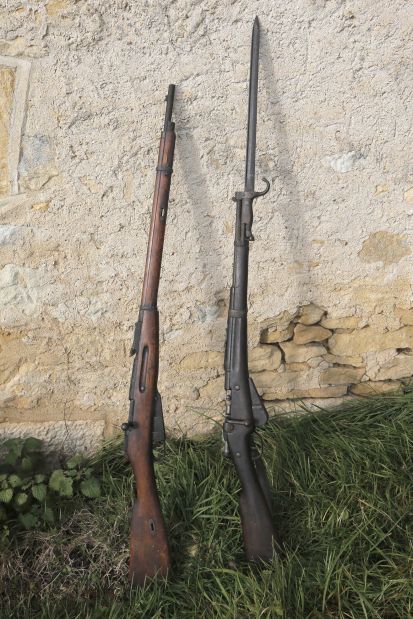
Two Word War One era rifles, one with an attached bayonet, lean against a farmhouse in Montignac, France, on Dec. 26, 2013. Despite technological advances with machine guns, mortars and grenades, the individual rifle remained the most crucial infantry weapon throughout the First World War. (AP Photo/Lionel Cironneau)
France World War One Centenary Weapons Rifle

A man holds A Word War One era rifle and bayonet in Montignac, France, on Dec. 26, 2013. Despite technological advances with machine guns, mortars and grenades, the individual rifle remained the most crucial infantry weapon throughout the First World War. (AP Photo/Lionel Cironneau)
France World War One Centenary Weapons Rifle

A man holds a Word War One era rifle with attached bayonet as he walks near a house in Montignac, France, on Dec. 26, 2013. Despite technological advances with machine guns, mortars and grenades, the individual rifle remained the most crucial infantry weapon throughout the First World War. (AP Photo/Lionel Cironneau)
WWI Belgium Ypres British Troops

The Battles of Ypres - Worn British troops passing by the gutted Market Hall of Ypres, during the winter of 1917-18. Half a million men were killed near the small Flanders town and after the Great War 60,000 workers labored for one year clearing the ruins. Rebuilding the town took six years. (AP-Photo)
WWI Belgium, destruction, Ypres

Ypres Cathedral in Ypres, Belgium, seen from the market square during World War I in an undated photo. (AP Photo)
WWI IRON HARVEST

**FILE**A wooden cross, a World War I shell and other mementos mark the place where Lancashire Fusiler Harry Wilkinson was killed in action in 1914 at St. Yvon, Belgium, in this Dec. 24, 2003 file photo. All along the so-called 30 kilometer salient and ridge that surrounds the nearby city of Ieper, better known to the soldiers of the 1914-18 World War by its French name, Ypres, farmers collect some 200 tons of metal a year, mostly shells, grenades, and gas canisters some of which pose a serious safety risk. (AP Photo/Virginia Mayo)
WWI IRON HARVEST

** ADVANCE FOR WEDNESDAY, JULY 11 **A wooden cross with a poppy on it lies on top of World War I shells found in the fields at the Sanctuary Wood museum in Zillebeke, Belgium, May 4, 2007. All along the so-called 30 kilometer salient and ridge that surrounds the nearby city of Ieper, better known to the soldiers of the 1914-18 World War by its French name, Ypres, farmers collect each year some 200 tons of shells, grenades and gas canisters, some of which pose a serious safety risk. (AP Photo/Virginia Mayo)
Belgium WWI Grenade

FILE - In this Jan. 9, 2014 file photo, members of the bomb disposal unit lower an unexploded shell in a sand bed onto their truck, at a construction site in Ypres, Northwestern Belgium. According to the Belgian Defense Department, two construction workers were killed on Wednesday, March 19, 2014, when they encountered the armament in a construction zone. Earlier this month a large amount of ammunition from the First World War was discovered on the border of the West Flemish municipalities of Passchendaele and Moorslede, for which the Belgian bomb squad is still working to clean up the site. (AP Photo/Yves Logghe, file)
Belgium WWI Grenade

FILE - In this Jan. 9, 2014 file photo, members of the bomb disposal unit measure an unexploded shell after it was loaded onto their truck, at a construction site in Ypres, Northwestern Belgium. According to the Belgian Defense Department, two construction workers were killed on Wednesday, March 19, 2014, when they encountered the armament in a construction zone. Earlier this month a large amount of ammunition from the First World War was discovered on the border of the West Flemish municipalities of Passchendaele and Moorslede, for which the Belgian bomb squad is still working to clean up the site. (AP Photo/Yves Logghe, file)
Most Popular

Hundreds turned out to the downtown campus of Pima Community College for this year's Mega Mania, August 1, 2026, Tucson, Ariz. Sponsored by Pi…

Arizona men's basketball hosts an open practice for members of the press to attend on Friday afternoon inside Richard Jefferson Gymnasium.

Community has been central to everything KXCI does, a testament to its tagline. “Tucson’s Community Radio,. which has been its guiding light s…

Host Thornydale fell behind from the start and couldn't catch up in falling to Northern California's Foothill 12-3 in the championship of the …

Images from the past week, July 28 - August 1, 2026, Tucson, Ariz.

Arizona Daily Star photographers capture summer heat across Southern Arizona.

Images from this year's monsoon action around Tucson by the Arizona Daily Star photography staff.

Arizona football hosts media day inside Davis Sports Center on Tuesday afternoon.

A mass shooting in downtown Tucson left nine injured, plus a suspect who was shot by an officer as he tried to run away on Sunday. Here's what…

Arizona football kicks off its first week of fall training camp on Wednesday morning at Tomey Field and Davis Sports Center.