

Sex scandal suit OK'd to advance; insurance up 45%; SWAT raid costs $60K
- Updated
Odd and interesting stories from the Midwest.
- Updated
CHICAGO (AP) — Health insurance premiums for Illinois residents who buy coverage through the Affordable Care Act's marketplace could increase by as much as 45 percent according to proposals submitted by insurers and made public Monday.
The leading insurer on Illinois' exchange, Blue Cross Blue Shield, is proposing increases for 2017 ranging from 23 percent to 45 percent for individual health care plans, according to proposals posted by Heathcare.gov. Another insurer, Coventry Health Care of Illinois, proposed rate increases as high as 21 percent.
Harken Health Insurance Company has proposed a nearly 29 percent hike in individual premiums and Health Alliance Medical Plans Inc. a more than 28 percent increase.
In a statement, Health Care Service Corporation, which operates Blue Cross Blue Shield of Illinois, said that although no final decision has been made, the proposed rates are in line with those in many markets across the country. It added that while some carriers have chosen to exit the market, it is "working toward continuing to provide health insurance options for consumers in Illinois.
"However, that must be done in a sustainable way," the statement said. "Premium rates must cover the anticipated health care needs of our members, and consumer protections exist in the way of rebates if a certain percent of premiums do not go directly to covering medical services and quality programs. "
The proposed hikes have been expected because the health care law has been a financial drain for many companies.
Analysts have noted insurers are facing higher medical costs from customers, and some companies priced their initial coverage too low in an attempt to grab new business.
The Illinois Department of Insurance has until Aug. 23 to review the proposed rates, but, unlike several other states, it doesn't have the power to reject the proposed rates outright.
"We don't put too much stock in the numbers as they stand right now because we know the (Department of Insurance) is really negotiating the rates up until the last deadline," Kathy Waligora, director of EverThrive Illinois' health reform initiative, told the Chicago Tribune.
Illinois' marketplace has been roiled by recent defections. UnitedHealthcare, the nation's largest health insurer, is leaving after just two years of minimal participation. And Chicago-based Land of Lincoln Health, a 3-year-old startup that sold plans throughout the state, collapsed after suffering heavy losses. Its 49,000 enrollees are looking for new coverage for the rest of the year.
- Updated
GRAND RAPIDS, Mich. (AP) — A federal judge has ruled in favor of two former Michigan House aides who say they were illegally fired before a sex scandal broke in the Capitol.
Judge Gordon Quist says Keith Allard and Ben Graham were engaged in protected activity under a whistleblower law when they reported wrongdoing by lawmakers Todd Courser and Cindy Gamrat. Their lawsuit against the House can go forward.
The aides were fired last July, shortly before an affair by Courser and Gamrat became public. Courser and Gamrat were accused of trying to cover up the affair. One quit the House, and the other was expelled.
The Detroit News (http://detne.ws/2avibrh ) says the House had asked a judge to dismiss the lawsuit. But Quist says Allard and Graham "spoke out on matters of public concern."
___
Information from: The Detroit News, http://detnews.com/
- Updated
FARGO, N.D. (AP) — A Dunseith woman accused of sexually abusing a boy has been sentenced to six months in prison and six months of home confinement.
Raelynn Thiefoe pleaded guilty in March to a federal charge of sexual abuse of a minor. Authorities say she engaged in a sexual act last year with a boy between the age of 12 and 16.
In handing down the sentence, U.S. District Judge Ralph Erickson said Thiefoe has a diminished learning capacity and is easily manipulated.
Thiefoe was ordered to undergo chemical dependency screening and treatment. Erickson says she must serve five years of supervised release.
- Updated
NAPERVILLE, Ill. (AP) — A 12-year-old Naperville resident is the youngest girl to climb to the highest point in each of the lower 48 states.
The Highpointers Club, a membership organization for hikers climbing the highest peaks in each state, confirmed Lucy Westlake's record, the Daily Herald (http://bit.ly/2amyA2L ) reported. The club said the previous record was set by a 17-year-old Kristen Kelliher of Vermont in 2011.
Club member and Highpointers Foundation Lead Director Dave Covill said achieving this goal at an early age is an amazing feat.
"That's extremely impressive when you consider that the previous record-holder was 17 and the third place was 18," he said.
Lucy's first climb was on a more than 1,300-foot mountain in Michigan's Upper Peninsula near her family's cabin. She ran, climbed and explored on the 6-kilometer route.
When Lucy was 7 and living in Kentucky in 2011, her family climbed the state's highest location, the more than 4,100-foot Black Mountain. The next year, she tackled 13 more climbs.
She broke the record after climbing Kings Peak in Utah this year. Lucy's next goal is Mount Denali in Alaska.
"It's so fun to be able to see the country like that," Lucy said. "Being the highest thing in the state is cool."
Rodney Westlake, Lucy's father, said the family's well-traveled lifestyle allowed Lucy to climb many mountains without even making it a goal.
"I've always had a love of the outdoors and wanted to raise my kids with that love," said Amy Westlake, Lucy's mother.
Rodney Westlake said his daughter is very athletic. When her family lived in Kentucky, Lucy competed in state championship races and placed third in a 2015 regional cross-country race. During her first year training as a competitive triathlete since her family moved to Naperville in January, she qualified for the USA Triathlon Youth Elite National Championship.
"She has unlimited endurance," her father said.
___
Information from: Daily Herald, http://www.dailyherald.com
- Updated
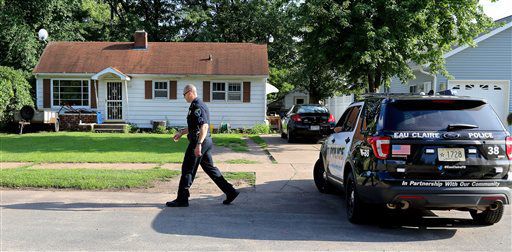
EAU CLAIRE, Wis. (AP) — Bail is set at $1 million for an Eau Claire man suspected of fatally shooting his neighbor in her home over the weekend.
The 44-year-old man was in court Monday for a bond hearing. He has not been formally charged.
Police identified the victim as 36-year-old Jenny Ward. Authorities say the suspect and Ward were neighbors.
The Leader-Telegram reports Eau Claire County District Attorney Gary King said during the hearing that the suspect confronted the woman in her home around 6:30 a.m. Saturday before shooting her several times. King says both of the woman's children were home and called police.
Police arrived and stopped the suspect trying to leave in a pickup. King says a rifle was found in the truck.
The suspect returns to court Thursday. He remains in jail.
___
Information from: Leader-Telegram, http://www.leadertelegram.com/
- Updated
GROSSE POINTE FARMS, Mich. (AP) — Five people have rescued a man from his car after he accidentally drove into Lake St. Clair in suburban Detroit.
Video posted online by Detroit-area news media (http://on.freep.com/2aKn7Nx ) shows the man, believed to be in his 60s or 70s, being pulled from his car Monday in Grosse Pointe Farms.
Police believe he had a health problem when his car crossed a median and two lanes of traffic before landing in Lake St. Clair.
Lt. Andrew Rogers says the man was unresponsive until the water hit his chin. He's expected to be OK.
The man was rescued by three police officers and two people who were working nearby for a landscaping service. One of the landscapers, John Lyon, tells WDIV-TV that he didn't hesitate to jump in the water.
- Updated
WEST LAFAYETTE, Ind. (AP) — An ordinance backed by the mayor of West Lafayette would require impounded animals to be implanted with identification microchips.
Owners of impounded animals would be required to have their pets chipped or pay a $200 fine under the county ordinance, the Lafayette Journal and Courier (http://on.jconline.com/2amCyIo ) reported. Owners could recover their pets within four days, paying $10 for the first offense and $20 for each successive offense.
Almost Home Humane Society executive director Stacy Rogers said about 150 lost pets end up at the society each year and more than 20 percent of them have been impounded before. The shelter has implanted more than 12,000 microchips over the past nine years.
"(Microchips) help us because our goal is to return animals to their home as soon as possible," Rogers said. "If animal control has a scanner in their truck, they could return that animal before it even gets to us."
Microchip implantation also helps authorities confront owners who ditch their pets.
"Ownership is a responsibility that some do not take seriously," said Sharon Dull, a volunteer at Crystal Creek Kennel in Battle Ground.
Nita Pollock, owner of Crystal Creek Kennel, said she supports the microchip implantation efforts.
"It's the best way to get pets back to their owners," Pollock said. "It's a dog collar that won't come off, that somebody can't take off."
___
Information from: Journal and Courier, http://www.jconline.com
- Updated
EVANSVILLE, Ind. (AP) — The city of Evansville paid $60,000 to settle a lawsuit filed by a woman whose home was damaged during a SWAT raid in 2012 as police investigated online threats against officers.
The Evansville Courier & Press reports (http://bit.ly/2apwFZa ) the settlement with Louise Milan was announced in May, but terms were not disclosed. The agreement does not identify any "liability, guilt, fault, or wrongdoing" by police or Milan. It also releases the city, police department, individual officers and Milan from further legal claims.
The lawsuit alleged police violated Milan's constitutional rights when the SWAT team tossed two flash-bang grenades into her home and forced their way in to serve a search warrant. Police were looking for evidence of anonymous internet posts threatening police. No evidence was found in the home.
___
Information from: Evansville Courier & Press, http://www.courierpress.com
- By KYLE POTTER Associated Press
- Updated
MINNEAPOLIS (AP) — Judy Bjerke Severson wants to be normal — visit friends and family, go to the grocery store or even sleep in her own bed — but she says the crippling pain from fibromyalgia and back surgery complications, as well as a painkiller-induced fog, have made her a shell of her former self.
Monday brought a sliver of hope to her and other Minnesota residents who have incurable pain: They can buy medical marijuana, after waiting years for Minnesota to legalize the drug's medical use and another year for intractable pain to be added as a qualifying condition.
Bjerke Severson was the first person Monday morning to be seen at a Bloomington clinic, one of eight statewide that sell the medicine.
"I can't tell you, I'm going to cry. I'm so excited," the 70-year-old Edina woman said, leaning on a pink cane before her appointment. "I'm in pain 24 hours a day, seven days a week."
Expanding the list of qualifying conditions to include intractable pain marks a critical juncture in the year-old program, which is among the most restrictive in the country. Manufacturers and patients have big hopes that it will usher in thousands of new patients, eventually bringing down high costs — which exceed $1,000 a month for some patients — and easing dependence on addictive narcotic painkillers.
Those hopes were buoyed by data from the state showing nearly 500 patients suffering intractable pain had registered in July, the first month of registration and a month before legal sales could begin. That's more than five times the number of people who signed up in the month ahead of the program's launch.
The Minnesota Legislature legalized medical marijuana in 2014. The law bans the plant form, but allows pills, oils and vapors to be used by patients with nine serious conditions who received their doctor's permission.
The Legislature directed Minnesota's health commissioner to determine if intractable pain should be added as a 10th condition within the program's first year. Commissioner Ed Ehlinger cited the program's successful first few months when announcing in December that intractable pain would qualify starting Aug. 1.
Kyle Kinglsey at Minnesota Medical Solutions, one of the state's two medical marijuana manufacturers, said he's confident a largely problem-free first year and his company's own outreach efforts to the medical community would make it easier in the second year. He also said he thinks doctors, many of whom patients have said are wary of the health benefits and possible drawbacks of marijuana, will be convinced it's an attractive alternative to addictive and often deadly opiate painkillers.
"This really is the shot in the arm that the program needs," said Kingsley, the company's chief executive. He said he expects as many as 40 new patients at Minnesota Medical Solutions on the first day.
The long-awaited expansion is welcome for patient advocacy organizations, though Maren Schroeder doubts whether it would have any impact on the program's costs. Her patient advocacy group, Sensible Minnesota, is pushing to allow patients to use the plant form and has petitioned Ehlinger to add post-traumatic stress disorder as a qualifying condition next year.
For now, manufacturers and patients are focused on intractable pain, which the state defines as pain that can't be otherwise treated or cured.
For Bjerke Severson, that means muscle spasms, tingling and fiery pain so severe she can barely walk. Having lived the last two decades with chronic pain, she struggles to describe it.
Bjerke Severson knows medical marijuana won't be a magic cure. But she is hoping to kick the hydrocodone and get some relief.
"I would love to do an errand," she said. "Things that people not just take for granted, but busywork they're sick of."
- Updated
KANSAS CITY, Kan. (AP) — A suburban Kansas City man has pleaded guilty to sending fake IRS letters to former girlfriends and business partners telling that they were under investigation for tax evasion.
The U.S. attorney's office says that 56-year-old Jeffrey Nickerson, of Lenexa, Kansas, pleaded guilty Monday to one count of impersonating a federal employee. Nickerson sent letters on IRS letterhead that said the victims were under investigation as a result of reports being filed to the IRS Fraud Investigations Hotline.
He knew a woman who worked at the IRS Service Center in Kansas City, Missouri, and admitted to using information gleaned from the IRS letterhead and publications she brought home with her.
Nickerson faces up to three years in federal prison and a fine up to $250,000. The sentencing date hasn't been set.
- By NICK LOWREY Capital Journal
- Updated
PIERRE, S.D. (AP) — The last weekend in September will be one to remember for eight young deer hunters.
At least that's what the South Dakota Game Fish and Parks Department is hoping.
The eight hunters each will have the chance to harvest their first deer from private land in Lyman County as part of a new program led by Conservation Officer Brian Ridgway.
The idea, he said, is to find some kids between the ages of 12 and 15 who didn't grow up as hunters and don't have the opportunities to get out in the field and then take them hunting with their parents.
"We're looking for those kids that don't come from hunting families," Ridgway told the Capital Journal (http://bit.ly/2ag3WWN ).
The Youth Deer Camp, as it is being called, will call the Snake Den Lodge near Presho its home base for the weekend of September 24-25. The Snake Den normally is a pheasant hunting operation and will have some pheasant hunters taking advantage of South Dakota's preserve hunting season that weekend, said Casey Griffith who runs the hunting side of the Snake Den's business.
"I think what they're trying to do is great," he said of the Youth Deer Camp. "Our economy is largely based on the outdoors and hunting."
The young hunters will get lessons on hunting safety, shooting guns ranging from .22-caliber pistols to shotguns and rifles, Ridgway said. And if everything goes according to plan, the hunters will get to learn how to field-dress a deer too.
They'll do all of this with at least one of their parents or a guardian in tow, Ridgway said. Ultimately the goal is to not only hook the kid on hunting but their parents as well.
"Everything that the kids do, the parents will do too," Ridgway said.
One exception to that rule will be harvesting a deer, he said.
Everything each of the kids need for the hunt will be provided for them, Ridgway said. That includes an Alps Outdoors pack full of hunting gear. Each of the hunters will get a mentor that will act as a guide during the two-day hunt and will be able to borrow a rifle if needed.
"If they really needed a shirt we'd provide that too," Ridgeway said.
The hunters will be spread out over property owned by the Snake Den lodge and a few neighboring landowners, Ridgway said. They'll be set up in blinds with their mentor and parent and will be looking exclusively for whitetail deer does.
The Youth Deer Camp fits right into the GFP's participation in the national R3 program, which aims to recruit, retain or reactivate hunters as a way to grow the base from which most conservation funding in the U.S. flows.
Ridgway, who came to South Dakota from Missouri, where he also worked as conservation officer, had participated in a similar deer camp program in that state. Those programs were pretty successful so, Ridgway said, he thought it would be worth a try here too.
In South Dakota kids can start hunting at the age of 12. Between that age and the age of 15, Ridgway said, appears to be a critical time for recruiting them into the hunting lifestyle.
"It seems to be about that pivotal age that they decide that's what they want to do with their lives," Ridgway said
Parents or kids interested in the Youth Deer camp must apply for the opportunity. Applicants will be asked a series of questions and will be selected to participate in the camp based on their answers. Each hunter selected will be provided a South Dakota youth deer hunting license in addition to three meals and equipment for the hunt.
For more information and to apply, contact GFP conservation officer, Brian Ridgway at 605.734.4578 or Brian.Ridgway@state.sd.us.
___
Information from: Pierre Capital Journal, http://www.capjournal.com
- Updated
MADISON, Wis. (AP) — The University of Wisconsin-Madison is creating a diversity program for its incoming freshmen students after a series of race-related incidents have occurred on campus.
The campus will test the program, called Our Wisconsin, on up to 1,000 freshmen to allow students to learn about themselves and others, the Milwaukee Journal Sentinel (http://bit.ly/2aJf3N8 ) reported.
"That's what the collegiate experience is all about," UW-Madison Dean of Students Lori Berquam said. "Some of our students are joining us from small towns and they're going to live in a residence hall that's bigger."
More than half of the university's students are from Wisconsin, which the U.S. Census Bureau said was nearly 88% white in 2015.
The campus is part of a national trend of colleges that believe mandatory cultural competency orientation can relieve racial tensions and help students navigate diverse work environments after graduation.
The program's creators said they consulted with other colleges that have implemented diversity programs, including University of Oklahoma, Oregon State University and the University of Michigan. A diversity consulting firm hired by the university wrote the program's curriculum.
University of Wisconsin-Madison has already hired an unidentified program director as well as an undergraduate student assistant. The program will also have 45 facilitators made up of students and faculty.
Chancellor Rebecca Blank set aside $150,000 to $200,000 from a special fund for the pilot program.
W. Lee Hansen, professor emeritus of economics at UW-Madison, has written several op-eds questioning the program and predicts there will be student backlash. He said the university's population of more than 43,000 will always include some people who have unshakable views on race and that diversity training only pits students against one another.
Last year, the university saw incidents in which swastikas were taped to a Jewish student's dorm room door, a Native American elder was heckled and a student of color received an anonymous note with racial threats.
___
Information from: Milwaukee Journal Sentinel, http://www.jsonline.com
- Updated
OMAHA, Neb. (AP) — Omaha Public Schools is set to open its first virtual school for kindergarten through eighth-grade students this month.
The Omaha Virtual School will be open to home-schooled students, giving them a mix of face-to-face instruction and online lessons, the Omaha World-Herald reported (http://bit.ly/2aJ5AFv ).
Students participating in the free program will be given a laptop to receive instruction at home at their own pace. They'll also be required to report in person once a week for face-to-face activities, such as science labs or field trips.
"I believe strongly that a school isn't just about the building, it's about the students," said Wendy Loewenstein, the director of the virtual school. "Not every student can find success in a traditional school environment, and our school will be providing another option for families to explore."
The school board unanimously approved the program last month and has received more than 180 applications from students who wish to enroll. Enrollment will be capped at 300 for the first year.
Students will be required to sign up for at least two courses, which cover core subject areas such as math and language arts, as well as several technology-oriented electives.
The district plans to hire four teachers and a student learning advocate, similar to a school counselor.
Superintendent Mark Evans said the program will avoid the pitfalls that have challenged virtual schools in other states.
"It's not uncommon to see articles across the nation about online schools that didn't do well," he said at the July 18 school board meeting. "In other states I've seen it happen because they didn't do it the right way. What you just heard tonight in this brief description is someone doing it the right way."
___
Information from: Omaha World-Herald, http://www.omaha.com
CHICAGO (AP) — Health insurance premiums for Illinois residents who buy coverage through the Affordable Care Act's marketplace could increase by as much as 45 percent according to proposals submitted by insurers and made public Monday.
The leading insurer on Illinois' exchange, Blue Cross Blue Shield, is proposing increases for 2017 ranging from 23 percent to 45 percent for individual health care plans, according to proposals posted by Heathcare.gov. Another insurer, Coventry Health Care of Illinois, proposed rate increases as high as 21 percent.
Harken Health Insurance Company has proposed a nearly 29 percent hike in individual premiums and Health Alliance Medical Plans Inc. a more than 28 percent increase.
In a statement, Health Care Service Corporation, which operates Blue Cross Blue Shield of Illinois, said that although no final decision has been made, the proposed rates are in line with those in many markets across the country. It added that while some carriers have chosen to exit the market, it is "working toward continuing to provide health insurance options for consumers in Illinois.
"However, that must be done in a sustainable way," the statement said. "Premium rates must cover the anticipated health care needs of our members, and consumer protections exist in the way of rebates if a certain percent of premiums do not go directly to covering medical services and quality programs. "
The proposed hikes have been expected because the health care law has been a financial drain for many companies.
Analysts have noted insurers are facing higher medical costs from customers, and some companies priced their initial coverage too low in an attempt to grab new business.
The Illinois Department of Insurance has until Aug. 23 to review the proposed rates, but, unlike several other states, it doesn't have the power to reject the proposed rates outright.
"We don't put too much stock in the numbers as they stand right now because we know the (Department of Insurance) is really negotiating the rates up until the last deadline," Kathy Waligora, director of EverThrive Illinois' health reform initiative, told the Chicago Tribune.
Illinois' marketplace has been roiled by recent defections. UnitedHealthcare, the nation's largest health insurer, is leaving after just two years of minimal participation. And Chicago-based Land of Lincoln Health, a 3-year-old startup that sold plans throughout the state, collapsed after suffering heavy losses. Its 49,000 enrollees are looking for new coverage for the rest of the year.
GRAND RAPIDS, Mich. (AP) — A federal judge has ruled in favor of two former Michigan House aides who say they were illegally fired before a sex scandal broke in the Capitol.
Judge Gordon Quist says Keith Allard and Ben Graham were engaged in protected activity under a whistleblower law when they reported wrongdoing by lawmakers Todd Courser and Cindy Gamrat. Their lawsuit against the House can go forward.
The aides were fired last July, shortly before an affair by Courser and Gamrat became public. Courser and Gamrat were accused of trying to cover up the affair. One quit the House, and the other was expelled.
The Detroit News (http://detne.ws/2avibrh ) says the House had asked a judge to dismiss the lawsuit. But Quist says Allard and Graham "spoke out on matters of public concern."
___
Information from: The Detroit News, http://detnews.com/
FARGO, N.D. (AP) — A Dunseith woman accused of sexually abusing a boy has been sentenced to six months in prison and six months of home confinement.
Raelynn Thiefoe pleaded guilty in March to a federal charge of sexual abuse of a minor. Authorities say she engaged in a sexual act last year with a boy between the age of 12 and 16.
In handing down the sentence, U.S. District Judge Ralph Erickson said Thiefoe has a diminished learning capacity and is easily manipulated.
Thiefoe was ordered to undergo chemical dependency screening and treatment. Erickson says she must serve five years of supervised release.
NAPERVILLE, Ill. (AP) — A 12-year-old Naperville resident is the youngest girl to climb to the highest point in each of the lower 48 states.
The Highpointers Club, a membership organization for hikers climbing the highest peaks in each state, confirmed Lucy Westlake's record, the Daily Herald (http://bit.ly/2amyA2L ) reported. The club said the previous record was set by a 17-year-old Kristen Kelliher of Vermont in 2011.
Club member and Highpointers Foundation Lead Director Dave Covill said achieving this goal at an early age is an amazing feat.
"That's extremely impressive when you consider that the previous record-holder was 17 and the third place was 18," he said.
Lucy's first climb was on a more than 1,300-foot mountain in Michigan's Upper Peninsula near her family's cabin. She ran, climbed and explored on the 6-kilometer route.
When Lucy was 7 and living in Kentucky in 2011, her family climbed the state's highest location, the more than 4,100-foot Black Mountain. The next year, she tackled 13 more climbs.
She broke the record after climbing Kings Peak in Utah this year. Lucy's next goal is Mount Denali in Alaska.
"It's so fun to be able to see the country like that," Lucy said. "Being the highest thing in the state is cool."
Rodney Westlake, Lucy's father, said the family's well-traveled lifestyle allowed Lucy to climb many mountains without even making it a goal.
"I've always had a love of the outdoors and wanted to raise my kids with that love," said Amy Westlake, Lucy's mother.
Rodney Westlake said his daughter is very athletic. When her family lived in Kentucky, Lucy competed in state championship races and placed third in a 2015 regional cross-country race. During her first year training as a competitive triathlete since her family moved to Naperville in January, she qualified for the USA Triathlon Youth Elite National Championship.
"She has unlimited endurance," her father said.
___
Information from: Daily Herald, http://www.dailyherald.com
EAU CLAIRE, Wis. (AP) — Bail is set at $1 million for an Eau Claire man suspected of fatally shooting his neighbor in her home over the weekend.
The 44-year-old man was in court Monday for a bond hearing. He has not been formally charged.
Police identified the victim as 36-year-old Jenny Ward. Authorities say the suspect and Ward were neighbors.
The Leader-Telegram reports Eau Claire County District Attorney Gary King said during the hearing that the suspect confronted the woman in her home around 6:30 a.m. Saturday before shooting her several times. King says both of the woman's children were home and called police.
Police arrived and stopped the suspect trying to leave in a pickup. King says a rifle was found in the truck.
The suspect returns to court Thursday. He remains in jail.
___
Information from: Leader-Telegram, http://www.leadertelegram.com/
GROSSE POINTE FARMS, Mich. (AP) — Five people have rescued a man from his car after he accidentally drove into Lake St. Clair in suburban Detroit.
Video posted online by Detroit-area news media (http://on.freep.com/2aKn7Nx ) shows the man, believed to be in his 60s or 70s, being pulled from his car Monday in Grosse Pointe Farms.
Police believe he had a health problem when his car crossed a median and two lanes of traffic before landing in Lake St. Clair.
Lt. Andrew Rogers says the man was unresponsive until the water hit his chin. He's expected to be OK.
The man was rescued by three police officers and two people who were working nearby for a landscaping service. One of the landscapers, John Lyon, tells WDIV-TV that he didn't hesitate to jump in the water.
WEST LAFAYETTE, Ind. (AP) — An ordinance backed by the mayor of West Lafayette would require impounded animals to be implanted with identification microchips.
Owners of impounded animals would be required to have their pets chipped or pay a $200 fine under the county ordinance, the Lafayette Journal and Courier (http://on.jconline.com/2amCyIo ) reported. Owners could recover their pets within four days, paying $10 for the first offense and $20 for each successive offense.
Almost Home Humane Society executive director Stacy Rogers said about 150 lost pets end up at the society each year and more than 20 percent of them have been impounded before. The shelter has implanted more than 12,000 microchips over the past nine years.
"(Microchips) help us because our goal is to return animals to their home as soon as possible," Rogers said. "If animal control has a scanner in their truck, they could return that animal before it even gets to us."
Microchip implantation also helps authorities confront owners who ditch their pets.
"Ownership is a responsibility that some do not take seriously," said Sharon Dull, a volunteer at Crystal Creek Kennel in Battle Ground.
Nita Pollock, owner of Crystal Creek Kennel, said she supports the microchip implantation efforts.
"It's the best way to get pets back to their owners," Pollock said. "It's a dog collar that won't come off, that somebody can't take off."
___
Information from: Journal and Courier, http://www.jconline.com
EVANSVILLE, Ind. (AP) — The city of Evansville paid $60,000 to settle a lawsuit filed by a woman whose home was damaged during a SWAT raid in 2012 as police investigated online threats against officers.
The Evansville Courier & Press reports (http://bit.ly/2apwFZa ) the settlement with Louise Milan was announced in May, but terms were not disclosed. The agreement does not identify any "liability, guilt, fault, or wrongdoing" by police or Milan. It also releases the city, police department, individual officers and Milan from further legal claims.
The lawsuit alleged police violated Milan's constitutional rights when the SWAT team tossed two flash-bang grenades into her home and forced their way in to serve a search warrant. Police were looking for evidence of anonymous internet posts threatening police. No evidence was found in the home.
___
Information from: Evansville Courier & Press, http://www.courierpress.com
- By KYLE POTTER Associated Press
MINNEAPOLIS (AP) — Judy Bjerke Severson wants to be normal — visit friends and family, go to the grocery store or even sleep in her own bed — but she says the crippling pain from fibromyalgia and back surgery complications, as well as a painkiller-induced fog, have made her a shell of her former self.
Monday brought a sliver of hope to her and other Minnesota residents who have incurable pain: They can buy medical marijuana, after waiting years for Minnesota to legalize the drug's medical use and another year for intractable pain to be added as a qualifying condition.
Bjerke Severson was the first person Monday morning to be seen at a Bloomington clinic, one of eight statewide that sell the medicine.
"I can't tell you, I'm going to cry. I'm so excited," the 70-year-old Edina woman said, leaning on a pink cane before her appointment. "I'm in pain 24 hours a day, seven days a week."
Expanding the list of qualifying conditions to include intractable pain marks a critical juncture in the year-old program, which is among the most restrictive in the country. Manufacturers and patients have big hopes that it will usher in thousands of new patients, eventually bringing down high costs — which exceed $1,000 a month for some patients — and easing dependence on addictive narcotic painkillers.
Those hopes were buoyed by data from the state showing nearly 500 patients suffering intractable pain had registered in July, the first month of registration and a month before legal sales could begin. That's more than five times the number of people who signed up in the month ahead of the program's launch.
The Minnesota Legislature legalized medical marijuana in 2014. The law bans the plant form, but allows pills, oils and vapors to be used by patients with nine serious conditions who received their doctor's permission.
The Legislature directed Minnesota's health commissioner to determine if intractable pain should be added as a 10th condition within the program's first year. Commissioner Ed Ehlinger cited the program's successful first few months when announcing in December that intractable pain would qualify starting Aug. 1.
Kyle Kinglsey at Minnesota Medical Solutions, one of the state's two medical marijuana manufacturers, said he's confident a largely problem-free first year and his company's own outreach efforts to the medical community would make it easier in the second year. He also said he thinks doctors, many of whom patients have said are wary of the health benefits and possible drawbacks of marijuana, will be convinced it's an attractive alternative to addictive and often deadly opiate painkillers.
"This really is the shot in the arm that the program needs," said Kingsley, the company's chief executive. He said he expects as many as 40 new patients at Minnesota Medical Solutions on the first day.
The long-awaited expansion is welcome for patient advocacy organizations, though Maren Schroeder doubts whether it would have any impact on the program's costs. Her patient advocacy group, Sensible Minnesota, is pushing to allow patients to use the plant form and has petitioned Ehlinger to add post-traumatic stress disorder as a qualifying condition next year.
For now, manufacturers and patients are focused on intractable pain, which the state defines as pain that can't be otherwise treated or cured.
For Bjerke Severson, that means muscle spasms, tingling and fiery pain so severe she can barely walk. Having lived the last two decades with chronic pain, she struggles to describe it.
Bjerke Severson knows medical marijuana won't be a magic cure. But she is hoping to kick the hydrocodone and get some relief.
"I would love to do an errand," she said. "Things that people not just take for granted, but busywork they're sick of."
KANSAS CITY, Kan. (AP) — A suburban Kansas City man has pleaded guilty to sending fake IRS letters to former girlfriends and business partners telling that they were under investigation for tax evasion.
The U.S. attorney's office says that 56-year-old Jeffrey Nickerson, of Lenexa, Kansas, pleaded guilty Monday to one count of impersonating a federal employee. Nickerson sent letters on IRS letterhead that said the victims were under investigation as a result of reports being filed to the IRS Fraud Investigations Hotline.
He knew a woman who worked at the IRS Service Center in Kansas City, Missouri, and admitted to using information gleaned from the IRS letterhead and publications she brought home with her.
Nickerson faces up to three years in federal prison and a fine up to $250,000. The sentencing date hasn't been set.
- By NICK LOWREY Capital Journal
PIERRE, S.D. (AP) — The last weekend in September will be one to remember for eight young deer hunters.
At least that's what the South Dakota Game Fish and Parks Department is hoping.
The eight hunters each will have the chance to harvest their first deer from private land in Lyman County as part of a new program led by Conservation Officer Brian Ridgway.
The idea, he said, is to find some kids between the ages of 12 and 15 who didn't grow up as hunters and don't have the opportunities to get out in the field and then take them hunting with their parents.
"We're looking for those kids that don't come from hunting families," Ridgway told the Capital Journal (http://bit.ly/2ag3WWN ).
The Youth Deer Camp, as it is being called, will call the Snake Den Lodge near Presho its home base for the weekend of September 24-25. The Snake Den normally is a pheasant hunting operation and will have some pheasant hunters taking advantage of South Dakota's preserve hunting season that weekend, said Casey Griffith who runs the hunting side of the Snake Den's business.
"I think what they're trying to do is great," he said of the Youth Deer Camp. "Our economy is largely based on the outdoors and hunting."
The young hunters will get lessons on hunting safety, shooting guns ranging from .22-caliber pistols to shotguns and rifles, Ridgway said. And if everything goes according to plan, the hunters will get to learn how to field-dress a deer too.
They'll do all of this with at least one of their parents or a guardian in tow, Ridgway said. Ultimately the goal is to not only hook the kid on hunting but their parents as well.
"Everything that the kids do, the parents will do too," Ridgway said.
One exception to that rule will be harvesting a deer, he said.
Everything each of the kids need for the hunt will be provided for them, Ridgway said. That includes an Alps Outdoors pack full of hunting gear. Each of the hunters will get a mentor that will act as a guide during the two-day hunt and will be able to borrow a rifle if needed.
"If they really needed a shirt we'd provide that too," Ridgeway said.
The hunters will be spread out over property owned by the Snake Den lodge and a few neighboring landowners, Ridgway said. They'll be set up in blinds with their mentor and parent and will be looking exclusively for whitetail deer does.
The Youth Deer Camp fits right into the GFP's participation in the national R3 program, which aims to recruit, retain or reactivate hunters as a way to grow the base from which most conservation funding in the U.S. flows.
Ridgway, who came to South Dakota from Missouri, where he also worked as conservation officer, had participated in a similar deer camp program in that state. Those programs were pretty successful so, Ridgway said, he thought it would be worth a try here too.
In South Dakota kids can start hunting at the age of 12. Between that age and the age of 15, Ridgway said, appears to be a critical time for recruiting them into the hunting lifestyle.
"It seems to be about that pivotal age that they decide that's what they want to do with their lives," Ridgway said
Parents or kids interested in the Youth Deer camp must apply for the opportunity. Applicants will be asked a series of questions and will be selected to participate in the camp based on their answers. Each hunter selected will be provided a South Dakota youth deer hunting license in addition to three meals and equipment for the hunt.
For more information and to apply, contact GFP conservation officer, Brian Ridgway at 605.734.4578 or Brian.Ridgway@state.sd.us.
___
Information from: Pierre Capital Journal, http://www.capjournal.com
MADISON, Wis. (AP) — The University of Wisconsin-Madison is creating a diversity program for its incoming freshmen students after a series of race-related incidents have occurred on campus.
The campus will test the program, called Our Wisconsin, on up to 1,000 freshmen to allow students to learn about themselves and others, the Milwaukee Journal Sentinel (http://bit.ly/2aJf3N8 ) reported.
"That's what the collegiate experience is all about," UW-Madison Dean of Students Lori Berquam said. "Some of our students are joining us from small towns and they're going to live in a residence hall that's bigger."
More than half of the university's students are from Wisconsin, which the U.S. Census Bureau said was nearly 88% white in 2015.
The campus is part of a national trend of colleges that believe mandatory cultural competency orientation can relieve racial tensions and help students navigate diverse work environments after graduation.
The program's creators said they consulted with other colleges that have implemented diversity programs, including University of Oklahoma, Oregon State University and the University of Michigan. A diversity consulting firm hired by the university wrote the program's curriculum.
University of Wisconsin-Madison has already hired an unidentified program director as well as an undergraduate student assistant. The program will also have 45 facilitators made up of students and faculty.
Chancellor Rebecca Blank set aside $150,000 to $200,000 from a special fund for the pilot program.
W. Lee Hansen, professor emeritus of economics at UW-Madison, has written several op-eds questioning the program and predicts there will be student backlash. He said the university's population of more than 43,000 will always include some people who have unshakable views on race and that diversity training only pits students against one another.
Last year, the university saw incidents in which swastikas were taped to a Jewish student's dorm room door, a Native American elder was heckled and a student of color received an anonymous note with racial threats.
___
Information from: Milwaukee Journal Sentinel, http://www.jsonline.com
OMAHA, Neb. (AP) — Omaha Public Schools is set to open its first virtual school for kindergarten through eighth-grade students this month.
The Omaha Virtual School will be open to home-schooled students, giving them a mix of face-to-face instruction and online lessons, the Omaha World-Herald reported (http://bit.ly/2aJ5AFv ).
Students participating in the free program will be given a laptop to receive instruction at home at their own pace. They'll also be required to report in person once a week for face-to-face activities, such as science labs or field trips.
"I believe strongly that a school isn't just about the building, it's about the students," said Wendy Loewenstein, the director of the virtual school. "Not every student can find success in a traditional school environment, and our school will be providing another option for families to explore."
The school board unanimously approved the program last month and has received more than 180 applications from students who wish to enroll. Enrollment will be capped at 300 for the first year.
Students will be required to sign up for at least two courses, which cover core subject areas such as math and language arts, as well as several technology-oriented electives.
The district plans to hire four teachers and a student learning advocate, similar to a school counselor.
Superintendent Mark Evans said the program will avoid the pitfalls that have challenged virtual schools in other states.
"It's not uncommon to see articles across the nation about online schools that didn't do well," he said at the July 18 school board meeting. "In other states I've seen it happen because they didn't do it the right way. What you just heard tonight in this brief description is someone doing it the right way."
___
Information from: Omaha World-Herald, http://www.omaha.com
Most Popular
-
Arizona lawmaker seeks to jump-start I-11 construction
-
Former Arizona governor admitted to partaking in Peep jousting
-
 Faculty concerned about changes to U of A admissions policy
 -
ICE agents pepper spray observers in South Tucson
-
Report: Sheriff Nanos improperly used position, resources in political foe's suspension

