

Woman fleeing robbery hit by truck; mowing less; wooden car trip
- Updated
Odd and interesting news from the Midwest.
- Updated
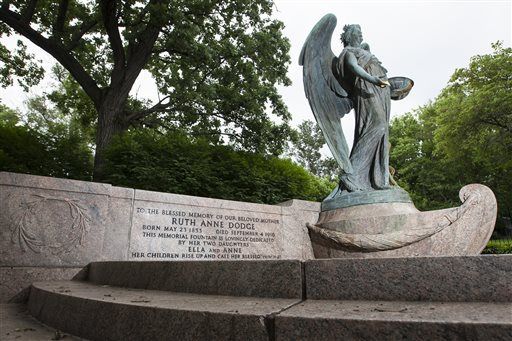
COUNCIL BLUFFS, Iowa (AP) — Council Bluffs officials and resident have spent nearly $10,000 on a 3-D image of a historic statue to ensure the artwork can be restored if it's ever damaged.
Residents and officials teamed for the scan of the Ruth Anne Dodge Memorial, according to The Daily Nonpareil (http://bit.ly/1Wt4jTy ).
The 96-year-old statue was sculpted by Daniel Chester French, who created the Lincoln Memorial in Washington. The bronze sculpture had fallen into disrepair but was restored in 1984 and now is listed on the National Register of Historic Places.
Residents wanted to be sure the statue could be restored if it were damaged, so the Lincoln/Fairview Neighborhood Association worked with the city to raise $9,750 for a California company that scanned the sculpture over several weeks, giving officials an exact replica of the artwork.
"The concern was that if something was broken off, for example, having some way to repair or recreate that piece was important," Parks Director Larry Foster said. "It's a unique piece."
Officials had considered creating a mold of the statue, but that option would have been more expensive and required the storage of the mold. The scanning option was cheaper and the data could be stored in a computer.
The scanning company did its work over several weeks and captured images at night.
Neighbors who worked to raise money said they were happy with the project.
Susan Seamands, the association's past president, said the statue is a beloved part of the community.
The statue, known as The Black Angel, commemorates the 1916 death of Ruth Anne Dodge, the wife of General Dodge, who served in the Civil War and oversaw construction of the Union Pacific Railroad.
"It's a good thing for the city, and our love for the angel doesn't stop there," Seamands said of her neighborhood group. "We annually go up there to clean up and to put in new mulch the city provides. It's a world-class artwork treasure."
___
Information from: The Daily Nonpareil, http://www.nonpareilonline.com
- By AMY R. SISK Bismarck Tribune
- Updated
BISMARCK, N.D. (AP) — Ken Ryan couldn't believe the attention his wooden car attracted when he drove it from the Canadian border at Antler to the Gulf of Mexico and back to North Dakota.
The vehicle drew questions from young men, old women and everyone in between curious about its unorthodox appearance, the Bismarck Tribune (http://bit.ly/1Vh8dhe ) reported. Many whipped out their phones to snap a picture before he continued down the interstate.
Ryan told them the story of how, 20 years after he bought a 1985 Pontiac Fiero, he replaced all but the frame to make the wooden car that's street-legal today.
"It follows the idea of a hot rod," he said. "You start with an older car, and you rebuild to your taste."
Ryan lived for years in south central Virginia after spending several decades in Sweden, where his wife is from.
His start with wood began in his 20s as he crafted musical instruments, such as guitars and stringed dulcimers, in his spare time. During the day, he worked as an international press officer for Ericsson, a telecommunications infrastructure company based in Stockholm.
Eventually, he moved from instruments to wooden boats before trying his hand at a car.
"I've had desk jobs all my life, so it's something that is fun to do, and creative and manual," he said.
While on the East Coast, Ryan purchased the Fiero and later put in a new V8 engine. He redid the brakes and suspension and acquired Atlantic white cedar, a lightweight wood used in boat building. The material is resilient, stands up to moisture and forms the bulk of the car's body.
The vehicle's front end is Kevlar with a smooth curvature reminiscent of cars of the late 1960s and early 1970s.
Ryan finished the bulk of the car in Virginia but ran into problems trying to get it registered. He said the state required it to be a replica of a previously made vehicle by an established car manufacturer.
"I could build a copy of a Corvette," he said. "That's not something I wanted to do. I didn't want to paint somebody else's picture."
So he shipped the car to Bismarck, where his sister, Pat Conrad, lives. He had to add a wooden bumper to comply with North Dakota's regulations before he was able to register it here.
Ryan returned to Sweden a year ago, so he planned a cross-country road trip in the United States this spring.
He first took the car from Bismarck to the border crossing near Antler before returning to his sister's house to gear up for the rest of the journey.
Headed south, he had just crossed into Nebraska from South Dakota when a state trooper flashed his lights.
"He stopped me," Ryan said. "Really, I think he just wanted to see the car."
The officer checked Ryan's license plates because he had one only on the rear of the car. South Dakota residents need plates on both sides, Ryan said.
Ryan's car was not registered there, so he said the officer let him continue on his journey. But first, the man snapped a photo.
The picture went viral on the Nebraska State Patrol Facebook page, garnering several hundred comments and more than 3,000 shares.
Ryan continued south to Galveston, Texas, where the temperature hit 90 degrees and he learned the car's air conditioning did not work. He plans to fix that and make several other adjustments before taking the vehicle next on a trip around North America.
Still, he's pleased with its performance. The car averaged 26.4 mpg on the 4,000-mile journey.
Ryan returned last week to Sweden, where he's working on another wooden vehicle. He hopes to register it there.
Meanwhile, he intends to store his first wooden car in Bismarck until his next trip to the United States, when he can take it for another spin.
"This is what I had intended to do with the car," he said, "get out and drive it."
___
Information from: Bismarck Tribune, http://www.bismarcktribune.com
This is an AP Member Exchange shared by the Bismarck Tribune
- Updated
EUREKA, Mont. (AP) — A 28-year-old man is expected to be charged in Lincoln County after officials say he ran down a Eureka bicyclist with a car in order to rob the victim.
The Daily Inter Lake reports (http://bit.ly/22t3ZEg ) that Montana Highway Patrol officers say the victim was riding a bicycle on Highway 37 on May 9 when he was struck from behind. The suspect then went through the cyclist's bag and stashed his vehicle.
Trooper Anthony Jenson says the suspect hitchhiked away from his hidden vehicle and was let out near the scene of the crash. The suspect then gave the victim's wallet to law enforcement and confessed to the crime.
The victim suffered fractures to the skull, road rash, a broken ankle, broken toe and a concussion.
___
Information from: Daily Inter Lake, http://www.dailyinterlake.com
- Updated
SALINA, Kan. (AP) — A central Kansas businessman says he is rebuilding what will be the deepest-diving submarine owned by a private individual once it's done.
KSHB-TV (http://bit.ly/1XH6dz3) reports Salina resident Scott Waters bought a Pisces VI submarine from storage and had it shipped to his hometown in middle of the country.
Waters, who owns several Kansas hardware stores, says he paid $30,000 for a sub that cost about $2.5 million to build in the 1970s.
He estimates it will take about four years and $130,000 to rebuild and fully test the submarine before it's finished.
Waters takes a pragmatic approach to his love of submarines by saying he's equally close to either ocean.
Several years ago he built himself a submarine that can dive to 300 feet.
___
Information from: KSHB-TV, http://www.kshb.com
- Updated
WILLMAR, Minn. (AP) — A Navy sailor who died more than half a century ago on the beaches of Normandy during World War II has been laid to rest in Willmar.
Navy Machinist Mate 1st Class John Anderson died on D-Day in the engine room of a landing craft tank that was destroyed by enemy fire. Anderson's family was told at the time his remains had washed out to sea.
But family members had always thought otherwise, and many years ago they enlisted the help of Willmar resident Jon Lindstrand.
Lindstrand spent four years tracking down the whereabouts of Anderson's remains, and in 2009 the family learned that Anderson may have been laid to rest in a grave in a Normandy American Military Cemetery. DNA testing was needed to prove the person buried at Normandy was Anderson, but Lindstrand said he and the family were turned down twice when they requested the test.
"There were a couple of times when you just wanted to give up," Lindstrand told WCCO television. "It just seemed like there was no way to get past the bureaucracy."
The family sought additional help from Sen. Amy Klobuchar.
Klobuchar said the Navy had first said it couldn't do tests on the body, so her office got involved and persuaded the Navy to perform the tests for the family, "and guess what, they were right," Klobuchar told KARE television.
DNA tests confirmed the person buried was Anderson, and he was brought back to Minnesota for a proper military farewell.
Anderson was buried Saturday near his family at Willmar's Fairview Cemetery.
- Updated
LINCOLN, Neb. (AP) — Parks workers in Lincoln are taking a more artistic approach to mowing to differentiate between short- and long-grass areas.
The work is an effort to aid the environment and save the city money, as workers reduce mowing in parts of a number of parks, according to the Lincoln Journal Star (http://bit.ly/1U5yvxN ).
Crews began reducing mowing more than a decade ago. That led to complaints from residents, so officials hope the new more artful mowing will better set off the distinction between more manicured and natural areas. Workers have established mowing patterns that look like flowing lines around trees.
"It makes the long grass look intentional, rather than forgotten," said Shawn Quinn, superintendent of the parks department's southeast district.
Allowing long grass on about 850 acres of parkland also saves the city an estimated $422,000 annually, as crews mow three times a season instead of the 14 times in other areas of parks.
The longer grass also has deeper roots that stabilize areas near streams and reduces pollution.
The city now is planning to plant more native grasses in long-grass areas. It also began a stormwater project in one park that includes a wetland pond that features native grass and wildflowers.
Quinn said he considers the effort a success because the department is receiving fewer complaints from residents.
___
Information from: Lincoln Journal Star, http://www.journalstar.com
- By JULIE CARR SMYTH AP Statehouse Correspondent
- Updated
COLUMBUS, Ohio (AP) — Ohio's treasurer is accusing the governor of killing a signature bill in 2014 that would have assured the future of his online database of government spending.
The clash over Republican Treasurer Josh Mandel's online checkbook initiative marks the latest turn in the tense relationship between Mandel and Republican Gov. John Kasich, the former presidential candidate.
Over the years, Mandel has spoken out against Kasich's proposal to tax big oil and gas drillers and the governor's decision to expand the Medicaid health insurance program for the poor. The latter option was made available under the federal health care law unpopular with so many Republicans.
Mandel, a former and likely future U.S. Senate candidate, also backed a different White House contender this year. He supported and cast a vote for Florida Sen. Marco Rubio while all Ohio's other GOP statewide officials supported Kasich.
The plot between the two men thickens with the saga of online checkbook legislation.
In remarks to the Ohio Association of Realtors last month, Mandel described pushing a bill to require the treasurer's office to maintain an ongoing government spending database.
"I thought this bill would pass pretty quickly," Mandel told the group in video obtained by The Associated Press. "It's sort of like baseball, motherhood, apple pie. Who's against government transparency?"
But, Mandel recounted, Kasich's office came to him and said they didn't like House Bill 175. "And they killed it. We couldn't get this thing passed," he said.
Kasich spokesman Joe Andrews said the governor supports Mandel's site for reporting local spending data, but more thorough state spending information was already available.
"Transparency is important to us and that's why we feel that the most accurate, complete and comprehensive state government financial data comes from the Office of Budget and Management who has day-to-day responsibility for managing the state budget and accounting system," he said in an email.
According to state lobbying records, 16 members of Kasich's staff did some form of lobbying on the checkbook measure. The state Department of Administrative Services and the Office of Budget and Management also got involved, records show.
Mandel ultimately launched OhioCheckbook.com in December 2014. He told the real estate group that was a week after he had learned the bill was dead. He recalled dubbing the effort Operation Shawshank because his staff chipped away at the project gradually over years like the protagonist in the prison movie "The Shawshank Redemption."
Mandel's office declined to comment on the remarks in the video other than to confirm the video was authentic. He has said that the legislation would have guaranteed the site continues after he is no longer treasurer.
"OhioCheckbook.com is the only site of its kind and has set a new national standard for government transparency," spokesman Chris Berry said in an email. "Treasurer Mandel earned Ohio the No. 1 ranking in the country for government transparency as a result of OhioCheckbook.com."
___
Follow Julie Carr Smyth at http://www.twitter/com/jcarrsmyth
For some of her other recent stories: http://bigstory/ap.org/content/julie-carr-smyth
- By STEVE BENNISH The Dayton Daily News
- Updated
DAYTON, Ohio (AP) — An abandoned factory in an East Dayton neighborhood is producing again, but this time around the product is all green.
It's The Urban Renewal Farm, or TURF, a project formed this year by a coalition of volunteers. The farm grows seedlings of collard greens, cabbage, broccoli, and spinach among other vegetables in an old boiler room. The vegetables are later grown in a parking lot that has plenty of sun exposure.
The three-story, 145,155-square-foot factory is for sale, but until it finds another use, volunteers with TURF will be growing vegetables aimed at the tables of urban residents.
Many neighborhoods in Dayton are called food deserts for a lack of easy availability of fresh produce.
Reilly Dixon, 24, vice president of the Urban Renewal Farm, said the farm's mission inspired him. "There's an unequal access to healthy produce based on economic status," he said. "We are here in a food desert. There's derelict infrastructure and we're trying to fix it."
Rain collectors will help supply water and there's talk of setting up an indoor growing operation with hydroponics as well a mushroom growing unit.
Alex Klug, 28, a horticulturalist at The Foodbank in Dayton and president of TURF, said the project doesn't have the direct backing of any large organization. It's the work of many people including herself and University of Dayton and Wright State University students. Members of the community interested in learning are also volunteering.
It's not an easy task. The organizers asked that the exact location of the garden area not be disclosed because of theft and metal scrapping that plagues the area.
The seedlings start in the boiler room and then are transferred to another location where they are placed under grow lights. They are then transferred by truck to a 1-acre parking lot in the area that is about a quarter filled with raised beds and barrels.
The vegetables are destined for markets like the Yellow Cab monthly Night Market at 700 E. Fourth St. that happens on the third Friday of the month, the 3rd on Third farmer's market and craft sales event at Third and Bates streets that is held on the third Sunday of every month through Oct. 16, and the Wright Stop Plaza bus hub downtown.
The urban farm project is the brainchild of Jim Wellman, 65, a local farmer and Riverside resident. His goal is to purchase the building with the parking lot, Wellman said.
He's been using the building for some years for agriculture-related projects of his own. Wellman said the location has everything going for it to create a farm in the city. "I saw the windows, the space and everything else," he said.
The overall goal of TURF is very broad, Klug said, including educating people about gardening, getting fresh produce to under-served neighborhoods and teaching people the value of doing it all themselves, Klug said.
"Especially with youth," Klug said. "To bring that back to their backyard."
Klug said she thinks the urban farm can produce thousands of pounds of vegetables. A generous donation from Ohio State University's Extension Office provided material for the 16 raised beds and enough good soil to fill them.
"We have a pretty good team and plenty of space," she said.
___
Information from: Dayton Daily News, http://www.daytondailynews.com
- BY ALEKSANDRA VUJICIC Associated Press
- Updated
DES MOINES, Iowa (AP) — Once again, the end of a school year means the end of several school districts in Iowa, continuing a trend seen for decades but one that doesn't get easier for the communities involved.
Because of the closure of the Farragut Community School District and merging of two others, classes won't resume after summer vacation at three schools in southwest Iowa. For students, it will require traveling extra miles to reach school, but for the communities it will be more than an inconvenience.
"It's a town of about 500 people here, so there's a bar, a post office and a bank. And then we've got the school," said Lisa Spencer, the principal who oversees 120 students who attended Farragut's seventh through 12th grade school. "That's what makes it even tougher to deal with. It's not just the loss of a school. It feels like it's the loss of a community."
The Iowa Board of Education made the rare decision to dissolve the school district in November, making it the third time the state has forced a school district to shut down, said Staci Hupp, an Education Department spokeswoman. The board made the decision after the district repeatedly overspent and failed to meet education standards.
Since Iowa school funding is based on student enrollment, many rural districts have struggled to keep their student numbers up amid declining populations. U.S. Census estimates released earlier this year showed that 71 of Iowa's 99 counties have lost population since 2010, and the trend stretches back decades.
"When you're losing kids, you're losing dollars," Spencer said. "It can become really difficult to keep your doors open."
Although Farragut's case is rare, Hupp said it's typical to see a few districts merge each school year, usually because of declining enrollment. This fall the Prescott and Creston school districts will merge, along with A-H-S-T and Walnut schools.
"Enrollment is declining in a majority of school districts in Iowa," Hupp said.
In 1938 there were over 900 school districts in the state, she said, and next fall there will be 333.
The consolidation comes as some urban and suburban areas are expanding.
That includes school districts in the Des Moines suburbs of Waukee and Ankeny. In Waukee, officials plan to open a new high school by 2021, and in Ankeny, the district recently opened a second high school.
But in southwest Iowa, 88 percent of those voting in the communities of Avoca, Hancock, Shelby and Tennant, which make up the A-H-S-T district, and in Walnut voted to merge the districts, said combined superintendent Jesse Ulrich.
The communities agreed it made sense to consolidate as Walnut had the state's largest enrollment decline over the past five years. The school district, which celebrated its 144th anniversary last month, had 72 students enrolled during the 2015-16 schoolyear, records show.
Walnut students will now travel about seven miles to the newly created AHSTW school district in Avoca, while their old school will likely become a city-owned community center. The new district will represent five communities with 800 students, Ulrich said.
Although they grow ever larger, leaders of rural schools note that state funding typically doesn't take into account their rising transportation costs.
"We cover 250 square miles, but we only serve 800 students," Ulrich said. "We don't get any additional funding because we have to travel them farther. That takes away the money we actually get to spend on educating kids."
Steve McDermott, the combined superintendent of Creston and Prescott schools, said consolidations will continue as remote towns struggle to attract enough students and teachers. He's even had upset community members approach him with concerns that losing a school will dissolve the community altogether.
"And my answer has always been: I'm afraid we've already lost a lot of our town and that's why we're losing our school," he said.
- By JAKE MAGEE The Janesville Gazette
- Updated
JANESVILLE, Wis. (AP) — Aaron Williams sat on a coffee table in his west-side Janesville home, controller in hand, his eyes transfixed on the television.
His 9-year-old son, Colby Williams, sat on the floor, his legs folded awkwardly. They were playing "Rocket League," a competitive video game that falls somewhere between a demolition derby and a giant game of soccer. The Williamses were playing online against another random two-person team that could have been as close as next door or as far away as Australia, The Janesville Gazette (http://bit.ly/1sdnCUn ) reported.
Colby hooted and hollered and his dad laughed each time they scored. When the teams were tied 3-3 and the game went into overtime, the father-son duo got more serious.
After a few close calls, the other team eventually scored, ending the game. The Williamses didn't care. What mattered was the time they had spent playing together.
___
A video game is any electronic game in which players control images on a screen.
Andrew Reuter, a 32-year-old gamer, said what defines a game is its interactivity. While movies, television shows and novels are passive forms of entertainment, video games require action on the player's part.
Arcade games of the 1970s were simpler than the blockbusters anyone can play in their living rooms today. Games began as tiny, two-dimensional pixels on a screen that players could control with simple remotes. These days, video games fill every play style and genre imaginable and can sometimes be mistaken for movies because of their lifelike graphics and lighting.
"They're able to tell larger stories now," Aaron Williams said. "Instead of just a guy running around shooting things, there can be a whole backstory of a person (and) history."
The modern gaming industry rivals Hollywood. Worldwide video game revenues are projected to reach $107 billion by 2017, according to gamesindustry.biz. By comparison, global box office revenue in 2015 was $38 billion, according to the Motion Picture Association of America.
Anyone can play a video game. From simple phone apps that require only a finger to complex action games that use every digit and test players' hand-eye coordination, there's something for everyone, Reuter said.
"If you're curious about getting into video games, you should try it," he said.
A person who has never touched a video game console might not be able to jump into this year's hottest action games right away, but beginners can find plenty of user-friendly games that will ease them into the hobby, Reuter said.
___
When Reuter was in high school, video games had a reputation for attracting geeks and nerds, partially thanks to the media's portrayal of them. Over the years, people have raised concerns that TV, comic books and video games promote violence and ruin kids' brains, but those allegations are constantly proved wrong, Reuter said.
Such perceptions have changed over time as the industry has grown and games have become mainstream, he said.
Neither Reuter nor Aaron Williams feels out of place talking about video games with co-workers or acquaintances. Plenty of friends their age play games, they said.
"In my experience, I'd be hard-pressed to find someone who doesn't play games," Williams said.
Even if Reuter doesn't play the same games as his friends, they can still talk about games, he said.
Some might think that video game talk is a foreign language. That might largely be due to a generational gap. Folks who didn't grow up playing games might never have felt compelled to pick them up in their adult years, but it's never too late, Reuter said.
"I think anyone could find a game they could enjoy," Williams said.
___
The pros of video games outweigh the cons, Williams and Reuter said.
When it comes to children, video games can be a great learning tool. A popular game among kids is "Minecraft," which is basically a digital form of Lego that allows players to build anything they want with virtual blocks.
Another lesser-known creative game is "Garry's Mod," which lets players manipulate and build objects in a virtual space.
"We let Colby play 'Garry's Mod' just about any time he wants just because you're learning to do different things, learning to create instead of just doing the same thing again and again," Williams said.
There's no substitute for going outside and creating things with your hands, but games such as "Minecraft" can complement kids' learning, Williams said.
Parents who game with their kids see it as a satisfying bonding experience. As soon as Colby was physically able to pick up a controller around age 4, he and his father started gaming together.
"That's one of the cool things about having a son is now I have someone in the house to play games whenever I want," Williams said. "It isn't something that he enjoys or I enjoy; we both enjoy playing the game and, more so, playing the game together."
Reuter is the proud father of a baby boy, and he hopes to share his love of gaming with his son one day, too.
Being gamers gives Williams and Reuter a leg up when it comes to safety. They're familiar with how online gaming works, so both are more knowledgeable when it comes to gaming safely.
For instance, whenever Williams and his son play online with strangers who are using microphones to communicate, only Williams will wear a headset so Colby doesn't hear anything inappropriate.
Both men know what kinds of games are appropriate for kids. Some parents mistakenly buy mature games for their children because they don't know what the games contain.
Gaming parents aren't immune from mistakes, though. Colby once told his parents he was receiving inappropriate messages from players on a phone app game.
"It was something happening that I didn't know about. I lost that control. That was kind of unknown territory for me," Williams said.
Now Colby is better about who he befriends in online games, and his parents are more vigilant.
"I learned from it; he learned from it," Williams said.
___
Information from: The Janesville Gazette, http://www.gazetteextra.com
This is an AP Member Exchange shared by The Janesville Gazette
- By KEITH UHLIG USA Today Network-Wisconsin
WISCONSIN RAPIDS, Wis. (AP) — Cindy Nepper may have majored in English, but she doesn't seem to understand the meaning of the word retired.
Cindy "retired" in 1994 after more than 20 years as a teacher in the Wisconsin Rapids School District, garnering a state Teacher of the Year award in 1976. But the lure of the classroom is strong for Cindy, and a school year hasn't gone by when she hasn't worked as a substitute at least a day. Today, at 82 years old, she continues to guide students nearly every school day.
It's a remarkable body of work in a profession that's known to challenge people of any age, USA Today Network-Wisconsin (http://wrtnews.co/245Lh4R ) reported.
"I do love it, and I very seldom have a day that isn't pleasant," Nepper said on Thursday afternoon, after spending the bulk of the day working with math student in Lincoln High School. "Every day is different. ... The kids, they respect me. Most of them like me. I'm a strict disciplinarian, and the goof-offs, well, they might not like me so much."
Often, instead of finding her days draining, Nepper gets a boost from immersion into a world of youthful energy. "I always try to start out each day with a positive attitude, and I almost always keep it throughout the day."
The Wisconsin Rapids School District has a website that allows its substitute teachers to log on and choose spots in which they can work the next day. Cindy doesn't take advantage of that system. She gets to sleep early, 9 to 9:30 in the evening, and wakes up early, 5 or 5:30 in the morning, and awaits the call from the school district that usually comes. That means she can be a sub in any kind of class at any grade level and in any kind of subject. She's taught gym classes, students with special needs and technical education classes.
It's not a traditional retirement, but Nepper is used to living a life outside of the mainstream with her husband of 61 years, Don Nepper. Don was a paper science engineer and inventor for Consolidated Papers for more than 43 years. The couple had six children, and when the youngest went off to kindergarten, Don encouraged Cindy to move beyond her stay-at-home mom role and enroll in college.
"He said I had a very good mind, was very intelligent and so forth," Cindy said. "He kept after me to do it, almost pushed me to do it. So I finally decided I would go and register."
That was in late 1960s. "It was very unusual at the time," Cindy said. But she found she loved going to school and thrived as an undergrad at the University of Wisconsin-Stevens Point. She would end up graduating with degrees in English and Spanish. Later, she would earn a master's degree in reading education, also from UW-Stevens Point
Cindy's daughter, Lisa Crockett, 58, of Stevens Point, remembers that her mother was asked to start the first-ever reading program at Lincoln High School.
"At this time, my two older sisters were at Lincoln High School, and I was to start my first year in the fall as well," Lisa said. "Can you imagine having your mom start at high school with you? I was not too thrilled.
"I was one of her first students in her first class," Lisa said. "I did not get any special treatment. If anything, she may have been a bit tougher on me."
Looking back, it was a good thing.
"I was so inspired by my mother," Lisa said. She went on to teach herself, as did one of her brothers and a sister.
"I was heavily influenced by my mom as a teacher. Perhaps it was because or she was in my high school or because she was my own teacher. I know I witnessed her teaching with depth and joy throughout the years. I could tell that teaching wasn't just a job to her," Lisa said.
Don still encourages Cindy to use her mind and energy; he insists that she continue to substitute as long as possible.
It's still more than a job to Cindy; she's still learning herself. Here's an example: As a little way to keep her mind sharp, she started playing a game with herself. She decided that she would attempt to learn all the students' names in new classes that she enters. "I'm not so good at names, and this was thing like crosswords, or something," Cindy said.
She found the students really, really liked it. That little thing, remember kids' names, matters, she said.
Cindy said teaching is a more demanding job than it was when she was in the regular classroom. But she finds today's teachers to be so prepared and good that it makes her job as a sub easy. That helps keep her going back, day after day.
"The teachers in our district are top notch, and they prepare. And then they see me in the hallway and thank me for subbing," Cindy said. "That's really nice."
___
Information from: Daily Tribune Media, http://www.wisconsinrapidstribune.com
This is an AP Member Exchange shared by USA Today Network-Wisconsin
COUNCIL BLUFFS, Iowa (AP) — Council Bluffs officials and resident have spent nearly $10,000 on a 3-D image of a historic statue to ensure the artwork can be restored if it's ever damaged.
Residents and officials teamed for the scan of the Ruth Anne Dodge Memorial, according to The Daily Nonpareil (http://bit.ly/1Wt4jTy ).
The 96-year-old statue was sculpted by Daniel Chester French, who created the Lincoln Memorial in Washington. The bronze sculpture had fallen into disrepair but was restored in 1984 and now is listed on the National Register of Historic Places.
Residents wanted to be sure the statue could be restored if it were damaged, so the Lincoln/Fairview Neighborhood Association worked with the city to raise $9,750 for a California company that scanned the sculpture over several weeks, giving officials an exact replica of the artwork.
"The concern was that if something was broken off, for example, having some way to repair or recreate that piece was important," Parks Director Larry Foster said. "It's a unique piece."
Officials had considered creating a mold of the statue, but that option would have been more expensive and required the storage of the mold. The scanning option was cheaper and the data could be stored in a computer.
The scanning company did its work over several weeks and captured images at night.
Neighbors who worked to raise money said they were happy with the project.
Susan Seamands, the association's past president, said the statue is a beloved part of the community.
The statue, known as The Black Angel, commemorates the 1916 death of Ruth Anne Dodge, the wife of General Dodge, who served in the Civil War and oversaw construction of the Union Pacific Railroad.
"It's a good thing for the city, and our love for the angel doesn't stop there," Seamands said of her neighborhood group. "We annually go up there to clean up and to put in new mulch the city provides. It's a world-class artwork treasure."
___
Information from: The Daily Nonpareil, http://www.nonpareilonline.com
- By AMY R. SISK Bismarck Tribune
BISMARCK, N.D. (AP) — Ken Ryan couldn't believe the attention his wooden car attracted when he drove it from the Canadian border at Antler to the Gulf of Mexico and back to North Dakota.
The vehicle drew questions from young men, old women and everyone in between curious about its unorthodox appearance, the Bismarck Tribune (http://bit.ly/1Vh8dhe ) reported. Many whipped out their phones to snap a picture before he continued down the interstate.
Ryan told them the story of how, 20 years after he bought a 1985 Pontiac Fiero, he replaced all but the frame to make the wooden car that's street-legal today.
"It follows the idea of a hot rod," he said. "You start with an older car, and you rebuild to your taste."
Ryan lived for years in south central Virginia after spending several decades in Sweden, where his wife is from.
His start with wood began in his 20s as he crafted musical instruments, such as guitars and stringed dulcimers, in his spare time. During the day, he worked as an international press officer for Ericsson, a telecommunications infrastructure company based in Stockholm.
Eventually, he moved from instruments to wooden boats before trying his hand at a car.
"I've had desk jobs all my life, so it's something that is fun to do, and creative and manual," he said.
While on the East Coast, Ryan purchased the Fiero and later put in a new V8 engine. He redid the brakes and suspension and acquired Atlantic white cedar, a lightweight wood used in boat building. The material is resilient, stands up to moisture and forms the bulk of the car's body.
The vehicle's front end is Kevlar with a smooth curvature reminiscent of cars of the late 1960s and early 1970s.
Ryan finished the bulk of the car in Virginia but ran into problems trying to get it registered. He said the state required it to be a replica of a previously made vehicle by an established car manufacturer.
"I could build a copy of a Corvette," he said. "That's not something I wanted to do. I didn't want to paint somebody else's picture."
So he shipped the car to Bismarck, where his sister, Pat Conrad, lives. He had to add a wooden bumper to comply with North Dakota's regulations before he was able to register it here.
Ryan returned to Sweden a year ago, so he planned a cross-country road trip in the United States this spring.
He first took the car from Bismarck to the border crossing near Antler before returning to his sister's house to gear up for the rest of the journey.
Headed south, he had just crossed into Nebraska from South Dakota when a state trooper flashed his lights.
"He stopped me," Ryan said. "Really, I think he just wanted to see the car."
The officer checked Ryan's license plates because he had one only on the rear of the car. South Dakota residents need plates on both sides, Ryan said.
Ryan's car was not registered there, so he said the officer let him continue on his journey. But first, the man snapped a photo.
The picture went viral on the Nebraska State Patrol Facebook page, garnering several hundred comments and more than 3,000 shares.
Ryan continued south to Galveston, Texas, where the temperature hit 90 degrees and he learned the car's air conditioning did not work. He plans to fix that and make several other adjustments before taking the vehicle next on a trip around North America.
Still, he's pleased with its performance. The car averaged 26.4 mpg on the 4,000-mile journey.
Ryan returned last week to Sweden, where he's working on another wooden vehicle. He hopes to register it there.
Meanwhile, he intends to store his first wooden car in Bismarck until his next trip to the United States, when he can take it for another spin.
"This is what I had intended to do with the car," he said, "get out and drive it."
___
Information from: Bismarck Tribune, http://www.bismarcktribune.com
This is an AP Member Exchange shared by the Bismarck Tribune
EUREKA, Mont. (AP) — A 28-year-old man is expected to be charged in Lincoln County after officials say he ran down a Eureka bicyclist with a car in order to rob the victim.
The Daily Inter Lake reports (http://bit.ly/22t3ZEg ) that Montana Highway Patrol officers say the victim was riding a bicycle on Highway 37 on May 9 when he was struck from behind. The suspect then went through the cyclist's bag and stashed his vehicle.
Trooper Anthony Jenson says the suspect hitchhiked away from his hidden vehicle and was let out near the scene of the crash. The suspect then gave the victim's wallet to law enforcement and confessed to the crime.
The victim suffered fractures to the skull, road rash, a broken ankle, broken toe and a concussion.
___
Information from: Daily Inter Lake, http://www.dailyinterlake.com
SALINA, Kan. (AP) — A central Kansas businessman says he is rebuilding what will be the deepest-diving submarine owned by a private individual once it's done.
KSHB-TV (http://bit.ly/1XH6dz3) reports Salina resident Scott Waters bought a Pisces VI submarine from storage and had it shipped to his hometown in middle of the country.
Waters, who owns several Kansas hardware stores, says he paid $30,000 for a sub that cost about $2.5 million to build in the 1970s.
He estimates it will take about four years and $130,000 to rebuild and fully test the submarine before it's finished.
Waters takes a pragmatic approach to his love of submarines by saying he's equally close to either ocean.
Several years ago he built himself a submarine that can dive to 300 feet.
___
Information from: KSHB-TV, http://www.kshb.com
WILLMAR, Minn. (AP) — A Navy sailor who died more than half a century ago on the beaches of Normandy during World War II has been laid to rest in Willmar.
Navy Machinist Mate 1st Class John Anderson died on D-Day in the engine room of a landing craft tank that was destroyed by enemy fire. Anderson's family was told at the time his remains had washed out to sea.
But family members had always thought otherwise, and many years ago they enlisted the help of Willmar resident Jon Lindstrand.
Lindstrand spent four years tracking down the whereabouts of Anderson's remains, and in 2009 the family learned that Anderson may have been laid to rest in a grave in a Normandy American Military Cemetery. DNA testing was needed to prove the person buried at Normandy was Anderson, but Lindstrand said he and the family were turned down twice when they requested the test.
"There were a couple of times when you just wanted to give up," Lindstrand told WCCO television. "It just seemed like there was no way to get past the bureaucracy."
The family sought additional help from Sen. Amy Klobuchar.
Klobuchar said the Navy had first said it couldn't do tests on the body, so her office got involved and persuaded the Navy to perform the tests for the family, "and guess what, they were right," Klobuchar told KARE television.
DNA tests confirmed the person buried was Anderson, and he was brought back to Minnesota for a proper military farewell.
Anderson was buried Saturday near his family at Willmar's Fairview Cemetery.
LINCOLN, Neb. (AP) — Parks workers in Lincoln are taking a more artistic approach to mowing to differentiate between short- and long-grass areas.
The work is an effort to aid the environment and save the city money, as workers reduce mowing in parts of a number of parks, according to the Lincoln Journal Star (http://bit.ly/1U5yvxN ).
Crews began reducing mowing more than a decade ago. That led to complaints from residents, so officials hope the new more artful mowing will better set off the distinction between more manicured and natural areas. Workers have established mowing patterns that look like flowing lines around trees.
"It makes the long grass look intentional, rather than forgotten," said Shawn Quinn, superintendent of the parks department's southeast district.
Allowing long grass on about 850 acres of parkland also saves the city an estimated $422,000 annually, as crews mow three times a season instead of the 14 times in other areas of parks.
The longer grass also has deeper roots that stabilize areas near streams and reduces pollution.
The city now is planning to plant more native grasses in long-grass areas. It also began a stormwater project in one park that includes a wetland pond that features native grass and wildflowers.
Quinn said he considers the effort a success because the department is receiving fewer complaints from residents.
___
Information from: Lincoln Journal Star, http://www.journalstar.com
- By JULIE CARR SMYTH AP Statehouse Correspondent
COLUMBUS, Ohio (AP) — Ohio's treasurer is accusing the governor of killing a signature bill in 2014 that would have assured the future of his online database of government spending.
The clash over Republican Treasurer Josh Mandel's online checkbook initiative marks the latest turn in the tense relationship between Mandel and Republican Gov. John Kasich, the former presidential candidate.
Over the years, Mandel has spoken out against Kasich's proposal to tax big oil and gas drillers and the governor's decision to expand the Medicaid health insurance program for the poor. The latter option was made available under the federal health care law unpopular with so many Republicans.
Mandel, a former and likely future U.S. Senate candidate, also backed a different White House contender this year. He supported and cast a vote for Florida Sen. Marco Rubio while all Ohio's other GOP statewide officials supported Kasich.
The plot between the two men thickens with the saga of online checkbook legislation.
In remarks to the Ohio Association of Realtors last month, Mandel described pushing a bill to require the treasurer's office to maintain an ongoing government spending database.
"I thought this bill would pass pretty quickly," Mandel told the group in video obtained by The Associated Press. "It's sort of like baseball, motherhood, apple pie. Who's against government transparency?"
But, Mandel recounted, Kasich's office came to him and said they didn't like House Bill 175. "And they killed it. We couldn't get this thing passed," he said.
Kasich spokesman Joe Andrews said the governor supports Mandel's site for reporting local spending data, but more thorough state spending information was already available.
"Transparency is important to us and that's why we feel that the most accurate, complete and comprehensive state government financial data comes from the Office of Budget and Management who has day-to-day responsibility for managing the state budget and accounting system," he said in an email.
According to state lobbying records, 16 members of Kasich's staff did some form of lobbying on the checkbook measure. The state Department of Administrative Services and the Office of Budget and Management also got involved, records show.
Mandel ultimately launched OhioCheckbook.com in December 2014. He told the real estate group that was a week after he had learned the bill was dead. He recalled dubbing the effort Operation Shawshank because his staff chipped away at the project gradually over years like the protagonist in the prison movie "The Shawshank Redemption."
Mandel's office declined to comment on the remarks in the video other than to confirm the video was authentic. He has said that the legislation would have guaranteed the site continues after he is no longer treasurer.
"OhioCheckbook.com is the only site of its kind and has set a new national standard for government transparency," spokesman Chris Berry said in an email. "Treasurer Mandel earned Ohio the No. 1 ranking in the country for government transparency as a result of OhioCheckbook.com."
___
Follow Julie Carr Smyth at http://www.twitter/com/jcarrsmyth
For some of her other recent stories: http://bigstory/ap.org/content/julie-carr-smyth
- By STEVE BENNISH The Dayton Daily News
DAYTON, Ohio (AP) — An abandoned factory in an East Dayton neighborhood is producing again, but this time around the product is all green.
It's The Urban Renewal Farm, or TURF, a project formed this year by a coalition of volunteers. The farm grows seedlings of collard greens, cabbage, broccoli, and spinach among other vegetables in an old boiler room. The vegetables are later grown in a parking lot that has plenty of sun exposure.
The three-story, 145,155-square-foot factory is for sale, but until it finds another use, volunteers with TURF will be growing vegetables aimed at the tables of urban residents.
Many neighborhoods in Dayton are called food deserts for a lack of easy availability of fresh produce.
Reilly Dixon, 24, vice president of the Urban Renewal Farm, said the farm's mission inspired him. "There's an unequal access to healthy produce based on economic status," he said. "We are here in a food desert. There's derelict infrastructure and we're trying to fix it."
Rain collectors will help supply water and there's talk of setting up an indoor growing operation with hydroponics as well a mushroom growing unit.
Alex Klug, 28, a horticulturalist at The Foodbank in Dayton and president of TURF, said the project doesn't have the direct backing of any large organization. It's the work of many people including herself and University of Dayton and Wright State University students. Members of the community interested in learning are also volunteering.
It's not an easy task. The organizers asked that the exact location of the garden area not be disclosed because of theft and metal scrapping that plagues the area.
The seedlings start in the boiler room and then are transferred to another location where they are placed under grow lights. They are then transferred by truck to a 1-acre parking lot in the area that is about a quarter filled with raised beds and barrels.
The vegetables are destined for markets like the Yellow Cab monthly Night Market at 700 E. Fourth St. that happens on the third Friday of the month, the 3rd on Third farmer's market and craft sales event at Third and Bates streets that is held on the third Sunday of every month through Oct. 16, and the Wright Stop Plaza bus hub downtown.
The urban farm project is the brainchild of Jim Wellman, 65, a local farmer and Riverside resident. His goal is to purchase the building with the parking lot, Wellman said.
He's been using the building for some years for agriculture-related projects of his own. Wellman said the location has everything going for it to create a farm in the city. "I saw the windows, the space and everything else," he said.
The overall goal of TURF is very broad, Klug said, including educating people about gardening, getting fresh produce to under-served neighborhoods and teaching people the value of doing it all themselves, Klug said.
"Especially with youth," Klug said. "To bring that back to their backyard."
Klug said she thinks the urban farm can produce thousands of pounds of vegetables. A generous donation from Ohio State University's Extension Office provided material for the 16 raised beds and enough good soil to fill them.
"We have a pretty good team and plenty of space," she said.
___
Information from: Dayton Daily News, http://www.daytondailynews.com
- BY ALEKSANDRA VUJICIC Associated Press
DES MOINES, Iowa (AP) — Once again, the end of a school year means the end of several school districts in Iowa, continuing a trend seen for decades but one that doesn't get easier for the communities involved.
Because of the closure of the Farragut Community School District and merging of two others, classes won't resume after summer vacation at three schools in southwest Iowa. For students, it will require traveling extra miles to reach school, but for the communities it will be more than an inconvenience.
"It's a town of about 500 people here, so there's a bar, a post office and a bank. And then we've got the school," said Lisa Spencer, the principal who oversees 120 students who attended Farragut's seventh through 12th grade school. "That's what makes it even tougher to deal with. It's not just the loss of a school. It feels like it's the loss of a community."
The Iowa Board of Education made the rare decision to dissolve the school district in November, making it the third time the state has forced a school district to shut down, said Staci Hupp, an Education Department spokeswoman. The board made the decision after the district repeatedly overspent and failed to meet education standards.
Since Iowa school funding is based on student enrollment, many rural districts have struggled to keep their student numbers up amid declining populations. U.S. Census estimates released earlier this year showed that 71 of Iowa's 99 counties have lost population since 2010, and the trend stretches back decades.
"When you're losing kids, you're losing dollars," Spencer said. "It can become really difficult to keep your doors open."
Although Farragut's case is rare, Hupp said it's typical to see a few districts merge each school year, usually because of declining enrollment. This fall the Prescott and Creston school districts will merge, along with A-H-S-T and Walnut schools.
"Enrollment is declining in a majority of school districts in Iowa," Hupp said.
In 1938 there were over 900 school districts in the state, she said, and next fall there will be 333.
The consolidation comes as some urban and suburban areas are expanding.
That includes school districts in the Des Moines suburbs of Waukee and Ankeny. In Waukee, officials plan to open a new high school by 2021, and in Ankeny, the district recently opened a second high school.
But in southwest Iowa, 88 percent of those voting in the communities of Avoca, Hancock, Shelby and Tennant, which make up the A-H-S-T district, and in Walnut voted to merge the districts, said combined superintendent Jesse Ulrich.
The communities agreed it made sense to consolidate as Walnut had the state's largest enrollment decline over the past five years. The school district, which celebrated its 144th anniversary last month, had 72 students enrolled during the 2015-16 schoolyear, records show.
Walnut students will now travel about seven miles to the newly created AHSTW school district in Avoca, while their old school will likely become a city-owned community center. The new district will represent five communities with 800 students, Ulrich said.
Although they grow ever larger, leaders of rural schools note that state funding typically doesn't take into account their rising transportation costs.
"We cover 250 square miles, but we only serve 800 students," Ulrich said. "We don't get any additional funding because we have to travel them farther. That takes away the money we actually get to spend on educating kids."
Steve McDermott, the combined superintendent of Creston and Prescott schools, said consolidations will continue as remote towns struggle to attract enough students and teachers. He's even had upset community members approach him with concerns that losing a school will dissolve the community altogether.
"And my answer has always been: I'm afraid we've already lost a lot of our town and that's why we're losing our school," he said.
- By JAKE MAGEE The Janesville Gazette
JANESVILLE, Wis. (AP) — Aaron Williams sat on a coffee table in his west-side Janesville home, controller in hand, his eyes transfixed on the television.
His 9-year-old son, Colby Williams, sat on the floor, his legs folded awkwardly. They were playing "Rocket League," a competitive video game that falls somewhere between a demolition derby and a giant game of soccer. The Williamses were playing online against another random two-person team that could have been as close as next door or as far away as Australia, The Janesville Gazette (http://bit.ly/1sdnCUn ) reported.
Colby hooted and hollered and his dad laughed each time they scored. When the teams were tied 3-3 and the game went into overtime, the father-son duo got more serious.
After a few close calls, the other team eventually scored, ending the game. The Williamses didn't care. What mattered was the time they had spent playing together.
___
A video game is any electronic game in which players control images on a screen.
Andrew Reuter, a 32-year-old gamer, said what defines a game is its interactivity. While movies, television shows and novels are passive forms of entertainment, video games require action on the player's part.
Arcade games of the 1970s were simpler than the blockbusters anyone can play in their living rooms today. Games began as tiny, two-dimensional pixels on a screen that players could control with simple remotes. These days, video games fill every play style and genre imaginable and can sometimes be mistaken for movies because of their lifelike graphics and lighting.
"They're able to tell larger stories now," Aaron Williams said. "Instead of just a guy running around shooting things, there can be a whole backstory of a person (and) history."
The modern gaming industry rivals Hollywood. Worldwide video game revenues are projected to reach $107 billion by 2017, according to gamesindustry.biz. By comparison, global box office revenue in 2015 was $38 billion, according to the Motion Picture Association of America.
Anyone can play a video game. From simple phone apps that require only a finger to complex action games that use every digit and test players' hand-eye coordination, there's something for everyone, Reuter said.
"If you're curious about getting into video games, you should try it," he said.
A person who has never touched a video game console might not be able to jump into this year's hottest action games right away, but beginners can find plenty of user-friendly games that will ease them into the hobby, Reuter said.
___
When Reuter was in high school, video games had a reputation for attracting geeks and nerds, partially thanks to the media's portrayal of them. Over the years, people have raised concerns that TV, comic books and video games promote violence and ruin kids' brains, but those allegations are constantly proved wrong, Reuter said.
Such perceptions have changed over time as the industry has grown and games have become mainstream, he said.
Neither Reuter nor Aaron Williams feels out of place talking about video games with co-workers or acquaintances. Plenty of friends their age play games, they said.
"In my experience, I'd be hard-pressed to find someone who doesn't play games," Williams said.
Even if Reuter doesn't play the same games as his friends, they can still talk about games, he said.
Some might think that video game talk is a foreign language. That might largely be due to a generational gap. Folks who didn't grow up playing games might never have felt compelled to pick them up in their adult years, but it's never too late, Reuter said.
"I think anyone could find a game they could enjoy," Williams said.
___
The pros of video games outweigh the cons, Williams and Reuter said.
When it comes to children, video games can be a great learning tool. A popular game among kids is "Minecraft," which is basically a digital form of Lego that allows players to build anything they want with virtual blocks.
Another lesser-known creative game is "Garry's Mod," which lets players manipulate and build objects in a virtual space.
"We let Colby play 'Garry's Mod' just about any time he wants just because you're learning to do different things, learning to create instead of just doing the same thing again and again," Williams said.
There's no substitute for going outside and creating things with your hands, but games such as "Minecraft" can complement kids' learning, Williams said.
Parents who game with their kids see it as a satisfying bonding experience. As soon as Colby was physically able to pick up a controller around age 4, he and his father started gaming together.
"That's one of the cool things about having a son is now I have someone in the house to play games whenever I want," Williams said. "It isn't something that he enjoys or I enjoy; we both enjoy playing the game and, more so, playing the game together."
Reuter is the proud father of a baby boy, and he hopes to share his love of gaming with his son one day, too.
Being gamers gives Williams and Reuter a leg up when it comes to safety. They're familiar with how online gaming works, so both are more knowledgeable when it comes to gaming safely.
For instance, whenever Williams and his son play online with strangers who are using microphones to communicate, only Williams will wear a headset so Colby doesn't hear anything inappropriate.
Both men know what kinds of games are appropriate for kids. Some parents mistakenly buy mature games for their children because they don't know what the games contain.
Gaming parents aren't immune from mistakes, though. Colby once told his parents he was receiving inappropriate messages from players on a phone app game.
"It was something happening that I didn't know about. I lost that control. That was kind of unknown territory for me," Williams said.
Now Colby is better about who he befriends in online games, and his parents are more vigilant.
"I learned from it; he learned from it," Williams said.
___
Information from: The Janesville Gazette, http://www.gazetteextra.com
This is an AP Member Exchange shared by The Janesville Gazette
- By KEITH UHLIG USA Today Network-Wisconsin
WISCONSIN RAPIDS, Wis. (AP) — Cindy Nepper may have majored in English, but she doesn't seem to understand the meaning of the word retired.
Cindy "retired" in 1994 after more than 20 years as a teacher in the Wisconsin Rapids School District, garnering a state Teacher of the Year award in 1976. But the lure of the classroom is strong for Cindy, and a school year hasn't gone by when she hasn't worked as a substitute at least a day. Today, at 82 years old, she continues to guide students nearly every school day.
It's a remarkable body of work in a profession that's known to challenge people of any age, USA Today Network-Wisconsin (http://wrtnews.co/245Lh4R ) reported.
"I do love it, and I very seldom have a day that isn't pleasant," Nepper said on Thursday afternoon, after spending the bulk of the day working with math student in Lincoln High School. "Every day is different. ... The kids, they respect me. Most of them like me. I'm a strict disciplinarian, and the goof-offs, well, they might not like me so much."
Often, instead of finding her days draining, Nepper gets a boost from immersion into a world of youthful energy. "I always try to start out each day with a positive attitude, and I almost always keep it throughout the day."
The Wisconsin Rapids School District has a website that allows its substitute teachers to log on and choose spots in which they can work the next day. Cindy doesn't take advantage of that system. She gets to sleep early, 9 to 9:30 in the evening, and wakes up early, 5 or 5:30 in the morning, and awaits the call from the school district that usually comes. That means she can be a sub in any kind of class at any grade level and in any kind of subject. She's taught gym classes, students with special needs and technical education classes.
It's not a traditional retirement, but Nepper is used to living a life outside of the mainstream with her husband of 61 years, Don Nepper. Don was a paper science engineer and inventor for Consolidated Papers for more than 43 years. The couple had six children, and when the youngest went off to kindergarten, Don encouraged Cindy to move beyond her stay-at-home mom role and enroll in college.
"He said I had a very good mind, was very intelligent and so forth," Cindy said. "He kept after me to do it, almost pushed me to do it. So I finally decided I would go and register."
That was in late 1960s. "It was very unusual at the time," Cindy said. But she found she loved going to school and thrived as an undergrad at the University of Wisconsin-Stevens Point. She would end up graduating with degrees in English and Spanish. Later, she would earn a master's degree in reading education, also from UW-Stevens Point
Cindy's daughter, Lisa Crockett, 58, of Stevens Point, remembers that her mother was asked to start the first-ever reading program at Lincoln High School.
"At this time, my two older sisters were at Lincoln High School, and I was to start my first year in the fall as well," Lisa said. "Can you imagine having your mom start at high school with you? I was not too thrilled.
"I was one of her first students in her first class," Lisa said. "I did not get any special treatment. If anything, she may have been a bit tougher on me."
Looking back, it was a good thing.
"I was so inspired by my mother," Lisa said. She went on to teach herself, as did one of her brothers and a sister.
"I was heavily influenced by my mom as a teacher. Perhaps it was because or she was in my high school or because she was my own teacher. I know I witnessed her teaching with depth and joy throughout the years. I could tell that teaching wasn't just a job to her," Lisa said.
Don still encourages Cindy to use her mind and energy; he insists that she continue to substitute as long as possible.
It's still more than a job to Cindy; she's still learning herself. Here's an example: As a little way to keep her mind sharp, she started playing a game with herself. She decided that she would attempt to learn all the students' names in new classes that she enters. "I'm not so good at names, and this was thing like crosswords, or something," Cindy said.
She found the students really, really liked it. That little thing, remember kids' names, matters, she said.
Cindy said teaching is a more demanding job than it was when she was in the regular classroom. But she finds today's teachers to be so prepared and good that it makes her job as a sub easy. That helps keep her going back, day after day.
"The teachers in our district are top notch, and they prepare. And then they see me in the hallway and thank me for subbing," Cindy said. "That's really nice."
___
Information from: Daily Tribune Media, http://www.wisconsinrapidstribune.com
This is an AP Member Exchange shared by USA Today Network-Wisconsin
Most Popular
-
 New Tucson lounge to embrace dark and cozy
 -
Gunfire during brawl at Tucson's Park Place leaves 2 wounded
-
Nancy Guthrie probe is not a cold case, Sheriff Chris Nanos says in wide-ranging interview
-
Investigators haven't questioned Tucson restaurant where Guthries filmed 'Today' show
-
Tipoff time, TV assignment announced for Arizona's 2nd-round NCAA Tournament game

