

'Big Lebowski' actor dies; bears put on show at beach; 'dirty sodas' fight
- Updated
Odd and interesting news from the West.

- By ALISHA ROEMELING The Register-Guard
- Updated
CRESWELL, Ore. (AP) — The role of a little sister is often to be protected by an older sibling. But in the case of Cheyenne Keller, a 12-year-old Creswell girl who died last week of a rare blood disease, she may have switched roles with an older brother — and inadvertently saved his life.
Cheyenne had been struggling with hemophagocytic lymphohistiocytosis, or HLH, since Feb. 9, when her mother, Karen Keller, took her to the doctor and insisted on blood tests for her daughter.
"She just wasn't feeling well, and that's not like her," Karen Keller recalled.
The blood tests were taken — and Cheyenne was whisked by air ambulance to Doernbecher Children's Hospital in Portland, where she would spend the next six months fighting for her life.
Only one in about 1 million children is diagnosed with HLH, which makes the disease a hard one to identify and then adequately fight.
In patients with primary HLH, cells of the immune system don't work properly to destroy infected or damaged cells, causing the immune system to become overstimulated and damaging the patient's tissues and organs, including the bone marrow, liver and brain.
Karen Keller said that, because the disease is so rare, Cheyenne initially was misdiagnosed with aplastic anemia, another rare condition in which the body stops producing enough new blood cells. "She just kept getting sicker and sicker," Keller said.
Doctors at Doernbecher eventually determined that Cheyenne had HLH and needed a bone marrow transplant. And that's where her big brother — 14-year-old Joseph Keller — stepped in.
Joseph was a perfect match for the transplant and thought for a short time that he would be able to save his little sister. Instead, he was told by doctors that he also has the HLH gene — and thus would not be able to donate his bone marrow.
While the news was devastating, Cheyenne eventually got the transplant she needed from a donor in another country, and Joseph's mutated gene of HLH was determined to be dormant.
The Keller family sees a glimmer of hope for Joseph's future, not only because of the gene's dormancy but because they learned early enough that he has the same rare illness as his sister. "Initially, we thought Joseph was going to be able to save (Cheyenne's) life," said Tom Hubbard, the children's uncle. "And as it turns out, her path and her story are probably what's going to save his. Her journey has allowed him to have life."
Karen Keller said she and her husband, Michael Keller, will be monitoring their son's health carefully to ensure that his HLH does not develop to the point that his sister's did.
"It makes us really anxious," she said. "We have to monitor it with blood tests and make sure he doesn't show any signs of the gene becoming activated. The doctors truly don't know what the chances are that it (will) become active. We just have to hope."
With transplants of any kind, there's always a risk that the body won't accept the new material.
In a cruel irony, Cheyenne's transplant was successful, and her body responded well to the new bone marrow. But by then, her immune system had been incredibly compromised because of the multiple rounds of chemotherapy she'd endured before the transplant, her mother said. "The week she died, she had beat the HLH," Karen Keller said. "But she had gotten meningitis in her spine, which spread to her brain, and that's what caused her to pass away. She would have beat the disease if it weren't for her lack of immune system."
Amid their crippling grief, Cheyenne's family members are trying not to think about the difficult, scary and painful moments, and instead remind themselves of the beautiful little girl she was.
"She was always considerate of other people's feelings, and she loved her brothers," Karen Keller said. "She played music and loved to paint, and she was very outgoing and kind.
"She was also a really good student — she was smart," Keller said of her daughter, who attended Creswell Middle School.
Hubbard said his niece was one of the sweetest girls he's ever known.
"We gave her a little fleece jacket for her birthday in December, and you would have thought we just bought her a brand new car, she was so thankful," Hubbard said. "She was amazing."
To help other families who may be going through the same process, the Keller family is working to establish a foundation in Cheyenne's name. "We want to help people who are going through this," Karen Keller said. "We're trying to turn this into a positive experience and make people aware of the disease."
Cheyenne was close to both of her brothers — 7-year-old Danny and 14-year-old Joseph.
Hubbard said Cheyenne's parents did their best to gently tell Danny that they were all going to have to let his sister go.
Danny, Hubbard said, "just kept saying, 'Give her some medicine so she can get better!' He didn't really understand what was happening, but for days after she died he just kept telling us, 'I miss her, I miss her already.'"
----
From The Register-Guard: http://www.registerguard.com
- Associated Press
- Updated
SACRAMENTO, Calif. (AP) — A California congressional candidate is questioning a state rule preventing candidates from using "veteran" as a ballot designation.
Republican Casey Lucius is running for California Congressional District 20 and says she wanted to describe herself on the ballot as professor, councilmember and veteran. She says she served on active duty for the U.S. Navy for seven years.
Election rules allow candidates to describe themselves on the ballot, but only using professions, vocations and occupations. It bans using a status that doesn't identify specifically how a candidate makes money or spends time, including the title veteran.
Lucius calls the restriction surprising and upsetting. Though she can't change the rule this year, she supports changing it for future elections.
The secretary of state's office did not respond to a request for comment.
- By MARK THIESSEN Associated Press
- Updated
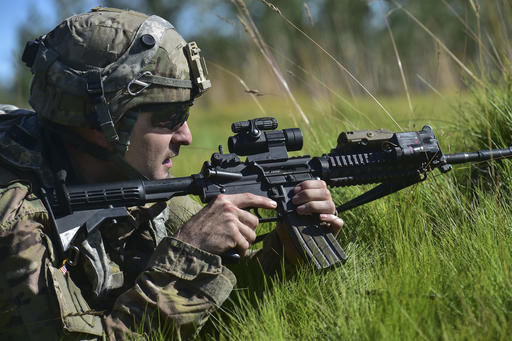
ANCHORAGE, Alaska (AP) — Soldiers from U.S. and Canada have spent much of the last few weeks engaging in war games in expansive interior Alaska, with Iowa National Guard personnel playing the role of the enemy.
Arctic Anvil, which ended this week for about 5,000 soldiers and support personnel, was the largest training held in Alaska in the last 15 or so years, said Brig. Gen. Martin Frank, a member of the Canadian Army and the deputy commanding general for U.S. Army Alaska. He is the first foreign officer to serve on the U.S. Army Alaska staff.
Among those training were 140 soldiers from the Third Canadian Division, a light armored vehicle company, Frank said.
"We've also got about 800 folks from the Iowa National Guard that are participating in the exercise who are playing the role of opposing forces," he said.
Also on hand were observers from partner nations Japan and Singapore.
The exercise tested the soldiers against two kinds of opponents, insurgents similar to what the forces faced in Iraq and Afghanistan and more traditional foes.
Frank said the troops have to maintain their skills with fighting insurgent forces.
"But we also have to be capable of defeating a near-peer enemy who might be equipped with tanks, with unmanned aerial vehicles, with aircraft, with all the things that we have so that we are ready to fight and ready to win regardless of what kind of opposing force or kind of adversary we come against," Frank said.
The exercise was intended to prepare the 1st Stryker Brigade Combat Team, 25th Infantry Division at Fort Wainwright, near Fairbanks, for an upcoming rotation at the National Training Center at Fort Irwin, California. The training also included soldiers from the 52nd Aviation Regiment.
Frank called the exercise a success. "I've seen an exponential increase in the capability and the readiness of the 1st Stryker Brigade, and in large part this is due to the command climate, the perspective of the commanders on the ground, and the soldiers on the ground, wanting to learn, wanting to become better," he said.
The training scenario, equipment and technical expertise were provided by the 196th Infantry Brigade's Joint Pacific Multinational Readiness Capability, and this was the first time they have provided the training outside its home base in Hawaii.
___
This story has been corrected to changes the location of the National Training Center to Fort Irwin, California.
- Updated
BOZEMAN, Mont. (AP) — Wildlife managers are considering changes to the hunting and slaughter of bison that leave Yellowstone National Park after past efforts failed to achieve population reduction goals set by a 2000 agreement.
Roughly 600 bison were killed during the past winter, including through shipments of the animals to slaughter and hunting by American Indians and state-licensed hunters.
Despite the hundreds of animals killed, officials told the Bozeman Daily Chronicle (http://bit.ly/2aDDfvX) that the park's bison population saw no significant decrease.
Montana officials and many ranchers have pushed to curb the park's bison population, which migrate by the thousands into the state when Yellowstone has severe winters. They can compete with livestock for grazing space and many bison carry brucellosis, a disease that can cause cattle to abort.
A 2000 agreement between Montana and federal agencies requires bison kept out of areas with cattle, resulting in thousands of bison captured and slaughtered and drawing condemnation from wildlife advocates.
Last year, officials held off from capturing bison until Feb. 15 to let hunting play a more significant role in reducing the population. But the move made it tougher to capture bison, resulting in fewer sent to slaughter.
John Harrison, a staff attorney for the Confederated Salish and Kootenai Tribes, said the delayed capture date "created a little more of an urgency" as hunters tried to take all the bison they could before trapping began.
People who live close to where hunting is concentrated, near Gardiner, have raised concerns over gunfire and gut piles left behind after the hunters are done that can attract scavenging bears.
The problem got worse last winter, after tribal governments and the state agreed to suspend hunting every other week to reduce pressure.
Instead the move concentrated the hunting pressure and led to congestion and more safety problems, officials said.
There have been no recorded transmissions of brucellosis from bison to cattle. There have been numerous brucellosis transmissions to cattle from elk.
Tens of thousands of elk roam the Yellowstone area and unlike bison there are no restrictions on where they can roam. Elk are widely hunted but not captured for slaughter.
___
Information from: Bozeman Daily Chronicle, http://www.bozemandailychronicle.com
- Updated
TUCSON, Ariz. (AP) — A Bowie man has been ordered to pay more than $8,700 in restitution for removing ancient Native American artifacts from an archaeological site in southern Arizona.
Federal prosecutors say 69-year-old David James Ioli also was sentenced Thursday to five years of probation.
A judge ordered Ioli to pay $8,707 to the U.S. Bureau of Land Management for the restoration and repair of the site.
Prosecutors say Ioli visited the Nine Mile site numerous times in April and May 2012.
The site is owned and managed by the BLM near Bowie.
Ioli was accused of excavating and removing numerous artifacts, including pottery, arrowheads and grinding stones.
He must turn over all artifacts he took and not enter lands owned by the BLM, National Park Service or U.S. Fish and Wildlife Service.
- By LINDSAY WHITEHURST Associated Press
- Updated
SALT LAKE CITY (AP) — A fight between two Utah chains that sell flavor-shot-spiked "dirty sodas," came to a federal courtroom Thursday as the sweet drinks grow increasingly popular in the predominantly Mormon state where sugar is a common indulgence.
Soda shop Swig contends competitor Sodalicious copied the trademarked "dirty" concept, down to the frosted sugar cookies sold alongside the sweet drinks.
Sodalicious argues dirty is a common drink moniker and tongue-in-cheek nicknames for their beverages like "Second Wife" make their business distinctly different.
The two sides sparred Thursday over a Sodalicious lawyer whose husband is one of the chain's co-owners. Swig contends it's a problem because she could accidently share the sensitive financial information and trade secrets that are becoming part of the court record in the case.
"If I was a competitor I'd find it very helpful," said Swig lawyer Mark Bettilyon. "It's just not fair."
But Sodalicious attorney Tessa Meyer Santiago says her husband only scouts new locations, and isn't involved in day-to-day business decisions.
Having to hire a new lawyer to would be unfairly expensive to the company, she said.
"I have no daily contact with anyone in company," she said. "There's one attorney on the case because cost is an issue."
Bettilyon argued that finding new locations is a key part of both chains' rapidly growing businesses.
"They're very profitable businesses. All you need to sit outside and see all the cars go by," he said. "It basically is a land grab at this point."
U.S. District Judge Dustin Pead decided the close relationship could be a problem, but said too many restrictions could also make the lawsuit unfairly costly for Sodalicious.
He decided to restrict what Santiago sees, but he also allowed Sodalicious to revise its request for information from the other side, so there wouldn't been too much information that's out of bounds.
The case is set for trial in August 2017. Swig's lawsuit filed last year asks for a court order barring Sodalicious from using words and signs too similar to theirs as well as unspecified damages.
- Updated
MALIBU, Calif. (AP) — The National Park Service says camera traps recorded a rare sighting of a black bear in Malibu Creek State Park.
The service said Thursday researchers spotted the bear in July 26 images taken by cameras that monitor wildlife in the Santa Monica Mountains, which are hemmed in by freeways and urban sprawl.
The Santa Monicas lying west of Los Angeles have not had a resident bear population since the 1800s when the range was home to grizzlies, which are now extinct in California.
Black bears now live in nearby ranges such as the Santa Susanas and San Gabriels but are rarely found south of U.S. 101. A bear was killed in 2014 an off-ramp in Westlake Village.
State parks district Superintendent Craig Sap says that if the bear decides to stay in Malibu Creek's 8,000 acres — "let's see what we can do to co-exist with it."
- Updated
GLENDALE, Calif. (AP) — A federal appeals court has affirmed a lower court ruling that threw out a lawsuit challenging a memorial in Southern California for women who were used as sex slaves for Japanese soldiers during World War II.
A judge two years ago decided plaintiffs did not prove their claim that they suffered tangible harm from the placement of the "Comfort Women" statue in Glendale Central Park.
The 9th U.S. Circuit Court of Appeals on Thursday upheld the judge's ruling.
Despite objections from Japanese-Americans, the City Council voted 4-1 in 2013 to permit installation of the 1,100-pound bronze monument.
Historians believe that as many as 200,000 girls and women from Korea, China and other occupied nations were forced into Japanese military brothels.
However, many Japanese and Japanese-Americans dispute the claims.
- By KIMBERLEE KRUESI Associated Press
- Updated
BOISE, Idaho (AP) — Idaho lawmakers have taken their first step in reviewing the state's contentious faith-healing exemption law, which allows families to cite religious reasons for medical decisions without fear of being charged with neglect or abuse.
Legal experts, child welfare workers and church-goers took turns testifying in front of a legislative working group on Thursday.
Supporters argue the law — which has been in place since the 1970s — protects religious freedom. Meanwhile, critics counter that the law has resulted in hundreds of vulnerable children being needlessly injured or dead.
In 2015, a working group appointed by the governor found that the deaths of two children occurred because the families withheld medical assistance for religious reasons
The interim committee will continue to meet over the summer, but it's unclear if they will submit a recommendation before the 2017 legislative session.
- Updated
PHOENIX (AP) — Figures from the Salt River Project show a disappointing 2016 runoff season that failed to quench Arizona's ongoing drought.
KJZZ-FM reports (http://bit.ly/2aLP31l ) that SRP predicted that spring and winter runoff would bring more than of 1 million acre feet of water. The recent results show only about a third of that amount made it into the system.
SRP's reservoirs are 50 percent full -- about the same level as last year. SRP is also pumping groundwater to supplement reservoirs.
Water managers maintain that they're still in good shape to meet the water demands of customers despite more than two decades of drought in central Arizona.
Research shows that it is common for central Arizona to 20- to 30-year droughts punctuated by a very wet year.
___
Information from: KJZZ-FM, http://www.kjzz.org/
- Updated
OLYMPIA, Wash. (AP) — State wildlife managers are planning to kill some wolves in a northeastern Washington pack after its members killed at least four cattle this year.
Department of Fish and Wildlife Director Jim Unsworth authorized killing a portion of the Profanity Peak pack in Ferry County after investigators on Wednesday confirmed a calf had been killed by a wolf. There are at least 11 wolves in the pack.
The department says preventative measures — such removing carcasses or increasing human presence — have not stopped livestock from being attacked, and such attacks will continue if the animals aren't removed.
The agency says it is following guidelines developed with an advisory group on when to remove wolves, including that there be at least four livestock attacks in a year.
It's the third time the department will remove wolves since the predators began recolonizing Washington about a decade ago, The Capital Press reported (http://goo.gl/PzvaxY ). There are now 19 wolf packs, all of them east of the Cascades.
"I'm disappointed there was another depredation, but happy to see the department is ready to step in," said Washington Cattlemen's Association Executive Vice President Jack Field.
Agents shot one wolf in northeastern Washington's Huckleberry pack in 2014 and seven wolves from the Wedge pack in 2012. In those cases, the U.S. Department of Agriculture's Wildlife Services assisted the state Department of Fish and Wildlife. Since then, a federal judge has ruled the federal agency can't help Washington lethally remove wolves without doing a more thorough study of the environmental impacts.
Several conservation groups objected to the decision, saying in a joint news release they do not want to see wolves killed in remote, roadless areas.
"We appreciate the agency's use of nonlethal measures to try to prevent losses of both livestock and wolves, and are glad to hear the ranchers in question have been working cooperatively with the state, but we are deeply saddened that wolves are going to die," Amaroq Weiss, of the Center for Biological Diversity, said in the news release. "We are not part of the advisory group but have made clear to the group that we don't support the killing of the public's wildlife on public lands."
- Updated
LAS VEGAS (AP) — Las Vegas police have rescued hundreds of birds after arresting two men during an illegal rooster-fighting investigation.
Police searched two Las Vegas homes Wednesday afternoon and recovered 600 roosters. The birds were put into steel cages and cardboard boxes and loaded into a trailer and an animal control vehicle.
Authorities did not provide many details about the investigation.
- By ALISHA ROEMELING The Register-Guard
CRESWELL, Ore. (AP) — The role of a little sister is often to be protected by an older sibling. But in the case of Cheyenne Keller, a 12-year-old Creswell girl who died last week of a rare blood disease, she may have switched roles with an older brother — and inadvertently saved his life.
Cheyenne had been struggling with hemophagocytic lymphohistiocytosis, or HLH, since Feb. 9, when her mother, Karen Keller, took her to the doctor and insisted on blood tests for her daughter.
"She just wasn't feeling well, and that's not like her," Karen Keller recalled.
The blood tests were taken — and Cheyenne was whisked by air ambulance to Doernbecher Children's Hospital in Portland, where she would spend the next six months fighting for her life.
Only one in about 1 million children is diagnosed with HLH, which makes the disease a hard one to identify and then adequately fight.
In patients with primary HLH, cells of the immune system don't work properly to destroy infected or damaged cells, causing the immune system to become overstimulated and damaging the patient's tissues and organs, including the bone marrow, liver and brain.
Karen Keller said that, because the disease is so rare, Cheyenne initially was misdiagnosed with aplastic anemia, another rare condition in which the body stops producing enough new blood cells. "She just kept getting sicker and sicker," Keller said.
Doctors at Doernbecher eventually determined that Cheyenne had HLH and needed a bone marrow transplant. And that's where her big brother — 14-year-old Joseph Keller — stepped in.
Joseph was a perfect match for the transplant and thought for a short time that he would be able to save his little sister. Instead, he was told by doctors that he also has the HLH gene — and thus would not be able to donate his bone marrow.
While the news was devastating, Cheyenne eventually got the transplant she needed from a donor in another country, and Joseph's mutated gene of HLH was determined to be dormant.
The Keller family sees a glimmer of hope for Joseph's future, not only because of the gene's dormancy but because they learned early enough that he has the same rare illness as his sister. "Initially, we thought Joseph was going to be able to save (Cheyenne's) life," said Tom Hubbard, the children's uncle. "And as it turns out, her path and her story are probably what's going to save his. Her journey has allowed him to have life."
Karen Keller said she and her husband, Michael Keller, will be monitoring their son's health carefully to ensure that his HLH does not develop to the point that his sister's did.
"It makes us really anxious," she said. "We have to monitor it with blood tests and make sure he doesn't show any signs of the gene becoming activated. The doctors truly don't know what the chances are that it (will) become active. We just have to hope."
With transplants of any kind, there's always a risk that the body won't accept the new material.
In a cruel irony, Cheyenne's transplant was successful, and her body responded well to the new bone marrow. But by then, her immune system had been incredibly compromised because of the multiple rounds of chemotherapy she'd endured before the transplant, her mother said. "The week she died, she had beat the HLH," Karen Keller said. "But she had gotten meningitis in her spine, which spread to her brain, and that's what caused her to pass away. She would have beat the disease if it weren't for her lack of immune system."
Amid their crippling grief, Cheyenne's family members are trying not to think about the difficult, scary and painful moments, and instead remind themselves of the beautiful little girl she was.
"She was always considerate of other people's feelings, and she loved her brothers," Karen Keller said. "She played music and loved to paint, and she was very outgoing and kind.
"She was also a really good student — she was smart," Keller said of her daughter, who attended Creswell Middle School.
Hubbard said his niece was one of the sweetest girls he's ever known.
"We gave her a little fleece jacket for her birthday in December, and you would have thought we just bought her a brand new car, she was so thankful," Hubbard said. "She was amazing."
To help other families who may be going through the same process, the Keller family is working to establish a foundation in Cheyenne's name. "We want to help people who are going through this," Karen Keller said. "We're trying to turn this into a positive experience and make people aware of the disease."
Cheyenne was close to both of her brothers — 7-year-old Danny and 14-year-old Joseph.
Hubbard said Cheyenne's parents did their best to gently tell Danny that they were all going to have to let his sister go.
Danny, Hubbard said, "just kept saying, 'Give her some medicine so she can get better!' He didn't really understand what was happening, but for days after she died he just kept telling us, 'I miss her, I miss her already.'"
----
From The Register-Guard: http://www.registerguard.com
- Associated Press
SACRAMENTO, Calif. (AP) — A California congressional candidate is questioning a state rule preventing candidates from using "veteran" as a ballot designation.
Republican Casey Lucius is running for California Congressional District 20 and says she wanted to describe herself on the ballot as professor, councilmember and veteran. She says she served on active duty for the U.S. Navy for seven years.
Election rules allow candidates to describe themselves on the ballot, but only using professions, vocations and occupations. It bans using a status that doesn't identify specifically how a candidate makes money or spends time, including the title veteran.
Lucius calls the restriction surprising and upsetting. Though she can't change the rule this year, she supports changing it for future elections.
The secretary of state's office did not respond to a request for comment.
- By MARK THIESSEN Associated Press
ANCHORAGE, Alaska (AP) — Soldiers from U.S. and Canada have spent much of the last few weeks engaging in war games in expansive interior Alaska, with Iowa National Guard personnel playing the role of the enemy.
Arctic Anvil, which ended this week for about 5,000 soldiers and support personnel, was the largest training held in Alaska in the last 15 or so years, said Brig. Gen. Martin Frank, a member of the Canadian Army and the deputy commanding general for U.S. Army Alaska. He is the first foreign officer to serve on the U.S. Army Alaska staff.
Among those training were 140 soldiers from the Third Canadian Division, a light armored vehicle company, Frank said.
"We've also got about 800 folks from the Iowa National Guard that are participating in the exercise who are playing the role of opposing forces," he said.
Also on hand were observers from partner nations Japan and Singapore.
The exercise tested the soldiers against two kinds of opponents, insurgents similar to what the forces faced in Iraq and Afghanistan and more traditional foes.
Frank said the troops have to maintain their skills with fighting insurgent forces.
"But we also have to be capable of defeating a near-peer enemy who might be equipped with tanks, with unmanned aerial vehicles, with aircraft, with all the things that we have so that we are ready to fight and ready to win regardless of what kind of opposing force or kind of adversary we come against," Frank said.
The exercise was intended to prepare the 1st Stryker Brigade Combat Team, 25th Infantry Division at Fort Wainwright, near Fairbanks, for an upcoming rotation at the National Training Center at Fort Irwin, California. The training also included soldiers from the 52nd Aviation Regiment.
Frank called the exercise a success. "I've seen an exponential increase in the capability and the readiness of the 1st Stryker Brigade, and in large part this is due to the command climate, the perspective of the commanders on the ground, and the soldiers on the ground, wanting to learn, wanting to become better," he said.
The training scenario, equipment and technical expertise were provided by the 196th Infantry Brigade's Joint Pacific Multinational Readiness Capability, and this was the first time they have provided the training outside its home base in Hawaii.
___
This story has been corrected to changes the location of the National Training Center to Fort Irwin, California.
BOZEMAN, Mont. (AP) — Wildlife managers are considering changes to the hunting and slaughter of bison that leave Yellowstone National Park after past efforts failed to achieve population reduction goals set by a 2000 agreement.
Roughly 600 bison were killed during the past winter, including through shipments of the animals to slaughter and hunting by American Indians and state-licensed hunters.
Despite the hundreds of animals killed, officials told the Bozeman Daily Chronicle (http://bit.ly/2aDDfvX) that the park's bison population saw no significant decrease.
Montana officials and many ranchers have pushed to curb the park's bison population, which migrate by the thousands into the state when Yellowstone has severe winters. They can compete with livestock for grazing space and many bison carry brucellosis, a disease that can cause cattle to abort.
A 2000 agreement between Montana and federal agencies requires bison kept out of areas with cattle, resulting in thousands of bison captured and slaughtered and drawing condemnation from wildlife advocates.
Last year, officials held off from capturing bison until Feb. 15 to let hunting play a more significant role in reducing the population. But the move made it tougher to capture bison, resulting in fewer sent to slaughter.
John Harrison, a staff attorney for the Confederated Salish and Kootenai Tribes, said the delayed capture date "created a little more of an urgency" as hunters tried to take all the bison they could before trapping began.
People who live close to where hunting is concentrated, near Gardiner, have raised concerns over gunfire and gut piles left behind after the hunters are done that can attract scavenging bears.
The problem got worse last winter, after tribal governments and the state agreed to suspend hunting every other week to reduce pressure.
Instead the move concentrated the hunting pressure and led to congestion and more safety problems, officials said.
There have been no recorded transmissions of brucellosis from bison to cattle. There have been numerous brucellosis transmissions to cattle from elk.
Tens of thousands of elk roam the Yellowstone area and unlike bison there are no restrictions on where they can roam. Elk are widely hunted but not captured for slaughter.
___
Information from: Bozeman Daily Chronicle, http://www.bozemandailychronicle.com
TUCSON, Ariz. (AP) — A Bowie man has been ordered to pay more than $8,700 in restitution for removing ancient Native American artifacts from an archaeological site in southern Arizona.
Federal prosecutors say 69-year-old David James Ioli also was sentenced Thursday to five years of probation.
A judge ordered Ioli to pay $8,707 to the U.S. Bureau of Land Management for the restoration and repair of the site.
Prosecutors say Ioli visited the Nine Mile site numerous times in April and May 2012.
The site is owned and managed by the BLM near Bowie.
Ioli was accused of excavating and removing numerous artifacts, including pottery, arrowheads and grinding stones.
He must turn over all artifacts he took and not enter lands owned by the BLM, National Park Service or U.S. Fish and Wildlife Service.
- By LINDSAY WHITEHURST Associated Press
SALT LAKE CITY (AP) — A fight between two Utah chains that sell flavor-shot-spiked "dirty sodas," came to a federal courtroom Thursday as the sweet drinks grow increasingly popular in the predominantly Mormon state where sugar is a common indulgence.
Soda shop Swig contends competitor Sodalicious copied the trademarked "dirty" concept, down to the frosted sugar cookies sold alongside the sweet drinks.
Sodalicious argues dirty is a common drink moniker and tongue-in-cheek nicknames for their beverages like "Second Wife" make their business distinctly different.
The two sides sparred Thursday over a Sodalicious lawyer whose husband is one of the chain's co-owners. Swig contends it's a problem because she could accidently share the sensitive financial information and trade secrets that are becoming part of the court record in the case.
"If I was a competitor I'd find it very helpful," said Swig lawyer Mark Bettilyon. "It's just not fair."
But Sodalicious attorney Tessa Meyer Santiago says her husband only scouts new locations, and isn't involved in day-to-day business decisions.
Having to hire a new lawyer to would be unfairly expensive to the company, she said.
"I have no daily contact with anyone in company," she said. "There's one attorney on the case because cost is an issue."
Bettilyon argued that finding new locations is a key part of both chains' rapidly growing businesses.
"They're very profitable businesses. All you need to sit outside and see all the cars go by," he said. "It basically is a land grab at this point."
U.S. District Judge Dustin Pead decided the close relationship could be a problem, but said too many restrictions could also make the lawsuit unfairly costly for Sodalicious.
He decided to restrict what Santiago sees, but he also allowed Sodalicious to revise its request for information from the other side, so there wouldn't been too much information that's out of bounds.
The case is set for trial in August 2017. Swig's lawsuit filed last year asks for a court order barring Sodalicious from using words and signs too similar to theirs as well as unspecified damages.
MALIBU, Calif. (AP) — The National Park Service says camera traps recorded a rare sighting of a black bear in Malibu Creek State Park.
The service said Thursday researchers spotted the bear in July 26 images taken by cameras that monitor wildlife in the Santa Monica Mountains, which are hemmed in by freeways and urban sprawl.
The Santa Monicas lying west of Los Angeles have not had a resident bear population since the 1800s when the range was home to grizzlies, which are now extinct in California.
Black bears now live in nearby ranges such as the Santa Susanas and San Gabriels but are rarely found south of U.S. 101. A bear was killed in 2014 an off-ramp in Westlake Village.
State parks district Superintendent Craig Sap says that if the bear decides to stay in Malibu Creek's 8,000 acres — "let's see what we can do to co-exist with it."
GLENDALE, Calif. (AP) — A federal appeals court has affirmed a lower court ruling that threw out a lawsuit challenging a memorial in Southern California for women who were used as sex slaves for Japanese soldiers during World War II.
A judge two years ago decided plaintiffs did not prove their claim that they suffered tangible harm from the placement of the "Comfort Women" statue in Glendale Central Park.
The 9th U.S. Circuit Court of Appeals on Thursday upheld the judge's ruling.
Despite objections from Japanese-Americans, the City Council voted 4-1 in 2013 to permit installation of the 1,100-pound bronze monument.
Historians believe that as many as 200,000 girls and women from Korea, China and other occupied nations were forced into Japanese military brothels.
However, many Japanese and Japanese-Americans dispute the claims.
- By KIMBERLEE KRUESI Associated Press
BOISE, Idaho (AP) — Idaho lawmakers have taken their first step in reviewing the state's contentious faith-healing exemption law, which allows families to cite religious reasons for medical decisions without fear of being charged with neglect or abuse.
Legal experts, child welfare workers and church-goers took turns testifying in front of a legislative working group on Thursday.
Supporters argue the law — which has been in place since the 1970s — protects religious freedom. Meanwhile, critics counter that the law has resulted in hundreds of vulnerable children being needlessly injured or dead.
In 2015, a working group appointed by the governor found that the deaths of two children occurred because the families withheld medical assistance for religious reasons
The interim committee will continue to meet over the summer, but it's unclear if they will submit a recommendation before the 2017 legislative session.
PHOENIX (AP) — Figures from the Salt River Project show a disappointing 2016 runoff season that failed to quench Arizona's ongoing drought.
KJZZ-FM reports (http://bit.ly/2aLP31l ) that SRP predicted that spring and winter runoff would bring more than of 1 million acre feet of water. The recent results show only about a third of that amount made it into the system.
SRP's reservoirs are 50 percent full -- about the same level as last year. SRP is also pumping groundwater to supplement reservoirs.
Water managers maintain that they're still in good shape to meet the water demands of customers despite more than two decades of drought in central Arizona.
Research shows that it is common for central Arizona to 20- to 30-year droughts punctuated by a very wet year.
___
Information from: KJZZ-FM, http://www.kjzz.org/
OLYMPIA, Wash. (AP) — State wildlife managers are planning to kill some wolves in a northeastern Washington pack after its members killed at least four cattle this year.
Department of Fish and Wildlife Director Jim Unsworth authorized killing a portion of the Profanity Peak pack in Ferry County after investigators on Wednesday confirmed a calf had been killed by a wolf. There are at least 11 wolves in the pack.
The department says preventative measures — such removing carcasses or increasing human presence — have not stopped livestock from being attacked, and such attacks will continue if the animals aren't removed.
The agency says it is following guidelines developed with an advisory group on when to remove wolves, including that there be at least four livestock attacks in a year.
It's the third time the department will remove wolves since the predators began recolonizing Washington about a decade ago, The Capital Press reported (http://goo.gl/PzvaxY ). There are now 19 wolf packs, all of them east of the Cascades.
"I'm disappointed there was another depredation, but happy to see the department is ready to step in," said Washington Cattlemen's Association Executive Vice President Jack Field.
Agents shot one wolf in northeastern Washington's Huckleberry pack in 2014 and seven wolves from the Wedge pack in 2012. In those cases, the U.S. Department of Agriculture's Wildlife Services assisted the state Department of Fish and Wildlife. Since then, a federal judge has ruled the federal agency can't help Washington lethally remove wolves without doing a more thorough study of the environmental impacts.
Several conservation groups objected to the decision, saying in a joint news release they do not want to see wolves killed in remote, roadless areas.
"We appreciate the agency's use of nonlethal measures to try to prevent losses of both livestock and wolves, and are glad to hear the ranchers in question have been working cooperatively with the state, but we are deeply saddened that wolves are going to die," Amaroq Weiss, of the Center for Biological Diversity, said in the news release. "We are not part of the advisory group but have made clear to the group that we don't support the killing of the public's wildlife on public lands."
LAS VEGAS (AP) — Las Vegas police have rescued hundreds of birds after arresting two men during an illegal rooster-fighting investigation.
Police searched two Las Vegas homes Wednesday afternoon and recovered 600 roosters. The birds were put into steel cages and cardboard boxes and loaded into a trailer and an animal control vehicle.
Authorities did not provide many details about the investigation.
Most Popular
-
Arizona lawmaker seeks to jump-start I-11 construction
-
 Faculty concerned about changes to U of A admissions policy
 -
Report: Sheriff Nanos improperly used position, resources in political foe's suspension
-
Tucson Water violates state rules for keeping track of its drinking supply
-
Over 70 fun events happening in Tucson in April 🎡🐰

