

Luring ghost hunters; 1,000 birthday cards; hanging tree axed
- Updated
Odd and interesting news from the Midwest.

- Updated
DUBUQUE, Iowa (AP) — Dubuque residents have gathered in solidarity at the site of a cross burning that occurred in the city last week.
The Telegraph Herald (http://bit.ly/23SpCic ) reports that about 200 participants tied small strips of fabric together Sunday to show a physical sign of unity in the wake of the incident. They prayed and sang as they held the tied strips in a wide circle.
"It's pretty cool," said Andrew Rutzebeck, a Dubuque resident. "It's a good thing that everybody gets together to fight against what needs to be fought."
Police are investigating the two burnt crosses found last week as a hate crime. They say they've reached out to the U.S. Attorney's Office and the FBI for assistance.
Police Chief Mark Dalsing says that the incident was the first cross burning in the city limits in about two decades. At least 14 cross burnings occurred in Dubuque from 1988 to 1993.
Peosta, Iowa, resident Caprice Jones heard about the event at his church and decided to participate.
"I come from Chicago, where there's a saying, 'To be aware is to be alive; to stand still is to die,'" Jones said. "I'm aware something is wrong, and I refuse to stand still."
A spokesman for the Dubuque branch of the NAACP, Howard Lee III, said he was impressed by the event's turnout, but that there's work to be done to fight racism in Dubuque.
"Unity is still there, but there's still a lot of deeper pieces that need to be addressed," Lee said. "But if you equate it to football, this (event) would be a good kickoff."
One of the event's organizers, Rev. Robert Hoch of University of Dubuque Theological Seminary, said he expects Sunday's message to resonate in the community.
"I hope Dubuque rises to its true self and claims the streets for peace," he said.
___
Information from: Telegraph Herald, http://www.thonline.com
- Updated
SIOUX FALLS, S.D. (AP) — An envelope found in a McCook County Sheriff's Office evidence locker is related to the case of a South Dakota inmate trying to prove his innocence, Sheriff Mark Norris said.
The Innocence Project of Minnesota began researching Stacy Larson's second-degree murder case a decade ago and concluded he could not have fired the shot that killed Ronald Hilgenberg in 1990, the Argus Leader reported (http://argusne.ws/1S6ynkV ). Larson has spent the past 25 years serving life in prison.
But the group's effort to exonerate Larson had come to halt after it concluded the evidence was lost or destroyed.
Norris said he was cleaning an evidence locker and digging through a box for an unrelated case when he found the packet.
"I was dumbfounded," he said.
Authorities have notified Larson's lawyer, Jason Rumpca, and the McCook County state's attorney about the evidence.
Julie Jonas, legal director for the Innocence Project of Minnesota, said she and Rumpca are discussing what the development means for the case.
"It makes me want to ask the sheriff to look again through everything to see if there's more that can be found in an odd place," Jonas said.
Jonas said the envelope contains swabs taken from Larson's car after his arrest, and testing could reveal whether gun powder residue was present in the car. A negative result could cast doubt on whether Larson fired a shotgun from his vehicle, as prosecutors described.
"It's not going to prove who did it, but it would prove that it wasn't me," Larson said Monday in a telephone interview with the newspaper.
Larson said he was shocked to learn about the discovery from his lawyer, and he hopes it can be a catalyst for reopening his case.
"I started freaking out," Larson said, "like holy cow."
Attorney General Marty Jackley said Monday he was aware of the development and was preparing to comment on the case later Monday.
___
Information from: Argus Leader, http://www.argusleader.com
- Updated
CLEVELAND (AP) — A northeastern Ohio businessman has been charged in federal court with bankrolling a luxurious lifestyle by failing to pay more than $600,000 in federal income taxes over a four-year period.
Forty-seven-year-old Thomas Klocker, of Lakewood, was charged in an information Monday with four counts of tax evasion. An information typically indicates a defendant has agreed to plead guilty.
Federal authorities say Klocker diverted money from his metals business in Westlake to pay for an expensive waterfront home, world travel and to maintain his 68-foot yacht called "Tommy Time." Authorities allege Klocker took improper business write-offs and failed to report $2 million in income from 2007 through 2010.
The information alleges Klocker claimed losses for expenses associated with Tommy Time personal use.
Court records don't indicate if Klocker has an attorney.
- By SOPHIA TAREEN Associated Press
- Updated
CHICAGO (AP) — A leading child advocacy organization threw its support behind a proposal to replace Illinois' flat income tax with a system to tax the wealthiest residents at higher rates, saying Monday the nearly $2 billion in expected revenue could help struggling social services.
The graduated income tax plan, revived last week by a deputy to House Speaker Michael Madigan, would be contingent on voter approval since it alters tax code. Democratic state Rep. Lou Lang of Skokie said he'd like voters in November to consider his idea, which would translate into a tax cut for 99 percent of state residents.
While Republican Gov. Bruce Rauner and business groups immediately objected to the proposal, an advocacy group for social service providers said it could bring in much needed revenue.
"This will allow the tools we need to not rely on low- and middle-income families," Voices for Illinois Children spokeswoman Emily Miller said Monday during a conference call with legislators. "We truly believe this is one of the best ways to move our state forward."
Attempts to oust the flat income tax, as well as institute a so-called "millionaires' tax," have failed in Illinois before. An effort to let voters consider an income tax system overhaul died in the General Assembly in 2014, and Madigan has unsuccessfully pushed for a surcharge on annual personal incomes over $1 million.
Rauner's administration said in a statement that Lang's proposal would send Illinois "even further into economic doldrums." The Illinois Chamber of Commerce questioned the impact on small business owners and predicted top earners would move away.
Rauner and legislative Democrats remain at impasse over a state budget for the fiscal year that began in July.
The tax plan and a coinciding proposal to allow voters to decide on overhauling the state's income tax system were expected in committee this week. But lawmakers will need to act quickly with a May 9 deadline to submit the proposed constitutional amendment ahead of November's election, according to election officials. Also, a constitutional amendment requires a three-fifths majority vote, including 71 House votes, which is the total number of House Democrats.
Illinois' current income tax rate for individuals is 3.75 percent, falling from 5 percent in January 2015 as the 2011 temporary income tax increase was rolled back.
Backers of Lang's plan estimated up to 40,000 tax filers in Illinois — representing both single and joint returns — would pay more.
Lang's legislation calls for most married taxpayers, filing joint or as head of household, to pay 3.5 percent on an income of $200,000 or less; 3.75 percent for those earning between $200,000 and $750,000; and 8.75 percent on earnings between $750,000 and $1.5 million. For those making over $1.5 million, the rate would be 9.75 percent.
All other taxpayers would pay 3.5 percent on income up to $100,000; 3.75 percent on income between $100,000 and $500,000; 8.75 percent between $500,000 and $1 million; and 9.75 percent on income over $1 million.
__
The bills are HB689 and HJRCA59.
__
Follow Sophia Tareen at http://twitter.com/sophiatareen.
- Updated
MIDDLEBURY, Ind. (AP) — An Indiana State police car struck an Amish horse-drawn buggy that pulled out in front of it, injuring both drivers.
State police say 20-year-old Bryan Dean Troyer of Middlebury was driving the buggy Sunday night when he failed to yield to a patrol car driven by 39-year-old Cpl. Peter Bradley. The crash occurred about 10:45 p.m. at a rural intersection along State Route 13 in Elkhart County.
Police say both men were treated at a hospital, Troyer for injuries to his foot, hip and back and Bradley for injuries to his left arm.
Investigators say the buggy did not have any functioning lights.
Police say the horse pulling the buggy ran from the scene after the crash and was later found at Troyer's home.
- Updated
INDIANAPOLIS (AP) — Wildlife officials in Indiana say they're not sure what they would do if they caught a black bear wandering the state's border with Michigan.
The Indianapolis Star (http://indy.st/1S5F32E ) reports that Michigan wildlife officials last week chose to euthanize an aggressive black bear spotted near the border. Michigan updated its response plan in 2011 to account for an increase in its bear population. But Indiana's Department of Natural Resources says it doesn't have a similar plan in place because the black bear was the first sighting in the state since 1871.
"We've not had to face that decision here. Indiana has not had a resident bear population (since) before the Civil War," said department spokesman Phil Bloom.
He says Indiana plans to develop its own bear management strategy, but nothing is imminent.
"It was discussed last year that when appropriate," Bloom said. "We're looking at doing that more down the road."
According to the National Wildlife Federation, the black bear population is rising in states where the animals have not been seen in years.
The population increase in Michigan can be attributed to a host of factors, including changes in hunting rules, bears becoming more comfortable in urban spaces, and bears moving longer distances to get to food, said Mark Sargent, a field operations manager for the Michigan Department of Natural Resources.
Michigan's plan recommends hunting as the main way to control the bear population. Education and outreach to communities about bear safety are also major parts of the strategy.
___
Information from: The Indianapolis Star, http://www.indystar.com
- By JORDAN KARTHOLL The Star Press
- Updated
By JORDAN KARTHOLL
The Star Press
WINCHESTER, Ind. (AP) — The rooms on the second floor of the Randolph County Infirmary are painted in red light as the sun sets in Winchester. The dimming glow catches on warped glass, wispy curtains and the odd shapes protruding from the decayed walls of the hospital.
In a few moments, there is only impenetrable darkness.
A woman screams.
The sound muffles through old floorboards. The encroaching darkness seems to trigger whatever is happening in the building's basement.
Down creaky stairs, at the end of a dusty, stone and concrete corridor, eight figures huddle in the infirmary kitchen near a waist-high wooden block once used as a base for chopping raw meat. The woman who screamed, Jamie Toney-Terharr, rejoins the group after a short retreat into an adjacent dining area.
"Something pulled the back of my shirt!" she yells. A few people in the kitchen laugh.
A man standing near the center of the group, Scott Felger, holds a device that crackles as it emits a multi-color light display, casting angular shadows against the frayed wallpaper of the kitchen as it cycles backward through radio frequencies. Occasionally, it sounds like someone is trying to speak through the device. They call it a spirit box.
The group grows silent as Felger asks the room a question.
"How did you hurt your head?"
They wait. No response.
"We want to know," Felger says more intently, "how did you hurt your head?"
Something appears to answer.
The sound of small objects smacking the linoleum floor reverberate from opposite corners in the kitchen. It's impossible to tell what source the noises are coming from in the dark. The sounds inspire another scream and a quick retreat from Jamie.
This is one of many encounters the two overnight tour groups have inside the infirmary. The investigation teams capture bizarre audio recordings known as EVPs. One group witnesses a plank of wood being tossed across the cavernous space of the building's attic. Some hear footsteps, some say they see "shadow people" trudging between doorways in the darkened basement hallway.
These are experiences Adam Kimmell, who purchased the building with Dan Allen and Chris Musgrove, was counting on when he and his fellow investors made what Kimmell calls the "super risky" decision to purchase the nearly 50,000-square-foot, 120-year-old structure from the county earlier this year.
"I realize when you buy a place like this and say you're going to make profit through ghost tourism people have a hard time believing you," Kimmell said.
So far, the risk has paid off.
The infirmary is the third vacant historic site, following a jail and former speakeasy in Hartford City, Kimmell acquired in Indiana. He said the infirmary has already become the most popular of the three allegedly haunted locations.
"You never realize how big the ghost-hunting community is," he said. "I knew the second I said this place was open for business people would flock in. It's a subculture of hardcore fanatics willing to travel all over the country to pursue their passion."
Kimmell, who is a veteran paranormal investigator himself and executive producer of the ghost-hunting show "Resident Undead," said the reason his target market is hard to measure could be because of the stigma attached to the ghost-hunting hobby.
"There are few people who will openly admit to being interested in this; some see it as taboo, that it's wrong to do these things," Kimmell said. "I think there's nothing wrong with the pursuit of trying to understand the world around us."
The perceived stigma is the reason participants in Kimmell's ghost tours are permitted to remain anonymous.
Getting the infirmary habitable required the cleaning and construction efforts of around 40 volunteers plus an additional $20,000 to $25,000 on top of the building's purchase price of around $369,000.
The original infirmary (alternatively known as the county home or poorhouse) was constructed in 1851 but was destroyed two years later in a fire. A second infirmary was constructed on the same spot in 1857 but was also closed two years later — this time demolished due to unsanitary living conditions. The third infirmary, built in 1899, is the structure that stands today on U.S. 27 south of Winchester, across the highway from the Randolph County 4-H Fairgrounds.
The Randolph County Infirmary provided housing and care for individuals who were unable to work, including the mentally and physically disabled, single mothers, the elderly and orphans. County homes were offered as a solution to local poverty before social welfare programs were created largely during the Great Depression.
The infirmary was officially closed in 2008 and spent its final years serving as a storage facility for the county.
Little was done to prevent the building's gradual dismantling by nature and vandalism since its closure.
Somewhat ironically, the historic site's reputation as a conduit for the dead is what allowed Kimmell and his team to resurrect the failing structure.
"In my experience hospitals, jails, asylums tend to be the most active locations," Kimmell said. "These are places where, for whatever reason, spirits are more open to communication."
Kimmell said the infirmary has already been booked by more than 60 film crews this year and has been reserved every weekend through 2017. People interested in taking ghost tours or performing their own investigations can still do so on weekdays.
"You would be surprised at the people who show up to a ghost hunt, from all corners of society," Kimmell said. "Police officers, lawyers, doctors . I think a lot of people want to validate what they believe about the afterlife."
Based on the volume of reported experiences, Kimmell said the site provides one of the more reliable means of coming in contact with the other side.
Kimmell, who said he isn't sure if supernatural experiences are evidence of the afterlife or simply a reality not currently understood, has had personal run-ins with whatever seems to occupy the infirmary.
"Once I was alone in the hospital and I hear three distinct footsteps coming up the stairs," Kimmell said. "Then the door handle in the room I was in started to turn and shake violently. . I'm a grown man and that was enough to make me want to run out of the building."
Kimmell is looking forward to two major events at the infirmary. A well-known television program he couldn't name due to a nondisclosure agreement is planning a filming session in the near future. Additionally, in what could add significantly to the building's existing notoriety, the "Resident Undead" team plans on using ground-penetrating radar to peer into what is believed to be a large section of unmarked graves at the back of the property. Kimmell hopes to film the gravesite project for a documentary.
To preserve the original, creepy aesthetic of the building and due to certain agreements Kimmell, Allen and Musgrove made with the county regarding upkeep, they have no plans to modernize the infirmary.
Kimmell said most of Winchester was excited about the prospect of the ghost tours bringing visitors to the town's local businesses. He said support he has received from the town and county commissioners has made the infirmary his favorite site.
"I love Winchester," Kimmell said. "The whole community has been amazing."
Kimmell's investment plan when it comes to local landmarks like the infirmary usually starts out with a town hall meeting to address possible concerns. Kimmell said, given how strange proposing re-purposing a historic site for paranormal investigations might seem, he expects some skepticism.
For Kimmell, however, chasing the unknown and intangible is as natural as any other endeavor.
"The world is much crazier than any of us think," Kimmell said.
___
Source: The (Muncie) Star Press, http://tspne.ws/1Scgspu
___
Information from: The Star Press, http://www.thestarpress.com
This is an AP-Indiana Exchange story offered by The (Muncie) Star Press.
- By BLAKE NICHOLSON Associated Press
- Updated
BISMARCK, N.D. (AP) — A Bismarck community college run by the five American Indian tribes in North Dakota is waiving tuition for members of federally recognized tribes, hoping to boost enrollment and give students a better financial start to life.
United Tribes Technical College will launch the one-year pilot program beginning with the fall semester and end its participation in the federal student loan program.
Student loans don't work for families who don't have savings or access to credit, and it's unconscionable to expose students with poor financial literacy to sizable debt, college President Leander "Russ" McDonald said.
"These are students from some of the most impoverished areas in the country, and we believe it's our obligation to offer realistic financial assistance to help them get started on a path that will change their lives," he said.
The school draws students from around the country and currently has 393 students enrolled, according to Kathy Johnson, vice president of student services. Nearly 40 tribal nations are represented in the student body. Students pay tuition of up to $200 per credit.
But enrollment has declined, mainly due to more available job opportunities, many tied to the oil industry that has boomed in recent years. Two dormitories on campus sit empty, and the college wants to beef up enrollment by almost 100 students. Even if the majority of them are eligible for the tuition waiver — 87 percent of current students are American Indian — fees they would pay for such things as housing, books and meals with the help of grants and scholarships could help make up for the lost tuition, McDonald said. Tuition accounts for only 10 percent of the federally funded college's $8.3 million annual operating budget, he said.
United Tribes is not the first to offer tuition waivers. More than half of the 37 tribal colleges and universities in the nation have some sort of tuition waiver program, according to Kathy Page, research and policy associate for the American Indian Higher Education Consortium. Last year, nearly 10 percent of all students in tribal schools received tuition waivers, she said.
"Financial stress is the single greatest deterrent to successful completion at our colleges, so any effort to help make college more affordable and help students complete a program is extremely important," said Carrie Billy, president and CEO of the consortium.
United Tribes will review the effectiveness of its tuition waiver program early next year. It will be offered at least through the 2017 summer semester.
___
Follow Blake Nicholson on Twitter at: http://twitter.com/NicholsonBlake
- Updated
JACKSON, Mo. (AP) — The "hanging tree" once used for executions in southeast Missouri's Cape Girardeau County has been taken down.
The Southeast Missourian (http://bit.ly/1qT0oSK ) reports that county officials ordered the tree in Jackson to be removed after determining it no longer was healthy enough to continue standing.
The mulberry tree was taken down Sunday.
"It was just structurally ... it was really bad," said Gary Hill, owner of Quality Tree Services in Jackson, who removed the tree.
"It had gotten to the point where it was a liability," he said.
The tree stood next to the Cape Girardeau County Courthouse. Missouri officially stopped using hanging as an execution method in 1937, but Cape Girardeau County's last hanging was June 15, 1899, when convicted killer 19-year-old John Headrick was "hanged by the neck between heaven and earth until he is dead," as ordered by Judge Henry C. Riley.
Headrick shot to death James M. Lail, 44, in July 1898 in front of Lail's wife and teenage daughter at Lail's farm south of Jackson. Headrick also shot Lail's wife in the back when she threw herself over the body of her husband, according to an article from the Southeast Missourian at the time of the crime. She survived.
The tree was there before the courthouse, which was built in 1909. Hill said it was unlikely the wood will be used for anything because it was severely rotted.
___
Information from: Southeast Missourian, http://www.semissourian.com
- Updated
CHEBOYGAN, Mich. (AP) — Authorities say three men have been arrested in connection with the theft of sugar maple logs from public state-managed lands in Michigan's northern Lower Peninsula.
The state Department of Natural Resources says Monday the men in their 20s are from Cheboygan, Charlevoix and Emmet counties. Names weren't immediately released, pending arraignments. The DNR says the thefts are under investigation and more charges are expected.
Late last year, conservation officers began getting complaints about large sugar maple trees being cut on state forestland. Only the thickest part of the trees — the lowest 8-12 feet — was taken most often. The DNR says more than 100 logs were believed stolen.
Investigators say logs were sold to sawmills. The public and members of the timber industry helped the DNR identify suspects.
- By LAUREN SLAVIN The (Bloomington) Herald-Times
- Updated
By LAUREN SLAVIN
The (Bloomington) Herald-Times
BLOOMINGTON, Ind. (AP) — What Abigail Guthrie thought was an incident of bad birthday luck turned into a fantastic, but nerve-wracking, surprise.
The Edgewood High School junior turned 17 Wednesday, and her parents, Rachel and Troy, wanted to find a creative way to give Abigail her birthday present - tickets to see Justin Bieber in concert in Louisville this week.
Instead of being tucked into a card, the ticket was hand-delivered by a Bloomington police officer. Abigail's parents arranged to have her pulled over for a fake traffic violation on the way to her birthday dinner.
"It's the first time I've ever gotten pulled over, and it's on my birthday!" Abigail Guthrie said in a video of the prank her father secretly recorded on his phone.
Guthrie has been a Bieber fan since elementary school, and the pop singer's popularity has surged with the recent release of his fourth album, "Purpose."
"She's always liked Justin Bieber," Rachel Guthrie said. "She loves concerts. She's just a big concert-goer."
Rachel Guthrie knew her daughter was interested in seeing the "Sorry" singer perform live in Indianapolis this summer. "Tickets are too expensive," she'd tell her daughter, trying to throw Abigail off the scent of her parents' plan. "Let's talk about it later."
"I know she's going to be excited, because she has no clue," Rachel Guthrie said.
Rachel and Troy Guthrie searched online for a tricky way to surprise their daughter with two tickets for her and a friend to see Bieber in concert. With the help of her sister, Rachel was able to arrange for Troy to meet with Sgt. Brandon Lopossa of the Bloomington Police Department and devise the birthday scheme.
"Birthdays, we have always tried to make our children feel special," Rachel Guthrie said. "We try to find something exciting. She's grown up fast, but every birthday we always try to do something special."
Troy Guthrie would tell his daughter that she would be driving the family to her birthday dinner. He would direct her to a restaurant, which would be a surprise. He had given the concert tickets and a description of the car they would be driving to Lopossa before the officer's shift, and they communicated plans through text messages.
The family made their way to Janko's Little Zagreb, and when she was close to Fairview Elementary School, Troy Guthrie told his daughter to make a right turn. But Abigail hadn't used her turn signal early enough in a school zone, Lopossa said, after turning on his lights and sirens and pulling the teen over.
"That was where he did a really good job of improvising," Rachel Guthrie said. "Her reaction is classic Abigail mad. She was ticked she was getting a ticket."
In the video, Rachel sits quietly in the back seat while Troy gently chastises his daughter that the insurance rates will go up if she gets a ticket.
"Please let me off with a warning," she whispers. "It's my birthday!"
But Lopossa returns with an envelope, and asks Abigail to look over the violation to see when her court date will be.
"What the heck is this?" Abigail shrieks after seeing what kind of "ticket" the police officer actually gave her. "I'm going to cry!"
"It's definitely something she's going to remember for a while," Rachel Guthrie said. "I'm also kind of glad that the first time she was pulled over we were there with her."
Lopossa has worked in law enforcement for 17 years. During a March awards ceremony, he received a merit certificate, a suicide prevention coalition award, a bravery and life saving award and a community service award. He also received the Bloomington Police Department's highest honor at the ceremony: He was named 2015's officer of the year.
"It's good for the younger generation to see that police are people, too. It's rewarding to see people happy," Lopossa said Thursday afternoon at a community outreach event on the Indiana University campus.
For the record, Abigail Guthrie properly used her turn signal at the four-way stop at Seventh and Rogers streets, he said.
___
Source: The (Bloomington) Herald-Times, http://bit.ly/1XAeGlI
___
Information from: The Herald Times, http://www.heraldtimesonline.com
This is an AP-Indiana Exchange story offered by The (Bloomington) Herald-Times.
- By JAYLYN COOK (Peoria) Journal Star
- Updated
By JAYLYN COOK
(Peoria) Journal Star
ROANOKE, Ill. (AP) — Alex Pfister learned to drive a tractor at a young age.
His dad taught him when he was 8 by letting him drive around in fields during the summer, he said.
On Friday, 15-year-old Pfister got the opportunity to drive one of his family's tractors into new territory: the parking lot of Roanoke-Benson High School.
The school hosted "Drive Your Tractor To School Day," which, as advertised, encouraged students to ditch the bus in favor of one of the heavy-duty vehicles.
The balmy temperatures and light breeze created the perfect conditions for Pfister, a freshman, and two other students who participated to ride to school without any interference from the elements.
Pfister got behind the wheel of a 1953 Massey-Harris 33 model. He said the faded red tractor has been in his family's possession for years before he was born.
"(Driving) it was pretty fun because these tractors aren't really made very much anymore," he said, citing the higher horsepower capabilities of other tractors as a reason for the MH-33's decrease in production.
Despite the improved performance of newer models, Pfister said the tractor he drove for the day still handles smoothly and without issue.
Roy Fuller, 16, took control of a McCormick Farmall tractor from 1940. Like Pfister, Fuller, a junior, was taught how to drive a tractor by his father. He learned when he was 4.
"This tractor's been in my family for 75 years," Fuller said. "It rides good, real smooth."
This was the third year Fuller has driven a tractor to school for the special day, and he said he's been happy to do it each time. He takes pride in his ability to operate a tractor.
He also said he takes pride in being able to drive his truck, as he recently received his license. But if he ever had to choose a vehicle to drive at all times, he made his choice clear.
"I'd rather have a truck," he said.
___
Source: (Peoria) Journal Star, http://bit.ly/1XEtu2D
___
Information from: Journal Star, http://pjstar.com
This is an Illinois Exchange story shared by the (Peoria) Journal Star.
- By EDITH BRADY-LUNNY The (Bloomington) Pantagraph
- Updated
By EDITH BRADY-LUNNY
The (Bloomington) Pantagraph
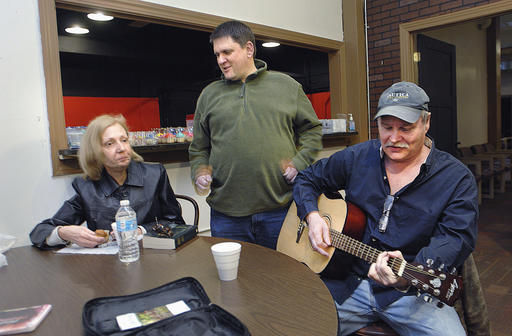
BLOOMINGTON, Ill. (AP) — When Charles Ahrens looks at the unfinished floors and walls of the third floor of a building that once hosted comedy shows, he sees a future home for people living on the streets, many of them mentally ill.
Ahrens, who is pastor of the Abundant Life in Christ Church, and a group of sturdy volunteers is working to transform the four-story building at 108 E. Market St. in downtown Bloomington into a space that could provide short-term housing for about 30 people.
A former chaplain with the Salvation Army who also worked with a street ministry for the homeless in San Francisco, he is undeterred by the magnitude of the project.
"It doesn't scare me. It's exciting. We have a good team," said Ahrens, who moved his church from a location on Lee Street to the former Laugh comedy club building in December. About 50 people attend Sunday worship services in the bright, sprawling first-floor room that is lined with rows of second-hand chairs.
On weekdays, volunteers arrive to set up coffee for morning Bible study and coordinate the community outreach work they perform on the streets.
"We have people who are desperately poor serving other poor people," said Ahrens.
Ahrens lives in one of the apartments on the second floor that includes two 3-bedroom and one 2-bedroom apartments along with space for dormitory-style housing. The 20 walled cubicles on the third floor that served as offices for State Farm in the 1950's will become rooms for homeless men.
Karen Zangerle, executive director of PATH (Providing Access to Help), welcomes the effort to add new housing opportunities for the homeless population served by her agency.
"We are in need of innovative ideas in the community for the people who have experienced homelessness for quite some time," said Zangerle, adding the traditional avenues of state and federal funding for housing fall short of what's needed in McLean County.
Ahrens recognizes that people who are without housing often are missing support in other areas, including mental health.
"We have people coming to church here who are looking for a fresh start. There's a guy coming today who's been living in his car," he said.
In the quest to link people with mental health services, Ahrens has seen delays in getting counseling appointments and long waits for hospital emergency rooms.
As the project unfolds, Ahrens plans to add on-site counselors and others who can help homeless residents address the deficits — employment and medical issues — that contribute to people living on the street.
A Mental Health Action Plan released last year by the McLean County Board estimated about 100 more supportive housing beds are needed in the community for homeless people living with a mental illness. Of that number, 54 would be used by the chronically homeless, according to the report. There are about 80 beds available now.
The two local homeless shelters, operated by Salvation Army and Home Sweet Home Mission, house about 150 men, women and children. Some of the daytime visitors to the Market Street church have come from the Salvation Army's warming center that takes in people during the winter months.
Sunday morning collections and rent from people who can pay something for their 30-day stay help cover the expenses; a bus and van also were donated to the church. Ahrens is hoping to attract volunteers with carpentry skills and donated building materials.
Glenda Jackson works as a staff minister, a job that includes kitchen duty and greeting people as they gather for Bible study.
"We've really seen a transformation in some people. The idea is to get them stable. We treat people well — with respect, compassion and dignity — things that are lacking in their lives," said Jackson.
When Mary Ahrens retires soon from her job with Goodwill, she will spend more time helping with her son's ministry. The passion for serving the most vulnerable is a trait that should be passed on, not stifled, she said.
"There is a segment of people that society does not want to touch or be around. We need to take them in and love them like everybody," she said.
___
Source: The (Bloomington) Pantagraph, http://bit.ly/1q4uxhd
___
Information from: The Pantagraph, http://www.pantagraph.com
This is an AP-Illinois Exchange story offered by The (Bloomington) Pantagraph.
DUBUQUE, Iowa (AP) — Dubuque residents have gathered in solidarity at the site of a cross burning that occurred in the city last week.
The Telegraph Herald (http://bit.ly/23SpCic ) reports that about 200 participants tied small strips of fabric together Sunday to show a physical sign of unity in the wake of the incident. They prayed and sang as they held the tied strips in a wide circle.
"It's pretty cool," said Andrew Rutzebeck, a Dubuque resident. "It's a good thing that everybody gets together to fight against what needs to be fought."
Police are investigating the two burnt crosses found last week as a hate crime. They say they've reached out to the U.S. Attorney's Office and the FBI for assistance.
Police Chief Mark Dalsing says that the incident was the first cross burning in the city limits in about two decades. At least 14 cross burnings occurred in Dubuque from 1988 to 1993.
Peosta, Iowa, resident Caprice Jones heard about the event at his church and decided to participate.
"I come from Chicago, where there's a saying, 'To be aware is to be alive; to stand still is to die,'" Jones said. "I'm aware something is wrong, and I refuse to stand still."
A spokesman for the Dubuque branch of the NAACP, Howard Lee III, said he was impressed by the event's turnout, but that there's work to be done to fight racism in Dubuque.
"Unity is still there, but there's still a lot of deeper pieces that need to be addressed," Lee said. "But if you equate it to football, this (event) would be a good kickoff."
One of the event's organizers, Rev. Robert Hoch of University of Dubuque Theological Seminary, said he expects Sunday's message to resonate in the community.
"I hope Dubuque rises to its true self and claims the streets for peace," he said.
___
Information from: Telegraph Herald, http://www.thonline.com
SIOUX FALLS, S.D. (AP) — An envelope found in a McCook County Sheriff's Office evidence locker is related to the case of a South Dakota inmate trying to prove his innocence, Sheriff Mark Norris said.
The Innocence Project of Minnesota began researching Stacy Larson's second-degree murder case a decade ago and concluded he could not have fired the shot that killed Ronald Hilgenberg in 1990, the Argus Leader reported (http://argusne.ws/1S6ynkV ). Larson has spent the past 25 years serving life in prison.
But the group's effort to exonerate Larson had come to halt after it concluded the evidence was lost or destroyed.
Norris said he was cleaning an evidence locker and digging through a box for an unrelated case when he found the packet.
"I was dumbfounded," he said.
Authorities have notified Larson's lawyer, Jason Rumpca, and the McCook County state's attorney about the evidence.
Julie Jonas, legal director for the Innocence Project of Minnesota, said she and Rumpca are discussing what the development means for the case.
"It makes me want to ask the sheriff to look again through everything to see if there's more that can be found in an odd place," Jonas said.
Jonas said the envelope contains swabs taken from Larson's car after his arrest, and testing could reveal whether gun powder residue was present in the car. A negative result could cast doubt on whether Larson fired a shotgun from his vehicle, as prosecutors described.
"It's not going to prove who did it, but it would prove that it wasn't me," Larson said Monday in a telephone interview with the newspaper.
Larson said he was shocked to learn about the discovery from his lawyer, and he hopes it can be a catalyst for reopening his case.
"I started freaking out," Larson said, "like holy cow."
Attorney General Marty Jackley said Monday he was aware of the development and was preparing to comment on the case later Monday.
___
Information from: Argus Leader, http://www.argusleader.com
CLEVELAND (AP) — A northeastern Ohio businessman has been charged in federal court with bankrolling a luxurious lifestyle by failing to pay more than $600,000 in federal income taxes over a four-year period.
Forty-seven-year-old Thomas Klocker, of Lakewood, was charged in an information Monday with four counts of tax evasion. An information typically indicates a defendant has agreed to plead guilty.
Federal authorities say Klocker diverted money from his metals business in Westlake to pay for an expensive waterfront home, world travel and to maintain his 68-foot yacht called "Tommy Time." Authorities allege Klocker took improper business write-offs and failed to report $2 million in income from 2007 through 2010.
The information alleges Klocker claimed losses for expenses associated with Tommy Time personal use.
Court records don't indicate if Klocker has an attorney.
- By SOPHIA TAREEN Associated Press
CHICAGO (AP) — A leading child advocacy organization threw its support behind a proposal to replace Illinois' flat income tax with a system to tax the wealthiest residents at higher rates, saying Monday the nearly $2 billion in expected revenue could help struggling social services.
The graduated income tax plan, revived last week by a deputy to House Speaker Michael Madigan, would be contingent on voter approval since it alters tax code. Democratic state Rep. Lou Lang of Skokie said he'd like voters in November to consider his idea, which would translate into a tax cut for 99 percent of state residents.
While Republican Gov. Bruce Rauner and business groups immediately objected to the proposal, an advocacy group for social service providers said it could bring in much needed revenue.
"This will allow the tools we need to not rely on low- and middle-income families," Voices for Illinois Children spokeswoman Emily Miller said Monday during a conference call with legislators. "We truly believe this is one of the best ways to move our state forward."
Attempts to oust the flat income tax, as well as institute a so-called "millionaires' tax," have failed in Illinois before. An effort to let voters consider an income tax system overhaul died in the General Assembly in 2014, and Madigan has unsuccessfully pushed for a surcharge on annual personal incomes over $1 million.
Rauner's administration said in a statement that Lang's proposal would send Illinois "even further into economic doldrums." The Illinois Chamber of Commerce questioned the impact on small business owners and predicted top earners would move away.
Rauner and legislative Democrats remain at impasse over a state budget for the fiscal year that began in July.
The tax plan and a coinciding proposal to allow voters to decide on overhauling the state's income tax system were expected in committee this week. But lawmakers will need to act quickly with a May 9 deadline to submit the proposed constitutional amendment ahead of November's election, according to election officials. Also, a constitutional amendment requires a three-fifths majority vote, including 71 House votes, which is the total number of House Democrats.
Illinois' current income tax rate for individuals is 3.75 percent, falling from 5 percent in January 2015 as the 2011 temporary income tax increase was rolled back.
Backers of Lang's plan estimated up to 40,000 tax filers in Illinois — representing both single and joint returns — would pay more.
Lang's legislation calls for most married taxpayers, filing joint or as head of household, to pay 3.5 percent on an income of $200,000 or less; 3.75 percent for those earning between $200,000 and $750,000; and 8.75 percent on earnings between $750,000 and $1.5 million. For those making over $1.5 million, the rate would be 9.75 percent.
All other taxpayers would pay 3.5 percent on income up to $100,000; 3.75 percent on income between $100,000 and $500,000; 8.75 percent between $500,000 and $1 million; and 9.75 percent on income over $1 million.
__
The bills are HB689 and HJRCA59.
__
Follow Sophia Tareen at http://twitter.com/sophiatareen.
MIDDLEBURY, Ind. (AP) — An Indiana State police car struck an Amish horse-drawn buggy that pulled out in front of it, injuring both drivers.
State police say 20-year-old Bryan Dean Troyer of Middlebury was driving the buggy Sunday night when he failed to yield to a patrol car driven by 39-year-old Cpl. Peter Bradley. The crash occurred about 10:45 p.m. at a rural intersection along State Route 13 in Elkhart County.
Police say both men were treated at a hospital, Troyer for injuries to his foot, hip and back and Bradley for injuries to his left arm.
Investigators say the buggy did not have any functioning lights.
Police say the horse pulling the buggy ran from the scene after the crash and was later found at Troyer's home.
INDIANAPOLIS (AP) — Wildlife officials in Indiana say they're not sure what they would do if they caught a black bear wandering the state's border with Michigan.
The Indianapolis Star (http://indy.st/1S5F32E ) reports that Michigan wildlife officials last week chose to euthanize an aggressive black bear spotted near the border. Michigan updated its response plan in 2011 to account for an increase in its bear population. But Indiana's Department of Natural Resources says it doesn't have a similar plan in place because the black bear was the first sighting in the state since 1871.
"We've not had to face that decision here. Indiana has not had a resident bear population (since) before the Civil War," said department spokesman Phil Bloom.
He says Indiana plans to develop its own bear management strategy, but nothing is imminent.
"It was discussed last year that when appropriate," Bloom said. "We're looking at doing that more down the road."
According to the National Wildlife Federation, the black bear population is rising in states where the animals have not been seen in years.
The population increase in Michigan can be attributed to a host of factors, including changes in hunting rules, bears becoming more comfortable in urban spaces, and bears moving longer distances to get to food, said Mark Sargent, a field operations manager for the Michigan Department of Natural Resources.
Michigan's plan recommends hunting as the main way to control the bear population. Education and outreach to communities about bear safety are also major parts of the strategy.
___
Information from: The Indianapolis Star, http://www.indystar.com
- By JORDAN KARTHOLL The Star Press
By JORDAN KARTHOLL
The Star Press
WINCHESTER, Ind. (AP) — The rooms on the second floor of the Randolph County Infirmary are painted in red light as the sun sets in Winchester. The dimming glow catches on warped glass, wispy curtains and the odd shapes protruding from the decayed walls of the hospital.
In a few moments, there is only impenetrable darkness.
A woman screams.
The sound muffles through old floorboards. The encroaching darkness seems to trigger whatever is happening in the building's basement.
Down creaky stairs, at the end of a dusty, stone and concrete corridor, eight figures huddle in the infirmary kitchen near a waist-high wooden block once used as a base for chopping raw meat. The woman who screamed, Jamie Toney-Terharr, rejoins the group after a short retreat into an adjacent dining area.
"Something pulled the back of my shirt!" she yells. A few people in the kitchen laugh.
A man standing near the center of the group, Scott Felger, holds a device that crackles as it emits a multi-color light display, casting angular shadows against the frayed wallpaper of the kitchen as it cycles backward through radio frequencies. Occasionally, it sounds like someone is trying to speak through the device. They call it a spirit box.
The group grows silent as Felger asks the room a question.
"How did you hurt your head?"
They wait. No response.
"We want to know," Felger says more intently, "how did you hurt your head?"
Something appears to answer.
The sound of small objects smacking the linoleum floor reverberate from opposite corners in the kitchen. It's impossible to tell what source the noises are coming from in the dark. The sounds inspire another scream and a quick retreat from Jamie.
This is one of many encounters the two overnight tour groups have inside the infirmary. The investigation teams capture bizarre audio recordings known as EVPs. One group witnesses a plank of wood being tossed across the cavernous space of the building's attic. Some hear footsteps, some say they see "shadow people" trudging between doorways in the darkened basement hallway.
These are experiences Adam Kimmell, who purchased the building with Dan Allen and Chris Musgrove, was counting on when he and his fellow investors made what Kimmell calls the "super risky" decision to purchase the nearly 50,000-square-foot, 120-year-old structure from the county earlier this year.
"I realize when you buy a place like this and say you're going to make profit through ghost tourism people have a hard time believing you," Kimmell said.
So far, the risk has paid off.
The infirmary is the third vacant historic site, following a jail and former speakeasy in Hartford City, Kimmell acquired in Indiana. He said the infirmary has already become the most popular of the three allegedly haunted locations.
"You never realize how big the ghost-hunting community is," he said. "I knew the second I said this place was open for business people would flock in. It's a subculture of hardcore fanatics willing to travel all over the country to pursue their passion."
Kimmell, who is a veteran paranormal investigator himself and executive producer of the ghost-hunting show "Resident Undead," said the reason his target market is hard to measure could be because of the stigma attached to the ghost-hunting hobby.
"There are few people who will openly admit to being interested in this; some see it as taboo, that it's wrong to do these things," Kimmell said. "I think there's nothing wrong with the pursuit of trying to understand the world around us."
The perceived stigma is the reason participants in Kimmell's ghost tours are permitted to remain anonymous.
Getting the infirmary habitable required the cleaning and construction efforts of around 40 volunteers plus an additional $20,000 to $25,000 on top of the building's purchase price of around $369,000.
The original infirmary (alternatively known as the county home or poorhouse) was constructed in 1851 but was destroyed two years later in a fire. A second infirmary was constructed on the same spot in 1857 but was also closed two years later — this time demolished due to unsanitary living conditions. The third infirmary, built in 1899, is the structure that stands today on U.S. 27 south of Winchester, across the highway from the Randolph County 4-H Fairgrounds.
The Randolph County Infirmary provided housing and care for individuals who were unable to work, including the mentally and physically disabled, single mothers, the elderly and orphans. County homes were offered as a solution to local poverty before social welfare programs were created largely during the Great Depression.
The infirmary was officially closed in 2008 and spent its final years serving as a storage facility for the county.
Little was done to prevent the building's gradual dismantling by nature and vandalism since its closure.
Somewhat ironically, the historic site's reputation as a conduit for the dead is what allowed Kimmell and his team to resurrect the failing structure.
"In my experience hospitals, jails, asylums tend to be the most active locations," Kimmell said. "These are places where, for whatever reason, spirits are more open to communication."
Kimmell said the infirmary has already been booked by more than 60 film crews this year and has been reserved every weekend through 2017. People interested in taking ghost tours or performing their own investigations can still do so on weekdays.
"You would be surprised at the people who show up to a ghost hunt, from all corners of society," Kimmell said. "Police officers, lawyers, doctors . I think a lot of people want to validate what they believe about the afterlife."
Based on the volume of reported experiences, Kimmell said the site provides one of the more reliable means of coming in contact with the other side.
Kimmell, who said he isn't sure if supernatural experiences are evidence of the afterlife or simply a reality not currently understood, has had personal run-ins with whatever seems to occupy the infirmary.
"Once I was alone in the hospital and I hear three distinct footsteps coming up the stairs," Kimmell said. "Then the door handle in the room I was in started to turn and shake violently. . I'm a grown man and that was enough to make me want to run out of the building."
Kimmell is looking forward to two major events at the infirmary. A well-known television program he couldn't name due to a nondisclosure agreement is planning a filming session in the near future. Additionally, in what could add significantly to the building's existing notoriety, the "Resident Undead" team plans on using ground-penetrating radar to peer into what is believed to be a large section of unmarked graves at the back of the property. Kimmell hopes to film the gravesite project for a documentary.
To preserve the original, creepy aesthetic of the building and due to certain agreements Kimmell, Allen and Musgrove made with the county regarding upkeep, they have no plans to modernize the infirmary.
Kimmell said most of Winchester was excited about the prospect of the ghost tours bringing visitors to the town's local businesses. He said support he has received from the town and county commissioners has made the infirmary his favorite site.
"I love Winchester," Kimmell said. "The whole community has been amazing."
Kimmell's investment plan when it comes to local landmarks like the infirmary usually starts out with a town hall meeting to address possible concerns. Kimmell said, given how strange proposing re-purposing a historic site for paranormal investigations might seem, he expects some skepticism.
For Kimmell, however, chasing the unknown and intangible is as natural as any other endeavor.
"The world is much crazier than any of us think," Kimmell said.
___
Source: The (Muncie) Star Press, http://tspne.ws/1Scgspu
___
Information from: The Star Press, http://www.thestarpress.com
This is an AP-Indiana Exchange story offered by The (Muncie) Star Press.
- By BLAKE NICHOLSON Associated Press
BISMARCK, N.D. (AP) — A Bismarck community college run by the five American Indian tribes in North Dakota is waiving tuition for members of federally recognized tribes, hoping to boost enrollment and give students a better financial start to life.
United Tribes Technical College will launch the one-year pilot program beginning with the fall semester and end its participation in the federal student loan program.
Student loans don't work for families who don't have savings or access to credit, and it's unconscionable to expose students with poor financial literacy to sizable debt, college President Leander "Russ" McDonald said.
"These are students from some of the most impoverished areas in the country, and we believe it's our obligation to offer realistic financial assistance to help them get started on a path that will change their lives," he said.
The school draws students from around the country and currently has 393 students enrolled, according to Kathy Johnson, vice president of student services. Nearly 40 tribal nations are represented in the student body. Students pay tuition of up to $200 per credit.
But enrollment has declined, mainly due to more available job opportunities, many tied to the oil industry that has boomed in recent years. Two dormitories on campus sit empty, and the college wants to beef up enrollment by almost 100 students. Even if the majority of them are eligible for the tuition waiver — 87 percent of current students are American Indian — fees they would pay for such things as housing, books and meals with the help of grants and scholarships could help make up for the lost tuition, McDonald said. Tuition accounts for only 10 percent of the federally funded college's $8.3 million annual operating budget, he said.
United Tribes is not the first to offer tuition waivers. More than half of the 37 tribal colleges and universities in the nation have some sort of tuition waiver program, according to Kathy Page, research and policy associate for the American Indian Higher Education Consortium. Last year, nearly 10 percent of all students in tribal schools received tuition waivers, she said.
"Financial stress is the single greatest deterrent to successful completion at our colleges, so any effort to help make college more affordable and help students complete a program is extremely important," said Carrie Billy, president and CEO of the consortium.
United Tribes will review the effectiveness of its tuition waiver program early next year. It will be offered at least through the 2017 summer semester.
___
Follow Blake Nicholson on Twitter at: http://twitter.com/NicholsonBlake
JACKSON, Mo. (AP) — The "hanging tree" once used for executions in southeast Missouri's Cape Girardeau County has been taken down.
The Southeast Missourian (http://bit.ly/1qT0oSK ) reports that county officials ordered the tree in Jackson to be removed after determining it no longer was healthy enough to continue standing.
The mulberry tree was taken down Sunday.
"It was just structurally ... it was really bad," said Gary Hill, owner of Quality Tree Services in Jackson, who removed the tree.
"It had gotten to the point where it was a liability," he said.
The tree stood next to the Cape Girardeau County Courthouse. Missouri officially stopped using hanging as an execution method in 1937, but Cape Girardeau County's last hanging was June 15, 1899, when convicted killer 19-year-old John Headrick was "hanged by the neck between heaven and earth until he is dead," as ordered by Judge Henry C. Riley.
Headrick shot to death James M. Lail, 44, in July 1898 in front of Lail's wife and teenage daughter at Lail's farm south of Jackson. Headrick also shot Lail's wife in the back when she threw herself over the body of her husband, according to an article from the Southeast Missourian at the time of the crime. She survived.
The tree was there before the courthouse, which was built in 1909. Hill said it was unlikely the wood will be used for anything because it was severely rotted.
___
Information from: Southeast Missourian, http://www.semissourian.com
CHEBOYGAN, Mich. (AP) — Authorities say three men have been arrested in connection with the theft of sugar maple logs from public state-managed lands in Michigan's northern Lower Peninsula.
The state Department of Natural Resources says Monday the men in their 20s are from Cheboygan, Charlevoix and Emmet counties. Names weren't immediately released, pending arraignments. The DNR says the thefts are under investigation and more charges are expected.
Late last year, conservation officers began getting complaints about large sugar maple trees being cut on state forestland. Only the thickest part of the trees — the lowest 8-12 feet — was taken most often. The DNR says more than 100 logs were believed stolen.
Investigators say logs were sold to sawmills. The public and members of the timber industry helped the DNR identify suspects.
- By LAUREN SLAVIN The (Bloomington) Herald-Times
By LAUREN SLAVIN
The (Bloomington) Herald-Times
BLOOMINGTON, Ind. (AP) — What Abigail Guthrie thought was an incident of bad birthday luck turned into a fantastic, but nerve-wracking, surprise.
The Edgewood High School junior turned 17 Wednesday, and her parents, Rachel and Troy, wanted to find a creative way to give Abigail her birthday present - tickets to see Justin Bieber in concert in Louisville this week.
Instead of being tucked into a card, the ticket was hand-delivered by a Bloomington police officer. Abigail's parents arranged to have her pulled over for a fake traffic violation on the way to her birthday dinner.
"It's the first time I've ever gotten pulled over, and it's on my birthday!" Abigail Guthrie said in a video of the prank her father secretly recorded on his phone.
Guthrie has been a Bieber fan since elementary school, and the pop singer's popularity has surged with the recent release of his fourth album, "Purpose."
"She's always liked Justin Bieber," Rachel Guthrie said. "She loves concerts. She's just a big concert-goer."
Rachel Guthrie knew her daughter was interested in seeing the "Sorry" singer perform live in Indianapolis this summer. "Tickets are too expensive," she'd tell her daughter, trying to throw Abigail off the scent of her parents' plan. "Let's talk about it later."
"I know she's going to be excited, because she has no clue," Rachel Guthrie said.
Rachel and Troy Guthrie searched online for a tricky way to surprise their daughter with two tickets for her and a friend to see Bieber in concert. With the help of her sister, Rachel was able to arrange for Troy to meet with Sgt. Brandon Lopossa of the Bloomington Police Department and devise the birthday scheme.
"Birthdays, we have always tried to make our children feel special," Rachel Guthrie said. "We try to find something exciting. She's grown up fast, but every birthday we always try to do something special."
Troy Guthrie would tell his daughter that she would be driving the family to her birthday dinner. He would direct her to a restaurant, which would be a surprise. He had given the concert tickets and a description of the car they would be driving to Lopossa before the officer's shift, and they communicated plans through text messages.
The family made their way to Janko's Little Zagreb, and when she was close to Fairview Elementary School, Troy Guthrie told his daughter to make a right turn. But Abigail hadn't used her turn signal early enough in a school zone, Lopossa said, after turning on his lights and sirens and pulling the teen over.
"That was where he did a really good job of improvising," Rachel Guthrie said. "Her reaction is classic Abigail mad. She was ticked she was getting a ticket."
In the video, Rachel sits quietly in the back seat while Troy gently chastises his daughter that the insurance rates will go up if she gets a ticket.
"Please let me off with a warning," she whispers. "It's my birthday!"
But Lopossa returns with an envelope, and asks Abigail to look over the violation to see when her court date will be.
"What the heck is this?" Abigail shrieks after seeing what kind of "ticket" the police officer actually gave her. "I'm going to cry!"
"It's definitely something she's going to remember for a while," Rachel Guthrie said. "I'm also kind of glad that the first time she was pulled over we were there with her."
Lopossa has worked in law enforcement for 17 years. During a March awards ceremony, he received a merit certificate, a suicide prevention coalition award, a bravery and life saving award and a community service award. He also received the Bloomington Police Department's highest honor at the ceremony: He was named 2015's officer of the year.
"It's good for the younger generation to see that police are people, too. It's rewarding to see people happy," Lopossa said Thursday afternoon at a community outreach event on the Indiana University campus.
For the record, Abigail Guthrie properly used her turn signal at the four-way stop at Seventh and Rogers streets, he said.
___
Source: The (Bloomington) Herald-Times, http://bit.ly/1XAeGlI
___
Information from: The Herald Times, http://www.heraldtimesonline.com
This is an AP-Indiana Exchange story offered by The (Bloomington) Herald-Times.
- By JAYLYN COOK (Peoria) Journal Star
By JAYLYN COOK
(Peoria) Journal Star
ROANOKE, Ill. (AP) — Alex Pfister learned to drive a tractor at a young age.
His dad taught him when he was 8 by letting him drive around in fields during the summer, he said.
On Friday, 15-year-old Pfister got the opportunity to drive one of his family's tractors into new territory: the parking lot of Roanoke-Benson High School.
The school hosted "Drive Your Tractor To School Day," which, as advertised, encouraged students to ditch the bus in favor of one of the heavy-duty vehicles.
The balmy temperatures and light breeze created the perfect conditions for Pfister, a freshman, and two other students who participated to ride to school without any interference from the elements.
Pfister got behind the wheel of a 1953 Massey-Harris 33 model. He said the faded red tractor has been in his family's possession for years before he was born.
"(Driving) it was pretty fun because these tractors aren't really made very much anymore," he said, citing the higher horsepower capabilities of other tractors as a reason for the MH-33's decrease in production.
Despite the improved performance of newer models, Pfister said the tractor he drove for the day still handles smoothly and without issue.
Roy Fuller, 16, took control of a McCormick Farmall tractor from 1940. Like Pfister, Fuller, a junior, was taught how to drive a tractor by his father. He learned when he was 4.
"This tractor's been in my family for 75 years," Fuller said. "It rides good, real smooth."
This was the third year Fuller has driven a tractor to school for the special day, and he said he's been happy to do it each time. He takes pride in his ability to operate a tractor.
He also said he takes pride in being able to drive his truck, as he recently received his license. But if he ever had to choose a vehicle to drive at all times, he made his choice clear.
"I'd rather have a truck," he said.
___
Source: (Peoria) Journal Star, http://bit.ly/1XEtu2D
___
Information from: Journal Star, http://pjstar.com
This is an Illinois Exchange story shared by the (Peoria) Journal Star.
- By EDITH BRADY-LUNNY The (Bloomington) Pantagraph
By EDITH BRADY-LUNNY
The (Bloomington) Pantagraph
BLOOMINGTON, Ill. (AP) — When Charles Ahrens looks at the unfinished floors and walls of the third floor of a building that once hosted comedy shows, he sees a future home for people living on the streets, many of them mentally ill.
Ahrens, who is pastor of the Abundant Life in Christ Church, and a group of sturdy volunteers is working to transform the four-story building at 108 E. Market St. in downtown Bloomington into a space that could provide short-term housing for about 30 people.
A former chaplain with the Salvation Army who also worked with a street ministry for the homeless in San Francisco, he is undeterred by the magnitude of the project.
"It doesn't scare me. It's exciting. We have a good team," said Ahrens, who moved his church from a location on Lee Street to the former Laugh comedy club building in December. About 50 people attend Sunday worship services in the bright, sprawling first-floor room that is lined with rows of second-hand chairs.
On weekdays, volunteers arrive to set up coffee for morning Bible study and coordinate the community outreach work they perform on the streets.
"We have people who are desperately poor serving other poor people," said Ahrens.
Ahrens lives in one of the apartments on the second floor that includes two 3-bedroom and one 2-bedroom apartments along with space for dormitory-style housing. The 20 walled cubicles on the third floor that served as offices for State Farm in the 1950's will become rooms for homeless men.
Karen Zangerle, executive director of PATH (Providing Access to Help), welcomes the effort to add new housing opportunities for the homeless population served by her agency.
"We are in need of innovative ideas in the community for the people who have experienced homelessness for quite some time," said Zangerle, adding the traditional avenues of state and federal funding for housing fall short of what's needed in McLean County.
Ahrens recognizes that people who are without housing often are missing support in other areas, including mental health.
"We have people coming to church here who are looking for a fresh start. There's a guy coming today who's been living in his car," he said.
In the quest to link people with mental health services, Ahrens has seen delays in getting counseling appointments and long waits for hospital emergency rooms.
As the project unfolds, Ahrens plans to add on-site counselors and others who can help homeless residents address the deficits — employment and medical issues — that contribute to people living on the street.
A Mental Health Action Plan released last year by the McLean County Board estimated about 100 more supportive housing beds are needed in the community for homeless people living with a mental illness. Of that number, 54 would be used by the chronically homeless, according to the report. There are about 80 beds available now.
The two local homeless shelters, operated by Salvation Army and Home Sweet Home Mission, house about 150 men, women and children. Some of the daytime visitors to the Market Street church have come from the Salvation Army's warming center that takes in people during the winter months.
Sunday morning collections and rent from people who can pay something for their 30-day stay help cover the expenses; a bus and van also were donated to the church. Ahrens is hoping to attract volunteers with carpentry skills and donated building materials.
Glenda Jackson works as a staff minister, a job that includes kitchen duty and greeting people as they gather for Bible study.
"We've really seen a transformation in some people. The idea is to get them stable. We treat people well — with respect, compassion and dignity — things that are lacking in their lives," said Jackson.
When Mary Ahrens retires soon from her job with Goodwill, she will spend more time helping with her son's ministry. The passion for serving the most vulnerable is a trait that should be passed on, not stifled, she said.
"There is a segment of people that society does not want to touch or be around. We need to take them in and love them like everybody," she said.
___
Source: The (Bloomington) Pantagraph, http://bit.ly/1q4uxhd
___
Information from: The Pantagraph, http://www.pantagraph.com
This is an AP-Illinois Exchange story offered by The (Bloomington) Pantagraph.
Most Popular
-
Arizona lawmaker seeks to jump-start I-11 construction
-
Former Arizona governor admitted to partaking in Peep jousting
-
 Faculty concerned about changes to U of A admissions policy
 -
ICE agents pepper spray observers in South Tucson
-
Report: Sheriff Nanos improperly used position, resources in political foe's suspension

