

Options weighed in cybersex case; can't use state seal; no more 'wards of state'
- Updated
Odd and interesting news from the Midwest.
- By ERIN ANDERSEN Lincoln Journal Star
- Updated
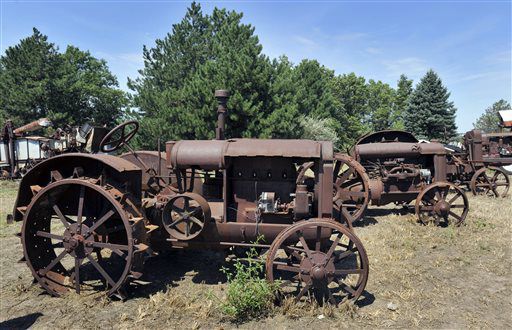
AUBURN, Neb. (AP) — Combines, plows, tractors and field cultivators dating back to Nebraska's early statehood stand along U.S. Highway 75 like prehistoric giants, their weathered joints rusted in place, wheels encased in concrete-hard grains of wind-whipped soil.
In the late 1800s, a young Ohioan named James Smith settled on this plot of Nebraska prairie just seven miles south of Auburn.
Three generations carried on his dream, raising hybrid seed corn, trees and cattle on Cloverdale Farms.
Harold and James Smith started a hybrid seed corn business, Nemaha Certified, which later became Nebraska Certified Plus when they partnered with a dozen other Nebraska farmers. Eventually, the business was purchased by Monsanto.
And for a century, the family retired equipment and vehicles in the fields, the barns, the sheds and outbuildings.
"We ran it to where we parked it," said 81-year-old J. Randel Smith, son of Harold Smith and grandson of James Smith.
On Saturday the old equipment and 100 years' worth of farming tools and vehicles go on the auction block.
Collectors, pickers and farmers from as far away as Wisconsin will bid on Ford Model T's, horse-drawn sleighs, a 1969 Chevrolet C50 dump truck with snowplow and newer-model tractors.
"I've done a lot of auctions, but I've never seen anything like this in my 65 years," said Marvin Caspers, 84, of Caspers Real Estate, Auctions & Appraisals, which is handling the sale.
"They never traded anything in," he told the Lincoln Journal Star (http://bit.ly/2bPuUuN). "They just drove under the trees and left it."
"The neighbors only remember two tractors ever coming off the place," added Mark Caspers, Marvin's son and business partner.
Randel Smith only remembers one.
"My father was over 100 when he died," Smith said. "He never traded anything off. My grandfather was the same way.
"And . I'm kind of that way."
"Not 'kind of,'" interjected Jane Smith, his wife of 55 years.
"My father was born here," Randel Smith said. "I was born here. ... We accumulated a lot of things."
About two years ago, with a little nudging from his wife, he decided it might be time to do something with all of that stuff.
So Randel Smith and his son and grandson Andrew started unearthing hidden gems and hauling them to the northwest corner of the farm.
For years, folks in Auburn asked when he was having that auction.
Now, with it just one day away, Marvin Caspers estimated 100 or more people a day have been meandering through the property, checking out the latest finds.
As auction day nears, Smith and his hired crew have ramped up the 1,000-acre archaeological expedition -- mowing weeds to uncover gems, cutting apart trees that have grown through and around steel spokes on wagon wheels and loading 18-foot-long trailers with shrink-wrapped pallets of shovels, hoes, hubcaps and tires, V belts, tubing and wood.
"It's like seeing history in progress," said Mark Caspers, who was 16 when his dad sent him to auction school.
They've handled a lot of large farm auctions, he said, but it's not often one gets to see the progression from horse to motorized farming equipment on a single site.
Marvin Caspers won't say if this is his final auction, but it's definitely one to hang his hat on.
For Randel Smith, it's a trip down a very long and meandering memory lane populated by rows of rusted vehicles and pieces of equipment.
When James Smith settled the land, work was done by horse.
"We found piles and piles of harnesses," said his grandson, as well as lots of old collars, saddles and horse blankets.
"When my dad was a kid, there were no cars or tractors," he recalled.
When Harold Smith wanted to visit his folks in Auburn, he rode a pony to the train station three miles away.
"He would turn the pony loose and it came right home," Randel Smith recalled. "Dad was a teenager before he saw a car. He got his first car when he was 15 or 16 years old."
The sale bill features three old sleighs, a three-seat horse-drawn carriage, disk plows (both horse-drawn and tractor-hitched), seed sorting tables, tractors, combines, hay balers, feed signs, a three-legged windmill tower, a floor safe that looks like it came out of an old Western and the decorative metal hearths of old wood-burning stoves. The Smiths got that 1969 school bus back in the day to haul teenagers to detassel.
Smith picks up a measuring wheel he figures belonged to his grandfather. A complete turn equals one rod — 16½ feet.
"As long as I can remember this was hanging in the garage," he says.
Mark Caspers points to a Case combine dating back to the early 1920s.
"I've never sold one like it."
Randel Smith stops in front of a UniHarvester corn picker/chopper.
"It still runs. It's a good machine," he says.
He pauses at a skid loader.
"It still runs. It's a good, powerful machine."
He hesitates in front of another piece of equipment: "I may want to keep that."
Randel Smith is a practical man — not sentimental — and he proves it as he picks his way through a grove of vehicles long put out to pasture: among them, five Ford Model T's, a Ford Model A, a 1948 three-quarter-ton Chevy pickup and a 1957 Ford Country Sedan wagon.
He points to a 1937 Chevrolet two-door.
"I met my wife in that car," he says.
Jane Smith was a young newspaper reporter in Auburn. She was walking home from the office on a hot July day and waved at him as he drove toward her. She was hoping for a ride home, she says.
Randel Smith just waved back and kept going.
That night, he called to explain himself: He didn't stop because the car had no seats. He, in fact, was sitting on a bucket.
That was 1957.
They married not quite four years later.
She recalls that she told him she was heading to Lincoln to visit some newly pinned girlfriends. The not-yet-betrothed couple was working on a fixer-upper house they had purchased for $5 in Brownville.
From atop a ladder, he wrapped his fraternity ring in a handkerchief and tossed it to her: We're pinned. Now let's get back to work.
Randel and James Smith, who started and continue to run the Spirit of Brownville Riverboat cruises and the River Inn Resort, didn't spend much time at the homestead — especially after his mom died in 2005 at age 97.
Watching a skid loader remove another haul from the two-story white barn, Randel Smith looks skyward. He fell from the top of that barn when he was 8. He was revived by artificial resuscitation.
Jane Smith retells the old family story of how folks in town joked that Randel Smith could afford real resuscitation — he didn't need artificial anything.
Randel Smith points to a 1971 Dodge motor home, transportation for many a family trip.
"Until my kids wouldn't ride with me anymore," he says.
It works — and it needs work.
A sterling blue 1979 Cadillac Sedan-DeVille sits in a sagging shed. The car belonged to his mother.
Next to it is a 1978 Pontiac Catalina convertible. A brand-new replacement top still in the box will be sold with the car on Saturday.
Smith points out a small dent near the tail light. A hired hand backed a piece of farm equipment into it.
"I was so disgusted. I drove it (Pontiac) in here for safekeeping and never moved it again," he says.
If the license plate is any indication, that was sometime in the 1990s.
"My father never traded a car. He drove it till he parked it," Smith said.
And it stayed put.
Like father, like son.
"I always said sometime I would sell it," Smith says of the possessions. "But I was never in a hurry.
"I didn't really save it," Smith said. "I just never got to it."
___
Information from: Lincoln Journal Star, http://www.journalstar.com
- Updated
CHICAGO (AP) — A suburban Chicago man facing terrorism charges for allegedly trying to set off a bomb in 2012 told a judge Friday he is sane, although he giggled and did impersonations on the witness stand.
Adel Daoud spoke during a hearing to decide his mental competency to stand trial on soliciting the murder of the undercover agent in the terrorism case and attacking a jail inmate in 2015, in addition to the terrorism charges.
Daoud has denied trying to ignite an inert bomb outside a Chicago bar in an FBI sting.
Speaking against the advice of his attorney, Thomas Durkin, Daoud told U.S. District Judge Sharon Johnson Coleman he often holds conversations with himself "because I don't need a second person," but he denied hearing voices or seeing illusions.
"If I'm crazy now, and I feel this is the best state I've been in, I had to be crazy forever," he said.
Durkin contends Daoud suffers from delusional disorder, a condition he says has worsened in recent months.
"Are you the defendant in this hearing?" Durkin asked during the hearing.
"I am the hostage, yes," Daoud answered.
Daoud's lawyers said they can't work with a man who believes the court system, including his own attorneys, are part of a vast conspiracy that will likely lead to Daoud's beheading.
"Would someone please tell me how I'm supposed to counsel someone who believes you are part of the Illuminati and that I might be part of the Illuminati?" Durkin said.
Prosecutors contend Daoud understands the charges against him, can assist in his own defense and that mental competency exams have determined that while he may hold extraordinary beliefs, he is not delusional or paranoid.
During the hearing, a government psychologist and a defense psychiatrist offered differing opinions about Daoud's mental state, an issue that essentially came down to their assessment of whether or not he is delusional or extremist and idiosyncratic. The judge must determine whether Daoud's mental state meets the legal standard for being able to face trial.
Coleman said she will rule Thursday on the 22-year-old's competence after considering the lawyers' arguments, case law and evidence.
- Updated
LINCOLN, Neb. (AP) — Nebraska Secretary of State John Gale is warning campaigns and businesses that the state seal cannot be used for political or commercial purposes.
Gale says he's issuing the warning as political campaigns ramp up ahead of the general election. Gales says he has not heard of any candidates using the seal on campaign materials so far but it has happened in past election cycles.
Gale will issue a warning notice to any violators.
Permission to use the seal must be obtained in writing from the Secretary of State's Office.
Gale says his office has recently received requests to use the seal. He's concerned "there may be a presumption that the state seal exists in the public domain and can be used for a multitude of purposes or products."
- Updated
FARGO, N.D. (AP) — Doug Burgum still has to woo voters before Election Day — but a least he's got the girl.
A campaign spokesman confirmed Friday that the GOP governor hopeful is engaged to marry Kathryn Helgaas of Fargo. A wedding date hasn't yet been set for the couple, and additional details weren't immediately available.
Burgum is known in North Dakota for building Fargo's Great Plains Software into a billion-dollar business, which he later sold to Microsoft.
He defeated North Dakota Attorney General Wayne Stenehjem in the Republican primary for governor.
The Fargo businessman faces Democrat Marvin Nelson in November.
- Updated
BISMARCK, N.D. (AP) — Gov. Jack Dalrymple has declared an emergency to make more state resources available to manage public safety risks from an ongoing oil pipeline protest near Cannon Ball.
Dalrymple said Friday the declaration allows the state to bring greater resources to bear if local officials need help addressing safety concerns.
Over two dozen protesters have been arrested since last week for interfering with the construction of the $3.8 billion Dakota Access Pipeline that's designed to carry North Dakota crude to Illinois.
Developers have agreed to halt construction of the project in southern North Dakota until a federal court hearing next week.
Dalrymple says the state is committed to protecting lawful assembly rights, but says unlawful acts have led to "serious public safety concerns."
The order doesn't include activation of the North Dakota National Guard.
- Updated
LINCOLN, Neb. (AP) — Nebraska legislative leaders are still trying to decide what action to recommend against a state senator who had cybersex on a state computer with a woman he met online.
Several members of the Legislature's Executive Board said Friday that they feel the need to address the issue before next year's session so that new senators aren't forced to decide the issue.
Committee members will meet again on Aug. 29 at 10:30 a.m. to hear testimony before deciding how to proceed against Sen. Bill Kintner of Papillion.
Kintner says a special session to discipline him is a waste of tax dollars, and any action against him can wait until next year's session. He says he looks forward to the opportunity to address his colleagues.
- Updated
CINCINNATI (AP) — A deputy in southwest Ohio has been put on paid leave after his wife was charged with prostitution and having drug-related items.
The Hamilton County sheriff's office says putting the deputy on administrative leave is standard practice while it investigates.
Sheriff's spokesman Mike Robison says the office is looking into allegations of wrongdoing at James Erpelding's residence.
Thirty-two-year-old Elizabeth Erpelding was arrested in Cincinnati on Wednesday on charges alleging sex for pay and possession of syringes and spoons used for heroin injections.
The sheriff's office says her husband first joined the office as a corrections officer in 1998.
A message seeking comment was left for her attorney Friday. A court hearing is scheduled for next Wednesday.
- Updated
LINCOLN, Neb. (AP) — A divorced father worried that his teenage daughters are at risk of abuse in their mother's home after she married a registered sex offender cannot have custody of the girls, the Nebraska Supreme Court ruled Friday.
A divided court upheld lower court rulings that rejected the father's request for custody of his two daughters to get them out of the home of their mother and her husband, who served four years in prison after a 2003 conviction for attempted sexual assault of his then-15-year-old stepdaughter from a previous marriage.
The father from Central City argued that a Phelps County District judge was wrong to find no significant risk to his teenage girls if they remain in the home of their mother and stepfather.
The ruling upholds the Nebraska Court of Appeals opinion last year that found the district court judge properly evaluated the facts of the case to determine that the stepfather does not pose a significant risk to the girls' safety.
A four-justice majority of the Supreme Court concluded that Nebraska's law only requires the mother to produce evidence that the girls were not at significant risk. The law is written in a way that presumes that since the stepfather is a sex offender with a felony offense, and has unsupervised contact with the girls, they are at risk. But the law further allows the custodial parent, in this case the mother, to overcome this presumption by presenting evidence tending to prove that the stepfather was not a significant risk to the girls.
"If she presented such evidence, then the presumption disappeared and the district court, as trier of fact, was not required to find that (the stepfather) was a significant risk," the justices wrote.
Both the district court and the Court of Appeals found that the mother overcame the presumption of significant risk by citing the stepfather's rehabilitative treatment and the lack of any reports or suspicion of sexual offenses since 2002.
The majority concluded the father presented little evidence about the risk the stepfather allegedly posed. Two justices disagreed with the majority opinion.
Justice William Connolly, who retired Aug. 1, wrote a sharply critical dissenting opinion chiding the majority for a decision that defies common sense.
"It leaves the noncustodial father, who is willing and able to care for his children, feeling helpless to protect his children," he wrote.
He said the court should require evidence of an assessment of the stepfather by a qualified evaluator to show there is not significant risk he will harm the girls.
Justice Lindsey Miller-Lerman in a separate dissenting opinion said she would give the father custody of the girls. She concluded the environment surrounding the stepfather's prior felony sexual assault crime bears a strong resemblance to the current domestic setup and the mother remains largely in denial.
The father's attorney, Brandon Brinegar, said the court's ruling ends the father's appeals and the mother will continue to have custody of the girls and the father visitation rights.
"We respectfully disagree with the majority and would have agreed with the dissenting opinions," Brinegar said.
The attorney for the mother did not immediately respond to messages.
- Updated
SPRINGFIELD, Ill. (AP) — Illinois Gov. Bruce Rauner has signed an executive order banning the state from calling children under its care wards and instead instructing they be called "youth in care."
Rauner signed the order Friday afternoon at the Illinois State Fair. It says the change is necessary because referring to foster children as wards make them "feel they are part of a bureaucracy instead of a family." It states that the way children are treated and labeled "has a substantial effect on their self-confidence and their trust in those they rely on."
Rauner's order calls the term "ward" outdated and says it will only be used going forward in situations required under Illinois law. It says the Illinois Department of Children and Family Services should instead use terms that show "respect and encouragement."
- Updated
JEFFERSONVILLE, Ind. (AP) — A cash-strapped southern Indiana county has ended talks with a nonprofit foundation to finance and operate a needle-exchange program aimed at slowing the spread of HIV and other diseases among intravenous drug users.
Clark County health officer Dr. Kevin Burke said the county has stopped working with the Los Angeles-based AIDS Healthcare Foundation. He told the News and Tribune for a story Friday (http://bit.ly/2bDwcFP ) that the Indiana State Department of Health did not want the county to agree to the foundation's request to participate in a discount drug program.
Health Department spokeswoman Jeni O'Malley said the agency has been providing guidance to Clark County since its initial submission last December to ensure that its application meets state requirements.
A message seeking comment could not be left for the foundation.
___
Information from: News and Tribune, Jeffersonville, Ind., http://www.newsandtribune.com
- Updated
SIOUX FALLS, S.D. (AP) — A Sioux Falls church has lost $16,000 from a scam involving asphalt work.
The Argus Leader (http://argusne.ws/2bIdJdd) reports that the Better Business Bureau in Sioux Falls received a report about the scam after two pavers finished only a portion of the church job.
The men paved part of the lot, secured two checks for $8,000 each, and then never returned to finish the work after cashing them. Sioux Falls BBB agent Jessie Schmidt says authorities have been alerted about the theft.
___
Online: https://www.bbb.org/scamtracker/us
___
Information from: Argus Leader, http://www.argusleader.com
- By ALEXA GOINS The Indianapolis Star
- Updated
INDIANAPOLIS (AP) — Step inside an auctioneer's world, a world of fast-talking, high-speed transactions. You rely on your voice to do the heavy lifting at the office.
Step inside a successful auctioneer's world. You sell some of the world's rarest classic cars for Barrett-Jackson and tens of thousands of dollars in motorcycles, automobiles and even construction equipment for a host of other clients. Your cadence is your craft.
Step inside the world of auctioneer TJ Freije. Or, more precisely, his world Aug. 6 last summer at the Indiana State Fair when something went terribly awry. The now 38-year-old thought he was having a stroke. Doctors would later tell him it was something else, something that threatened to end his career: Bell's palsy.
Bell's palsy is a viral infection that causes damage to the seventh cranial nerve. The facial nerves on one side of the face become temporarily paralyzed. Side effects include an inability to close the eyelids, the drooping of the mouth and problems enunciating.
"I thought my days as a competitive auctioneer were over," said Freije, a resident of Clayton in Hendricks County.
Scientists and doctors have yet to figure out exactly what causes Bell's palsy. About 40,000 Americans are afflicted with it each year. Seventy percent of people with complete paralysis recover within six months, and 94 percent of those with partial paralysis also recover within that time frame, according to the American Academy of Otolaryngology. Most people afflicted with Bell's Palsy recover, but in rare cases it does not disappear.
Freije stumbled into his career as an auctioneer. Although he was raised by an auctioneer father and his late grandfather also was an auctioneer, Freije was resistant to follow in their footsteps.
"When I got out of high school, I didn't really want to," Freije said. "I went to college, and I didn't want to be in the family business. I wanted to be a high school football coach."
After coming home from college in the summer of 1998, Freije's father, Tom, took his son to his first automobile auction at Auto Dealers Exchange in Indianapolis. The experience, Freije recalled, was "fast, fun and exciting."
He changed his career path. He attended Midway Auction School in Mooresville, where he graduated in 1999. He later completed the Certified Auctioneers Institute program in 2013 and tried to get his foot in the door in the world of contract auctioneering.
He found great success. His professional credits now span state lines from Indiana to California. Aside from the family business, Freije & Freije Auctions & Marketing, he is auctioneering for Indianapolis Car Exchange, ADESA, Auto Dealers Exchange, Barrett-Jackson, National Powersport Auctions, Martin & Martin Auctioneers and Caterpillar Auction Services.
Joseph Mast, owner of Mast Auctioneers and lead auctioneer at Barrett-Jackson, met Freije about a decade ago doing auctions through the National Auctioneers Association.
"TJ has a very good cadence," Mast said. "He's energetic, enthusiastic, and he really knows how to work a crowd and put them at ease while making them have lots of fun at the same time."
But no career comes without its challenges.
For Freije that challenge came last August after the incident at the State Fair.
With no improvements in the first few weeks after his Bell's palsy diagnosis, panic started to set in. Freije wrestled with the idea that permanent damage could be a possibility.
For an auctioneer, the side effects can pose a serious threat in a profession that relies heavily on vocal performance.
Freije also lost the ability to close his right eye and had to tape it shut at night to sleep. The right side of his mouth began drooping. Taking a sip of water or a bite of food without it falling out of his mouth became a daily challenge.
Freije's wife, Jodi, works as a physician's assistant and was familiar with the symptoms of Bell's palsy. She assumed her husband's symptoms would subside within a week or so.
"You're stressed because you're worried that he can't do what he loves to do," Jodi said. "You're also worried about your finances, the dreams that he has set for himself. To raise a family in the auction business, it just becomes really stressful. At first I wasn't real concerned, but then after about a week when he was not improving, then that's when you're like, 'Oh my gosh, what's going to happen?'"
The next few months took Freije through a series of treatments and doctor's visits including steroid therapy, acupuncture, facial massages, antiviral medication and electric muscle stimulation.
"I purchased an electrical stimulus unit," Freije said. "I would stand in front of the mirror and try to make my face move."
He returned to work. Selling turned out to be more difficult as he had to put in more effort to get his voice to make the auction chants that had come so easy before. He also had to hold his eye closed while selling. He made video recordings of his auction chants, which he would play back to critique his progress.
It took four months before he saw improvement. His treatments have since helped heal most of the effects. Freije has some permanent damage, but it's only noticeable to those closest to him.
Freije credits those closest to him for his turnaround.
"Without my faith, family and friends, I am not sure if I would've had the strength to improve," Freije said.
Freije said that his wife played a large part in the healing process, though she said that she "didn't do anything special."
She points to her husband and her husband's faith as making the largest difference.
"He is very motivated, and I think just by leaving it in God's hands and just having faith that he would still be able to do it," Jodi said. "He was able to handle it probably better than a lot of people would."
Nearly a year after he first learned of his Bell's palsy, Freije took on another career challenge. In July he headed to the International Auctioneers Championship put on by the National Auctioneers Association in Grand Rapids, Mich., where he faced off against 73 other male competitors.
Freije took home the men's title of the 29th International Auctioneers Champion, becoming the first Indiana man to do so.
Standing on that stage in Michigan after being announced as the winner, a long list of prestigious names raced through his head.
"I was thinking about the other names, the other men that have won and how well thought of they are in the industry, so it was a really humbling to think of those guys," Freije said. "And then I was thinking about everybody that had helped me get there from my wife Jodi to my parents and all of my auction family that helped lift me up."
___
Source: The Indianapolis Times, http://indy.st/2bJ6Zgi
This is an AP-Indiana Exchange story offered by The Indianapolis Star.
- Updated
CENTREVILLE, Mich. (AP) — Michigan environmental officials say they have stepped in to begin the emergency drawdown of water from a southwestern Michigan dam.
The Department of Environmental Quality announced Friday it's acting at the Centreville Dam amid recent and forecast heavy rainfalls — and a dispute that's left the dam without an operator. The department recently ordered the owner to take action, but he hasn't been able to gain access to the Prairie River dam because of a legal spat with an adjacent landowner.
Luke Trumble, a state dam safety engineer, says officials intervened because overflowing water could cause the dam to fail and threaten residents' health and safety. He says somebody needs to operate the dam's movable gates during heavy rainfall or floods.
The drawdown is expected to be done by Wednesday.
- By CAROL MOTSINGER The Cincinnati Enquirer
- Updated
CINCINNATI (AP) — This is not the one you notice.
It's one of a thousand collectibles in this Essex Studios space and it's not the one that's dancing. Or chatting in Japanese at the push of a button.
It's not the one covered in crystals from claw-to-crown. It doesn't even have an eye-popping patterned complexion like flowers or flames.
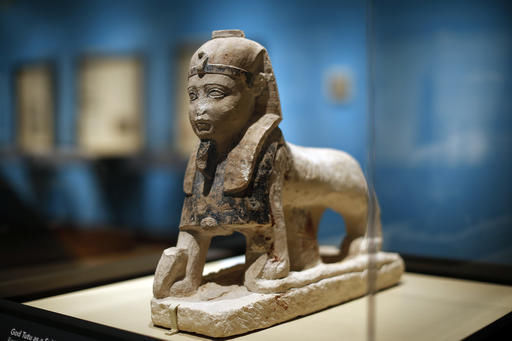
This one isn't even technically gray. This cat's coat is a worn-out black. Posed on his hind legs, he's a bit scraggy and a lot lanky. Parts are missing, one ear is chipped.
His left paw is raised.
That is what makes him the one. That beckoning paw turns this feline figurine into a beloved talisman.
It is Micha Robertson's first maneki-neko, or Lucky Cat statue. In 2002, it was an impulse buy at the Cheviot Goodwill. Today, it is the bedrock of Robertson's Lucky Cat Museum, an ever-growing display of the Japanese charms that opened four years ago.
"For me, one of the big draws is that is such a basic idea: It's a cat with its paw up," Robertson said. "So many people interpret it in so many different ways. It can be shaped to fit all sorts of different themes and ideas and feelings. It's just kind of amazing."
And as her personal collection grows, so does the museum. They are, in fact, the same thing.
Last month, it moved into a first-floor space almost twice as large as its previous spot in Essex Studios. Once just by-appointment-only, the free gallery and gift shop is now open a few hours a day, five days a week.
With each addition comes a new variation on the charm. Robertson owns so many forms of this fortune cat that the museum is organized around different themes, styles and sizes, materials and meanings.
Almost all come from online auctions and ship from Japan. But she's never been to the Lucky Cat's native country. With fingers crossed, Robertson hopes that trip is on the horizon. And there is room for her and a full shipping container on that flight home.
Back at the Lucky Cat Museum, one case is full of the classic white cat holding a gold coin, popularized in the mid-century. The kind you recognize from restaurant counters and shop windows.
There's a whole row of solar-powered metallic cats waving at visitors. A cluster of Lucky Cat-designed telephones in the corner. Feline-themed toilet paper rolls and finger puppets, too.
Another clowder — that's what you call a group of cats — hails from Hawaii. One is carved from lava rock. All of them are throwing up a shaka or hang loose sign.
A shelf shows an assortment of matchbooks. One massive inflatable greets at the door.
Some were constructed a century ago. Others, earlier this year.
There are also myriad legends around this folk hero, popular since Japan's Edo Period. That's 1603 to 1868.
The Lucky Cat Museum, however, subscribes to one narrative: The temple cat. Look closely for a miniature display on Tokyo's Gotoku-ji shrine.
The story goes something like this: A lord is riding by a dilapidated temple. A storm rolls in.
The lord and his horse seek shelter under a nearby tree. He spots the priest's cat, paw raised, beckoning him. (Remember, to Westerners that motion looks like a greeting, a wave. In Japan, it means "come here.")
Some unseen force compels the lord to comply. Moments later, lightning strikes the tree.
That's what lucky looks like.
In honor of this good fortune, that lord revived the shrine. And now, people from around the globe visit Gotoku-ji and purchase Lucky Cat figurines to honor granted wishes.
Robertson ordered a Gotoku-ji figurine to join her collection. It hasn't arrived yet, but the wish has.
The Lucky Cat Museum isn't just Robertson's dream-come-true. It's her everyday.
"Being a cat-obsessed freak is natural to me," she said with a laugh.
For Robertson, this whole thing started, actually, with the real-life inspiration for the maneki-neko. All and any kind of feline, really.
The fuzzy and fat. The needy and the aloof. Curious and anxious.
The lucky and the unlucky.
And it started early, at the very beginning. Like from the first hours of her life. Robertson's first cat wasn't a pet. It was her nursemaid, she said.
"There hasn't been a time in my life when I didn't have pet cats," Robertson said. " ... (we) really seem to gel."
She loves that cats can take care of themselves. That they come to her if they want attention. And that it's harder to get that attention from them. So she feels really loved when they do want that attention. Oh, and of course, they are freaking adorable.
She and her husband live with their four cats in Fort Wright, Kentucky. One, Little Miss, is in the museum. In a way. A favorite Japanese artist painted a sculpture to match Little Miss's black and orange and white fur. The photograph of Little Miss next to it is proof.
Robertson wants people to know about this contemporary artist — be sure to ask her about what his house looks like. She wants especially cat lovers in this country to understand and appreciate and support this tradition.
"I love being able to share the knowledge and the passion," she said. "I'm not talkative unless it's something I care about. I don't like being in crowds. I'm not a people person."
So her car parked outside of Essex Studios? The one painted to look like the cat character in the Japanese animated film, "Mei and the Kittenbus"? That decoration isn't designed to shine a spotlight on herself or even the museum.
She just loves seeing people's delighted expressions when she's stopped next to them at a light. And when someone shouts "Kittenbus!" from the sidewalk? That's the best, Robertson said.
The same goes for making her collection public. People "need to see this work," she said.
Originally, this work was in her home. Specifically, her computer desk in her study. Before long, the Lucky Cats overran the desk. Next, they populated a shelf. Then another. And another. And another.
The bookcases became cat cases. The study? A cat shelter.
So when a friend was seeking someone to split rent in Essex Studios, Robertson decided it was time to share her treasures with the world. And founded the only Lucky Cat Museum in the country, joining two similar institutions in Japan.
But her's is different. Not just because of location or language. It's free.
"It's my collection," she said. "People shouldn't have to pay to look at it. I wouldn't pay them to come visit me at home."
So she continues to work at Cappel's costume shop.
Her gift shop brings in some cash. A trained puppeteer, she sells her own Lucky Cat creations there. Like her original "bonbon kittens," decorative cats nestled in candy wrappers.
There is something else not to miss but hard to find at the Lucky Cat Museum. Because, well, he might be hiding.
It's Jeffh Jefferson, an alabaster cat with a bright, fluffy tail.
___
Information from: The Cincinnati Enquirer, http://www.enquirer.com
- Updated
BENTON, Ill. (AP) — Illinois state Rep. Gary Forby says legislation that Gov. Bruce Rauner signed into law will extend statutes of limitations on crimes that financially exploit the elderly.
Forby tells The (Carbondale) Southern Illinoisan (http://bit.ly/2b3TSGJ ) that the law extends statutes of limitations from three years to seven years. That means charges can be brought against individuals accused of financially exploiting seniors or the disabled for seven years instead of three years.
Forby, a Benton Democrat, was a co-sponsor of the legislation. He says the legislation is important because such crimes can put victims "in dire financial situations, robbing them of their savings."
The votes on the legislation were unanimous in both the Illinois House and Illinois Senate.
___
Information from: Southern Illinoisan, http://www.southernillinoisan.com

- Updated
DETROIT (AP) — A unique housing project of small, colorful huts is being built on an empty lot in Detroit.
The Detroit News (http://detne.ws/2bq8Gxk ) reports that a village of Quonset huts will be designed by Edwin Chan, a Los Angeles architect with world-class credentials.
The buildings are half-moon shaped structures with walls made of corrugated steel that will be 600 to 1,100 square feet. They will have utilities, bathrooms, kitchens and security measures.
"I'm very excited about this project. It's a little bit unusual for me," Chan said. "This is very much about community engagement. It was a chance to do something in a city that seems on the verge of another transformation."
The goal of the project, called True North, is to create affordable housing in an area of Detroit that same some well-kept structures, but also empty lots, vacant storefronts and homes that look ransacked.
"There is so much creativity going on in Detroit neighborhoods in terms of what to do with empty spaces — community gardens are one example," said Robert Fishman, interim dean of the Taubman College of Architecture and Urban Planning at the University of Michigan. "But that has to be complemented with the advanced thinking that only trained architecture can supply. The two together will be a very powerful combination."
Local design and architecture firm Studio Detroit designed and built two prototype huts. The company will work with Chan on the larger development.
"The reason we can get someone like Chan involved is because many designers and architects are exploring what is the future of shelter and housing," said John Patrick, founder of ABOVE THE FOLD, a Detroit firm that works with architects, designers and others on development and business projects.
Patrick said Chan has been commissioned by a New York developer who is financing the project but wants to remain unidentified at this point.
___
Information from: The Detroit News, http://detnews.com/
- By BRIAN BLAIR The (Columbus) Republic
- Updated
COLUMBUS, Ind. (AP) — The leader of Bartholomew County's largest house of worship feels both abundantly blessed and sufficiently challenged as he prepares to help his congregation celebrate the close of its year-long 175th anniversary Saturday.
The Rev. Clem Davis, pastor of St. Bartholomew Catholic Church, sees a growing segment of young adults and families with babies in the parish where an average of 2,000 people attend four services weekly. But offsetting that positive local development is a national trend of declining weekend church attendance facing Catholic leaders.
"We're called to be evangelists," said Davis of bolstering Catholic commitment and fervor.
Davis, associate pastor the Rev. Andy Syberg, and former St. Bartholomew priests will conduct a Mass at 4 p.m. Saturday with Indianapolis Archbishop Joseph W. Tobin to mark the Columbus congregation's historic anniversary. A packed house of worship of more than 1,000 people is expected.
St. Bartholomew had 1,592 registered households representing 4,327 total Catholics as of last year, said Greg Otolski, the Indianapolis archdiocese's director of communications. Figures also show the parish as among the oldest in the archdiocese.
St. Mary-of-the-Knobs Parish in Floyd County, which began as part of the Diocese of Bardstown, Kentucky, officially began in 1823, making it the oldest. Although the local Catholic parish began in 1841, records show that the first Catholic service in Columbus unfolded in a home in 1822 for about a half dozen people.
The Columbus congregation has been a voice for sanctity of life and social justice issues such as opposing the death penalty, including local gatherings highlighting that stance. But outreach to Haiti also has marked its recent mission, wherein members have helped the poverty-stricken nation with earthquake recovery and even restored a Catholic parish hall several years ago.
In the past few years, its Hispanic ministry also has grown significantly to attract about 450 people weekly to the church's Spanish service.
Moreover, the church initiated a high-profile bridge to the Muslim community last year when its members formed a 14-person panel with the Islamic Society of Columbus Indiana after St. Bartholomew and two other Christian churches were spray-painted in 2014 with Islamic graffitti.
The Catholic faith dictates demonstrating God's love to all, Davis said.
Millie Harmon, the church's liturgy coordinator, mentioned that parish pioneers made it possible for today's wide-ranging ministry.
"We are grateful for those whose shoulders we stand on today — those people who gave their all so that we could be doing the work that we are doing today," Harmon said. "We pray to have the same faith, hope and charity that our ancestors had."
Among the differences, however, is a wide variety of music that is shared during weekend services. A 40-member conglomeration of all of St. Bartholomew's music groups, from its traditional choir to a folk-style guitar ensemble, will be part of Saturday's celebration.
Andrea Davis, who is not related to Pastor Davis, has been leading the anniversary celebration for the past year and is part of a family linked to the church for more than a half century. Recognizing the church's practical impact on her own life, she figures emotion will be abundant this weekend.
"I think a lot of people there will be really touched," Andrea Davis said, adding that this is one of the biggest events she has been a part of.
The significance of the event has spilled into downtown along Washington Street via several anniversary banners designed by local graphic artist Tammy Apple.
Pastor Davis and other parish leaders have identified several specific national-scope challenges impacting the local church in the next several years. They include:
Finding new ways to engage youth and young families.
Finding ways to continue to reach an ethnically diverse population.
Coping with trends showing that only 30 percent of adults raised as Roman Catholics are active in practicing their faith and finding ways to reconnect with those Christians
Facing figures showing an increasing number of cradle Catholics practicing their Christian faith within other church denominations.
Harmon said she looks to local Catholics of long ago for future inspiration.
"It's always been a prayer of ours," she said, "that we continue the selflessness, the faithfulness, and the commitedness that people had to have had in 1841, and at the turn-of-century, during the Great Depression, and during the wars."
___
Source: The (Columbus) Republic, http://bit.ly/2b3zSkz
___
Information from: The Republic, http://www.therepublic.com/
This is an Indiana Exchange story shared by The (Columbus) Republic.
- By ERIN ANDERSEN Lincoln Journal Star
AUBURN, Neb. (AP) — Combines, plows, tractors and field cultivators dating back to Nebraska's early statehood stand along U.S. Highway 75 like prehistoric giants, their weathered joints rusted in place, wheels encased in concrete-hard grains of wind-whipped soil.
In the late 1800s, a young Ohioan named James Smith settled on this plot of Nebraska prairie just seven miles south of Auburn.
Three generations carried on his dream, raising hybrid seed corn, trees and cattle on Cloverdale Farms.
Harold and James Smith started a hybrid seed corn business, Nemaha Certified, which later became Nebraska Certified Plus when they partnered with a dozen other Nebraska farmers. Eventually, the business was purchased by Monsanto.
And for a century, the family retired equipment and vehicles in the fields, the barns, the sheds and outbuildings.
"We ran it to where we parked it," said 81-year-old J. Randel Smith, son of Harold Smith and grandson of James Smith.
On Saturday the old equipment and 100 years' worth of farming tools and vehicles go on the auction block.
Collectors, pickers and farmers from as far away as Wisconsin will bid on Ford Model T's, horse-drawn sleighs, a 1969 Chevrolet C50 dump truck with snowplow and newer-model tractors.
"I've done a lot of auctions, but I've never seen anything like this in my 65 years," said Marvin Caspers, 84, of Caspers Real Estate, Auctions & Appraisals, which is handling the sale.
"They never traded anything in," he told the Lincoln Journal Star (http://bit.ly/2bPuUuN). "They just drove under the trees and left it."
"The neighbors only remember two tractors ever coming off the place," added Mark Caspers, Marvin's son and business partner.
Randel Smith only remembers one.
"My father was over 100 when he died," Smith said. "He never traded anything off. My grandfather was the same way.
"And . I'm kind of that way."
"Not 'kind of,'" interjected Jane Smith, his wife of 55 years.
"My father was born here," Randel Smith said. "I was born here. ... We accumulated a lot of things."
About two years ago, with a little nudging from his wife, he decided it might be time to do something with all of that stuff.
So Randel Smith and his son and grandson Andrew started unearthing hidden gems and hauling them to the northwest corner of the farm.
For years, folks in Auburn asked when he was having that auction.
Now, with it just one day away, Marvin Caspers estimated 100 or more people a day have been meandering through the property, checking out the latest finds.
As auction day nears, Smith and his hired crew have ramped up the 1,000-acre archaeological expedition -- mowing weeds to uncover gems, cutting apart trees that have grown through and around steel spokes on wagon wheels and loading 18-foot-long trailers with shrink-wrapped pallets of shovels, hoes, hubcaps and tires, V belts, tubing and wood.
"It's like seeing history in progress," said Mark Caspers, who was 16 when his dad sent him to auction school.
They've handled a lot of large farm auctions, he said, but it's not often one gets to see the progression from horse to motorized farming equipment on a single site.
Marvin Caspers won't say if this is his final auction, but it's definitely one to hang his hat on.
For Randel Smith, it's a trip down a very long and meandering memory lane populated by rows of rusted vehicles and pieces of equipment.
When James Smith settled the land, work was done by horse.
"We found piles and piles of harnesses," said his grandson, as well as lots of old collars, saddles and horse blankets.
"When my dad was a kid, there were no cars or tractors," he recalled.
When Harold Smith wanted to visit his folks in Auburn, he rode a pony to the train station three miles away.
"He would turn the pony loose and it came right home," Randel Smith recalled. "Dad was a teenager before he saw a car. He got his first car when he was 15 or 16 years old."
The sale bill features three old sleighs, a three-seat horse-drawn carriage, disk plows (both horse-drawn and tractor-hitched), seed sorting tables, tractors, combines, hay balers, feed signs, a three-legged windmill tower, a floor safe that looks like it came out of an old Western and the decorative metal hearths of old wood-burning stoves. The Smiths got that 1969 school bus back in the day to haul teenagers to detassel.
Smith picks up a measuring wheel he figures belonged to his grandfather. A complete turn equals one rod — 16½ feet.
"As long as I can remember this was hanging in the garage," he says.
Mark Caspers points to a Case combine dating back to the early 1920s.
"I've never sold one like it."
Randel Smith stops in front of a UniHarvester corn picker/chopper.
"It still runs. It's a good machine," he says.
He pauses at a skid loader.
"It still runs. It's a good, powerful machine."
He hesitates in front of another piece of equipment: "I may want to keep that."
Randel Smith is a practical man — not sentimental — and he proves it as he picks his way through a grove of vehicles long put out to pasture: among them, five Ford Model T's, a Ford Model A, a 1948 three-quarter-ton Chevy pickup and a 1957 Ford Country Sedan wagon.
He points to a 1937 Chevrolet two-door.
"I met my wife in that car," he says.
Jane Smith was a young newspaper reporter in Auburn. She was walking home from the office on a hot July day and waved at him as he drove toward her. She was hoping for a ride home, she says.
Randel Smith just waved back and kept going.
That night, he called to explain himself: He didn't stop because the car had no seats. He, in fact, was sitting on a bucket.
That was 1957.
They married not quite four years later.
She recalls that she told him she was heading to Lincoln to visit some newly pinned girlfriends. The not-yet-betrothed couple was working on a fixer-upper house they had purchased for $5 in Brownville.
From atop a ladder, he wrapped his fraternity ring in a handkerchief and tossed it to her: We're pinned. Now let's get back to work.
Randel and James Smith, who started and continue to run the Spirit of Brownville Riverboat cruises and the River Inn Resort, didn't spend much time at the homestead — especially after his mom died in 2005 at age 97.
Watching a skid loader remove another haul from the two-story white barn, Randel Smith looks skyward. He fell from the top of that barn when he was 8. He was revived by artificial resuscitation.
Jane Smith retells the old family story of how folks in town joked that Randel Smith could afford real resuscitation — he didn't need artificial anything.
Randel Smith points to a 1971 Dodge motor home, transportation for many a family trip.
"Until my kids wouldn't ride with me anymore," he says.
It works — and it needs work.
A sterling blue 1979 Cadillac Sedan-DeVille sits in a sagging shed. The car belonged to his mother.
Next to it is a 1978 Pontiac Catalina convertible. A brand-new replacement top still in the box will be sold with the car on Saturday.
Smith points out a small dent near the tail light. A hired hand backed a piece of farm equipment into it.
"I was so disgusted. I drove it (Pontiac) in here for safekeeping and never moved it again," he says.
If the license plate is any indication, that was sometime in the 1990s.
"My father never traded a car. He drove it till he parked it," Smith said.
And it stayed put.
Like father, like son.
"I always said sometime I would sell it," Smith says of the possessions. "But I was never in a hurry.
"I didn't really save it," Smith said. "I just never got to it."
___
Information from: Lincoln Journal Star, http://www.journalstar.com
CHICAGO (AP) — A suburban Chicago man facing terrorism charges for allegedly trying to set off a bomb in 2012 told a judge Friday he is sane, although he giggled and did impersonations on the witness stand.
Adel Daoud spoke during a hearing to decide his mental competency to stand trial on soliciting the murder of the undercover agent in the terrorism case and attacking a jail inmate in 2015, in addition to the terrorism charges.
Daoud has denied trying to ignite an inert bomb outside a Chicago bar in an FBI sting.
Speaking against the advice of his attorney, Thomas Durkin, Daoud told U.S. District Judge Sharon Johnson Coleman he often holds conversations with himself "because I don't need a second person," but he denied hearing voices or seeing illusions.
"If I'm crazy now, and I feel this is the best state I've been in, I had to be crazy forever," he said.
Durkin contends Daoud suffers from delusional disorder, a condition he says has worsened in recent months.
"Are you the defendant in this hearing?" Durkin asked during the hearing.
"I am the hostage, yes," Daoud answered.
Daoud's lawyers said they can't work with a man who believes the court system, including his own attorneys, are part of a vast conspiracy that will likely lead to Daoud's beheading.
"Would someone please tell me how I'm supposed to counsel someone who believes you are part of the Illuminati and that I might be part of the Illuminati?" Durkin said.
Prosecutors contend Daoud understands the charges against him, can assist in his own defense and that mental competency exams have determined that while he may hold extraordinary beliefs, he is not delusional or paranoid.
During the hearing, a government psychologist and a defense psychiatrist offered differing opinions about Daoud's mental state, an issue that essentially came down to their assessment of whether or not he is delusional or extremist and idiosyncratic. The judge must determine whether Daoud's mental state meets the legal standard for being able to face trial.
Coleman said she will rule Thursday on the 22-year-old's competence after considering the lawyers' arguments, case law and evidence.
LINCOLN, Neb. (AP) — Nebraska Secretary of State John Gale is warning campaigns and businesses that the state seal cannot be used for political or commercial purposes.
Gale says he's issuing the warning as political campaigns ramp up ahead of the general election. Gales says he has not heard of any candidates using the seal on campaign materials so far but it has happened in past election cycles.
Gale will issue a warning notice to any violators.
Permission to use the seal must be obtained in writing from the Secretary of State's Office.
Gale says his office has recently received requests to use the seal. He's concerned "there may be a presumption that the state seal exists in the public domain and can be used for a multitude of purposes or products."
FARGO, N.D. (AP) — Doug Burgum still has to woo voters before Election Day — but a least he's got the girl.
A campaign spokesman confirmed Friday that the GOP governor hopeful is engaged to marry Kathryn Helgaas of Fargo. A wedding date hasn't yet been set for the couple, and additional details weren't immediately available.
Burgum is known in North Dakota for building Fargo's Great Plains Software into a billion-dollar business, which he later sold to Microsoft.
He defeated North Dakota Attorney General Wayne Stenehjem in the Republican primary for governor.
The Fargo businessman faces Democrat Marvin Nelson in November.
BISMARCK, N.D. (AP) — Gov. Jack Dalrymple has declared an emergency to make more state resources available to manage public safety risks from an ongoing oil pipeline protest near Cannon Ball.
Dalrymple said Friday the declaration allows the state to bring greater resources to bear if local officials need help addressing safety concerns.
Over two dozen protesters have been arrested since last week for interfering with the construction of the $3.8 billion Dakota Access Pipeline that's designed to carry North Dakota crude to Illinois.
Developers have agreed to halt construction of the project in southern North Dakota until a federal court hearing next week.
Dalrymple says the state is committed to protecting lawful assembly rights, but says unlawful acts have led to "serious public safety concerns."
The order doesn't include activation of the North Dakota National Guard.
LINCOLN, Neb. (AP) — Nebraska legislative leaders are still trying to decide what action to recommend against a state senator who had cybersex on a state computer with a woman he met online.
Several members of the Legislature's Executive Board said Friday that they feel the need to address the issue before next year's session so that new senators aren't forced to decide the issue.
Committee members will meet again on Aug. 29 at 10:30 a.m. to hear testimony before deciding how to proceed against Sen. Bill Kintner of Papillion.
Kintner says a special session to discipline him is a waste of tax dollars, and any action against him can wait until next year's session. He says he looks forward to the opportunity to address his colleagues.
CINCINNATI (AP) — A deputy in southwest Ohio has been put on paid leave after his wife was charged with prostitution and having drug-related items.
The Hamilton County sheriff's office says putting the deputy on administrative leave is standard practice while it investigates.
Sheriff's spokesman Mike Robison says the office is looking into allegations of wrongdoing at James Erpelding's residence.
Thirty-two-year-old Elizabeth Erpelding was arrested in Cincinnati on Wednesday on charges alleging sex for pay and possession of syringes and spoons used for heroin injections.
The sheriff's office says her husband first joined the office as a corrections officer in 1998.
A message seeking comment was left for her attorney Friday. A court hearing is scheduled for next Wednesday.
LINCOLN, Neb. (AP) — A divorced father worried that his teenage daughters are at risk of abuse in their mother's home after she married a registered sex offender cannot have custody of the girls, the Nebraska Supreme Court ruled Friday.
A divided court upheld lower court rulings that rejected the father's request for custody of his two daughters to get them out of the home of their mother and her husband, who served four years in prison after a 2003 conviction for attempted sexual assault of his then-15-year-old stepdaughter from a previous marriage.
The father from Central City argued that a Phelps County District judge was wrong to find no significant risk to his teenage girls if they remain in the home of their mother and stepfather.
The ruling upholds the Nebraska Court of Appeals opinion last year that found the district court judge properly evaluated the facts of the case to determine that the stepfather does not pose a significant risk to the girls' safety.
A four-justice majority of the Supreme Court concluded that Nebraska's law only requires the mother to produce evidence that the girls were not at significant risk. The law is written in a way that presumes that since the stepfather is a sex offender with a felony offense, and has unsupervised contact with the girls, they are at risk. But the law further allows the custodial parent, in this case the mother, to overcome this presumption by presenting evidence tending to prove that the stepfather was not a significant risk to the girls.
"If she presented such evidence, then the presumption disappeared and the district court, as trier of fact, was not required to find that (the stepfather) was a significant risk," the justices wrote.
Both the district court and the Court of Appeals found that the mother overcame the presumption of significant risk by citing the stepfather's rehabilitative treatment and the lack of any reports or suspicion of sexual offenses since 2002.
The majority concluded the father presented little evidence about the risk the stepfather allegedly posed. Two justices disagreed with the majority opinion.
Justice William Connolly, who retired Aug. 1, wrote a sharply critical dissenting opinion chiding the majority for a decision that defies common sense.
"It leaves the noncustodial father, who is willing and able to care for his children, feeling helpless to protect his children," he wrote.
He said the court should require evidence of an assessment of the stepfather by a qualified evaluator to show there is not significant risk he will harm the girls.
Justice Lindsey Miller-Lerman in a separate dissenting opinion said she would give the father custody of the girls. She concluded the environment surrounding the stepfather's prior felony sexual assault crime bears a strong resemblance to the current domestic setup and the mother remains largely in denial.
The father's attorney, Brandon Brinegar, said the court's ruling ends the father's appeals and the mother will continue to have custody of the girls and the father visitation rights.
"We respectfully disagree with the majority and would have agreed with the dissenting opinions," Brinegar said.
The attorney for the mother did not immediately respond to messages.
SPRINGFIELD, Ill. (AP) — Illinois Gov. Bruce Rauner has signed an executive order banning the state from calling children under its care wards and instead instructing they be called "youth in care."
Rauner signed the order Friday afternoon at the Illinois State Fair. It says the change is necessary because referring to foster children as wards make them "feel they are part of a bureaucracy instead of a family." It states that the way children are treated and labeled "has a substantial effect on their self-confidence and their trust in those they rely on."
Rauner's order calls the term "ward" outdated and says it will only be used going forward in situations required under Illinois law. It says the Illinois Department of Children and Family Services should instead use terms that show "respect and encouragement."
JEFFERSONVILLE, Ind. (AP) — A cash-strapped southern Indiana county has ended talks with a nonprofit foundation to finance and operate a needle-exchange program aimed at slowing the spread of HIV and other diseases among intravenous drug users.
Clark County health officer Dr. Kevin Burke said the county has stopped working with the Los Angeles-based AIDS Healthcare Foundation. He told the News and Tribune for a story Friday (http://bit.ly/2bDwcFP ) that the Indiana State Department of Health did not want the county to agree to the foundation's request to participate in a discount drug program.
Health Department spokeswoman Jeni O'Malley said the agency has been providing guidance to Clark County since its initial submission last December to ensure that its application meets state requirements.
A message seeking comment could not be left for the foundation.
___
Information from: News and Tribune, Jeffersonville, Ind., http://www.newsandtribune.com
SIOUX FALLS, S.D. (AP) — A Sioux Falls church has lost $16,000 from a scam involving asphalt work.
The Argus Leader (http://argusne.ws/2bIdJdd) reports that the Better Business Bureau in Sioux Falls received a report about the scam after two pavers finished only a portion of the church job.
The men paved part of the lot, secured two checks for $8,000 each, and then never returned to finish the work after cashing them. Sioux Falls BBB agent Jessie Schmidt says authorities have been alerted about the theft.
___
Online: https://www.bbb.org/scamtracker/us
___
Information from: Argus Leader, http://www.argusleader.com
- By ALEXA GOINS The Indianapolis Star
INDIANAPOLIS (AP) — Step inside an auctioneer's world, a world of fast-talking, high-speed transactions. You rely on your voice to do the heavy lifting at the office.
Step inside a successful auctioneer's world. You sell some of the world's rarest classic cars for Barrett-Jackson and tens of thousands of dollars in motorcycles, automobiles and even construction equipment for a host of other clients. Your cadence is your craft.
Step inside the world of auctioneer TJ Freije. Or, more precisely, his world Aug. 6 last summer at the Indiana State Fair when something went terribly awry. The now 38-year-old thought he was having a stroke. Doctors would later tell him it was something else, something that threatened to end his career: Bell's palsy.
Bell's palsy is a viral infection that causes damage to the seventh cranial nerve. The facial nerves on one side of the face become temporarily paralyzed. Side effects include an inability to close the eyelids, the drooping of the mouth and problems enunciating.
"I thought my days as a competitive auctioneer were over," said Freije, a resident of Clayton in Hendricks County.
Scientists and doctors have yet to figure out exactly what causes Bell's palsy. About 40,000 Americans are afflicted with it each year. Seventy percent of people with complete paralysis recover within six months, and 94 percent of those with partial paralysis also recover within that time frame, according to the American Academy of Otolaryngology. Most people afflicted with Bell's Palsy recover, but in rare cases it does not disappear.
Freije stumbled into his career as an auctioneer. Although he was raised by an auctioneer father and his late grandfather also was an auctioneer, Freije was resistant to follow in their footsteps.
"When I got out of high school, I didn't really want to," Freije said. "I went to college, and I didn't want to be in the family business. I wanted to be a high school football coach."
After coming home from college in the summer of 1998, Freije's father, Tom, took his son to his first automobile auction at Auto Dealers Exchange in Indianapolis. The experience, Freije recalled, was "fast, fun and exciting."
He changed his career path. He attended Midway Auction School in Mooresville, where he graduated in 1999. He later completed the Certified Auctioneers Institute program in 2013 and tried to get his foot in the door in the world of contract auctioneering.
He found great success. His professional credits now span state lines from Indiana to California. Aside from the family business, Freije & Freije Auctions & Marketing, he is auctioneering for Indianapolis Car Exchange, ADESA, Auto Dealers Exchange, Barrett-Jackson, National Powersport Auctions, Martin & Martin Auctioneers and Caterpillar Auction Services.
Joseph Mast, owner of Mast Auctioneers and lead auctioneer at Barrett-Jackson, met Freije about a decade ago doing auctions through the National Auctioneers Association.
"TJ has a very good cadence," Mast said. "He's energetic, enthusiastic, and he really knows how to work a crowd and put them at ease while making them have lots of fun at the same time."
But no career comes without its challenges.
For Freije that challenge came last August after the incident at the State Fair.
With no improvements in the first few weeks after his Bell's palsy diagnosis, panic started to set in. Freije wrestled with the idea that permanent damage could be a possibility.
For an auctioneer, the side effects can pose a serious threat in a profession that relies heavily on vocal performance.
Freije also lost the ability to close his right eye and had to tape it shut at night to sleep. The right side of his mouth began drooping. Taking a sip of water or a bite of food without it falling out of his mouth became a daily challenge.
Freije's wife, Jodi, works as a physician's assistant and was familiar with the symptoms of Bell's palsy. She assumed her husband's symptoms would subside within a week or so.
"You're stressed because you're worried that he can't do what he loves to do," Jodi said. "You're also worried about your finances, the dreams that he has set for himself. To raise a family in the auction business, it just becomes really stressful. At first I wasn't real concerned, but then after about a week when he was not improving, then that's when you're like, 'Oh my gosh, what's going to happen?'"
The next few months took Freije through a series of treatments and doctor's visits including steroid therapy, acupuncture, facial massages, antiviral medication and electric muscle stimulation.
"I purchased an electrical stimulus unit," Freije said. "I would stand in front of the mirror and try to make my face move."
He returned to work. Selling turned out to be more difficult as he had to put in more effort to get his voice to make the auction chants that had come so easy before. He also had to hold his eye closed while selling. He made video recordings of his auction chants, which he would play back to critique his progress.
It took four months before he saw improvement. His treatments have since helped heal most of the effects. Freije has some permanent damage, but it's only noticeable to those closest to him.
Freije credits those closest to him for his turnaround.
"Without my faith, family and friends, I am not sure if I would've had the strength to improve," Freije said.
Freije said that his wife played a large part in the healing process, though she said that she "didn't do anything special."
She points to her husband and her husband's faith as making the largest difference.
"He is very motivated, and I think just by leaving it in God's hands and just having faith that he would still be able to do it," Jodi said. "He was able to handle it probably better than a lot of people would."
Nearly a year after he first learned of his Bell's palsy, Freije took on another career challenge. In July he headed to the International Auctioneers Championship put on by the National Auctioneers Association in Grand Rapids, Mich., where he faced off against 73 other male competitors.
Freije took home the men's title of the 29th International Auctioneers Champion, becoming the first Indiana man to do so.
Standing on that stage in Michigan after being announced as the winner, a long list of prestigious names raced through his head.
"I was thinking about the other names, the other men that have won and how well thought of they are in the industry, so it was a really humbling to think of those guys," Freije said. "And then I was thinking about everybody that had helped me get there from my wife Jodi to my parents and all of my auction family that helped lift me up."
___
Source: The Indianapolis Times, http://indy.st/2bJ6Zgi
This is an AP-Indiana Exchange story offered by The Indianapolis Star.
CENTREVILLE, Mich. (AP) — Michigan environmental officials say they have stepped in to begin the emergency drawdown of water from a southwestern Michigan dam.
The Department of Environmental Quality announced Friday it's acting at the Centreville Dam amid recent and forecast heavy rainfalls — and a dispute that's left the dam without an operator. The department recently ordered the owner to take action, but he hasn't been able to gain access to the Prairie River dam because of a legal spat with an adjacent landowner.
Luke Trumble, a state dam safety engineer, says officials intervened because overflowing water could cause the dam to fail and threaten residents' health and safety. He says somebody needs to operate the dam's movable gates during heavy rainfall or floods.
The drawdown is expected to be done by Wednesday.
- By CAROL MOTSINGER The Cincinnati Enquirer
CINCINNATI (AP) — This is not the one you notice.
It's one of a thousand collectibles in this Essex Studios space and it's not the one that's dancing. Or chatting in Japanese at the push of a button.
It's not the one covered in crystals from claw-to-crown. It doesn't even have an eye-popping patterned complexion like flowers or flames.
This one isn't even technically gray. This cat's coat is a worn-out black. Posed on his hind legs, he's a bit scraggy and a lot lanky. Parts are missing, one ear is chipped.
His left paw is raised.
That is what makes him the one. That beckoning paw turns this feline figurine into a beloved talisman.
It is Micha Robertson's first maneki-neko, or Lucky Cat statue. In 2002, it was an impulse buy at the Cheviot Goodwill. Today, it is the bedrock of Robertson's Lucky Cat Museum, an ever-growing display of the Japanese charms that opened four years ago.
"For me, one of the big draws is that is such a basic idea: It's a cat with its paw up," Robertson said. "So many people interpret it in so many different ways. It can be shaped to fit all sorts of different themes and ideas and feelings. It's just kind of amazing."
And as her personal collection grows, so does the museum. They are, in fact, the same thing.
Last month, it moved into a first-floor space almost twice as large as its previous spot in Essex Studios. Once just by-appointment-only, the free gallery and gift shop is now open a few hours a day, five days a week.
With each addition comes a new variation on the charm. Robertson owns so many forms of this fortune cat that the museum is organized around different themes, styles and sizes, materials and meanings.
Almost all come from online auctions and ship from Japan. But she's never been to the Lucky Cat's native country. With fingers crossed, Robertson hopes that trip is on the horizon. And there is room for her and a full shipping container on that flight home.
Back at the Lucky Cat Museum, one case is full of the classic white cat holding a gold coin, popularized in the mid-century. The kind you recognize from restaurant counters and shop windows.
There's a whole row of solar-powered metallic cats waving at visitors. A cluster of Lucky Cat-designed telephones in the corner. Feline-themed toilet paper rolls and finger puppets, too.
Another clowder — that's what you call a group of cats — hails from Hawaii. One is carved from lava rock. All of them are throwing up a shaka or hang loose sign.
A shelf shows an assortment of matchbooks. One massive inflatable greets at the door.
Some were constructed a century ago. Others, earlier this year.
There are also myriad legends around this folk hero, popular since Japan's Edo Period. That's 1603 to 1868.
The Lucky Cat Museum, however, subscribes to one narrative: The temple cat. Look closely for a miniature display on Tokyo's Gotoku-ji shrine.
The story goes something like this: A lord is riding by a dilapidated temple. A storm rolls in.
The lord and his horse seek shelter under a nearby tree. He spots the priest's cat, paw raised, beckoning him. (Remember, to Westerners that motion looks like a greeting, a wave. In Japan, it means "come here.")
Some unseen force compels the lord to comply. Moments later, lightning strikes the tree.
That's what lucky looks like.
In honor of this good fortune, that lord revived the shrine. And now, people from around the globe visit Gotoku-ji and purchase Lucky Cat figurines to honor granted wishes.
Robertson ordered a Gotoku-ji figurine to join her collection. It hasn't arrived yet, but the wish has.
The Lucky Cat Museum isn't just Robertson's dream-come-true. It's her everyday.
"Being a cat-obsessed freak is natural to me," she said with a laugh.
For Robertson, this whole thing started, actually, with the real-life inspiration for the maneki-neko. All and any kind of feline, really.
The fuzzy and fat. The needy and the aloof. Curious and anxious.
The lucky and the unlucky.
And it started early, at the very beginning. Like from the first hours of her life. Robertson's first cat wasn't a pet. It was her nursemaid, she said.
"There hasn't been a time in my life when I didn't have pet cats," Robertson said. " ... (we) really seem to gel."
She loves that cats can take care of themselves. That they come to her if they want attention. And that it's harder to get that attention from them. So she feels really loved when they do want that attention. Oh, and of course, they are freaking adorable.
She and her husband live with their four cats in Fort Wright, Kentucky. One, Little Miss, is in the museum. In a way. A favorite Japanese artist painted a sculpture to match Little Miss's black and orange and white fur. The photograph of Little Miss next to it is proof.
Robertson wants people to know about this contemporary artist — be sure to ask her about what his house looks like. She wants especially cat lovers in this country to understand and appreciate and support this tradition.
"I love being able to share the knowledge and the passion," she said. "I'm not talkative unless it's something I care about. I don't like being in crowds. I'm not a people person."
So her car parked outside of Essex Studios? The one painted to look like the cat character in the Japanese animated film, "Mei and the Kittenbus"? That decoration isn't designed to shine a spotlight on herself or even the museum.
She just loves seeing people's delighted expressions when she's stopped next to them at a light. And when someone shouts "Kittenbus!" from the sidewalk? That's the best, Robertson said.
The same goes for making her collection public. People "need to see this work," she said.
Originally, this work was in her home. Specifically, her computer desk in her study. Before long, the Lucky Cats overran the desk. Next, they populated a shelf. Then another. And another. And another.
The bookcases became cat cases. The study? A cat shelter.
So when a friend was seeking someone to split rent in Essex Studios, Robertson decided it was time to share her treasures with the world. And founded the only Lucky Cat Museum in the country, joining two similar institutions in Japan.
But her's is different. Not just because of location or language. It's free.
"It's my collection," she said. "People shouldn't have to pay to look at it. I wouldn't pay them to come visit me at home."
So she continues to work at Cappel's costume shop.
Her gift shop brings in some cash. A trained puppeteer, she sells her own Lucky Cat creations there. Like her original "bonbon kittens," decorative cats nestled in candy wrappers.
There is something else not to miss but hard to find at the Lucky Cat Museum. Because, well, he might be hiding.
It's Jeffh Jefferson, an alabaster cat with a bright, fluffy tail.
___
Information from: The Cincinnati Enquirer, http://www.enquirer.com
BENTON, Ill. (AP) — Illinois state Rep. Gary Forby says legislation that Gov. Bruce Rauner signed into law will extend statutes of limitations on crimes that financially exploit the elderly.
Forby tells The (Carbondale) Southern Illinoisan (http://bit.ly/2b3TSGJ ) that the law extends statutes of limitations from three years to seven years. That means charges can be brought against individuals accused of financially exploiting seniors or the disabled for seven years instead of three years.
Forby, a Benton Democrat, was a co-sponsor of the legislation. He says the legislation is important because such crimes can put victims "in dire financial situations, robbing them of their savings."
The votes on the legislation were unanimous in both the Illinois House and Illinois Senate.
___
Information from: Southern Illinoisan, http://www.southernillinoisan.com
DETROIT (AP) — A unique housing project of small, colorful huts is being built on an empty lot in Detroit.
The Detroit News (http://detne.ws/2bq8Gxk ) reports that a village of Quonset huts will be designed by Edwin Chan, a Los Angeles architect with world-class credentials.
The buildings are half-moon shaped structures with walls made of corrugated steel that will be 600 to 1,100 square feet. They will have utilities, bathrooms, kitchens and security measures.
"I'm very excited about this project. It's a little bit unusual for me," Chan said. "This is very much about community engagement. It was a chance to do something in a city that seems on the verge of another transformation."
The goal of the project, called True North, is to create affordable housing in an area of Detroit that same some well-kept structures, but also empty lots, vacant storefronts and homes that look ransacked.
"There is so much creativity going on in Detroit neighborhoods in terms of what to do with empty spaces — community gardens are one example," said Robert Fishman, interim dean of the Taubman College of Architecture and Urban Planning at the University of Michigan. "But that has to be complemented with the advanced thinking that only trained architecture can supply. The two together will be a very powerful combination."
Local design and architecture firm Studio Detroit designed and built two prototype huts. The company will work with Chan on the larger development.
"The reason we can get someone like Chan involved is because many designers and architects are exploring what is the future of shelter and housing," said John Patrick, founder of ABOVE THE FOLD, a Detroit firm that works with architects, designers and others on development and business projects.
Patrick said Chan has been commissioned by a New York developer who is financing the project but wants to remain unidentified at this point.
___
Information from: The Detroit News, http://detnews.com/
- By BRIAN BLAIR The (Columbus) Republic
COLUMBUS, Ind. (AP) — The leader of Bartholomew County's largest house of worship feels both abundantly blessed and sufficiently challenged as he prepares to help his congregation celebrate the close of its year-long 175th anniversary Saturday.
The Rev. Clem Davis, pastor of St. Bartholomew Catholic Church, sees a growing segment of young adults and families with babies in the parish where an average of 2,000 people attend four services weekly. But offsetting that positive local development is a national trend of declining weekend church attendance facing Catholic leaders.
"We're called to be evangelists," said Davis of bolstering Catholic commitment and fervor.
Davis, associate pastor the Rev. Andy Syberg, and former St. Bartholomew priests will conduct a Mass at 4 p.m. Saturday with Indianapolis Archbishop Joseph W. Tobin to mark the Columbus congregation's historic anniversary. A packed house of worship of more than 1,000 people is expected.
St. Bartholomew had 1,592 registered households representing 4,327 total Catholics as of last year, said Greg Otolski, the Indianapolis archdiocese's director of communications. Figures also show the parish as among the oldest in the archdiocese.
St. Mary-of-the-Knobs Parish in Floyd County, which began as part of the Diocese of Bardstown, Kentucky, officially began in 1823, making it the oldest. Although the local Catholic parish began in 1841, records show that the first Catholic service in Columbus unfolded in a home in 1822 for about a half dozen people.
The Columbus congregation has been a voice for sanctity of life and social justice issues such as opposing the death penalty, including local gatherings highlighting that stance. But outreach to Haiti also has marked its recent mission, wherein members have helped the poverty-stricken nation with earthquake recovery and even restored a Catholic parish hall several years ago.
In the past few years, its Hispanic ministry also has grown significantly to attract about 450 people weekly to the church's Spanish service.
Moreover, the church initiated a high-profile bridge to the Muslim community last year when its members formed a 14-person panel with the Islamic Society of Columbus Indiana after St. Bartholomew and two other Christian churches were spray-painted in 2014 with Islamic graffitti.
The Catholic faith dictates demonstrating God's love to all, Davis said.
Millie Harmon, the church's liturgy coordinator, mentioned that parish pioneers made it possible for today's wide-ranging ministry.
"We are grateful for those whose shoulders we stand on today — those people who gave their all so that we could be doing the work that we are doing today," Harmon said. "We pray to have the same faith, hope and charity that our ancestors had."
Among the differences, however, is a wide variety of music that is shared during weekend services. A 40-member conglomeration of all of St. Bartholomew's music groups, from its traditional choir to a folk-style guitar ensemble, will be part of Saturday's celebration.
Andrea Davis, who is not related to Pastor Davis, has been leading the anniversary celebration for the past year and is part of a family linked to the church for more than a half century. Recognizing the church's practical impact on her own life, she figures emotion will be abundant this weekend.
"I think a lot of people there will be really touched," Andrea Davis said, adding that this is one of the biggest events she has been a part of.
The significance of the event has spilled into downtown along Washington Street via several anniversary banners designed by local graphic artist Tammy Apple.
Pastor Davis and other parish leaders have identified several specific national-scope challenges impacting the local church in the next several years. They include:
Finding new ways to engage youth and young families.
Finding ways to continue to reach an ethnically diverse population.
Coping with trends showing that only 30 percent of adults raised as Roman Catholics are active in practicing their faith and finding ways to reconnect with those Christians
Facing figures showing an increasing number of cradle Catholics practicing their Christian faith within other church denominations.
Harmon said she looks to local Catholics of long ago for future inspiration.
"It's always been a prayer of ours," she said, "that we continue the selflessness, the faithfulness, and the commitedness that people had to have had in 1841, and at the turn-of-century, during the Great Depression, and during the wars."
___
Source: The (Columbus) Republic, http://bit.ly/2b3zSkz
___
Information from: The Republic, http://www.therepublic.com/
This is an Indiana Exchange story shared by The (Columbus) Republic.
Most Popular
-
Driver falls 100 feet in fatal Catalina Highway crash
-
Tipoff time, TV assignment announced for Arizona's 2nd-round NCAA Tournament game
-
Nancy Guthrie probe is not a cold case, Sheriff Chris Nanos says in wide-ranging interview
-
Barnes & Noble to open new store in Tucson
-
Quick turnaround to Sweet 16 game vs. Arkansas is a drill Wildcats already know

