Deadlines coming up for potential marijuana dispensary applicants in Arizona
Time is running out to take mandatory training and education classes offered by Arizona’s health department for potential candidates to the state’s adult-use marijuana “social equity ownership program.”
The deadline to sign up and create a valid profile for the training is Wednesday, Nov. 17. The deadline to complete the training is now Wednesday, Nov. 24, after a change in Arizona Department of Health Services guidelines.
“A lot of people don’t know about that deadline,” said Rana Lashgari, president of Arizona Municipal Strategies, a Phoenix-based lobbying group partnering with the United Food and Commercial Workers Union, Local 99, to create the Arizona Marijuana Equity Center, a service to help potential social equity ownership applicants apply.
Passed as part of Proposition 207, which made adult-use recreational marijuana legal in Arizona, the “social equity ownership” program sets aside 26 licenses for “people from communities disproportionately impacted by the enforcement of previous marijuana laws.”
The Arizona Department of Health Services has offered trainings, which are free, can only be taken online and are led by industry experts. They cover topics like legal compliance and regulatory statutes, branding and marketing, fundraising as well as legal advice.
“It’s an educational opportunity that all the applicants must take,” said Tom Salow, branch chief for the AZDHS. “It’s going to cover a variety of topics. Some of those areas, some folks may need some education on.”
If potential candidates to the program are interested in applying and are just now learning of the process, they’ll need to act fast according to Lashgari, noting “it probably takes about two full days,” to complete the pre-recorded videos and accompanying tests.
Lashgari said the training deadline is one of many coming in the next month that potential applicants to the social equity program face. The department will accept applications over a two-week period from Dec. 1-14.
In addition to the training classes, applicants will also need to have acquired a “facility agent card,” which requires a fingerprint and background check. Those take time to process, Lashgari said.
Also, one of the three criteria candidates have to meet (there are four, only three must be met) to be eligible to apply to the program stipulates that an applicant with an eligible low-level marijuana offense must have that offense expunged.
On top of all that, each application is subject to a $4,000 application fee.
All of that is a lot to navigate, said Lashgari, even for someone from a legal background.
“People, as they navigate these rules, can sometimes be stuck in this gray, limbo-like area,” she said.
For anyone who is interested in applying, AZDHS said it is offering “one-on-one” support to help with any potential questions.
In addition, outside resources, like Lashgari’s new Arizona Marijuana Equity Center, are offering to help potential applicants with any questions and in filling application paperwork.
“We want to get this message out,” she said. “We want to support the social equity applicants in the industry.”
Lawsuit could cloud 'social equity' dispensary program's future in Arizona
The state’s plan to issue 26 “social equity” marijuana dispensary licenses early next year could be delayed after a lawsuit aimed at preventing established cannabis companies from acquiring the licenses was filed.
The complaint, filed last week in Maricopa County Superior Court, claims the requirements laid out in Proposition 207, which legalized adult-use marijuana in-state, are being violated by the state health department’s current rules governing who can qualify for the state-issued licenses, which will be financially valuable to the holders.
If the suit proceeds, it could delay the scheduled timetable of deadlines rapidly approaching for potential social equity license applicants.
If successful, the suit would have the Arizona Department of Health Services, the agency in charge of regulating the state’s medical and recreational marijuana industries, scrap its rules and establish a new set governing the social equity program.
“The lawsuit demands compliance with the intent of Proposition 207,” a press release put out by the plaintiff’s said. “As it stands now, the regulations proposed by the state do not prohibit venture capital firms and large, mostly white-owned, multistate marijuana companies from snatching up all social equity licenses from the 26 successful applicants — effectively defeating the purpose of the voter-approved social equity program.”
Passed as part of Proposition 207, the “social equity ownership” program sets aside 26 licenses for “people from communities disproportionately impacted by the enforcement of previous marijuana laws.”
The lawsuit was filed by the Greater Phoenix Urban League and Acre 41, a collection of black female entrepreneurs focused on expanding access to Arizona’s burgeoning marijuana industry.
Along with the state health department and its current director, the suit also names Gov. Doug Ducey and the state of Arizona as defendants.
Celestia Rodriguez, one of the lawsuit’s plaintiffs and a member of Acre 41, said she was concerned about many issues raised by the current rules, but most profoundly about the issue of actual equity being achieved through the program.
“If they (the social equity licenses) need to be transferred, they need to be transferred to another social equity applicant, never into an investor or a multistate operator’s hands,” she said.
Under the language of state health department’s rules, potential applicants are required to own at least 51% of an operation. However, the rules allow the applicant to sell to another dispensary or established entity immediately after acquiring the license.
Rodriguez and the Greater Phoneix Urban league see a problem in that.
“Most concerning to the Greater Phoenix Urban League, the regulations fail to ensure the 26 social equity dispensaries will be operated in a way that benefits communities most harmed by the ‘War on Drugs,’ ” the plaintiff’s release said.
Currently, applications are set to be accepted from Dec. 1-14, with a lottery determining the 26 license winners slotted sometime for early next year.
AZDHS current rules stipulate applicants to the social equity ownership program meet three of the four requirements to qualify:
An income less than four times the federal poverty level for three of the past five years. For 2021, the federal poverty guidelines for a family of four are $26,500, or $106,000 for an individual from the family to qualify.
A previous marijuana-related conviction that’s been expunged, or a state or federal marijuana conviction. Documents of either the expungement or conviction are required.
Having a spouse, parent, child, sibling or guardian who was convicted of a marijuana crime, or has had it expunged.
Resided at least three of the past five years in a “community that has been disproportionately affected by the enforcement of Arizona’s previous marijuana laws.” These are defined by AZDHS as the 87 ZIP codes with high rates of incarceration for marijuana crimes and social services. Eight of those ZIP codes are in the Tucson area.
Rodriguez said that, besides the issue of license transferability, there are other issues inherent to the current AZDHS rules. For one, the guideline governing ZIP codes isn’t inclusive enough. It should include where potential applicants grew up.
“You might’ve went to high school or lived in a neighborhood and then moved out the neighborhood within the last three to four years,” she said. “It doesn’t mean you weren’t affected by living in a disproportionately impacted area, because you were. That’s when you really would’ve been affected, in your childhood, not when you were an adult.”
If the lawsuit is successful, Rodriguez hopes it spurs a more inclusive and truly socially equitable round of rule making from AZDHS, in partnership with the communities it’s required to help serve by Proposition 207. That way, those applicants who end up with one of the 26 social equity ownership licenses have a shot at succeeding on their without having to turn to already established operators.
After a year of legalization, marijuana advocates push for lower prices, better access
A little more than a year ago, Arizona voters approved Proposition 207, the Smart and Safe Arizona Act, which legalized adult-use marijuana and directed the state to establish a recreational market for the drug.
When all the ballots were counted, Proposition 207 won with 60% of the vote.
With that, Arizona joined more than 15 other states and the nation’s capital in legalizing marijuana for adult use. What followed in that year was a series of initial events for an industry that is both nascent and growing, as well as mature and established.
Here’s how Arizona’s year-old recreational marijuana market is doing, according to industry insiders.
Fast rollout
When Proposition 207 passed in November 2020, it would still be a few months before the Arizona Department of Health Services, the state agency tasked with setting up and regulating the state’s adult-use market, would have the rules and infrastructure in place to begin handing out recreational dispensary licenses.
However, unlike its 2020 peer states Montana and New Jersey, which also passed recreational marijuana measures in November of that year and have both yet to establish recreational infrastructure, Arizona quickly established a licensing system for its dispensaries.
“I think that the other kind of a feather in the cap as it were, in terms of the implementation of the program, is that we were up and running within 75 days,” said Samuel Richard, executive director for the Arizona Dispensary Association.
Before Arizona’s rollout, no other state had ever gone from approving a recreational ballot measure to implementation in faster than 90 days. Richard praised both AZDHS and the already established and robust medical marijuana dispensary network for helping to make such a quick turnaround possible.
“The decade of experience that we had working with each other leading into Prop. 207, we were able to open up adult use relatively quickly because they had a strong understanding of how the industry operates,” he said.
Mike Robinette, executive director of the Arizona branch of the National Organization for the Reform of Marijuana Laws, or NORML, also praised the state for its rollout and said he believed the last year has been especially good for adults who have had to acquire marijuana on the street through the black market.
Additionally, the threat of legal consequences has been nearly eliminated.
“One thing that is incredibly impactful and positive is the fact that in the state of Arizona now, any adult 21 years or older who consumes cannabis responsibly will never be hassled again, or be prosecuted for such,” Robinette said.
On top of the end to marijuana prohibition within the state, Prop. 207 also set up a new legal mechanism to help expunge low-level marijuana and paraphernalia charges, something Robinette said is a game changer for people who have felt the most immediate effects of the “War on Drugs.”
While Robinette said the process isn’t being fully utilized by the population it’s targeted too, having the option to have such cases removed from a person’s record has had life-changing results.
“People have an opportunity now to have records sealed and expunged,” he said. “For convictions that have followed them for their lives and had deleterious effects on their lives due to those convictions.”
A work in progress
However, Robinette said when it comes to expungements, there’s a lot more the state could be doing. While language within the law calls for the legal process to expunge eligible offenses within a month, the reality is most cases are taking up to two months or more to be fully adjudicated.
He said he would like to see the process simplified and expanded, to help people who have already been burdened by the legal system.
“That way records can be pulled and people can, through prosecutor’s offices throughout Arizona, that those charges can just be automatically expunged,” he said.
Robinette also noted that the slow expungement process played a part in possibly keeping some eligible candidates for the state’s upcoming “social equity ownership program” from applying, since having expunged such cases from one’s record is one of the four stipulations to being eligible to even apply to the program.
And having more dispensaries in more areas of the state is another area of concern for both Robinette and Richard.
Some municipalities, like Gilbert, preemptively passed ordinances that either severely limited or made it virtually impossible for recreational dispensaries to operate. Other jurisdictions, like tribal lands, which fall under the purview of the federal government, are also similarly underrepresented.
“It’s shrapnel from the war on drugs,” Richard said. “I don’t know how else to describe it, but when we’ve lived under prohibition for a century, it’s going to take a little while to come out and change the hearts and minds.”
Ultimately, the number of dispensaries is tied to a formula passed in 2010 in Prop. 203, Arizona’s Medical Marijuana Act, that ties the total number of dispensaries in the state to the number of retail pharmacies.
After the state distributes 26 social equity ownership licenses early next year, that total will stand at around 170 active dispensary licenses. According to Robinette, that means that not only do some areas see little to no access to medical or recreational dispensaries, prices for products are inflated.
That’s especially tough for low-income customers and patients, Robinette said.
“We are seeing some high prices on the market and that’s not good for patients, particularly patients who are on fixed incomes, are veterans who are patients, retirees who are patients.”
Robinette did say that NORML will be lobbying the Legislature in the coming session over ways of making Arizona’s medical marijuana program more affordable for groups who find themselves on fixed incomes.
“One of our other legislative agendas is to decrease patient card costs, to try to get patients some relief relative to that,” he said.
The future
Costs for consumers and patients are something Robinette and Richard would like to see come down as the recreational market grows and matures over the next five years.
David Belsky, the CEO of FlowerHire, a staffing and consulting agency that focuses on the legal cannabis market, said he expects consumer prices to drop in the next five years. It’s just a question of supply meeting demand.
“I think you’ll see lots of price compression,” Belsky said. “Like you’ll see the wholesale price of cannabis flower and cultivation drop substantially as more supply comes online.”
Belsky said he also foresees the array of products available to consumers increasing and diversifying to match what he’s seen in other states, as well as regulatory practices in place to govern the delivery of recreational marijuana to consumers.
Currently, a special license is required for delivery to medical patient’s only.
Arizona will face the same challenges other legal marijuana states, and almost every other industry, are facing in the next five years Belsky said: staffing.
“I think that frontline workers are a challenge to recruit for in any industry anywhere,” he said. “Currently, you have the ‘Great Resignation’ and all those things. However, I think cannabis is a more attractive industry for folks to work in than other more legacy industries.”
The reason for that allure?
It’s one of the best industries for people to achieve the “American Dream,” according to Belsky.
“What I mean by that is: you work hard, you’re a first mover in an industry, you get industry experience, you get a network and that industry is going to continue to grow and add jobs and add resources,” he said. “So you have the opportunity to move up, but based on hard work, by getting your foot in the door of this industry. You know, folks recognize that.”
State picks 8 ZIP codes in Tucson area that qualify for 'social equity' pot dispensary program
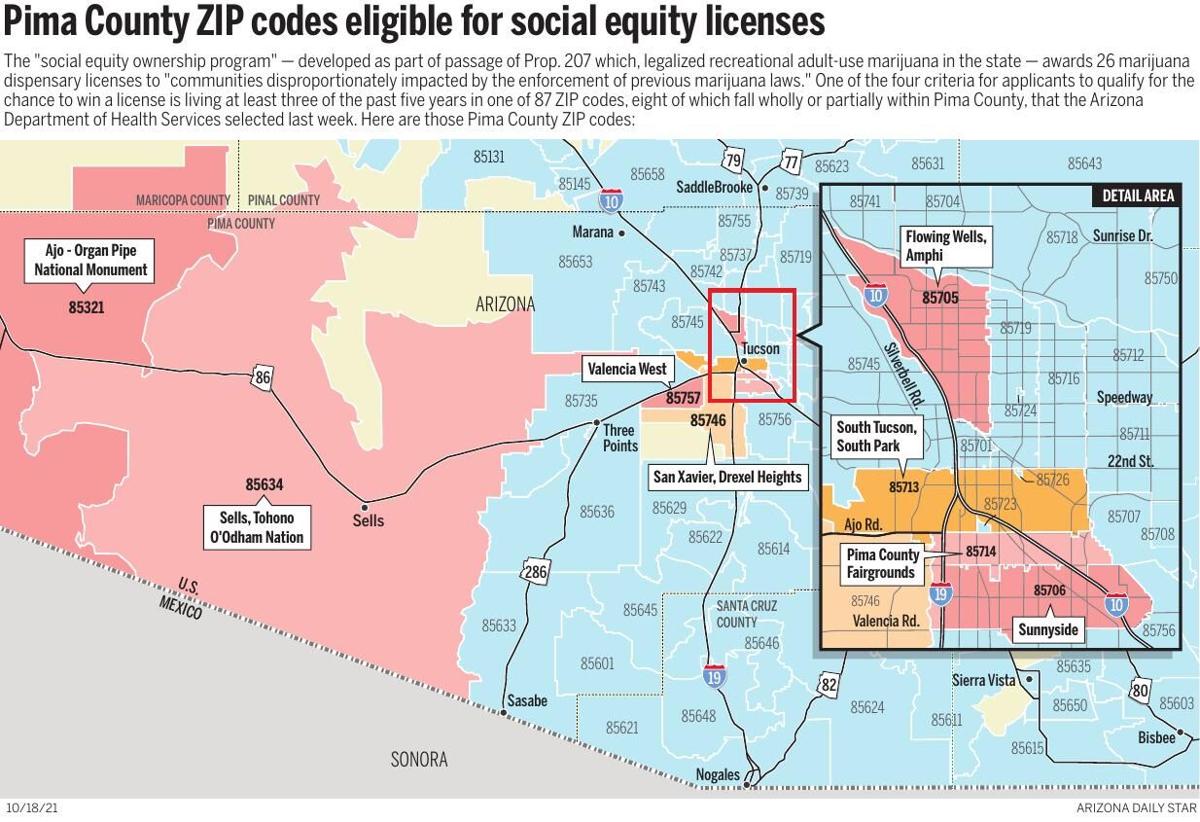
The Arizona health department released a list of 87 ZIP codes, eight of which fall wholly or partially in Pima County, that will help determine the eligibility of applicants to the state’s “social equity” program for two dozen licenses to own marijuana dispensaries.
“(The Arizona Department of Health Services) conducted an extensive analysis concerning whether a community meets the social equity program’s requirement of disproportionate impact from the enforcement of previous marijuana laws,” the health department said.
Two weeks ago, the department released the 87 ZIP codes in Arizona that are essential for potential applicants to be eligible to meet the geographic requirement behind the state’s four-criteria application process. The local ZIP codes include an area west of Tucson that includes the Tohono O’odham Nation lands, on the south side, the southwest side, the southeast side, and a corridor along I-10 stretching north from the downtown area.
The ZIP codes selected locally are: 85321, 85634, 85757, 85746, 85705, 85713, 85714 and 85706.
Former ADHS Director Will Humble said the ZIP code selections are essential because of how many potential applicants are expected to check that criteria as part of their applications. “I mean we are talking up to 70% of applicants, potential applicants, here,” he said. The state will select who gets the special licenses, which can be financially lucrative to the holder, in early 2022.
For weeks, critics and potential licensees had wondered how the state came up with these ZIP codes? Now, the health department has made its methodology known.
Importance of ZIP codes
First, it helps to understand what makes the release of these ZIP codes so important in the context of the social equity ownership program. Passed as part of Proposition 207, which made adult-use recreational marijuana legal in the state, the “social equity ownership” program sets aside 26 licenses for “people from communities disproportionately impacted by the enforcement of previous marijuana laws.”
To be considered by the health department for the chance to win a social equity marijuana dispensary license, one must meet three of the following four criteria:
A household income less than four times the federal poverty level for three of the past five years. According to federal guidelines, a family of four could earn no more than $106,000 to qualify.
Either a previous marijuana conviction where expungement was granted, or a state or federal marijuana conviction. A copy of the expungement or conviction document must be submitted.
A spouse, parent, child, sibling or guardian who was convicted of a marijuana crime.
Proof of living three of the past five years in a “community that has been disproportionately affected by the enforcement of Arizona’s previous marijuana laws.”
The final criteria references the ZIP codes released this month. So for those potential applicants, living in the designated ZIP codes helps them meet one of the criteria that will be used by the state to approve an application for consideration.
But why are they so important?
Humble, who oversaw the rollout of Arizona’s medical marijuana program in his time as director, praised the department for at least acknowledging there has been an over-policing problem when it comes to marijuana possession.
“It’s the first time that I know of where the state has conceded, that there are areas that have been over-policed and over-prosecuted, don’t forget about that,” Humble said.
Mike Robinette, the executive director of the Arizona chapter of the National Organization for the Reform of Marijuana Laws, differed from Humble, giving credit instead to Arizona voters. “It truly is the reflection of Arizona’s voters’ will in passing Prop. 207 by a 60 to 40 margin,” he said.
Humble said the department most likely used ZIP codes as one of the criteria because it would be easy to administer that part of the selection process. “They can be verified easily and quickly when the applications come in,” he said.
However, according to potential social equity applicant and cannabis entrepreneur Zsa Zsa Simone Brown, using ZIP codes will open the applicant pool to people it wasn’t intended for. She gave a hypothetical example of being arrested in Maricopa County while living in a Pima County ZIP code that isn’t on the health department’s list.
“Let’s say I’m in Maricopa for the day and I got arrested, but I lived in Tucson and another ZIP code. I don’t qualify” for the ZIP code criteria, she said. “I can qualify as far as being arrested, but as far as the address and all that stuff, I still would not qualify.”
Instead of ZIP codes, Simone Brown said she is an advocate of using law enforcement districts or census tract areas tied to arrest and prosecution rates in a related jurisdiction to better target individuals she believes the social equity program was meant for.
But, Humble countered, easily trackable and actionable data is important for the licensing process.
“Administratively, you need something to verify, and ZIP code is super verifiable,” he said. “Whereas you don’t have ‘police beat’ on your water bill.”
Food assistance was considered
The department said it drew on data from the U.S. census’ 2019 racial population estimates and the Arizona Department of Economic Security’s numbers on the Supplemental Nutrition Assistance Program, or SNAP, to come up with two criteria for choosing the 87 eligible ZIP codes. Those two criteria used were the aggregate “minority” population and the number of people receiving SNAP benefits in those areas.
Basing a methodology off those two criteria is “interesting and notable” according to Jon Udell, an attorney with the Rose Law Group and the communication director for the Arizona’s branch of NORML.
“It’s surprising,” he said. “Most of us were expecting the criteria to be based off the arrests or conviction rates in a particular area, not race or socioeconomic status.”
Udell said criteria behind the methodology could come into play if and when future lawsuits challenging the legality and constitutionality of the program are filed.
Robinette echoed Udell but argued it wasn’t necessarily a bad idea to try to even the playing field using the racial makeup and socioeconomic background of an area.
“The concern becomes are you necessarily reaching an African American who has been disproportionately impacted by drug laws? Not just someone who has been living in an disenfranchised area relative to socioeconomics,” Robinette said.
What’s next?
Applicants to the social equity ownership program will be able to apply for a spot in the Department of Health Services’ random drawing for licenses between Dec. 1-14, with the actual drawing coming up in early 2022, according to the department.
There will be 26 licenses awarded. In the meantime, applicants must complete online training.
Rules for Arizona's social equity marijuana program finalized
Rules for what could be the last marijuana dispensary licenses issued by Arizona have been finalized by the state’s health department.
The the final draft report by the Arizona Department of Health Services’ “social equity ownership program” was issued Thursday. In general, the program is intended to “promote the ownership and operation of marijuana establishments … by individuals from communities disproportionately impacted by the enforcement of previous marijuana laws,” according to the department’s website.
The major changes include clearing up language around the transferability of a social equity license. It effectively bars applicants from entering into prior agreements with larger retailers to sell or take over an applicant’s license. The initial application fee of $5,000, which is nonrefundable, was also lowered to $4,000.
However, critics and potential applicants to the program contend that, while the final draft closes a big loophole, it still falls short of establishing a truly equitable program.
“Not very good,” Zsa Zsa Simone Brown, a cannabis entrepreneur and potential social equity program applicant, said of the final rules. “Some of the things in there are good, and I can see where they can benefit. But there’s still some things that are missing,” like a point-based application system and better transferability controls, Brown said.
The National Organization for the Reform of Marijuana Laws, or NORML, issued a statement Thursday praising AZDHS for changing language in the documents that allowed for potential licensees to “flip” their license to an outside buyer. Before the change, there was concern from applicants and advocates that potential licensees could enter into agreements to sell their licenses to individuals with deep pockets or to established marijuana consortiums.
Brown said the department could have gone further. She said she would have liked to see more restrictive language about what potential licensees could do. Under the final rules, there is no restriction on when licensees can sell their rights. Licensees can theoretically sell those rights immediately.
“If they are going to be transferable, then one, it should be a longer time period that you have to hold on to them,” Simone Brown said. “And then secondly, if you are going to transfer a sale, that it should only be to another social equity applicant.”
Brown and NORML also were critical of AZDHS not extending the period for potential applicants with eligible marijuana-related convictions or arrests to have them be expunged from their records, an argument tied into the departments release of eligible ZIP codes for applicants last week.
Even if an applicant were to apply for expungement now, with the average turnaround time of two months to be processed by the courts, they would likely miss the AZDHS-set application period of Dec. 1 to Dec. 14, according to NORML.
Additionally, applicants for the social equity program might be out of luck when it comes to opening a dispensary after the licenses are handed out in early 2022, when AZDHS is set to hold a random distribution, according to the agency.
Due to a formula that ties the number of dispensaries to the number of retail pharmacies — 100 pharmacies to every 1 dispensary — it’s possible there will be no more legal dispensary licenses issued in the state for the foreseeable future, officials said.
Local cannabis café, advocacy group hosting expungement clinic
The Southern Arizona branch of a marijuana advocacy group, along with a new social equity collaborative, are partnering with a local cannabis café on Saturday, July 3, to help anyone arrested, charged, convicted and/or sentenced with certain marijuana-related crimes.
The Harambe Café, located at 6464 E. Tanque Verde Road, will play host to an expungement clinic for people with previous marijuana convictions. The event will last from 10 a.m. to 4 p.m. There are no appointments needed, and walk ups are accepted and encouraged.
“We've designed these clinics so that we provide the most help to the greatest number, because there's somewhere between a quarter million and half a million eligible folks who will need these services,” said Julie Gunnigle, director of politics for Arizona National Organization for Reform of Marijuana Laws, or NORML, which is organizing the event.
Anyone with a prior conviction for something now decriminalized by passage of Prop. 207 is eligible. Gunnigle said that anyone seeking expungement should bring any and all related paperwork and documentation with them.
“But even if you couldn't find the paperwork, we can still help you,” she said. “From beginning to end, on a simple case, the process takes about 15 minutes and folks will leave with their filled-out petition in hand so that it's ready to file on July.”
Attorneys from around the area, as well as law students will be on hand to assist. Individuals will not have to enter into an attorney-client relationship to participate, said Southern Arizona NORML executive director Mike Robinette.
While there are potentially thousands of individuals eligible for expungement according to state records, Robinette was unsure about the turnout.
“Regardless if it’s one person or one hundred people an hour, it’s just great to finally be able to offer a service like this that can help people,” Robinette said.
According to Gunnigle, who has put on a few similar events in the Phoenix area already and is a trained attorney, these clinics are necessary mostly due to the states’ unwillingness to help.
“Prosecutor’s offices could have and should have, in my opinion, expunged these offenses automatically and universally,” she said. “Instead we're relying on folks to come forward and put their information on the prosecutor's website or come forward to a clinic like this.”
She said, it’s taken “precisely zero effort” to find attorneys willing to help out and participate in these clinics. Plus, the passage of Prop. 207 created the state’s first expungement process, something both Gunnigle and Robinette hope is expanded.
Arizona's 'social equity' program for marijuana licensing draws some concerns
The rules governing eligibility for Arizona’s program awarding marijuana dispensary licenses to individuals from communities hit hardest by the war on drugs are almost finalized.
But critics argue the rules do not go far enough to help those the program is intended for — lower income residents from underserved communities who have, or have a family member, with minor marijuana convictions.
Passed as part of Proposition 207, which made adult-use recreational marijuana legal in the state, the “social equity ownership” program sets aside 26 licenses for “people from communities disproportionately impacted by the enforcement of previous marijuana laws.”
“It was also supposed to remove what lots of people viewed to be a perverse situation where a person selling cannabis with a license could become a billionaire and a person selling cannabis without one could go to prison for decades,” said Julie Gunnigle, board member for the Arizona chapter of NORML, which advocates for reforming marijuana laws.
However, it does not mention specific communities.
While the program could be a game changer to Black, Hispanic, veterans and other individuals in underserved communities, it could also fetch license winners a cool payday — since the licenses can be sold — and ultimately leave out the people it was supposed to help in the first place.
The biggest problem
The inclusion of social equity licenses was part of a package of rules included in the recreational marijuana proposition ostensibly to level the playing field by allowing those who may have been impacted by the enforcement of drug laws to obtain a license, Gunnigle said.
However, according to Gunnigle, there is a fatal flaw at the heart of the program: the lack of constraints on the transferability of the licenses as soon as they are awarded under the social equity program.
That, and money.
She estimates a newly won license could fetch anywhere between $10 million and $20 million for the holder on the open market. That leaves the possibility where an individual is awarded a social equity license and turns around and sells it to someone who otherwise would not qualify.
“When you create a program like this, where licenses are freely transferable on Day 1 and are transferable to other people other than social equity applicants and doesn’t have any strings attached … you’ve created a system that’s just right for exploitation,” said Gunnigle.
Zsa Zsa Simone Brown, a Black woman, veteran and owner of a cannabis lifestyle and wellness brand, agreed with Gunnigle’s assessment.
“If that’s what it says, and we’re gonna allow a management services organization or someone who already has a dispensary to buy that, then it’s no longer a social equity license,” said Brown, who is a potential applicant seeking one of the licenses.
Brown would like language added that says a social equity license winner may sell his or her license but only to another qualified applicant, and not an already established business or corporation.
Brown’s biggest fear is instead of a dispensary ending up in the hands of someone living in and from a community affected by the war on drugs or considered impoverished, it could end up in the new hip and trendy section of a city.
“You’re not going to get anything different if you keep rocking with the same set,” she said.
Broad rules, qualifications
Although not fully codified yet, the Arizona Department of Health Services, the agency tasked with overseeing marijuana distribution, issued a draft proposal in May laying out what qualifications and requirements applicants in the program must meet.
On top of a $5,000 nonrefundable application fee and having to have lived in the state at least three of the last five years, applicants must meet four of the following five stipulations:
A household income of less than 400% of the federal poverty level in at least three of the last five years. The current federal poverty level is $26,500 for a family of four, meaning an applicant’s household income has to be less than $106,000.
The person has to have been convicted of charges related to marijuana or marijuana paraphernalia and does not have an excluded felony offense, or had a conviction and has petitioned for expungement of charges relating to the possession of less than 2½ ounces of marijuana.
The person has to have a spouse, surviving spouse, parent, child, sibling or legal guardian convicted of a violation of state or federal laws related to marijuana or marijuana paraphernalia.
Complete a state-approved training course on running a dispensary.
One rule has language that is still to be finalized by Sept. 1, according to the health department website:
An applicant has to have lived at least three of the last five years in a “community that has been disproportionately affected by the enforcement of Arizona’s previous marijuana laws.”
According to Steve Elliott, communications director for the state health department, the 26 social equity ownership licenses, which can be applied for during a brief window between Dec. 1 through Dec. 14 this year, will be distributed by way of random drawing sometime in late December.
Because the department expects so many applications to be submitted for the 26 licenses, the exact method of selecting the winners has yet to settled, Elliott said.
The rules, on their face, seem benign, and almost rise to the level of what the spirit of Prop. 207 meant to solve — leveling the playing field, but Brown said she does not see specific enough language within the rules to assure her the “social equity” part of the program is fulfilled.
“They have not mentioned that people of color and veterans and Hispanics had been the people who have been disproportionately attacked and have suffered throughout the war on drugs,” she said.
Brown points to that broad language, the $5,000 nonrefundable application fee and some of the residential qualifications as hurdles that are seemingly made to keep her, and others like her, from realizing their true financial and business potential by allowing almost anyone to qualify and apply.
“I know some young men in my area who happened to be white men who would qualify for one of those easily based on this,” she said. “They may have had a cannabis conviction or the area that they chose to live in … the different criteria just make it still so vague.
“I just feel like this is another opportunity for the state to collect millions of dollars in applications for a handful of licenses,” Brown said. “And they’re going to go to the people who already had them.”
Pima County Attorney Laura Conover filed 14 petitions Monday, July 12 to expunge low-level marijuana charges from the records of eligible local residents.
Such petitions became easier to file after Prop. 207 passed last year, which legalizes marijuana use and possession for those 21 and older and allows for the clearing of past minor marijuana charges.
The Arizona health department has opened registration for training classes that applicants who want to be eligible for one of the state’s marijuana “social equity” licenses will be required to take.
While the application fee is $5,000, with no guarantee of being awarded a license, the classes are free.
“It’s an educational opportunity that all the applicants must take,” said Tom Salow, branch chief for the Arizona Department of Health Services. “It’s going to cover a variety of topics. Some of those areas, some folks may need some education on.”
Passed as part of Proposition 207, which made adult-use recreational marijuana legal in the state, the “social equity ownership” program sets aside 26 licenses to operate a dispensary for “people from communities disproportionately impacted by the enforcement of previous marijuana laws.”
On top of applicants, each listed officer or board member on an applicant’s petition is also required to attend the classes, which will be offered live online on Sept. 20-21.
That session will be recorded and played online again, with a live question-and-answer segment to follow on Oct. 12-13. Applicants and other attendees are encouraged to attend one of these two live events.
For applicants that can’t make either, or are only able to attend for one of the two days, the health department will offer computer-based training from mid-October through mid-December. The computer-based training will be structured after the live, recorded segments, Salow said.
According to the department’s website, the classes will be led by industry experts, and will cover such topics as compliance and regulatory statutes, branding and marketing, fundraising and legal advice.
“How to get funding for a new license may not be the easiest thing to navigate without some assistance or guidance,” Salow said.
To that end, any applicants who still have questions after going through the mandatory classes can also reach out to AZDHS for additional one-on-one support and clinics to help potential licensees with the application process and the chance to meet with instructors to have questions answered.
The application period to apply for a social equity license will be from Dec. 1-14. According to Salow, a random drawing from that pool of applicants will take place sometime in early 2022.
New state rules for marijuana 'social equity' licensing good step, advocates say
The latest draft of the state’s rules governing the distribution of “social equity ownership” licenses needed to own a marijuana dispensary was released by the Arizona Department of Health Services last week, giving some clarity to rules critics had called purposefully vague.
“These new set of rules do appear to quite possibly close the loophole relative to previous drafts, where it seemed like it could be quite possible that a single individual could sponsor an unlimited number of applications,” said Mike Robinette, executive director of the Southern Arizona branch of the National Organization for the Reform of Marijuana Laws, or NORML.
The rule change makes clear anyone listed as a principal officer, board member or person entitled to 10% or more of the profits of the applying entity can now only include their name on two applications for one of the 26 social equity licenses.
Passed as part of Proposition 207, which made adult-use recreational marijuana legal in Arizona, the “social equity ownership” program sets aside 26 licenses for “people from communities disproportionately impacted by the enforcement of previous marijuana laws.”
Those applications can be submitted Dec. 1-14, and the drawing for the licenses is still to be announced but is set to take place in early 2022, according to Tom Salow, branch chief for the Arizona Department of Health Services.
Julie Gunnigle, director of politics for the Arizona NORML, issued a news release praising the state health department for listening to critics and echoed Robinette on preserving the spirit of a program passed by voters last November.
“We are thrilled that the department is listening to stakeholder feedback and community comments and has limited the ability of a small number of individuals to flood the social equity lottery with applications for the purposes of reselling the license,” she said. Reselling the license could be very profitable for the owner of the license.
Earth’s Healing Dispensary is located next to apartments and an RV center on Benson Highway.
Rebecca Sasnett, Arizona Daily Star
Still, the new draft rules are not final.
Robinette noted advocates and industry insiders are still waiting to see how AZDHS wrestles with the most nebulous part of the rules: how to define a “community that has been disproportionately affected by the enforcement of Arizona’s previous marijuana laws.”
“Our understanding was that would be in early September,” he said. “But then these rules just drop … it wasn’t in that. So we’re still hoping, fingers crossed, into later September.”
Drive up Interstate 10 and you’re bound to notice them: Billboards for marijuana dispensaries, most of them with addresses somewhere in the greater Phoenix area.
In fact, the number of active and open dispensaries in Maricopa County — 86, as of this month — outnumbers the amount of operating dispensaries in the rest of the state, combined. And, when compared to Pima County, Maricopa sports a 5-to-1 advantage. Pima County has 16 operating dispensaries.
“Those numbers roughly correspond to the populations of the Phoenix metro area and the Tucson metro area,” says Jon Udell, a cannabis attorney with Rose Law Group in Scottsdale and communications director for the Arizona branch of the National Organization for the Reform of Marijuana Laws, or NORML.
In fact, there are nearly 4½ people in Maricopa for every 1 Pima County resident, giving the state’s most populous county just a slight edge on dispensaries per-capita.
And while population tells most of the story, it’s the money tied to that population that’s shaped the landscape of where dispensaries are, and aren’t, in Arizona today.
Follow the money
In 2010, Arizona voters approved Proposition 203, or the Arizona Medical Marijuana Act. With its passage, the Arizona Department of Health Services was put in charge of setting rules, guidelines and regulations for the new industry.
Under the law, patients with certain medical conditions and a doctor’s recommendation can obtain up to 2½ ounces of marijuana every two weeks.
In response, AZDHS developed a lottery system where applicants for a prospective dispensary license could submit applications, each costing a non-refundable fee of $25,000, in hopes of winning one of a limited number of licenses with the right to distribute marijuana.
That total number of dispensary licenses is tied in perpetuity to a formula set into law with the passage of Prop. 203. Essentially, the number of total marijuana dispensaries in Arizona is dependent on the total number of retail pharmacies.
“For every 10 medical pharmacies, the department of health was required to award one marijuana license,” says Samuel Richard, executive director of the Arizona Dispensary Association.
Originally, AZDHS awarded 99 initial dispensary licenses in 2013 statewide, when the medical marijuana law took effect. After a census of pharmacies in 2016, the state issued an additional 31 licenses, bringing the total to 130.
Those initial licenses were supposed to be awarded to people and entities around the state, according to former AZDHS director Will Humble.
"Otherwise, we were just going to get a whole bunch of applications for downtown Phoenix," he said. "We got 12 applications for the ASU (area) and we'd get zero for up north of the Grand Canyon."
At first, the medical licenses were well distributed.
“They were kind of, sort of far-flung across the state,” Udell said. “People tried to submit competitive applications in regions that weren't being serviced already.”
However, those initial awarded medical licenses weren’t tied to any one geographical area. And, if a license holder decided, after operating for three years in a rural area (or any area) that they’d like to either move their dispensary or transfer the license, there was nothing written into state rules to stop it.
“Many of them relocated to places that were more profitable,” Udell said. “So that's been a pretty common feature of the industry.”
And because Maricopa County has by far the most medical card holders and (with the passage of Prop. 207) more prospective recreational use customers, it made sense for license holders to relocate to an area that would have more potential for profit. Also, with the passage last year of Proposition 207, the state now allows anyone 21 and older to possess up to an ounce of marijuana or six plants for recreational use.
“That's, in my view, where the discrepancy between the two (Maricopa County and Pima County) kind of comes from,” Udell said. “The cause of the discrepancy between the two of them is they’re (license holders) just trying to go where people are located and demand is highest.”
More on the way
While Arizona’s medical marijuana industry is nearing a decade old, it’s adult-use recreational program isn’t out of its first year yet.
With its implementation earlier this year comes new programs aimed at better distributing dispensary licenses to under-served counties and areas.
The first of those programs, the “empty county back-fill” lottery, awarded 13 county-specific, adult-use only licenses in April to groups and individuals who had applied.
That lottery, aimed at counties with two or less dispensaries, had no real effect on Maricopa and Pima counties, as those licenses, while ultimately transferable, are tied to the county they are awarded in, said Udell.
“Gila County just got I want to say two new dispensaries,” he said. “Those dispensaries will be required to stay in Gila County. They can relocate down the road, but they have to relocate to another spot in Gila County.”
However, the state’s next round of licenses, distributed under the “social equity ownership” program, should have some effect on where Pima County residents can purchase marijuana.
The program is geared towards providing licensed dispensary ownership to “people from communities disproportionately impacted by the enforcement of previous marijuana laws.” These 26 licenses will be handed out in early 2022, according to Tom Salow, branch manager with AZDHS.
Unlike the rural county program, licenses handed out under the social equity ownership program won’t be tied to a specific county or location.
Earths Healing Dispensary is one of 16 operating marijuana dispensaries in Pima County.
Rebecca Sasnett, Arizona Daily Star
According to Richard, with Tucson’s relatively friendly zoning laws, he foresees a few additional dispensaries sprouting up as a result of the program.
“I’m fairly certain that there will be at least a few more dispensaries moving into town,” he said.
The future of dispensaries
Once the state issues 26 social equity licenses next year, the total will be 169 active licenses, although as of publication, only about 125 are attached to active retail locations.
For comparison, Washington, a state with a similar population to Arizona of over 7 million, has more than 1,000 dispensaries – not just licenses, but retail dispensaries. Oklahoma, a state with roughly half Arizona’s population, has more than 2,000.
Richard explained that relatively low number of dispensaries per-capita in Arizona compared to other states is due to two factors: voters not wanting the program to end up “like Oklahoma or California, with dispensaries on every corner,” he said — and the related fact that the marijuana industry is still viewed as being part of the black market.
"Many cities and counties still treat marijuana much like pawn shops and gentlemen’s clubs," he said.
Plus, 169 licenses is actually more active licenses than the 10-to-1 pharmacy-to-dispensary formula allows, Udell points out.
“It's totally absurd,” he said. “Arguably it made some sense for the medical marijuana act because they were medical dispensaries, but would we tie the number of liquor stores or licensed alcohol distributors to determine pharmacy numbers?"
Both Richard and Udell were in agreement that, barring action by the Arizona Legislature, another voter initiative or continued population growth that necessitates more than 1,700 retail pharmacies in the state, that total of 169 active dispensary licenses isn’t likely to change soon – if ever.
Pima County Attorney Laura Conover filed 14 petitions Monday, July 12 to expunge low-level marijuana charges from the records of eligible local residents.
Such petitions became easier to file after Prop. 207 passed last year, which legalizes marijuana use and possession for those 21 and older and allows for the clearing of past minor marijuana charges.
Judge decided to allow the state to accept applications to be considered for one of 26 special licenses despite lawsuits asking for the program to put on hold.