

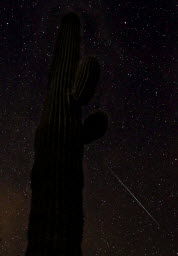
I write about three meteor showers every year – the Perseids in August, the Leonids in November, and the Geminids this week.
There are many other meteor showers, but these on average are the best, weather and moon permitting.
There are also random meteors all night long, but they are not as numerous as those in a meteor shower and do not seem to come from the same point in the sky (radiant) as those from a meteor shower.
Meteor showers are caused by the Earth crossing the orbit of a comet that has spread tiny grains of debris along it path. When we encounter this debris, meteors are produced, which seem to radiate from a single spot. A meteor shower is named for the constellation where its radiant is located.
The Geminids’ radiant is in Gemini the Twins. Many consider this the best meteor shower of the year. It is said to produce up to 120 bright, multicolored meteors an hour at its peak, but do not expect to see this many.
People are also reading…
However, the Geminids do produce a lot of bright meteors, well worth bundling up for observing on a cold December evening. This year the peak of the Geminids is this weekend.
Unfortunately, the last quarter moon rises at 12:06 a.m. Sunday, interfering with the Geminids in the later morning hours. You can start observing in the early evening on the Saturday as Gemini is above the horizon by 7 p.m.
Bundle up, get a comfortable chair, have coffee and hot chocolate at hand, look toward the east and enjoy the show.


