

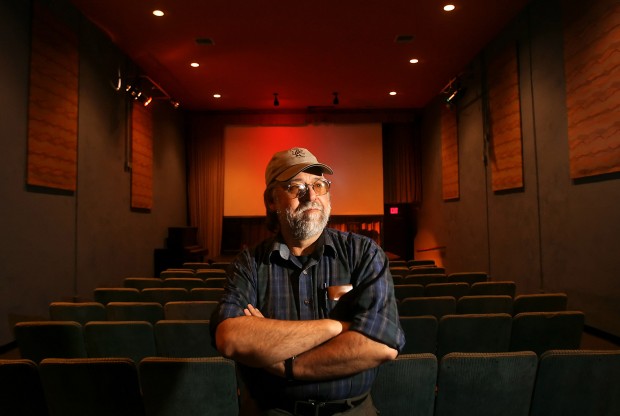




The Screening Room opened on East Congress Street two decades ago, but the storefront theater didn't fully arrive on the downtown scene until about six months ago.
That's when its dazzling new marquee was installed.
With a flick of a switch, preceded, of course, by years of fundraising, the bright neon sign put the long-suffering Screening Room on the map.
Suddenly, the downtown theater, which seats 130 people, went from chronically overlooked to can't be missed.
That's good news for the 2010 Arizona International Film Festival, which opens tonight at the Screening Room and continues for the next 10 days.
Now in its 19th year, the festival is the brainchild and continuing passion of Giulio Scalinger, who moved to Tucson in 1985 and has worked to foster independent filmmaking here ever since.
People are also reading…
Scalinger moved to the Old Pueblo with his future wife, Claudia Jespersen, a longtime arts administrator who now serves as executive director of the Arizona Media Arts Center, the nonprofit agency that Scalinger created in 1986 to promote Southern Arizona filmmaking.
Operating under the umbrella of AzMAC, the Screening Room opened in a raggedy storefront wedged between the Dinnerware gallery and a.k.a. Theatre.
"Those were the days," says Scalinger, recalling a time in the 1990s when art exhibits and stage productions had the block buzzing with crowds three or four nights a week.
Meg Nolan's fearless a.k.a Theater burned hot and bright, commanding most of the attention for a while. But Scalinger kept plugging away, slowly making improvements to the space next door and willing the film festival into reality year after year.
Now, long after a.k.a. flamed out and Dinnerware moved to bigger digs, the Screening Room is alive and kicking.
And so is the festival, which has established itself as an ambitious, rigorously curated showcase of independent film. In a state that's littered with film festivals from Sedona to Scottsdale - even Arivaca's got one - the AIFF is the oldest. It was first presented in November 1990 at the Temple of Music and Art and has unspooled at the Screening Room (and other theaters) every April since 1993.
Tonight's opening event is a collection of a half-dozen short films representing different genres.
Scalinger, who was knocked out by the quality of short films submitted this year, picked the lineup to show "the range of what's happening in independent filmmaking."
"This year, the standard of shorts is really exceptional," he said. "Really good stuff."
Scalinger sees plenty of movies at festivals, hoping to cherry-pick titles for AIFF, and he watches many more at the west-side home he shares with his wife and two dogs, a Doberman named Gabriella and a golden retriever puppy, Solea.
Of the roughly 600 films he watched in preparation for this year's festival, he's not sure how many titles he watched at home. Let's just say the DVD player got quite a workout.
Thank heaven for the fast-forward button, eh?
"Actually, because the filmmakers send us an entry fee, I feel it's my duty to watch all of them to the end," says Scalinger, a former teacher of video production and exhibition at the University of Arizona.
"The festival requirement is that it has to have been made the year before and as much as possible, it should be an Arizona premiere."
Scalinger, who retired from the teaching two years ago, was born and raised in Johannesburg, South Africa (he'd rather not say when), and went to film school in London. He lived in several other cities before landing in Salt Lake City, where before coming to Tucson, he led the Utah Media Center and worked with the festival that's now centered in Park City and called the Sundance Film Festival.
"Some say that my taste tends to run toward the darker stuff, and I've been told that I take too many risks," he says.
If you've never heard of Scalinger, it's no accident. He's always preferred to stay out of the spotlight and, true to form, wasn't keen on being photographed for today's story.
We're not here for us; we're here for the filmmakers.
"I've heard that as long as I've known him," says Mia Schnaible, a volunteer at the Screening Room since 2002.
"I started as just your normal, run-of-the-mill, ticket-taking volunteer who worked my way up," says Schnaible, who is now the director of marketing and development - still unpaid.
Scalinger, the volunteer in chief, is always willing to try new things, she says.
"I have a lot of friends who are in bands and play music, and he let me create the music cafes for the festival," Schnaible says.
Starting tonight at the Hut and continuing nightly at various watering holes from Sharks to the Shanty, the music cafes are designed to highlight local acts and give festival-goers a place to gather at night's end.
The Screening Room is also earning a name for itself as an alcohol-free place to hear live music, with Mark Growden and other musicians singing the praises of its sound.
You can hear for yourself Saturday night, when Al Perry will host a powerhouse acoustic showcase at the Screening Room as part of Club Crawl.
The lineup, which includes Fish Karma, Al Foul and Billy Sedlmayr, represents the first time the Screening Room has participated in the Tucson Weekly's twice-yearly Club Crawl.
Money woes mean fewer invites to filmmakers
"The big difference this year is money," says Scalinger, explaining that the Arizona Media Arts Center, like most nonprofit organizations, experienced a dramatic drop in donations and other funding as the economy cratered.
Although this year's festival has about the same number of films as in previous years, budget woes forced the festival to scale back in other ways.
"Where the funding cuts have really hurt us is that usually we have money to bring in filmmakers," Scalinger says. "Usually, we place them in the schools, and it gives kids the opportunity to learn about independent filmmakers.
"It's our 20th anniversary next year, and one of my ideas is to bring back a filmmaker from each festival and see how they've done."
Bryan Singer, for example. He was here in 1994 with his first feature film, "Public Access."
Says Scalinger: "Remember Cafe Magritte? Well, Singer loved that place, and one night he was telling us about this crazy film he was going to make and we thought, 'Yeah, well that's not going to work.' And it was 'The Usual Suspects.' "
Scalinger laughs.
Looking ahead, he can't help but wonder about the future of film festivals and film distribution. With the popularity of video sites such as YouTube, it's becoming harder to say what's a world premiere, he says.
One thing's for sure: Technology is changing everything, allowing anybody and everybody to make movies. Cameras are getting better and less expensive all the time, and constantly improving software enables whiz-bang editing at home.
That means more good movies, sure, but also lots and lots more bad movies, Scalinger says.
"If you don't have the knack of telling a good story and if you don't know how to use the cinematic language, all the technology in the world isn't going to help you," he says.
Even so, he's encouraged by the sheer number of homegrown movies.
"I'm amazed at how many films I see coming out of Southern Arizona every year," he says. "From an independent point of view, film is flourishing."
Thanks in no small part to the efforts of one Giulio Scalinger.
If you go
• What: The 2010 Arizona International Film Festival, featuring 18 feature films representing 16 countries. Nearly 60 short films will also be screened, plus films by and for youths. In addition, there will be workshops, parties, panel discussions and other events.
• When: Tonight through April 25.
• Where: Films will be shown at the Screening Room, 127 E. Congress St., and at the Crossroads Festival, 4811 E. Grant Road.
• Tickets: $6 for screenings before 6 p.m.; $8 for screenings between 6 and 10 p.m.; $5 for screenings after 10.
• More information: A complete schedule of events is online at filmfestivalarizona.com
Did you know?
The Phoenix Film Festival, which opened last Thursday and closes tonight, is the undisputed big daddy of Arizona film festivals in terms of attendance and prestige.
First presented in 2000, the Phoenix festival has grown into a slick, high-profile celebrity magnet. Just to give you a taste, consider this: Tonight's closing film is the Arizona premiere of "Middle Men," with stars Luke Wilson and Giovanni Ribisi in attendance, but of course.


