

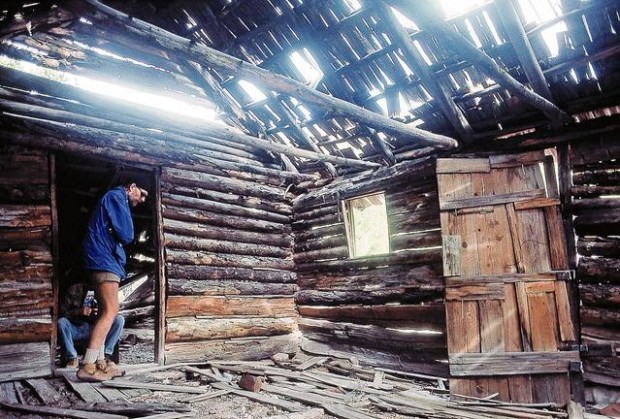
Three lawmen and the father of a backwoods family lay dead in the dirt after a furious shootout at a remote Southern Arizona cabin in 1918.
Now, 88 years later, one vexing question still hangs over the gunfight: Who started it?
Tucson writer and outdoorsman Pete Cowgill will delve into the shootout and ensuing manhunt in a free public program May 16.
His talk and slide show — the "Great Shootout at Power Cabin" — begins at 7 p.m. in the Pima County Medical Society Auditorium, 5199 E. Farness Drive. It's sponsored by the Southern Arizona Hiking Club.
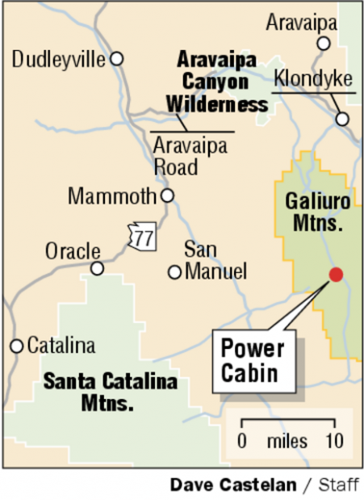
"It happened back in some very remote, tough country" in the Galiuro Mountains northeast of Tucson, said Cowgill, a former Arizona Daily Star outdoor writer who has backpacked to the cabin site. "There's no easy way to get in there even today."
People are also reading…
Cowgill, referring to historical accounts, said one faction in the shootout consisted of rancher and miner Jeff Power; his sons, John and Tom Power; and a hired hand, former Indian scout Tom Sisson.
"The Powers were some hard-nosed, tough-as-nails people," Cowgill said. "They had to go all the way to Safford to get supplies for their place way out there in the Galiuros. They apparently had run-ins with people in Safford and didn't take any guff from anybody."
It might have been that animosity that set the stage for an eventual run-in with lawmen. But Cowgill said the shootout also stemmed indirectly from World War I.
"The Power brothers were supposed to register for the draft, but they didn't," he said. "They defied the draft. Their father wanted them to stay in the Galiuros and keep working" in the family's cattle and mining endeavors.
The upshot was that four lawmen arrived at the cabin early on the morning of Feb. 10, 1918, with plans to take John and Tom Power into custody.
Leading the group was Sheriff Frank McBride. He was accompanied by deputies Martin Kempton and Kane Wootan, and deputy U.S. Marshal Frank Haynes.
"The sheriff and his men surrounded the cabin before dawn," Cowgill said, "but there are very divergent views of what happened after that."
What's certain is that lead started flying — and when the shooting was over, McBride, Kempton and Wootan lay dead and Jeff Power was mortally wounded. He died a short while later.
But which side triggered the shootout?
Cowgill said he's not sure.
"I side a little bit more with the Powers than the sheriff's group because of the way the shootout occurred," he said. "They surrounded the cabin and apparently didn't identify themselves as lawmen. . . . If they'd stayed back a bit and called out, the shootout might have been avoided."
Two books about the incident duel over the question of blame.
One of the books — "Shoot-out at Dawn: An Arizona Tragedy" by Tom Power with John Whitlatch — takes the Power family line.
A section written by Tom Power says that his father heard sounds outside the cabin and thought it might be a mountain lion stalking their horses.
He writes that his father picked up a rifle, went to the door and opened it. Just then, according to the book, "somebody out in the darkness yelled in a tight, tense voice: 'Throw up your hands! Throw up your hands!'
"Startled, and knowing he was a point-blank target standing in the lighted doorway, father dropped his rifle and started to raise his hands into the air," the account continues. "Before he got his hands all the way up, three quick shots rang out. He spun around and fell on his back in the dirt in front of the cabin."
The Power brothers then returned fire, the book says.
But another book — "The Evaders or Wilderness Shoot-out: The Story of the Power Affair" by Darvil B. McBride — spins a very different yarn.
Citing an account from the surviving lawman, Haynes, the book says that the elder Power was outside the cabin and apparently raised his hands. But then, according to the book, someone pushed open the door behind him and shoved a gun through. Shots — either from the man behind the door or the elder Power — then touched off the fray, according to this book's version.
When the shooting stopped, lawman Haynes hightailed it to report the carnage.
John and Tom Powers, along with family employee Sisson, took off — and eventually were pursued by numerous posses on a nearly monthlong manhunt.
Cowgill's talk will describe their route of flight — through Redfield Canyon, to the San Pedro River, into the Dragoon Mountains and to the Chiricahua Mountains, where their horses gave out. The fugitives crossed the Chiricahuas on foot and made their way into Mexico, where they eventually surrendered to U.S. Cavalry troops who had crossed the border.
The three were tried on various charges, convicted and sent to prison. Sisson died behind bars. The two Power brothers served 42 years and were finally paroled in 1960.
Tom Power lived until 1970.
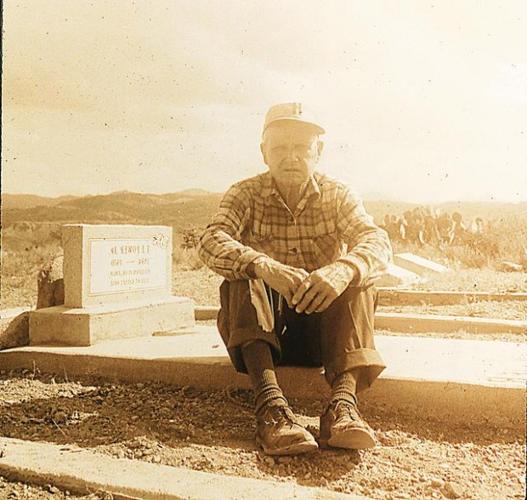
His brother, John, died in 1976. But not before Cowgill chanced to meet him in person.
"It was in Kielberg Canyon" in the vicinity of the cabin site, Cowgill said of the 1964 encounter. "I was backpacking in there when I met him. He had a pack on his back and a big old .45 on his hip.
"He was short and stocky and looked as hard as nails — but he was very pleasant. He said he had some mining claims up there."
A few years later, after learning some of the history of the shootout, Cowgill met with Power again in the little town of Klondyke on the edge of the Galiuro Mountains.
"We sat down and talked for probably an hour," Cowgill said.
What did Power have to say about the shootout?
"I decided not to ask him about it," Cowgill said. "So much had been written about it already. It was so long ago."
• What: A talk and slide show called "Great Shootout at Power Cabin" will be presented by writer and outdoorsman Pete Cowgill. A former outdoor writer at the Arizona Daily Star, Cowgill is co-author of "The Santa Catalina Mountains: A Guide to the Trails and Routes" and other works about outdoor adventure. The show is sponsored by the Southern Arizona Hiking Club.
• When: 7 p.m. May 16
• Where: Pima County Medical Society Auditorium, 5199 E. Farness Drive. It's south of East Grant Road and east of North Rosemont Boulevard.
• Cost: Free
• Information: 751-4513


