MIAMI — Winged babies shooting heart-shaped arrows might get most of the credit on Valentine's Day, but the real magic behind millions of romantic bouquets happens in a cargo warehouse at a South Florida airport.
Agricultural specialists at Miami International Airport will process about 990 million stems of cut flowers in the weeks before Feb. 14, according to U.S. Customs and Border Protection. Around 90% of the fresh cut flowers being sold for Valentine's Day in the United States come through Miami, while the other 10% pass through Los Angeles.
Roses, carnations, pompons, hydrangeas, chrysanthemums and gypsophila arrive on hundreds of flights, mostly from Colombia and Ecuador, to Miami on their journey to florists and supermarkets across the U.S. and Canada.

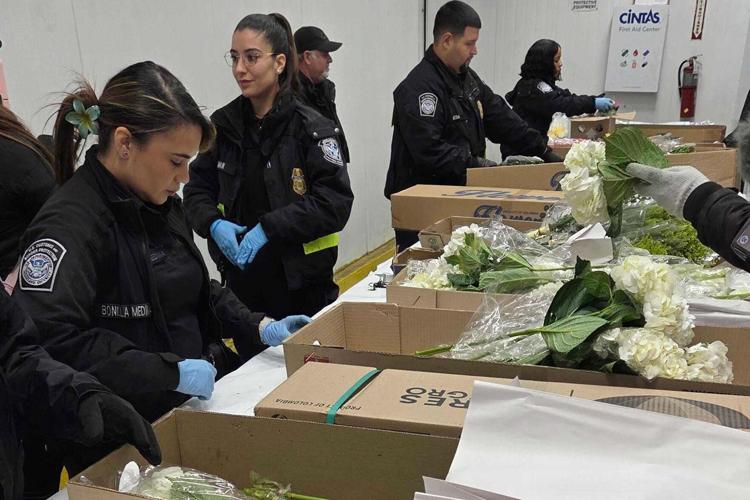
Valentine's Day flowers are unwrapped and inspected by U.S. Customs and Border Protection agriculture specialists at Miami International Airport on Friday, Feb. 6, in Miami.
Miami's largest flower importer is Avianca Cargo, based in Medellín, Colombia. In preparation for Valentine's Day, the company is transporting about 19,000 tons of flowers on 320 full cargo flights, CEO Diogo Elias said Feb. 6 in Miami. They're running more than twice as many flights compared to normal.
People are also reading…
"We fly flowers for the whole year, but Valentine's is special," Elias said. "Much more concentrated on roses, red roses especially. More than 50-60% are red roses at this time."
Customers buying flowers will likely see an increase in price this year. Christine Boldt, executive vice president for the Association of Floral Importers of America, said the cause is largely related to tariffs placed last year on imports from Colombia and Ecuador, along with a new minimum wage enacted this year in Colombia.

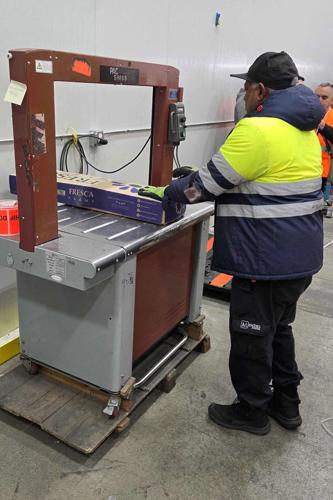
An Avianca Cargo worker rewraps Valentine's Day flowers after they were inspected by U.S. Customs and Border Protection agriculture specialists at Miami International Airport on Friday, Feb. 6, in Miami.
"This adds significant dollars to the bouquets that are coming in," Boldt said. "Every consumer is gonna have to face additional costs."
Despite higher prices, flowers continue to make up one of MIA's largest imports, airport director Ralph Cutié said. The airport received almost 3.5 million tons of cargo last year, with flowers accounting for about 400,000 tons. More than a quarter of those flowers are shipped before Valentine's Day, marking a 6% increase over last year.
"The mother, the wife, the girlfriend in Omaha, Nebraska, that gets their flowers for either Valentine's or Mother's Day, chances are those flowers passed through our airport," Cutié said. "And that's something we take a lot of pride in."

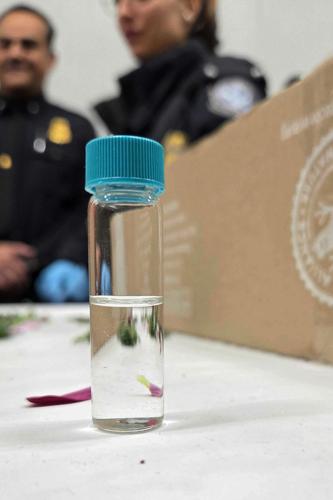
A test tube containing an insect larvae discovered by U.S. Customs and Border Protection agriculture specialists at Miami International Airport on Friday, Feb. 6, in Miami.
CBP agriculture specialists check the bundles of flowers for potentially harmful plant, pest and foreign animal diseases from entering the country, CBP senior official Daniel Alonso said. Inspectors on average find about 40 to 50 plant pests a day, the most common being moths. Pests are turned over to the U.S. Department of Agriculture, which determines the potential threat.
"Our rigorous process is vital to safeguarding the floral and agricultural industries, ensuring that our imported flowers are not introducing any pests or harmful diseases," Alonso said.


Inspectors check Valentine's Day flowers bound for US stores

Valentine's Day flowers are unwrapped and inspected by U.S. Customs and Border Protection agriculture specialist Elaine Mendez at Miami International Airport, and Friday, Feb. 7, 2025, in Miami. (AP Photo/Marta Lavandier)

Valentine's Day roses are unwrapped after being inspected by U.S. Customs and Border Protection agriculture specialist Elaine Mendez Friday at Miami International Airport in Miami.

U.S Customs and Border Protection agriculture specialist Elaine Mendez looks for pests inside boxes of lilies, Friday, Feb. 7, 2025, at Miami International Airport in Miami. (AP Photo/Marta Lavandier)

Shirley Silva, a U.S. Customs and Border Protection agriculture specialist, shakes a bouquet of flowers in search of pests Friday in Miami.

U.S. Customs and Border Protection agriculture specialist Shirley Silva places an insect larvae she found in a box of roses Friday, Feb. 7, 2025, at Miami International Airport in Miami. (AP Photo/Marta Lavandier)

U.S. Customs and Border Protection agriculture specialist Daniel Villegas inspects a box of flowers from South America, Friday, Feb. 7, 2025, at Miami International Airport, in Miami. (AP Photo/Marta Lavandier)

U.S. Customs and Border Protection agriculture specialist Shirley Silva inspects a box of roses that were grown in Ecuador, Friday, Feb. 7, 2025, at Miami International Airport in Miami. (AP Photo/Marta Lavandier)

Boxes of flowers arrive from Colombia Friday, Feb. 7, 2025, at Miami International Airport, in Miami. (AP Photo/Marta Lavandier)

U.S. Customs and Border Protection agriculture specialist Shirley Silva looks at a test tube with an insect larvae she found in a box of roses Friday, Feb. 7, 2025, at Miami International Airport in Miami. (AP Photo/Marta Lavandier)