

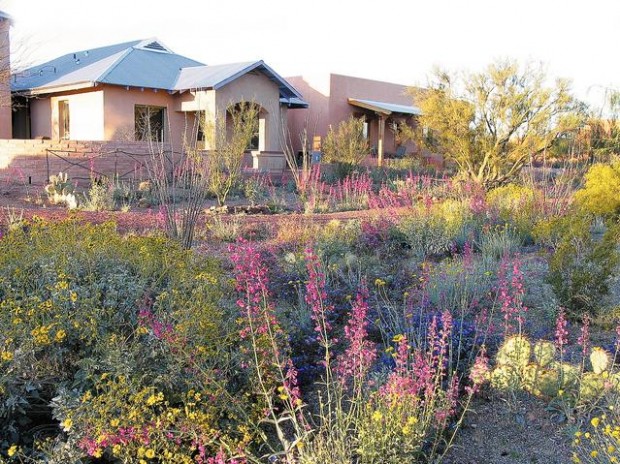
After more than 70 days without measurable rainfall in Tucson, speaking about planting a yard without an irrigation system seems nothing short of ridiculous. However, making a garden without a permanent irrigation system is indeed possible; if you need further evidence, take a walk in the desert and look around — you will see growing things.
The problems with automatic irrigation systems are well-documented: confusing timers, automatic valves that sometimes refuse to close, and emitters that occasionally clog or get eaten by rodents. That said, drip systems are useful and do save water, but they are not affordable for everyone. The following tips will help guide adventurous and/or wealth-challenged gardeners in planning a no-drip yard.
● Adjust your expectations.
Realize that a yard that does not have regular irrigation will necessarily look a whole lot more like the surrounding desert than a lawn. But what's so bad about that? The desert is beautiful. Remember that a no-drip garden, just like the desert, will go through periods of bloom and dormancy according to rainfall. Don't expect a no-drip yard to be in full flower nine months of the year.
People are also reading…
● Start small.
When you are aiming for maximum drought-tolerance, buy the smallest plants you can find. This will give the plant a higher proportion of roots to "shoots" (the part of the plant above the ground.) The higher the root-to-shoot ratio, the better the plant will be able to take in enough water to survive. Remember that all of the plants you see growing in the desert began as seeds and even a 30-foot-tall saguaro was once a teacup-size plant growing in the shade of a tree.
● Plant in mild weather.
Fall and early spring are the best times to plant new plants to avoid drought stress. Planting in June without an irrigation system or at least a serious commitment to drag the hose around is foolish at best.
● Hug those cacti and succulents.
It's a strange and prickly world, but Tucson is home to a universe of cacti- and succulent-plant growers and nurseries and there are no better plants adapted to a very low- to no-irrigation regime. If you can't tolerate cacti, the non-irrigated garden is not for you.
● Use rainwater to your advantage.
Get out a shovel and wheelbarrow and do your best to direct rainwater into basins where your plants are located. You'll need to make sure that water doesn't back up toward your house during heavy rainfall.
● Consider temporary irrigation.
For the first one to two years your plants will require periodic irrigation, especially during periods of prolonged drought. For those who leave town in the summer, inexpensive battery-powered timers can be rigged to a temporary above-ground drip tubing that will last until the plants are established. If you stay around Tucson in the summer and don't mind moving the hose around, a good hose-end bubbler might do the trick for the first couple of summers.
● Contact freelance reporter Scott Calhoun at scalhoun@azstarnet.com.
A few plants for the no-drip garden
» Foothills palo verde
» Fishhook barrel cactus
» Saguaro
» Ocotillo
» Limberbush
» Purple prickly pear
» Soaptree yucca
» Chuperosa
» Desert milkweed
» Paperflower (from seed)
» Desert zinnia (from seed)
» Parry's penstemon (from seed)