


Ninety years after the last vestiges of Tucson's walled fort known as San Agustín del Tucson were carted off, a portion of the presidio has now come to life Downtown.
But re-creating the late 18th century in modern-day Tucson hasn't come easy.
Adobe walls had to be stabilized. Uniforms had to be meticulously researched. And then there was that cannon — one that shoots out toast, rather than fire power.
One can only wonder what the presidio's original inhabitants — and the Apaches they fought — would think of all this.
Inside, meet some of the stalwarts determined to keep our history alive — with or without limitations. — Bonnie Henry
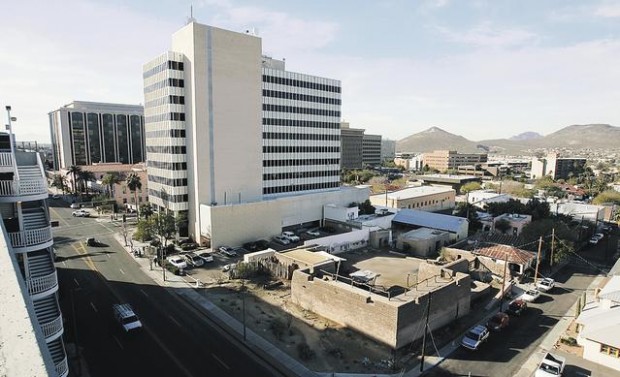
The Transamerica Building looms to the south, sometimes blocking the sun. Across the street is a parking garage. Trains can be heard rumbling in the distance.
People are also reading…
And plunked in the middle of all this modern urbanity sits Tucson's distant past: the re-created Presidio San Agustín del Tucson.
Part anachronism, all dream — particularly for Tucson architect Lewis Hall, who in 1984 helped found the Tucson Presidio Trust for Historic Preservation.
Its main mission: reconstruct a portion of Tucson's long-gone fort, which dates back to the late 1770s. Hall had an even bigger dream.
"He wanted the whole thing. He wanted to tear down City Hall," says another Presidio Trust founder, Sybil Needham. "It was an obsession with him."
Lewis died in 1998, a year before funding to reconstruct a portion of the presidio was approved.
The location: a parking lot, three acres in all, on the northeast corner of Church Avenue and Washington Street.
Funded with $2.67 million in Rio Nuevo money, re-creation became reality last May, though not without its naysayers.
"Some people say you can't restore," says Needham. "But the Alamo is restored. All those buildings bombed to gravel during World War II have been restored."
Archaeologist and anthropologist Gayle Hartmann, who is a former president of the Presidio Trust, says, "Yes, this is a reconstruction. It used to be a parking lot. I don't think that matters. It's a glimpse of history."
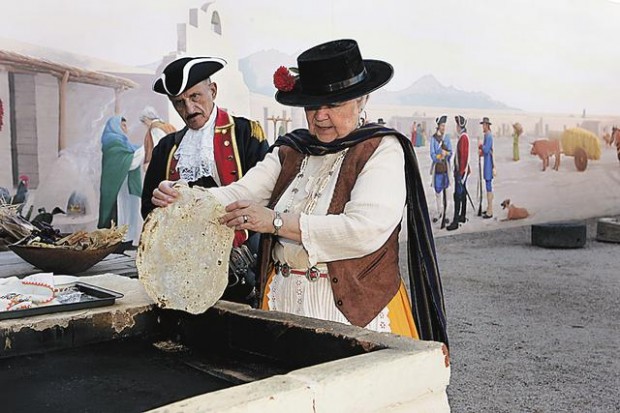
For 14 months, workers labored to reconstruct the northeast tower, a soldier's family home, a soldiers barracks, a warehouse, a Sonoran street scene mural, an horno for baking bread, and a 2,000 year-old pithouse.
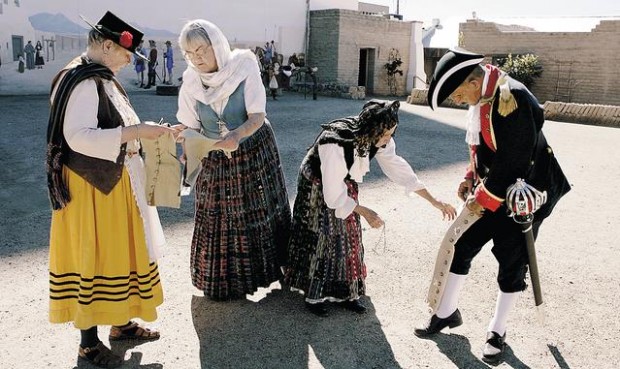
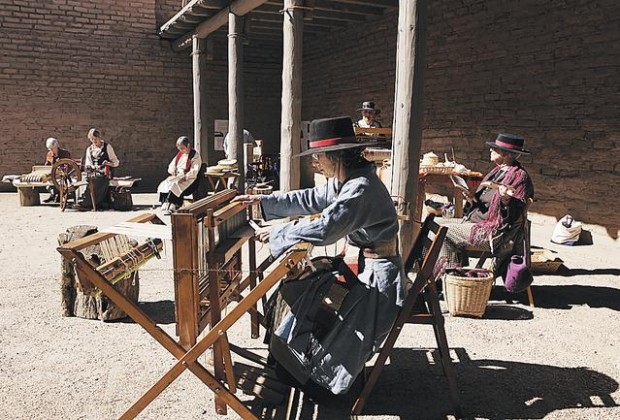
Visitors can take a self-guided tour of all this Wednesdays through Sundays. And on Saturdays, now through April 5, re-enactors are bringing this slice of late-18th-century Tucson to life: how the people of the presidio dressed, what they ate, how they defended themselves.
A few steps and almost a century away is a territorial courtyard and the restored Siqueiros-Jácome home, dating to 1866, which offers exhibits and a gift shop.
Just as today's world intrudes beyond the presidio, there's a nod to modern times inside as well.
The fort's adobe walls are stabilized with concrete. There's rebar in the tower walls. And ramps and modern restrooms were built to accommodate disabled visitors.
Even so, it's a huge achievement for the Presidio Trust — especially when one considers the alternative: a six-lane highway proposed by the city in 1988.
If You Go
Living history re-enactments at the presidio take place every Saturday through April 5 from 10 a.m. to 3 p.m. at the northeast corner of Church Avenue and Washington Street.
Events scattered throughout the remaining Saturdays include spinning and weaving, bread-baking, soap-making, carpentry and leather-making.
The April 5 event also will include games for kids, 18th-century soldiering, medicine and food demonstrations and the trying on of 18th-century clothing.
All events are free and parking is free on nearby streets on the weekends.
The presidio and gift shop and exhibits in the nearby Siqueiros-Jácome house are also open 10 a.m.-4:30 p.m. Wednesdays-Sundays, closed Mondays and Tuesdays.
For more information, call 884-4214 or log on to tucsonpresidiotrust.org.
Be part of the past
Want to dress up as a presidio soldier or just learn more about the Tucson Presidio Trust?
Call 298-7052 for more information.
The group is always looking for more members and volunteers for its re-enactments.
No posole for you, thanks to the health department. And before you fire that musket, better warn the neighbors.
Yep, going back in time a couple of centuries does have its pitfalls — but also its rewards.
Meet some of the members of the Tucson Presidio Trust working to keep our history alive:
Gayle Hartmann
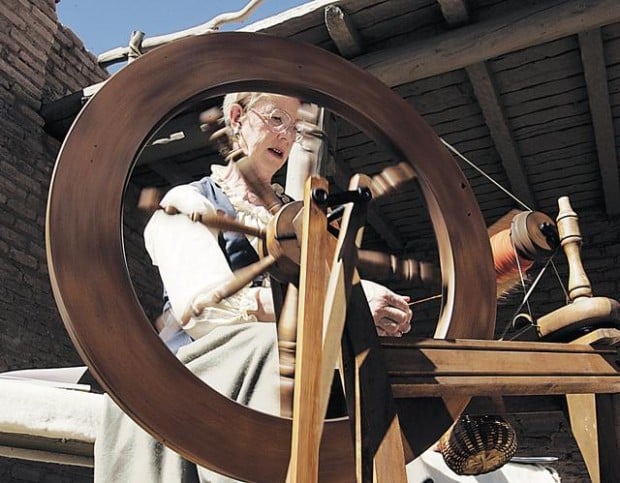
Gayle Hartmann learned about authenticity from the ground up. A cotton bush planted inside the presidio wall is now providing some native cotton — enough for volunteers to demonstrate cleaning, carding, spinning and weaving techniques of the early settlers.
"I wanted to promote some skills from this period," says Hartmann, 65, an archaeologist, anthropologist and past president of the Tucson Presidio Trust.
She began with a couple of bags of cotton from the Pima County Cooperative Extension Service.
"We learned how to take the seeds out, to card, and then to spin and make it into thread," says Hartmann, who took a class in weaving and rounded up a group of weavers and spinners.
"We're trying to explain what life was like around 1800, the skills needed to survive.
"This has been a wonderful small-scale success for Rio Nuevo. People say nothing's happening down here. This has happened."
Hector Soza
His great-great-great grandfather once patrolled the grounds where Hector Soza now strolls.
His name was José María Sosa, and he served at Tubac and then at Tucson after its presidio was founded in 1775.
Quite naturally, Soza — the name was changed from Sosa in 1891 — portrays his ancestor.
Thanks to old service records, Soza has a pretty good idea of what José María looked like.
"He was 5-feet-4, black hair and eyebrows, brown eyes, black beard, a swarthy complexion and a sharp nose."
Promoted to sergeant in 1782, José María escorted supply caravans and took part in 20 campaigns against the Apaches. "He did get wounded in one of his legs," says Soza.
José María was still a soldier when he died at age 56, says Soza, who at age 78 must portray a much younger man.
"I paint my hair and mustache black every time we do events. But I do not have a beard. It's too hot."
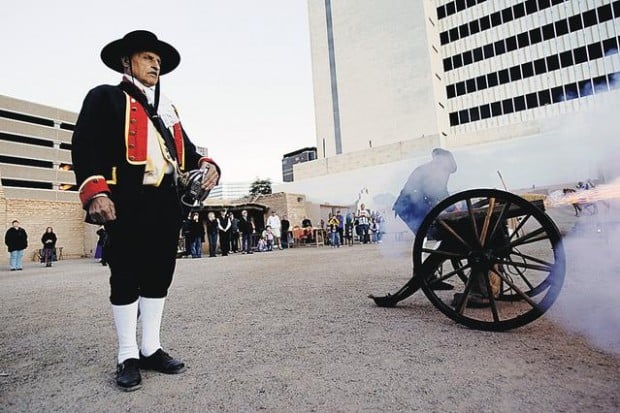
He does, however, try to emulate the period uniform, right down to the white stockings and buckled shoes.
As for what José María Sosa might say about his descendant's lifestyle today, Soza answers without hesitation: "He would say, 'Get a horse.' He must have been a marvelous horseman."
Mickie Soza
Mickie Soza's head hurts. Blame it on the comb and lace mantilla she wears while portraying a comandante's wife at a fiesta or church during presidio re-enactments.
"You have to keep your head up high and stiff or the mantilla will fall forward. My head aches by the time I'm done."
And we just thought Spanish "upper class" women of the 1800s were haughty.
Married to a man who's a direct descendant of a presidio soldier, Soza is a stickler when it comes to getting her outfit exactly right.
"We're trying to research what they truly wore. There were little snatches written here and there," she says.
Silks and satins and velvets were in vogue, says Soza, 76. "Spanish women were formal, but for everyday they wore cotton and linen."
Shoes had little heels and big buckles in front. "And there was no left and right foot," she says.
Hooks and eyes, rather than buttons and zippers, kept everything in place, she adds. But there's a limit to authenticity, it turns out.
"I had a velvet jacket I took all the buttons off and tried the hook and eye. It worked, but if you wore the amount of clothing they wore underneath, it was way too tight."
Sybil Needham
For several years, Sybil Needham shared her homemade posole at Casa Cordoba, in the Tucson Museum of Art Historic Block. There, Tucson Presidio Trust volunteers did their re-enactments before the presidio opened last year.
No more.
"I can't get past the health department," says Needham, who acknowledges that the Pima County Health Department mandates that prepared foods for such events must be made in a county-inspected commercial kitchen.
"So I don't make the posole anymore," says Needham, 70, a founding member of the Tucson Presidio Trust.
The group does bake bread in an earthen oven called an horno, and recently cooked some chickens — though they didn't share them with visitors.
"We can't share anything we make," says Needham. "I think it's kind of rude."
Present-day presidio soldiers also can patrol atop the adobe tower — but once they're done, the ladder must be hidden away. Safety was a factor. So was the Americans with Disabilities Act.
"If we let some of the people up on ladders, we had to let them all up," says Needham. "Now, they have a ladder locked in the tower. Only soldiers can bring the ladder out and patrol."
Despite such modern-day intrusions, Needham is looking back to the future the presidio now affords. "We're hoping to get school groups in here."
Did You Know . . .
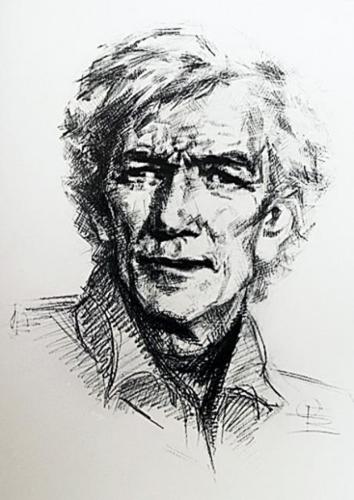
Lewis Hall, who founded the Tucson Presidio Trust for Historic Preservation and fought long and hard for the presidio's reconstruction, was also a well-known architect.
Among his works: Tohono Chul Park's Tea Room, originally built as a home, and what is now Anthony's in the Catalinas restaurant on North Campbell Avenue.
In 1782, a cannon was used to scare away Apaches. Now, the biggest reaction comes from the cars in the parking garage across the street.
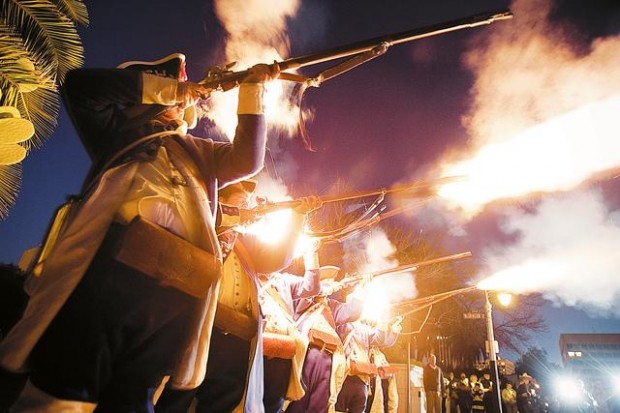
"We fired the cannon for the grand opening of the presidio," says Rick Collins, 52, who portrays a presidio soldier — one who sometimes gets to fire off a replica cannon. "It was hilarious. For 15 seconds we couldn't talk. We had to wait for the car horns to stop."
And yes, he, along with fellow cannon-firer Jeff Coleman, 48, are now proud graduates of cannon firing school.
"The Presidio Trust sent us to Florida, where the National Park Service has an 18th-century cannon school," says Coleman.
He and other presidio soldiers also shoot off their flintlock muskets at least once a month. "I do stay in touch with El Presidio Neighborhood Association and let them know when we're firing," says Coleman.
In the next few weeks, the men expect to replace their borrowed cannon with a new $10,000 four-pounder, donated through the Marshall Foundation.
For now, Coleman and Collins are the only two certified to fire the cannon, which spews out something akin to toast, rather than metal.
Presidio San Agustín del Tucson Timeline
• 1690s: Father Eusebio Francisco Kino visits the Tucson basin and finds a series of O'odham villages along the Santa Cruz River.
• 1752: A presidio fort is established at Tubac.
• 1775: Capt. Hugo O'Conor, an Irishman employed by the Spanish military, tours the presidios on the northern frontier and recommends moving Tubac's soldiers to Tucson. He picks the Tucson site, El Presidio de San Agustín del Tucson, on Aug. 20, 1775.
• 1782: Only a log palisade encloses a few buildings and the adobe wall perimeter is still incomplete when Apaches launch a surprise attack in May, nearly destroying the fort. Cannon fire scares them away.
• 1783: The fort's adobe walls are completed: 10 feet high, 3 feet thick, about 750 feet long on each side.
• 1792: A peace agreement with the Apaches results in several hundred of them moving next to the fort. In exchange for information on other Apaches, they are given food, clothing and tools.
• 1821: Mexican independence is won, but the new government has little money to spend on frontier posts. Apaches resume their raids.
• 1848: The census shows only 509 residents inside the presidio — the only Mexican settlement in Arizona.
• 1854: The Gadsden Purchase makes Tucson part of the United States.
• 1856: Mexican soldiers evacuate the post. The American military has no use for the fort, and many of its adobe bricks are hauled away for other buildings.
• 1918: The last standing section of the presidio is demolished.
Source: Tucson archaeologist Homer Thiel, who has spent years excavating the foundations and other reminders of the presidio.
Centuries before any presidio walls started going up, ancient peoples were living along the Santa Cruz River — and, it turns out, right inside what would later become Presidio San Agustín del Tucson.
Four Early Agricultural period pithouses, including one dating to 450 B.C., have been found inside the presidio.
Finding the foundations to a fort a mere couple of centuries old also proved daunting.
During construction of the Old Pima County Courthouse in 1929, archaeologists located the southeast corner of the fort. Salvaged adobe bricks are now on display inside the Pima County Assessor's Office.
In 1954, an excavation at the northeast corner of Church Avenue and Washington Street uncovered a pre-Hohokam pithouse. The site, which later became a parking lot, is now a re-created portion of the presidio, including that pithouse.
Using a ground-penetrating radar study from the previous year, in 1992 volunteers with the Center for Desert Archaeology helped expose a north-south adobe wall thought to be the east presidio wall.
Volunteers returned in 1998 to search for sections of the north, south and west walls.
Today, we know the walls lie beneath the Old Pima County Courthouse, the mayor and City Council parking lot, the corner of Main Avenue and Washington Street, and the corner of Washington Street and Church Avenue.
Approved in 1999 as part of Rio Nuevo and opened in May of last year, the presidio's speedy 14-month reconstruction caught officials off guard.
As far as day-to-day operations, "the city did not have a budget line for this," says Tucson Presidio Trust board member Gayle Hartmann, who also serves as liaison with the city.
Tucson Parks Department employees now staff the presidio, which cost $2.67 million, with Presidio Trust volunteers doing programs and training.
When other westside Rio Nuevo projects open, such as the University of Arizona Science Center, the city will "have discussions on how to manage it all, whether it's city, county, nonprofit, or a joint operation," says City Manager Mike Hein. In the meantime, the presidio is up and somehow running. Arizona Daily Star 1999 Tohono Chul Park's Tea Room.