

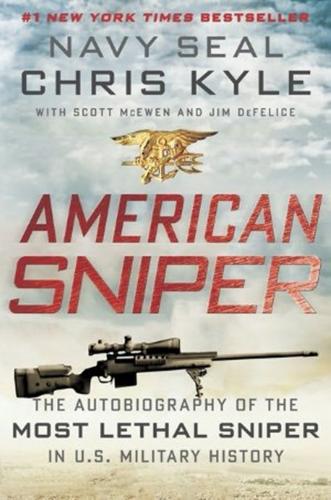

"American Sniper: The Autobiography of the Most Lethal Sniper in U.S. Military History"
By Chris Kyle with Scott McEwen and Jim DeFelice
Former SEAL Chris Kyle is a Texas country boy who found a home in the SEALs and developed a talent for the dangers of warfare and finding the right spot from which to kill an enemy with a single shot. Sniping requires patience, nerve and a certain cold-bloodedness, all of which Kyle displayed relentlessly in the major battles of Iraq.
"After the first kill," Kyle writes, "the others come easy. I don't have to psych myself up, or do something special mentally - I look through the scope, get my target in the cross hairs, and kill my enemy, before he kills one of my people."
The book is about one man's evolution from restless civilian to dedicated killer. This book is not for those who like their American military personnel to be diffident and dutifully respectful of their enemies.
People are also reading…
Kyle is unpossessed by political correctness. He has a seething contempt for the enemy, disdain for Iraqi security forces who are supposed to be U.S. allies, and hardly any feeling at all for Iraqi civilians.
Kyle's view is blunt and simplistic. His voice deserves attention as the sound of anger from the battlefield and the difficulty of resuming anything that passes for a normal life.
The voice of Kyle's wife, Tara, also deserves attention. Several passages of her comments are interspersed with her husband's story of war and killing. "Little by little, I realized I wasn't the most important thing in his life. The words were there, but he didn't mean it." Later, she confides: "When our marriage reached a crisis, I said I wouldn't love him the same if he re-enlisted again. ... In the beginning, I believed he loved me more than anything. Slowly the SEAL Teams started to become his first love."
It may not be what Kyle and his co-authors intended, but the story of strife between husband and wife is what gives "American Sniper" much of its wallop: the truism that even when the shooting stops, the impact of the war on those who fought it, and those who love them, has only begun.
Tony Perry, Los Angeles Times
"The Expats"
By Chris Pavone
Chris Pavone channels spy-fiction superstars Robert Ludlum and John le Carre in his amazing first novel.
Kate Moore leaves her double life as a wife and mother and a covert operative in the CIA when her husband, Dexter, gets a new job in Luxembourg. She tries to be a stay-at-home mom (her husband had no idea of her job working for the CIA), and though her former bosses aren't concerned, she's worried that her past will come back to haunt her.
Soon her new life as an expat begins to unravel.
Kate meets a friendly pair from America, and the two couples start spending time together. Dexter practically lives at the office and becomes increasingly obsessed with work. Bored - and a bit concerned - Kate's old instincts kick in, and she begins to investigate her husband and their new friends. It doesn't take long for her to discover that Dexter's job isn't what she thought it is, and that he might be responsible for the theft of a huge sum of money. Kate also discovers evidence that the American couple are assassins - and that she and Dexter are their next targets.
"The Expats" is a skillful and atmospheric descent into paranoia. Kate's journey as her life falls apart is compelling, and the novel is impossible to put down.
Jeff Ayers, for The Associated Press
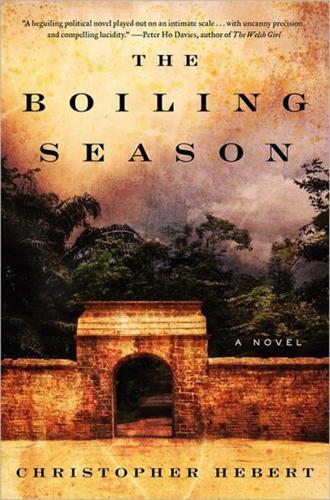
"The Boiling Season"
By Christopher Hebert
Allegories about the morality of international development projects are rarely as subtle and lyrical as Christopher Hebert's debut novel, "The Boiling Season."
The novel is set on an unnamed Caribbean island, but it's hard to read the story as taking place anywhere other than Haiti. The wealthy live behind walls on a protected hillside, literally looking down at the teeming slums below. Political careers are built on money and brutality.
Seeking refuge from the country's many upheavals is Alexandre, a naive young man whose sole ambition is to leave the slums behind. He first gains access to the world of privilege as the valet to an important senator, then uses those connections to secure a position as caretaker of a neglected estate even farther up into the mountains. Busily transforming the estate into an opulent resort for a wealthy American businesswoman, Alexandre chooses not to see the civil war brewing.
Madame Freeman, as Alexandre calls the businesswoman, isolates herself from the island's politics. When a sprawling shantytown pops up, she paints those closest to the road in bright colors to disguise their poverty from her guests.
As it becomes clear that she cannot control what's happening beyond her walls, she abandons the estate, leaving Alexandre ill-prepared to face the people he's tried to escape all his life.
Jennifer Kay, The Associated Press