

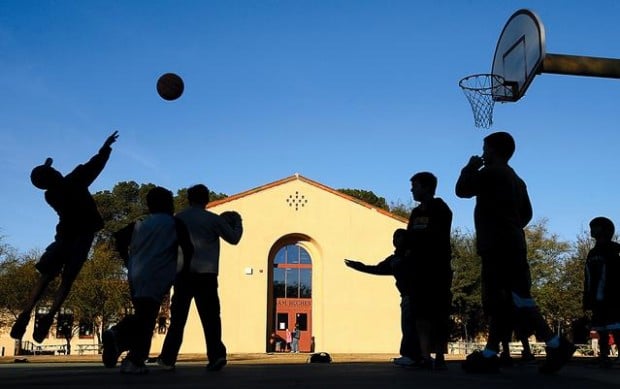
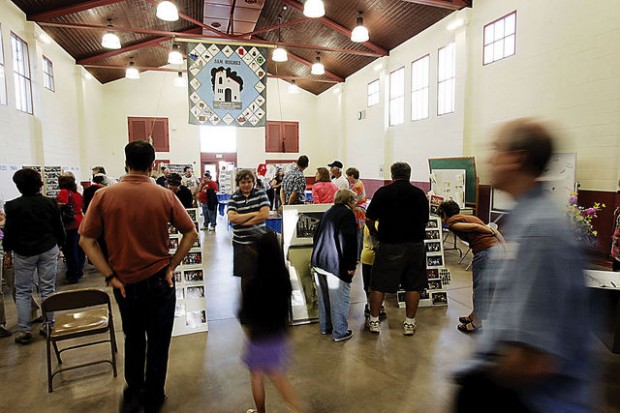
"It's a true passion. It's more than just keeping their property values up," says principal Roseanne De Cesari of what her historic Sam Hughes Elementary School means to its neighbors. So when rumors began to fly around the Midtown community that the school was being expanded, neighbors got interested. And when they learned what was planned, they got worried.
Turn inside to read the tale of neighbors and parents who fought to keep their school architecturally intact, and of how the budget soared to six times its original figure.
When pupils and parents hold their annual Chuckwagon event next weekend, the public will be able to see the results for themselves. — Gillian Drummond
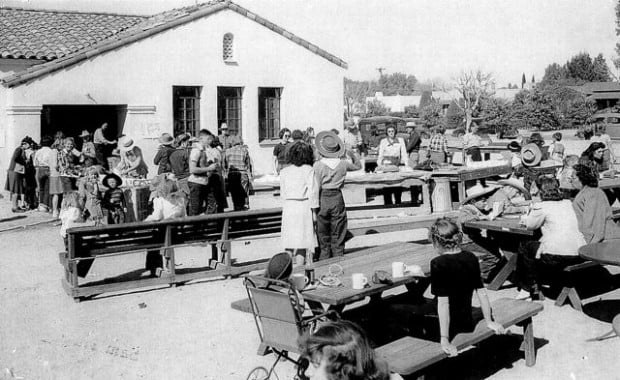
John O'Dowd remembers well running through the grounds of Sam Hughes Elementary School in the 1940s. Arriving there as a fourth-grader, he went on to see his four children attend the Midtown school and to serve as its parent-teacher association president.
People are also reading…
In the decades since, the historic school has added a kitchen and installed air conditioning. It has said goodbye to the old fold-out wooden doors that used to let the sun and air in each classroom. Security has tightened against the changing outside world.
In essence, though, the character of the 1920s building and enclosed courtyard has remained, along with the involvement of the surrounding Midtown community.
Not surprisingly, when rumors began to fly around the historic Sam Hughes neighborhood that the school was building a new multipurpose room, residents got interested. When they discovered the plans called for a modern stand-alone building, they got worried.
How the neighborhood fought for an architecturally compatible addition despite costs that soared to six times the original budget is a story of determination, professional ingenuity and in some ways luck.
The emergence of "the box"
After a state audit of the school declared Sam Hughes Elementary deficient in interior physical education space, Tucson Unified School District began to plan for a multipurpose room in the corner of the school playing field. The district also was ordered to upgrade the school's kitchen, which was to stay where it was in the main building.
Members of the Sam Hughes Neighborhood Association started to refer to it as "the box."
"I thought if I have to walk by that ugly building every day, this is not going to work," said Carolyn Classen, the association's secretary whose home looks onto the school.
Some association members got to work, touring the city to look at other schools.
"We were dismayed," said Classen of what she calls the "cookie cutter buildings" the school district had been erecting in other elementary schools.
Then they visited Carrillo Magnet School, a 1930s building in the Barrio Viejo Downtown. "Their multipurpose room was built into the (existing) structure. That's when we began to think an addition was possible, that it didn't have to be that way," said Classen.
The problem: TUSD had just $300,000 to spend. And the neighbors knew that historic renovation or reproduction seemed impossible on such a tight budget.
"The pitbull that didn't give up"
In its drive to have TUSD consider other options for Sam Hughes, the association became, by its own admission, a thorn in the school district's side. O'Dowd sought meetings and had letters drawn up to both the TUSD board and administrators at the state level. He also made cases to the State Historic Preservation Office in Phoenix and the Tucson-Pima County Historical Commission, with no success.
Marcus Jones, TUSD's head of bonds, recalls "a lot of heated discussion" between the school district and Sam Hughes neighbors throughout 2004. For a while, O'Dowd and his allies became regular fixtures at the school district's board meetings.
"At one, he brought the whole neighborhood association to make a united front," said Jones.
Although some of the neighbors sensed defeat after months of wrangling, Classen said, O'Dowd was dogged.
"He was the pitbull that didn't give up. I already had given up. I thought TUSD was going to win this battle," she said.
Then, in the fall of 2004, the neighborhood association passed a motion that would change the course of the school's history: The group voted to use grant money awarded to it by the Southwestern Foundation for Education and Historical Preservation to hire two Tucson architects to produce an alternative plan.
How the stars aligned
Tucson architects Bob Vint and Jody Gibbs, who were hired by the association, wanted to stay true to the style and intentions of the original architect of Sam Hughes Elementary, Roy Place.
Since the building went up in the 1920s, the school was added to piecemeal, although hardly haphazardly. Place's idea was to create a rectangle of classrooms around a courtyard, and in 1949 that finally happened.
What Vint and Gibbs proposed was radical: to replace a middle classroom that housed the school's library with the new multipurpose room and to add on to the rectangle at either side: kitchen at one side and new library at the other.
The obvious stumbling block was money; here was a plan that involved much more work than was originally intended.
By now, school principal Roseanne De Cesari and some of the school's parents were beginning to agree "the box" was indeed a bad idea. De Cesari recalls standing in the original proposed location with several PTA members and assembling some stones where the stand-alone building was going to be. They used a tape measure to see how high it would stand. One of those parents was Lori Stratton.
De Cesari said they realized the building would stick out from the surrounding historic homes like the proverbial sore thumb."
"We looked at each other and said, 'Oh my God, the neighborhood association is right. It's just going to be awful.' " And then, said De Cesari, "the stars aligned."
In November 2004, O'Dowd and Vint attended a TUSD board meeting and during a "call to audience" presented their plan in an allotted time of just three minutes.
Stratton just happened to attend. She knew discussion of the building work was on the agenda, but she didn't know the architects would be there, and was definitely not planning to speak, she said. But after listening to their proposal, she stood up and voiced her support.
Stratton grew up in Sam Hughes, attended the school herself and now has two children there. She also majored in architecture at college.
When she talks of Vint and Gibbs' revised plan, she compares it to love at first sight. "I was willing to go along with fine and then I saw fabulous. It was so well thought out and made so much sense, there was at that point no going back to accepting OK."
According to O'Dowd and Stratton, the proposal may have remained just that, or at best been tabled for a later meeting, if she had not spoken up.
Stratton credits Jones and TUSD Superintendent Roger Pfeuffer with literally think outside of "the box." "The easy way would have been to throw up the (original) building and move on."
Asked why the neighbors' proposal now seemed attractive, Jones said it was simply a matter of him doing his job.
"Everything I do I've got to justify. We had to come up with something that made sense for the school and the district," he said. "It all created a balance that the neighborhood association was looking for."
There was still the question of money.
Coincidentally, more funding was suddenly available to TUSD through the 2004 bond, approved by voters right around the same time. And in what O'Dowd calls a "genius" move, Jones came up with the idea of combining the original money from the School Facilities Board with bond money to pay for the new work.
Jones also found a way to officially employ Vint and Gibbs by having them operate as consultants.
Back to school
When pupils and teachers returned to school in August 2007 — its 80th-birthday year — it was not to a new "box" but to a building that had expanded to the tune of close to $2 million — more than six times the original budget. The design allows for classrooms to be added on and for the creation of two extra courtyards — thus planning for future growth and also honoring Roy Place's historic design.
"This is actually how the original school grew — in stages," said Vint.
"It began in 1927 as a single row of classrooms on Wilson (Avenue), and classrooms were gradually added over the next 10 years in a U-shaped plan to create the central courtyard."
Those involved agree the road was rocky but there were lessons learned. Such as, said the TUSD's Jones: "How much effort should the school district put into (these projects) with historical significance? The process we used at Sam Hughes is not practical to use every time because of the time factors involved."
The situation at Sam Hughes was "unique" and "unusual," said TUSD Superintendent Roger Pfeuffer, because of the opportunity for collaboration and the use of multiple resources.
"The key lesson learned would be how much good can be accomplished when the available resources of all kind can be focused on the goals that will benefit the students," said Pfeuffer. "The end result was a result of positive timing, persistence of the neighborhood association and the unique opportunity to combine funding."
For his part, O'Dowd hopes the whole affair sets a precedent for historic schools and other buildings, to allow for the fact that they may need more than what he calls "formula funding."
De Cesari said: "I don't think there's another school in the state that received the sort of treatment this school received."
But Stratton said she'd hate for people to think Sam Hughes Elementary got preferential treatment because of its history, its largely middle-class residents, or the fact that some of its neighbors happen to be attorneys.
"There have been times when I've heard whisperings of 'Is this equitable?' and I think the answer is it is equitable. This isn't about anything other than honoring a beautiful building and wanting to do the right thing," said Stratton.
The school's PTA funds paid for $10,000 in landscaping to finish the whole project off.
Stratton herself spent hours etching the shape of orange tree leaves into the still-soft concrete near one of the school gates. "A lot of times I was thinking, 'Will anybody even notice?' "
And then one day she saw that some pupils had filled in the leaf outlines with colored chalk. They'd noticed. And so, she hopes, will generations to come.
history of Sam Hughes Elementary
• 1927: The school opens on Wilson Street. Architect Roy Place designed the building so that it could be added to gradually, creating an enclosed courtyard.
• 1930-1949: Classrooms are added until the school becomes the rectangular structure Place envisioned.
• 1954: A kitchen and cafeteria are added.
• 1992: Air conditioning is installed.
• August 2007: Students return to a new library, kitchen and multipurpose room.
See the addition for yourself
• What: Sam Hughes Elementary's annual Chuckwagon. The event dates back to 1937 – 10 years after the school opened.
• When: 3-7 p.m., Saturday.
• Where: Sam Hughes Elementary, 700 N. Wilson Ave., near North Campbell Avenue and East Sixth Street.
• Cost: Free admission; purchase tickets for food activities.
• What's on the agenda: Activities such as golf, basketball, beanbag toss and spin art, a jumping castle and food stalls. The organizers – Sam Hughes Parent-Teacher Association – also promise some vintage wagons and a roping rodeo queen for this year's rodeo-themed Chuckwagon.
Did You Know . . .
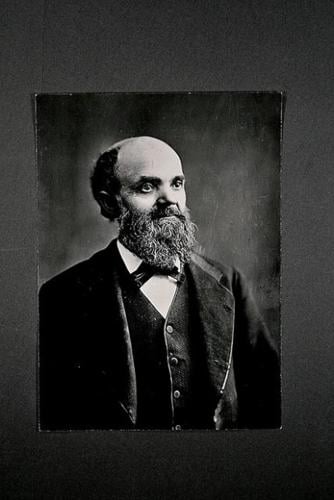
Sam Hughes, for whom the Tucson school is named, never attended a day of formal schooling in his life. Even so — and perhaps because of his large family — he is credited with helping Territorial Gov. Anson P.K. Safford establish public education in the Territory.
Source: Arizona Historical Society.
"He was the pitbull that didn't give up. I already had given up. I thought TUSD was going to win this battle."
— Carolyn Classen,
Speaking about John O'Dowd, above