
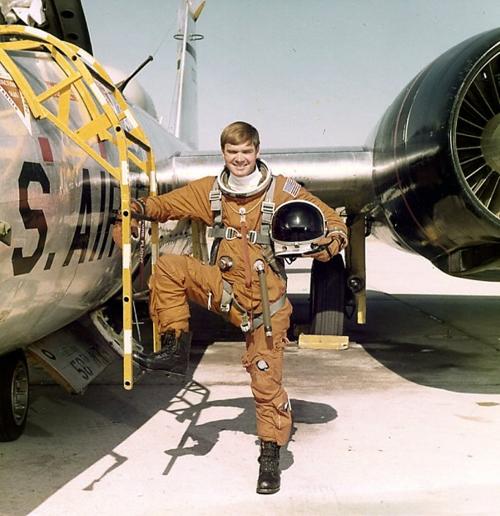
It was a remark by a winter visitor that got my attention. Asked what impressed her most about Tucson, she admitted that it was not the Arizona-Sonora Desert Museum, not the desert landscape and not our wonderful weather.
Rather, and surprisingly, it was "The Boneyard."
There was something about seemingly endless rows of retired aircraft on 2,600 acres in the very heart of metropolitan Tucson that was profoundly fascinating. Then there was the nickname, not the historically accurate but dry and bureaucratic Storage Depot, or Military Aircraft Storage and Disposition Center (MASDC), or Aerospace Maintenance and Regeneration Center (AMARC), or the current 309th Aerospace Maintenance and Regeneration Group (309th AMARG).
The very mention of the place brought memories rushing back, for it was MASDC that had given me my introduction to Tucson 34 years prior. On that warm spring day I had been tasked, as a young military pilot, to fly the last of a unique group of aircraft from our home base in Albuquerque to presumably its final resting place at The Boneyard.
People are also reading…
It was the WB-57F, a highly modified Martin Canberra medium bomber that the Air Force and the Atomic Energy Commission had funded for providing high-altitude reconnaissance, research and atmospheric sampling for nuclear debris.
At times bristling with laser devices, cameras and sampling equipment, it had taken us around the world to engage in missions, most of them above 65,000 feet, for numerous government agencies. Only 22 were ever made, so the prospect of ending a short 11-year equipment life with a flight to a desert grave was surprisingly moving, especially to a cocky, supposedly hardened throttle jockey fresh from combat in Vietnam and a pampered tour with a selectively manned flying unit.
The bird had provided a certain amount of adventure and travel, so I was sincerely sorry to see it approaching retirement. Transiting the Pacific with little more than a compass and an airspeed indicator for navigation had seemed a daring exploit at the time. Chasing radioactive clouds around the world - the South Pacific for French nuclear tests and the Far East, Alaska and Europe for explosions by the People's Republic of China - was exciting and apparently vital to national security.
Quarterly missions throughout the Western Hemisphere to measure residual nuclear debris in the stratosphere presented both pleasure and danger.
High-altitude flights north of the Arctic Circle provided an unparalleled view of the Northern Lights that took our minds off the peril of landing through thick ice fog at Fairbanks and the certainty that we could not possibly survive an ejection at those altitudes and latitudes.
Missions well south of the tip of South America exposed us to the wonders of Argentine beef and wine but also to air turbulence across the Andes severe enough to crack pressure-suit helmets against the canopy.
In any event, I recall how difficult it was to become visually oriented upon arriving over Tucson. The muted browns and grays of the city were distinctly different from the crisp greens and browns of other cities in the Southwest, and it was The Boneyard, replete with nearly 5,000 aircraft arranged in geometric military precision, that led my eyes to the Davis-Monthan runway.
Once near the ground, it became suddenly apparent to my backseater and me that every subsequent event had potentially emotional meaning. Never again, for example, would observers be able to marvel at the sight of those huge wings, an "aluminum overcast," that seemed so graceful, yet so out of proportion with the fuselage. Never again would observers witness the strange, mournful sound of differential thrust during taxi, as I made up for the absence of nose-wheel steering by advancing and retarding first the left throttle, then the right.
For perhaps the final time, observers would be alarmed at the possibility that those drooping wings, with so little ground clearance, could accidentally contact the ground before the landing gear, sending a crew careening into the desert.
The poignancy continued as we dismounted. Leaving the cockpit for the final time, stowing our flight gear and being greeted by ground crewmen who could possibly be our craft's "executioners" all had silent, sad portent. Which of these gentlemen might eventually subject our craft to the crushing, dismembering "Guillotine"? Even signing off the maintenance forms one last time seemed to have additional meaning. (Who, for instance, would now be interested that the left engine was running rough and that a gauge was malfunctioning?)
We comforted ourselves by recalling that the bird was going into "flyable storage," ostensibly a candidate for being refurbished and reentering service at some future date. Our individually fitted pressure suits had gone into climate-controlled storage in Florida, we had hopefully retained our checklists and flight manuals, and some of us had written the operations plans that could be used to bring the fleet back to life.
Deep down, though, we knew better. We drove off quickly, being careful not to look back.
Life in print
Glenn Perry went on to fly another high-altitude aircraft, the Lockheed U-2, from Davis-Monthan AFB in the 1970s. He retired as an Air Force colonel in 1992 and has lived in Tucson since then. He serves as an instructor in management at the University of Phoenix.