

Skip to main contentSkip to main content
Register for more free articles.
Log in Sign up
Back to homepage
Subscriber Login
Keep reading with a digital access subscription.
Subscribe now
You have permission to edit this collection.
Edit
Arizona Daily Star
56°
  • Sign in
  • Subscribe Now
  • Manage account
  • Logout
    • Manage account
    • e-Newspaper
    • Logout
  • News
    • Sign up for newsletters
    • Local
    • Arizona
    • Business
    • Crime
    • Nation & World
    • Markets & Stocks
    • SaddleBrooke
    • Politics
    • Archives
    • News Tip
  • Arizona Daily Star
    • E-edition
    • E-edition-Tutorial
    • Archives
    • Special Sections
    • Merchandise
    • Circulars
    • Public Notices
    • Readers' Choice Awards
    • Buyer's Edge
  • Obituaries
    • Share Your Story
    • Recent Obituaries
    • Find an Obituary
  • Opinion
    • Submit a Letter
    • Submit guest opinion
    • Letters to the Editor
    • Opinion & Editorials
    • National Columnists
  • Sports
    • Arizona Wildcats
    • Greg Hansen
    • High Schools
    • Roadrunners
  • Lifestyles
    • Events Calendar
    • Arts & Theatre
    • Food & Cooking
    • Movies & TV
    • Movie Listings
    • Music
    • Comics
    • Games
    • Columns
    • Play
    • Home & Gardening
    • Health
    • Get Healthy
    • Parenting
    • Fashion
    • People
    • Pets
    • Travel
    • Faith
    • Retro Tucson
    • History
    • Travel
    • Outdoors & Rec
    • Community Pages
  • Brand Ave. Studios
  • Join the community
    • News tip
    • Share video
  • Buy & Sell
    • Place an Ad
    • Shop Local
    • Jobs
    • Homes
    • Freedom RV AZ
    • Marketplace
    • I Love A Deal
  • Shopping
  • Customer Service
    • Manage My Account
    • Newsletter Sign-Up
    • Subscribe
    • Contact us
  • Mobile Apps
  • Weather: Live Radar
  • Facebook
  • Twitter
  • Bluesky
  • YouTube
  • Pinterest
  • Instagram
© 2026 Lee Enterprises
Terms of Service | Privacy Policy
Arizona Daily Star
News+
Read Today's E-edition
Arizona Daily Star
News+
  • Log In
  • $1 for 3 months
    Subscribe Now
    • Manage account
    • e-Newspaper
    • Logout
  • E-edition
  • News
  • Obituaries
  • Opinion
  • Wildcats
  • Lifestyles
  • Newsletters
  • Comics & Puzzles
  • Buyer's Edge
  • Jobs
  • Freedom RV AZ
  • 56° Sunny
Share This
  • Facebook
  • Twitter
  • Bluesky
  • WhatsApp
  • SMS
  • Email

Try outrunning this spider-like creature; pruning roses

  • Dec 10, 2015
  • Dec 10, 2015 Updated Feb 15, 2016

Answers to your questions on bugs and gardening in Southern Arizona.

Giant agave bug

Question: I found this insect on my gas grill today. Is this the kissing bug I have been reading about?

Answer: What you are seeing is the giant agave bug (Acanthocephala thomasi). Kissing bugs (Triatoma species) are smaller and don’t have the bright orange feet and orange tips on the antennae. Also, the kissing bugs feed primarily on mammals, such as pack rats and humans, whereas the bug you found feeds on plants. Recently, there was a flurry of news reports in other parts of the country on the kissing bugs and the associated Chagas disease they can transmit. These stories then spread through social media, gathering some misinformation as they went. So I understand why you are concerned. Despite the media hype, this was not actually new information.

Kissing bugs are more common in the Southwest. However, the risk of Chagas disease transmission in Arizona is very low, according to University of Arizona Cooperative Extension Specialist Dawn Gouge. UA researchers found a high rate of infection (about 40 percent) of kissing bugs in southern Arizona by the protozoan Trypanosoma cruzi that causes the Chagas disease infection. However, the kissing bugs in Arizona differ from those in areas where Chagas disease is a health problem and are not as effective in transmitting the disease to humans. The reason has to do with the timing of blood feeding and defecating. Our local species fly then poop as opposed to poop then fly. The protozoa are passed in feces, not during blood feeding, so by waiting to defecate until after they fly from where they eat, their behavior greatly reduces chances for transmission.

Peter L. Warren is the urban horticulture agent for Pima County Cooperative Extension and the University of Arizona. Questions may be emailed to tucsongardensage@gmail.com

May be okay to spray buffelgrass

Question: Our HOA has declared war on buffelgrass: a good thing. But rather than remove it, they are having intense commercial spraying of glyphosate using concentrations higher than the typical herbicide available to homeowners. I cannot find information (from scientific sources such as .edu) about the immediate or long-term toxicity of the spray on cactus or our desert trees. Do you know of any research showing what it may do?

Answer: According to our University of Arizona Cooperative Extension Weed Specialist, Bill McCloskey, direct spraying of cacti with glyphosate repeatedly will probably kill most cactus species but they can withstand incidental spray contact (i.e., the whole plant is not sprayed) intermittently and can survive a single direct spraying. Generally, we recommend spraying grass-specific herbicides for grass control (e.g., fluaziflop, sethoxydim or clethodim on bermuda grass) to avoid injuring the cacti. Unfortunately, this class of herbicides doesn’t work well on buffelgrass, but maybe repeated spraying would eventually do it. Manual removal of buffelgrass would be effective in this case but understandably hard around cacti.

Peter L. Warren is the urban horticulture agent for Pima County Cooperative Extension and the University of Arizona. Questions may be emailed to tucsongardensage@gmail.com

Desert Broom's beauty in the eyes of beholder

Question: I have a desert broom plant in my yard that has turned into a tree. I really like it but it is now blooming and is sending cottony stuff all over the yard. My neighbor said it is a weed and a nuisance and I should cut it down. Is there any way I can keep it from blooming?

Answer: Desert broom (Baccharis sarothroides) is a native plant and very common in the Southwest. It is often considered a weed because of its ability to colonize open spaces quickly. My predecessor at the University of Arizona Cooperative Extension, George Brookbank, was a proponent of this plant as a good native shrub for landscape use, so not everyone sees this plant as a weed. There is no way to prevent it from blooming, but you could prune off the flowers before they go to seed and start taking flight. That way you could still enjoy the plant to some extent and hopefully appease your neighbor.

Peter L. Warren is the urban horticulture agent for Pima County Cooperative Extension and the University of Arizona. Questions may be emailed to tucsongardensage@gmail.com
Mesquite twig girdler

Question: I occasionally run across a dead branch on some of my mesquite trees. The dead branch sticks out like a sore thumb, and on closer inspection, there is a ring around the branch etched into the bark. The foliage in front of the ring is dead, but behind everything appears fine. First, do you know what causes this? Second, should I be concerned. And third, should I be preventing this and how? Right now, all I do is prune the branch out.

Answer: The ring etched in the bark is the work of the mesquite twig girdler (Oncideres rhodosticta). This beetle is in the family Cerambycidae that are commonly referred to as long-horned beetles due to their long antennae. The adults aren’t commonly seen on the trees although they are attracted to lights at night if you want to find them. The female chews a ring in the stem and deposits her eggs further out on the stem. The eggs hatch in the stem and the larvae feed on the dying wood in the stem caused by the girdle cutting off nutrients to the end of the branch. The larvae will overwinter in the wood and adults will emerge in the spring. Research has shown the damage has no affect on the health of mesquite trees and it is simply nature’s way of pruning. So the good news is you don’t have to do anything to prevent these beetles from chewing on your trees.

Peter L. Warren is the urban horticulture agent for Pima County Cooperative Extension and the University of Arizona. Questions may be emailed to tucsongardensage@gmail.com

Winter visitors return to dead landscaping, wonder about timing

Q: We are snowbirds here November through March. Much of our landscape was redone the last week of March and we departed April 3. Now we have just returned and I see our 5-gallon emus (red valentine shrubs) have bit the dust and a couple red barrels are dying. These plants should have been sturdy enough for their western exposure site. Our new sprinkler system is one year old and works fine. Would you guess that these plants should not have been planted so late in the spring before we left right away? Perhaps they needed two to three daily waterings on hot summer days but no one was here? Our gardener/landscaper didn’t indicate that there should be any problems and he knew we are here just part time and he set the sprinklers.

We both chose the plants together and he knew we were leaving immediately after he installed the landscape. He wasn’t able to schedule our work sooner and I think maybe the job shouldn’t have been done after late January to allow the plants to settle in before the heat hit.

A: The last week of March and into April we were seeing temperatures in the high 80s and low 90s. If your irrigation was working properly and delivering the right amount of water then you might have been OK, although western sun exposure is a tough place to get started when it gets hot.

Drip irrigation is the preferred method rather than a sprinkler and the recommended amount for the summer season is once every 14 days to a depth of 12 to 18 inches for the barrel cacti and 24 to 36 inches for the emu shrubs. The barrels (Ferocactus species) are certainly desert plants and the emu (Eremophila maculata) is from Australia and a good desert adapted plant so their chance of survival in your area is good.

You are asking the right questions and if you are planning to try again, I recommend planting earlier, maybe now, so they can get established before the summer and make sure to adjust your irrigation to fit the needs of the plants.

Peter L. Warren is the urban horticulture agent for the Pima County Cooperative Extension and the University of Arizona. Questions may be emailed to tucsongardensage@gmail.com
When to prune roses

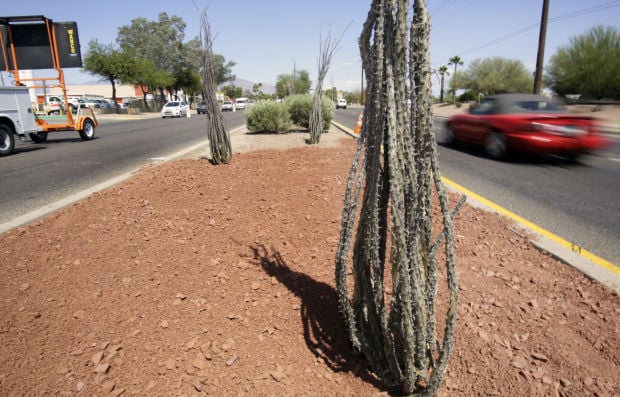
Q: When is the correct time to prune roses in the Tucson area? And do you prune them like we do in the Midwest, i.e. cut back near the ground?

Answer: The pruning of roses is recommended twice per year in Tucson. The first pruning can be done in late January to a height of 15 inches or so. This time remove all dead wood, crossing branches, and small leaves. Seal the fresh pruning cuts with Elmer’s glue to prevent insects from invading the newly cut branches, fertilize, and then water.

In mid-September a lighter pruning is recommended. This time remove one third of the plant along with any diseased or dead wood but leave any leaflets. Seal fresh cuts with Elmer’s Glue, fertilize, and water.

The Pima County Master Gardeners teach classes on roses and other things at some of the public libraries in case you’re interested. Check your library schedules or call the Extension Office for more information,626-5161.

Peter L. Warren is the urban horticulture agent for the Pima County Cooperative Extension and the University of Arizona. Questions may be emailed to tucsongardensage@gmail.com
Controlling leafminer

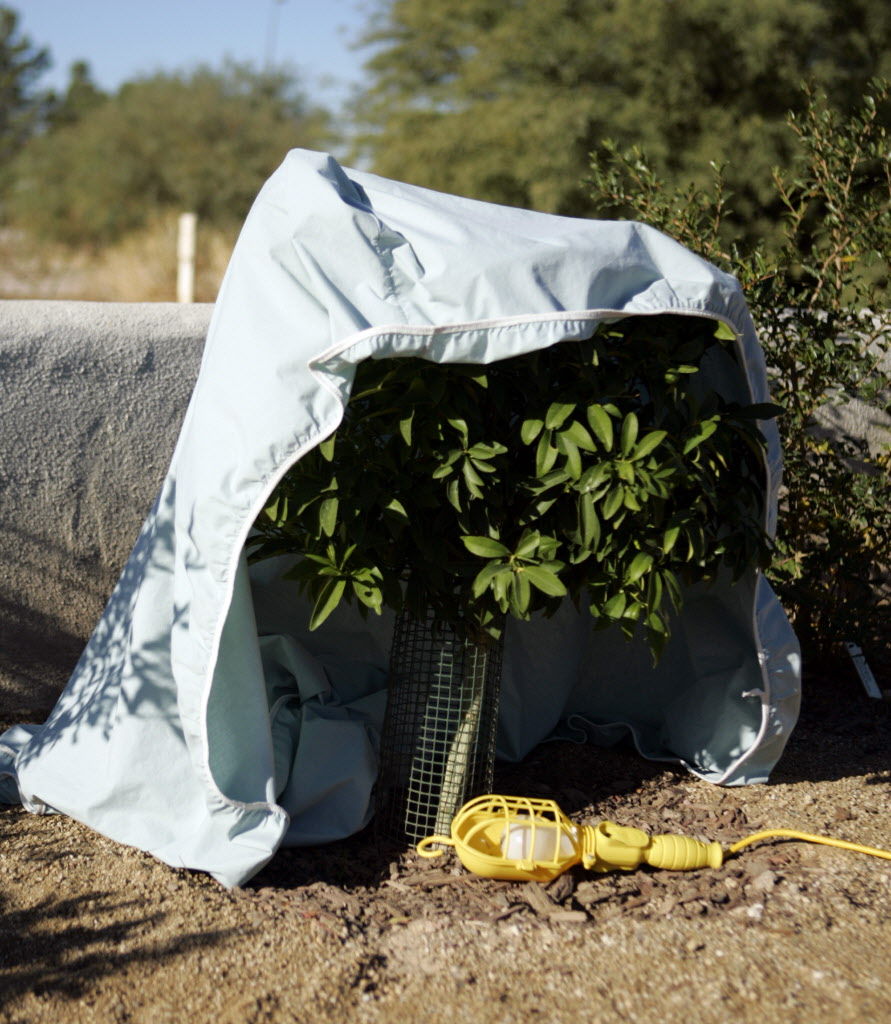
Q: I am writing to inquire about recommendations for a nontoxic approach to controlling citrus leafminer on a young lime tree I am growing in a large pot. I do not recall having this pest in the past and have had limes, grapefruit and lemons for many years. This new lime tree I planted about a year ago is now infested on all the new leaves and I am wondering if there might be a nontoxic method to reduce or eliminate them. I have looked up information on the web but the recommendations seem to be relatively toxic and I would prefer to avoid those if possible.

A: Because your lime tree is young, insecticides are generally recommended to prevent these insects from slowing the growth of the tree. That said, you could let your tree tough it out since there are natural enemies that prey on the citrus leafminer and the leaves they damage are still effective food producers for the tree.

Other things you can do to manage the situation include avoiding pruning except for water sprouts and branches broken by wind, et cetera, and only fertilizing outside of the normal flights of the adults. The adults are most often seen in the summer and fall months. Both pruning and fertilizing promote the new growth that is most attractive to these insects.

Peter L. Warren is the urban horticulture agent for the Pima County Cooperative Extension and the University of Arizona. Questions may be emailed to tucsongardensage@gmail.com
Anthropod that moves at 10 mph

Q: I’ve never seen a bug like this one found in my garage. It had eyes and would move quickly when I put my finger in front of it.

A: This is a solpugid. It is a member of the arachnid class in the phylum of arthropods and related to spiders and scorpions but distinct enough to warrant their own order. Their habitat is the desert and they are predators of other arthropods and have a reputation for being fast; their top speed is reportedly around 10mph. They have no venom, are harmless to humans, and do a good bit of pest management for us while we sleep. All things considered, they are good to have around.

Peter L. Warren is the urban horticulture agent for the Pima County Cooperative Extension and the University of Arizona. Questions may be emailed to tucsongardensage@gmail.com

City won't let palm tree go natural

Question: I have a palm tree the city wants me to trim. I don’t want to spend the money to have someone else do it. I don’t want to climb a 20-foot ladder with a chainsaw. And I like the way this tree looks. Can you help me by saying something about how this form is considered by many people to be attractive and is a common landscape practice?

Answer: It is a common practice to leave a full skirt on palm trees and you can find others in the city just like yours. Most palm trees with a full skirt are a bit taller and as long as the bottom 10 feet of the tree is bare and the dead fronds are away from anything that might catch fire, everything is deemed okay. Some people find the natural form of these trees with a full skirt to be attractive and others like to see them well pruned. Unfortunately for you, the city requires the latter when the skirt hangs low like yours does. The hazards of palm skirts and the risks are mostly fire and having it fall on someone and crush them.

Peter L. Warren is the urban horticulture agent for the Pima County Cooperative Extension and the University of Arizona. Questions may be emailed to tucsongardensage@gmail.com

Road widening hurts Aleppo pine

Question: I found a patch of Aleppo pine that is dying on the west side of La Canada. The road was recently widened (3 years ago) and this whole group fronts close to the road. Could the die-off be due to road widening?

Answer: Yes, the trees could be suffering from the road widening. Construction would likely damage the roots on that side of the tree and typically damage such as this shows up above ground a few years later. It would be difficult to protect such large trees in a road-widening because their roots likely extend two to three times the width of the crown. In a different construction situation the property owner could ask for a protective zone to be fenced off around the tree to help more of the root system to survive. Typically when we see trees that have been attacked by pine engraver beetles, the color of the needles ranges from straw to reddish colors.

Peter L. Warren is the urban horticulture agent for the Pima County Cooperative Extension and the University of Arizona. Questions may be emailed to plwarren@cals.arizona.edu

Tortoise beetle quick to feed on plants in morning glory family

Q: What is the beetle eating my sweet potato leaves?

A: This is a species of leaf beetle, Chelymorpha phytophagica, that is more specifically a tortoise beetle. They are known to feed on members of the Convolvulaceae plant family otherwise known as the morning glory family. Sweet potato is among almost 2,000 species of vines (mostly), trees, shrubs, and herbs. Other family members include notorious weeds (bindweed and dodder) and these insects may use these as alternate host plants.

The beetles can defoliate and if there is a large population, reduce the vigor of the plants. Since most plants can handle a little defoliation, it is not something to worry about if only small numbers of beetles are seen.

Peter L. Warren is the urban horticulture agent for the Pima County Cooperative Extension and the University of Arizona. Questions may be emailed to plwarren@cals.arizona.edu

When to fertilize rose bushes

Q: I am taking care of two rose bushes and my fertilizing dates have been a month apart. That has not been a problem but now with fall coming on, my question is do I need to fertilize them another time or leave them alone? My last fertilizer dates have been June 27 for one plant and July 27 for the other one. Neither bush has been really great at producing roses this year, but I try to water them thoroughly (45 minutes) every couple days in the really hot part of the summer. Also, should I cut the plants back a lot before winter or not?

A: The answer to your first question is yes, it would be good to fertilize again now. Roses are heavy feeders that need to be supplied with nitrogen and phosphorus. It is better to apply small amounts every six weeks during the growing season beginning after you prune them in January or February and continue until June. Some like to continue fertilizing through the summer at half strength while others give their roses a break until fall. In either case, going back to regular fertilization can begin again in September and up through mid-October.

We recommend watering roses every three to five days in the summer down to 18 to 24 inches. In the spring and fall, you can back it off to every five to seven days and in the winter, every seven to 14 days. There is no need to prune now; you can take care of that in the new year.

Peter L. Warren is the urban horticulture agent for the Pima County Cooperative Extension and the University of Arizona. Questions may be emailed to plwarren@cals.arizona.edu

Silver sagebrush is a nice soft silvery foliage

Q: We found a strange plant in our yard — a “volunteer” — and were wondering what it is because it is crowding out something we planted.

A: This is Artemisia cana (silver sagebrush). It’s a native species in the western states and western Canada and a member of the Asteraceae or sunflower family. Some wildlife and livestock will eat it in case you are keeping sheep. Otherwise, it has nice soft silvery foliage that is a good desert adaptation and yellow flowers.

Peter L. Warren is the urban horticulture agent for the Pima County Cooperative Extension and the University of Arizona. Questions may be emailed to plwarren@cals.arizona.edu

Watch for salt damage

Q: My pyracantha leaves recently started looking like the attached picture. A drip system waters it every three days for 30 minutes. Hasn’t had a fertilizer application since Memorial Day.

A: What you are seeing is salt damage. Salts build up in the root zone from our salty water and from fertilizers. The solution is first to overwater to flush the salt through the root zone and then change your irrigation schedule to water less often but deeper. For non-desert shrubs like pyracantha it is best to water every seven to 10 days to a depth of 24 to 36 inches in the summer, every 10 to 14 days in the spring and fall, and every 14 to 21 days in the winter.

Peter L. Warren is the urban horticulture agent for the Pima County Cooperative Extension and the University of Arizona. Questions may be emailed to plwarren@cals.arizona.edu.

Why sycamore trees are looking bad

Q: I’ve been noticing the sycamore trees around where I live look pretty awful. The leaves are pale and curled up. What is causing this problem?

A: The local trees in Tucson are being eaten by the sycamore lace bug (Corythucha ciliata), a native insect, and present across North America. Sycamore lace bugs cause damage to leaves on sycamores as well as London plane trees. These lace bugs are white in color, about 1/8 inch in size, and feed on the underside of leaves on host trees. Adult lace bugs tend to have an almost see-through appearance, which, combined with venation on wings and ridges on their bodies, lends them their common name. The nymphs differ in appearance from the adults in that they are black and spiny. Adults are very mobile and their movement is aided by wind. Lace bugs go through five life stages: egg, three immature or nymph stages, and adult. Adults overwinter in bark crevices or branch junctures, and become active again in the spring when leaves begin to break from their buds. Shortly thereafter, the adults lay eggs on the underside of leaves and eggs hatch within a matter of days of being laid. Nymphs feed on the underside of the leaves as they grow. Nymphs, which are wingless, smaller, and more rounded in shape, tend to cluster together on the underside of infested leaves. Wherever they are feeding, frass (insect feces) may be seen as well. The frass appears as tiny drops, shiny and dark in color. The life cycle is about 45 days in length, allowing for several generations throughout the year.

Early infestations are evident when white spotting begins to occur on leaves where the insects are feeding. Black spots, the frass of the insects, appear widely across the underside of the leaves as well. Heavy infestations can result in bronzing and drying of leaves. Eventually, those leaves will fall prematurely, making trees look to be in poor health. Established trees can sustain this damage for several seasons. Young or newly planted trees experience more adverse effects during infestations than established trees. The damage is more severe as weather patterns bring drier conditions.

Though there are insecticides and other types of management actions that can be taken, most damage is aesthetic. Watering trees properly can help relieve stress on trees. Additionally, strong streams of water on leaves can be effective in removing insects, especially when targeting lace bugs in the nymph stage, before severe damage occurs. However, these infestations do not require any treatment. There are also natural fungi as well as predators and parasites of lace bugs that can help manage populations.

Peter L. Warren is the urban horticulture agent for the Pima County Cooperative Extension and the University of Arizona. Questions may be emailed to plwarren@cals.arizona.edu.

Better solar use in the garden

Q: I would like to take better advantage of solar power in my garden. What ways are there to do this?

A: There are a few ways that are fairly easy to get started and then if you want to dig deeper, so to speak, you can explore other ways. To start, you might consider preserving your garden produce by dehydrating it in a solar dehydrator. These can be made fairly easily and there are plans to be found on the Internet. You can also use solar irrigation controllers in a garden drip system. If you are interested in more details and possibly some other energy-saving options, there is an Energy Masters course being offered this fall at the Campus Agricultural Center. This course will teach folks how solar PV, hot water and space heating technology work; costs and benefits of off-grid and hybrid PV systems; how to size solar PV for on and off-grid systems and solar hot water systems; local, state, and federal incentives for systems; and lastly, financing options for renewable energy. You can search the Internet for “2015 Arizona Energy Masters Course” for more details.

Peter L. Warren is the urban horticulture agent for the Pima County Cooperative Extension and the University of Arizona. Questions may be emailed to plwarren@cals.arizona.edu.

Spotting mites

Q: What do mites look like?

Answer: There are different kinds of mites. They are all related to spiders, ticks, and scorpions and they are members of the Arachnid class of Arthropods. The most common ones we see on plants are spider mites and resemble tiny spiders under magnification. Another type of mite that may be found on plants is called the eriophyid mite. These look more like maggots and are generally much smaller so you would probably need a microscope to see them. They sometimes cause plant galls to form where they feed. While some mites are plant feeders, some feed on mold, and dust mites feed on dead skin. Other mites are predators and parasites that feed on insects such as honey bees, animals such as birds and bats, or in the case of chiggers, animals like us. As the song goes, “Well little bugs have littler bugs upon their backs to bite ’em. And the littler bugs have still littler bugs and so ad infinitum.”

Peter L. Warren is the urban horticulture agent for the Pima County Cooperative Extension and the University of Arizona. Email: plwarren@cals. arizona.edu

Witch's broom

Q: I am finding strange growths on my oleander. What is causing this and what can I do about it?

A: Your oleander sample is showing symptoms of a witch’s broom (just in time for Halloween), caused by a fungus called Sphaeropsis tumefaciens that is commonly seen on oleander and other landscape plants. To manage this situation, prune branches at least 6 inches below where symptoms are seen. Look at the cut end of the stem to see if there’s any discoloration from the fungal growth in the wood. Prune that branch back further, if so. Make sure to prune during dry times, avoiding periods when rainfall is expected 24 hours before or after pruning. To prevent infection of unaffected plant parts, dip pruning tools in a disinfectant such as 10 percent Clorox or rubbing alcohol before using them on another branch or plant. If you have a bucket of bleach handy, with several pairs or pruners on hand, make one cut, then place the pruner in the bucket, and retrieve another one from the sanitizing solution. Bleach needs a good 30 seconds to sanitize the pruner surface if this disease is to be killed. Severely infected plants should be removed and destroyed. No chemical fungicides are available to control this disease. We don’t know of any Oleander cultivars that have resistance to this disease.

Peter L. Warren is the urban horticulture agent for the Pima County Cooperative Extension and the University of Arizona. Email: plwarren@cals. arizona.edu

Hunting scorpions

Q: I have lived in this house since it was built in 1978 and had never seen a scorpion. About three years ago, there was a major road construction project a half mile away and that’s when the scorpions started. They began showing up about once every two to three weeks. My regular exterminator comes in March, June and September and in addition to spraying inside and out, he began laying down scorpion granules at every visit. The scorpion visits became farther apart but have continued. I was just beginning to think they had finally disappeared until this last week when I saw one crawling around my desk where I work all day, every day. He missed my wrath that day but I saw him the next day in the bathroom (I’m fairly certain it was the same one). I dispatched him immediately. Why do these nasty critters keep showing up and how can I get rid of them once and for all? My house is clear of clutter inside and out and the weeds are kept at bay.

A: You may have answered your first question already. It could be that habitat destruction from the nearby road project may have played a role in diverting the scorpion population in your general direction. How you get rid of them requires an integrated pest management approach. Pest-proofing your home is an essential first step. You’re already on the right track by keeping the area surrounding your house free of weeds. Other things that allow them refuge are stacks of anything including woodpiles, stones, bricks, etc. Install weather-stripping around loose fitting doors and windows and ensure door sweeps are tight fitting. Store garbage containers in a frame that allows them to rest above ground level. Plug holes in brick veneer with steel wool, pieces of nylon scouring pad or small squares of screen wire. Caulk around roof eaves, pipes and any other cracks into the building. Keep window screens in good repair. Make sure they fit tightly in the window frame.

Scorpions are almost impossible to manage with insecticides alone. Because they are nocturnal, spraying in the daytime is ineffective. A proactive approach is to find them before they enter your house. Scorpions fluoresce or glow under ultraviolet light so they are easy to find with the aid of a black-light during the night. Nighttime scorpion hunting is a lot of fun but make sure that you wear boots and have long tongs if you want to capture the scorpions to move them. Black-lights can be ordered from the internet or obtained from pet stores and electronic retailers. Once located, collect the scorpions using long forceps and keep them in a sealable, sturdy container. As these wonderful creatures are such a benefit to our environment please consider collecting and releasing the scorpions into the natural desert rather than killing them.

Peter L. Warren is the urban horticulture agent for the Pima County Cooperative Extension and the University of Arizona. Email: plwarren@cals. arizona.edu

Splitting oranges

Orange tree

Valencia oranges are just one variety of citrus that does well in the Tucson area.

A.E. Araiza / Arizona Daily Star 2011

Q: I have an orange tree that is 9 years old. The oranges look OK and are being watered by a sprinkling system. I also had the tree pruned this year and am getting more growth. They are starting to turn orange in color, but I noticed some oranges had already changed to the color orange or partially orange. Those are the ones I had to pick off the tree because they were all split in the middle with an orange on either side, except for one that was black (inside) on one side. I want to know what is causing the oranges to split in half. I do occasionally give them some extra water (especially in the summer) with a hose for about 20 minutes or so. Is there anything I can do to keep from losing all my oranges?

A: Split fruit can be caused by a variety of stressful conditions for an orange tree, including extreme fluctuations in temperature, humidity, soil moisture and fertilization. The rind splits when water and sugars are transported from the roots to the fruit and the rind is unable to expand quickly enough. If you are watering and fertilizing properly and otherwise taking good care of the tree, it is less likely you will have problems. The factors we have the most control over are fertilization and soil moisture so it is important to provide fertilizer at the right time of year and deep irrigation rather than just watering on the surface. I am afraid your sprinkler and hose method is not enough for your tree. I recommend you check to make sure your irrigation schedule is providing water down to 36 inches below ground. You can check this with a soil probe. It is best to install a drip irrigation system around the outside of the tree canopy and operating on a schedule that provides water 36 inches deep every seven to 10 days in the summer, every 10 to 21 days in the spring and fall, and every 14 to 21 days in the winter.

Peter L. Warren is the urban horticulture agent for the Pima County Cooperative Extension and the University of Arizona. Email: plwarren@cals. arizona.edu

Beware of carpet beetles

Q: What is this tiny black beetle with orange spots? There are a bunch of tiny black beetles with orange spots in our kitchen pantry.

A: Those are carpet beetles and their larvae you will recognize as tiny, hairy grubs. Often what are found are the cast skins of the larvae from their molts among your damaged things. They are common indoor pests of stored products and other organic materials. Back in the day, when most carpets were made of wool or other natural fibers, these insects got their name. They can be found on a variety of things besides carpets and are most likely infesting something near where you are seeing them in the pantry. These insects are sometimes used by mammalogists to clean animal skeletons in scientific collections. Sadly, they are also a serious museum pest and are notorious for eating insect collections and other dead animals. In your situation, the first things to check are any open containers of pet food, bird seed, etc. Then start working through things stored in cardboard boxes or other easily chewed containers. You might also check if you have any boxes or clothing made of natural materials. The eradication of these beetles is difficult. Sanitation and exclusion are the most important tactics.

Peter L. Warren is the urban horticulture agent for the Pima County Cooperative Extension and the University of Arizona. Questions may be emailed to plwarren@cals.arizona.edu.

Not so serious cactus problems

Q: My prickly pear appears to be turning black in places. Also, the saguaro and the tree next to it seem to have a brown substance on the base. Are these termites? If so, how do you treat or is it too late?

A: Your prickly pear appears to be suffering from Phyllosticta pad spot, a fungal disease commonly seen in our area. It is spread by wind and rain so it travels easily from plant to plant. You can remove infested pads and plants if you like.

There is no way to prevent it from happening so managing the plant by pruning is really the only option. The saguaro may have termites; it is hard to see from the photo. Typically desert encruster termites (Gnathamitermes perplexus) will colonize the outside of older saguaros where there are dead woody areas. They bring their mud habitat with them so you might see what looks like mud caked on the base of the cactus. Scrape a bit off and you might see the small white termites run for cover. Since termites are only after the dead wood, the live part of the cactus is safe from harm.

Peter L. Warren is the urban horticulture agent for the Pima County Cooperative Extension and the University of Arizona. Email: plwarren@cals. arizona.edu

Being safe from black widows

Q: When my car was serviced a couple of days ago a large black widow and her nest fell on the technician. He took it down and we sprayed under the car but I’m concerned there are some inside the car. Also, I’m wondering how one would be nesting under my car. My car sits in a carport and is driven almost every day. What can I do to keep this from happening again and make sure they aren’t in the car?

A: It would be good to see the nest to know if any hatched but I bet from your description that you disposed of it already. Spraying under the car may have taken care of any young ones crawling about. Mothers will stay near to defend their egg sacs and the young spiderlings stay close by her soon after they hatch. Then they go ballooning away to start their own webs in a new spot if they survive and most do not.

It is not easy to keep insects, spiders, and even rodents out of vehicles. They are excellent shelters against the environment, especially when shaded as yours is by the carport. Parking in the sun could be a benefit in this situation since it would get very hot inside and probably not be a good habitat for anything for very long.

We can sometimes screen out rodents but smaller animals are more difficult. The best way to keep them out is to make the area around your carport less hospitable so they have farther to go to seek shelter. This can be accomplished by keeping the surrounding area clear of any plant material, be they ornamental plants or weeds, and other objects that could also act as a shelter such as a woodpile or a storage shed.

Difficulty with black widow spiders

Q: My question is about black widow spiders. We have been told that they are difficult to get rid of and we have had several on the outside of our home. Their web is different from most spiders so even if I see a black spider and the web is similar I kill it without checking for the red hourglass. I’m quite concerned for my grandchildren when they are here visiting, and my husband who loves to garden. First off are there black spiders that are look-alikes and should I also threat them with the same caution? What is the best way to get rid of them along with the eggs they lay? We have the outside perimeter of the house sprayed twice a year and the line of death has worked for the insects we don’t want in the house. However, walking into a spider web of any kind has me really uneasy.

A: The western black widow spider (Lactrodectus hesperus) is fairly unique in its coloration for our area so there are no lookalikes to be seen. There is a false black widow that is not venomous but it is found in southern California and other pacific coast states, primarily in urban areas as a house spider. Their color is more purplish-brown with pale yellow markings. The body of the black widow female is shiny and black and the hourglass mark on the underside is red.

The good news about black widows is that they are not aggressive and not seeking to bite humans. You are correct about them being hard to eradicate so part of being safe is teaching your grandchildren what they look like and to avoid handling them. Wearing gloves while working in the garden is always a good idea to protect against accidental encounters with black widow spiders and other things.

Perimeter pesticide sprays are not a good way to manage insects and spiders because they won’t provide long-term control. These days many pesticides degrade fairly quickly in the environment so spraying twice a year for no specific reason is basically recreational pesticide use. It is better to spot treat where and when you see insect pests so you get the best bang for your buck and so you don’t unnecessarily kill off good bugs that could be helping you manage other pests.

Reducing clutter around your home is one of the easiest ways to minimize encounters with spiders and other arthropods. Outdoors this often means keeping weeds and other vegetation under control and reducing piles of anything such as firewood or moving piles to outlying areas.

Outdoor lighting will attract insects and the spiders that eat them so you have to balance the safety of having lighting with keeping the lights from shining directly on structures. Because they are nocturnal you can hunt for spiders at night and dispatch them with your shoe or whatever tool you prefer. You can also remove them to an area away from your home if you want to be nice to them. After all, they are eating insects that might otherwise bother you so they’re not all bad.

Peter L. Warren is the urban horticulture agent for the Pima County Cooperative Extension and the University of Arizona. Email: plwarren@cals. arizona.edu

When to harvest olives and what to do with them

Q: We have an olive tree loaded with olives in various stages of ripeness from partially green to fully ripe and falling from the tree. Is it too early to harvest and cure the olives?

A: Now is the right time to harvest and either brine them or press them for oil. Harvest is often timed when they start to change color from green to purple and it looks like yours are doing just that. The only difference between green olives and black olives is ripeness. Unripe olives are green and fully ripe olives are black.

Olives are cured or pickled before consumption, using various methods including oil-cured, water-cured, brine-cured, dry-cured, and lye-cured. Green olives must be soaked in a lye solution before brining, whereas ripe black olives can proceed straight to brining.

Arizona’s desert climate encourages rapid growth and olive trees grown for oil require less water than those grown for canning, so there’s a natural bond with the desert environment for olive oil production. Arizona grown-olives are produced primarily for their high quality oil.

Peter L. Warren is the urban horticulture agent for the Pima County Cooperative Extension and the University of Arizona. Email: plwarren@cals. arizona.edu

Desert stalked puffball

Q: I found the mushroom in the attached photo on my Amado property last weekend, its about 8-inches tall and under a mature 25-foot native mesquite tree. Do you know what kind of mushroom it is?

A: According to University of Arizona Cooperative Extension Plant Pathologist Barry Pryor it is Battarrea phalloides, known as the desert stalked puffball. Although it is relatively uncommon, it is seen yearly in various places.

In the U.S. it may be found in the Southwestern states and Hawaii. Its habitat includes dry sandy soils and it is associated with certain plants including Opuntia species such as prickly pear cacti. It is inedible and can grow to 15 inches in height.

Peter L. Warren is the urban horticulture agent for the Pima County Cooperative Extension and the University of Arizona. Email: plwarren@cals. arizona.edu

Dead Log Bark Beetles

Q: I was wondering if you could help me out with another insect ID. I have this tree that crashed and while inspecting it found what appears to be insect holes and the insect attached. Is it possible for this insect to affect a tree?

A: This is an uncommon beetle without a nice common name. I checked with our identification expert, Gene Hall, in the entomology department on campus to be sure since I hadn’t seen one before. The scientific name of the beetle is Trimitomerus riversi and it belongs to the insect Family Pythidae — Dead Log Bark Beetles.

This species, the only one of the genus found in North America, is restricted to Southern Arizona. While adults have been collected, the larval stage and life cycle of this beetle is unknown. Larvae of other species in the Pythidae family have been collected in the subcortical of dead conifers, deciduous logs, or sapwood of rotted conifers.

There is still much to learn about the natural histories of this group so getting an identity is the best we can do for now. With upwards of 70 million insect species out there and a little over one million described, we occasionally find one that we don’t now much about. The family descriptor, dead log bark beetles, makes me think you have nothing to worry about.

Peter L. Warren is the urban horticulture agent for the Pima County Cooperative Extension and the University of Arizona. Questions may be emailed to plwarren@cals.arizona.edu

Giant mesquite bugs

Q: Can you identify this insect? It’s beautiful, gentle and somehow makes me think of an acoustic guitar. There are perhaps 30 of them in the main crook of a tree at my home.

Ar: These giant mesquite bugs (Thasus neocalifornicus) are a common sight in desert southwest landscapes, particularly on mesquite trees during May-August. These large bugs commonly aggregate in family groups and look impressive that way with their brightly colored nymphs. Despite their name, they may also be found on other garden and landscape plants.

They cause no significant plant damage, are harmless to humans, and do not have a venomous bite or sting so enjoy these bright highlights on our mesquite trees.

Peter L. Warren is the urban horticulture agent for the Pima County Cooperative Extension and the University of Arizona. Questions may be emailed to plwarren@cals.arizona.edu

What to plant in October

What vegetables can I plant this time of year?

A. In October you can plant quite a few things. It really depends on what you want to eat.

Here is a list to start with. Artichoke, arugula, fava beans, garbanzo beans, lentils, beets, bok choy, broccoli, cabbage, carrots, collards, eggplant, endive, fennel, garlic, kale, lavender, leeks, lettuce, mustard greens, onion, scallions, oregano, parsley, parsnip, peas, radish, rutabaga, spinach, Swiss chard and turnips.

Hungry yet? You might want to check out our publication on the 10 Steps to a Successful Vegetable Garden. Go to extension.arizona.edu and search under publications.

Peter L. Warren is the urban horticulture agent for the Pima County Cooperative Extension and the University of Arizona. Email: plwarren@cals. arizona.edu

Problems with gnats

Q: I would like to know the species and life habits of the tiny, submillimeter-length insects that hover around your face and unceasingly try to get into your ears and nostrils. They emit a high-pitched hum close up. In all creation, there is no more annoying animal. Can anything be done to discourage them?

A: You are likely seeing one or more species of flies. Determining which species would be difficult without examining them under a microscope. There are about 290 species in North America. The ones that try to get into your eyes, nose, and ears go by a variety of common names including grass flies, stem-miner flies, eye gnats, and pecker gnats. They are attracted to moist locations so the eyes are a common target and can be vectors of pink eye so it’s good to wash them out if you get them in your eyes. These flies typically breed in areas where there is food and moisture. For some, their food is grass species, some others are scavengers of animal products, and a few feed on insects. In my experience, we see a spike in their populations of flying adults during and immediately after the summer monsoon season. Discouraging them is best accomplished the same way we discourage their relatives, the mosquitoes. Reduce places that have standing water after a rain so they are less likely to breed nearby. There are insecticides that work but they only kill on contact and there are probably billions of flies active at one time so you might kill a few and then the survivors move in to reclaim the space. This is yet another group of insects that reminds us that we are only sharing space with this enormous, diverse, and highly successful class of animals that predates us by close to 350 million years and will likely still be in charge when we are long gone.

Peter L. Warren is the urban horticulture agent for the Pima County Cooperative Extension and the University of Arizona. Email: plwarren@cals. arizona.edu

Issues with a Mexican fan palm

Q: We bought a blue Mexican fan palm at a local nursery four years ago in a 15 gallon container, it was fairly large — read expensive — and looked healthy. I was careful to dig a large planting hole and careful removing the plant from the containers. I put it on our drip. Today, four hours once a week with a two gallon emitter inserted in a 12-inch watering spike. So the water dispenses at the roots not the surface. It has continued to put on new fronds. However, for every new one that opens an old one withers. After four years, the plant is no bigger than the day we bought it. Fortunately, no smaller. But we’d had hoped it would become a substantial palm.

A: The Mexican fan palm (Washingtonia robusta) is well suited for our Arizona heat and is typically a fast grower. Most trees really take off in their third year after planting so you should have seen some significant growth in the past year at least. The possible issues that would prevent fast growth are insufficient water, fertilizer, and poor soil. We recommend watering every five to 10 days in the summer to a depth of 36 inches. In the spring and fall, water every seven to 10 days and in the winter, every 14 to 21 days. Drip emitters should be placed in a circular fashion around the trunk to distribute the water evenly to the roots. You can apply a slow release fertilizer around the root zone once each year. Planting holes should be twice as wide as the diameter of the container and deep enough that the root-shoot interface is about one inch below the surface of the soil. Since you didn’t specify, I wonder if the tree was planted at an appropriate depth.

Peter L. Warren is the urban horticulture agent for the Pima County Cooperative Extension and the University of Arizona. Email: plwarren@cals. arizona.edu

Yellow-orange blotches on palo verde

Q: The bark of my palo verde tree had yellow-orange blotches on it about six inches in length just about everywhere. I noticed that there is a hole in what looks to be the center of each of these blotches. It looks as though something has either bored into or out of the tree. The bore diameter is around 1/16th of an inch.

1. Is there any chance of salvaging the tree?

2. I have another palo verde around 10 feet from the effected one that shares the same canopy. Is the second palo verde at risk? If so, what can I do to minimize contamination?

3. The trees are in the same wash are the same age and share a microclimate. Are there any reasons why one was affected?

4. Is there anything I can do to ensure that if I do lose the one tree I will not lose any more?

A: The beetles were identified by Gene Hall of the University of Arizona Entomology Department as Trogoxylon prostomoides, a type of wood-boring beetle found in a variety of dead and dying trees. They are not the cause of death, but rather a decomposer species that is attracted to the tree by way of chemical cues the tree gives off as it dies.

There is nothing to do to manage the beetles because they are endemic to the area. However, you can manage the health of nearby trees to make them less susceptible to attack. This mainly includes sufficient watering for desert species such as palo verde trees. Desert trees need a good soak every two to three weeks during the spring, summer, and fall to a depth of 24 to 36 inches.

These beetles have been found in other desert legume species in the plant family Fabaceae such as mesquite. This family includes many native Sonoran Desert trees and they are all known for their drought tolerance but long-term drought conditions can be hard on even the toughest plants.

Peter L. Warren is the urban horticulture agent for the Pima County Cooperative Extension and the University of Arizona. Email: plwarren@cals. arizona.edu

Dealing with a tall ocotillo

Garden Sage-ocotillo

At 20 feet tall, reader’s ocotillo is about as big as they get. An ocotillo only lives about 60 years under ideal conditions.

Courtesy of Stan Shebs

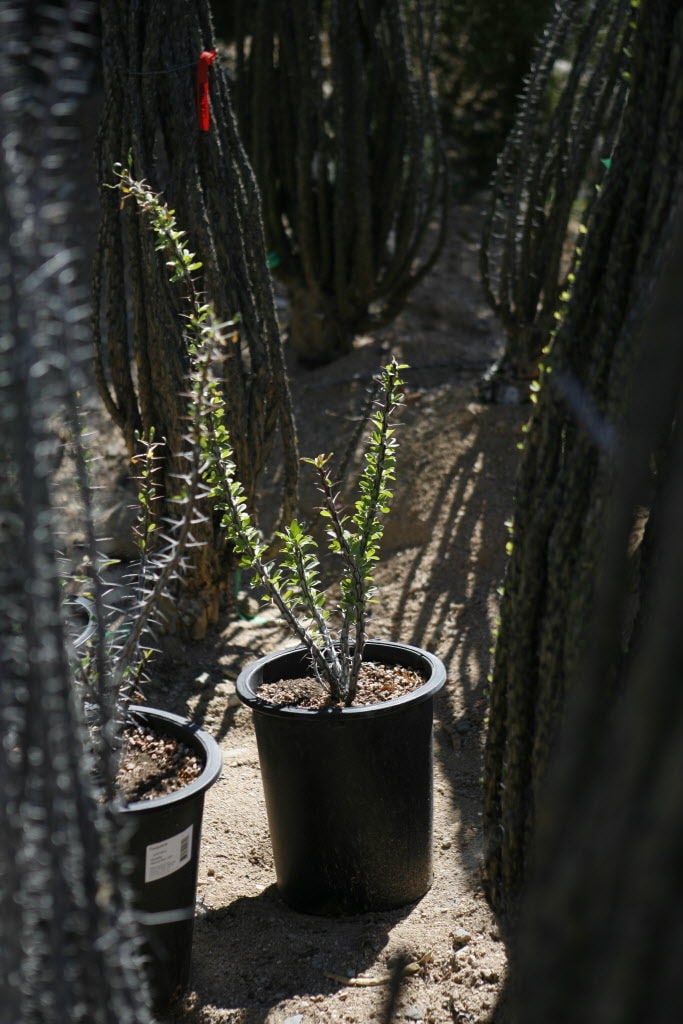
Q: I have an ocotillo in my yard that is about 20-feet tall. When it leafs out it does not leaf in the tallest two or three feet. It has not bloomed in several years. What can I do?

A: Your ocotillo is quite large and they don’t grow much taller than that. They also only live about 60 years under ideal conditions. It’s possible that the tallest parts are not receiving nutrients as readily as the lower parts due to age and because it’s a long way to the top.

These are tough desert plants that don’t require much care. Watering is only done sparingly in years when we receive less rain than average and excess water can damage these plants.

In nature, ocotillos do just fine without fertilizer in soils that have very little organic matter. If you want to try giving it a little slow-release fertilizer in early summer in the form of compost, that wouldn’t do any harm as long as you don’t overdo it. Distributing a half-inch of compost over the root zone and lightly watering it in is the most you would need.

Peter L. Warren is the urban horticulture agent for the Pima County Cooperative Extension and the University of Arizona. Email: plwarren@cals. arizona.edu

Tips on growing a banana tree

Q: About 15-20 years ago my son gave my husband a banana tree that was about 3 feet tall. It sat outside in the hot sun in the summer and in the low 20s in the winter. We live in the Tanque Verde area so we are close to the wash where it does get down to 14 degrees in the winter. The tree languished there until about three years ago.

It was dying, all brown, scaly, and all the leaves were peeling off. I decided that it was either going to die or we had to do something. So we put it into a 3-foot diameter pot with better soil (potting soil mixed with our llama and rabbit poop) and moved it into the “hot tub room.” This is a room with a hot tub and a 15-foot ceiling and windows facing north. So, the banana tree started to grow. Now it is so tall and robust that the leaves are touching the ceiling and it has bananas. I water it about three times a week and it is looking good. My question is, what next?

A: Congratulations on bringing your banana plant back to good health. Bananas in an ideal situation will multiply rapidly and form a grove. Like many plants, they require water, fertilization, and sun. The watering is more critical during the warm months when they are actively growing.

Your well-draining soil and fertilizer are surely helpful as it grows. Our hot desert sun can be too much for young plants, so it is good to protect them. A larger container would allow your plant to grow bigger and spread out. Dividing up the two plants would allow you to keep one inside and put one outside while the weather is warm, if that is appealing.

I’ve seen banana plants in landscapes in Phoenix. There may be some in Tucson, but we are more prone to the occasional frost or freeze and bananas cannot tolerate much cold weather. Keeping it indoors or in a protected area outside is the best we can do here.

Fruiting requires 10 to 15 months of above-freezing temperatures, so keeping it in a greenhouse or in your hot tub room is the best way to grow the fruit. If you plan to keep one outside, be prepared to cover it as we do for citrus and sensitive cacti and succulents if cold temperatures are in the forecast.

Peter L. Warren is the urban horticulture agent for the Pima County Cooperative Extension and the University of Arizona. Email: plwarren@cals. arizona.edu

Doodlebugs

Question: I’m sorry to bug you again, but I can’t think of anyone else to ask. When I have been going out in the backyard, in the dirt there are dozens of tiny craters. They are perfect, about an inch deep, and inch wide, and perfectly circular. Something is making them in the night, what can it be?

Answer: The craters are like tiny pitfall traps and each contains a doodlebug at the bottom under the sand. They are supposedly called doodlebugs because of the way they doodle in the sand while they meander about. They are young antlions, a kind of predatory insect of the family Myrmeleontidae. If you know your ancient Greek, the translation is easy (myrme = ant, leon = lion). They sit in the bottom of the cone shaped hole waiting for unsuspecting ants to fall in and then they eat them. Interestingly, these insects make their cone shaped traps using the steepest angle the sand can maintain that shape so that the slightest disturbance will cause the prey and the sand to fall to the bottom where the antlion waits, jaws up, for supper. It can be cheap entertainment for kids if they like to manually put ants into the holes and watch the carnage. That’s what we did. Caution: playing with insects is habit forming and they might grow to be entomologists like me.

Pretty weeds feed butterflies

Q: Can you tell me something about the weed called funastrum twine vine?

A: The plant in question is considered a weed to some and an ornamental plant to others. As we like to say, a weed is a plant out of place or a plant whose economic potential has yet to be realized. Funastrum cynanchoides, otherwise known as fringed twinevine, climbing milkweed vine, and twine-vine is in the Asclepiadaceae or milkweed family. It is a smooth vine with umbels of pale white, star-like flowers and long twining stems often clambering over tops of bushes. It has milky sap, hence the name, and is a food plant for caterpillars and several species of butterflies including monarchs and queens. There are several similar species in the Southwest, all hairy or downy and with foliage that smells somewhat like hot rubber. Its native distribution is Southern California east through southern Utah to Oklahoma and Texas, and south to Mexico. It’s native habitat is chaparral and brush country and open woodlands. It requires a moderate amount of water, part shade, and can survive in a variety of soil types.

Peter L. Warren is the urban horticulture agent for the Pima County Cooperative Extension and the University of Arizona. Questions may be emailed to plwarren@cals.arizona.edu

Planting bougainvilleas

Q: Any instructions for planting a bougainvillea in Green Valley? I will purchase a potted plant and put it in a hole in the ground.

A: Bougainvillea is a tough plant and digging a hole that is as deep, but not deeper than the roots in the container is the main thing. You can set the container in the hole once you think it is deep enough to make sure. The main things to watch out for when selecting a site are protection from the cold and proper irrigation. In Green Valley, there is a greater chance of frost damage, and this plant can die back to the ground. So choosing a site that is somewhat protected or close to hardscaping that can radiate heat is helpful. In extreme cold, you may have to cover it like we do with citrus. Also this plant doesn’t need much water but it does need some, especially to get established, so make sure there is a way to get drip irrigation or hand watering to the plant.

Peter L. Warren is the urban horticulture agent for the Pima County Cooperative Extension and the University of Arizona. Questions may be emailed to plwarren@cals.arizona.edu

Non-invasive grass to plant

Q: I am wondering about adding some native grasses to our landscape. They are

1) Muhlenbergia dumosa, bamboo muhly;

2) Muhlenbergia rigens, deer grass; and

3) Stipa tenuissima, Mexican thread grass.

I know some grasses are invasive so I am concerned about them. Are there problems with them being invasive in other people’s yards or over populating?

A: Our friends at the Natural Resources Conservation Service are experts in this area and they say the Muhlenbergia species are native to Arizona and are commonly used in landscaping here. Bamboo muhly typically spreads very slowly by rhizomes and doesn’t readily re-seed. Deer grass also doesn’t really “move around” in the landscape. I wouldn’t suggest the use of Mexican feather/thread grass in landscapes as it does have the potential to become invasive.

Peter L. Warren is the urban horticulture agent for the Pima County Cooperative Extension and the University of Arizona. Email: plwarren@cals. arizona.edu

Growing royal poinciana trees

Q: I need some advice on how to grow royal poinciana trees. The trees I have are babies. I have in the past lost a few I think due to over watering. I have them in different size plastic containers, in cactus, palm, and flower potting soil, in the shade with just a little morning sun.

A: The general recommendation for non-desert tree species is watering once every seven to 10 days in the summer to a depth of 24 to 36 inches. This is, of course, for trees planted in the ground. The frequency would be greater for container trees and really depends on how fast your container dries out. The time it takes for a container to dry out depends on the size of the container and how much exposure it receives. This tree likes the heat and naturally grows in a hot and humid environment. You might need to experiment with your irrigation system and your moisture meter to see how long the soil takes to dry.

The problem with growing this tree in Tucson is the cold since they cannot tolerate a freeze. Prepare for that by finding a protected place for your containers and/or getting some frost cloth to cover them.

Peter L. Warren is the urban horticulture agent for the Pima County Cooperative Extension and the University of Arizona. Email: plwarren@cals. arizona.edu

Ground cover

Q: I am looking for a list of ground covers that grow and cover rapidly and that survive desert winters.

A: Here are a few ideas from the “Landscape Plants for the Arizona Desert” publication from AMWUA.org. All are hardy to at least 15 degrees Fahrenheit.

Fast Growth:
  • Trailing acacia (Acacia redolens) — Look for the prostrate form.
  • Trailing desert broom (Baccharis hybrid) — Look for non-seeding selections.
  • Bush morning gory (Convolvulus cneorum).
  • Saltillo primrose (Oenothera stubbei).
Moderate Growth:
  • Trailing dalea (Dalea greggii) — Also try Dalea capitata.
  • Trailing gazania (Gazania rigens) — look for a variety of flower and foliage colors.
  • Tufted evening primrose (Oenothera caespitosa).
  • Trailing rosemary (Rosmarinus officinalis) ‘Prostratus.’
  • Creeping germander (Teucrium chamaedrys) “prostratum.”
  • Find the entire publication online at amwua.org .

Peter L. Warren is the urban horticulture agent for the Pima County Cooperative Extension and the University of Arizona. Email: plwarren@cals. arizona.edu

Garden culprit: The striped cucumber beetle

Q: I have a question regarding the attached photo of an unknown bug visiting one of my squash flower plants. This morning I counted eight of the same type crawling all over the squash flowers. Any idea of what type of bug this is and will its presence be a problem?

A: It is a striped cucumber beetle (Acalymma vittatum). They are in the family Chrysomelidae, commonly known as leaf beetles, and pests of cucurbit crops such as squash, pumpkin, zucchini, gourds, watermelon and cucumber. The adults mainly feed on pollen, flowers and foliage. The larvae feed on roots and stems.

They have the potential to spread bacterial wilt in cucurbits. I recommend removing them when you can catch them. An insect net might come in handy if you are growing a lot of these plants.

Peter L. Warren is the urban horticulture agent for the Pima County Cooperative Extension and the University of Arizona. Email: plwarren@cals. arizona.edu

Watch out for herbicides and palo verde

Q: I have two mature palo verde trees in the enclosed portion of our backyard (many more in the desert). They are next to each other surrounding a rock outcropping. There was a nasty shrub in the rock outcropping that I kept trimming back, but it always returned. So I bought a small container of poison ivy killer (only shrub killer I could find) and sprayed the contents on the shrub. Good news is shrub appears dead. Bad news is one of the two palo verde trees dropped the leaves off of the branches growing from one of the three main trunks. The main branches are still green, but the small leaf bearing branches have turned brown, though still pliable. The other two main trunks of that tree and the other palo verde are unaffected. Will the tree survive and regrow its leaves?

A: It is hard to know how much herbicide your tree absorbed. The roots of mature trees extend two or three times the diameter of the crown. The best thing you can do for the trees is taking good care of them. That means deep watering once every two weeks down to about 24 to 36 inches. Make sure the water is going to the absorbing roots that are out around the drip line (the edge of the crown) of the tree. These trees need that much water anyway and flushing out the root zone may help wash out the herbicide. Time will tell if the tree got a strong enough dose to do it in.

Herbicides can be used in situations where plants are in close proximity by painting them on the offending plant rather than spraying or drenching the soil. Often this is done soon after making a basal pruning cut. This should reduce exposure to nearby desirable plants.

Peter L. Warren is the urban horticulture agent for the Pima County Cooperative Extension and the University of Arizona. Email: plwarren@cals. arizona.edu

Read up on household insect pests

Q: Is there a good, free information source about household insect pests?

A: Yes, the University of Arizona Cooperative Extension has many publications online about various insect pests. If you can’t find a particular one, please ask me for directions. There is also an online handbook through the UA Pest Management Center at cals.arizona.edu/apmc/Handbook.html

There also are free workshops on managing pests in and around buildings. These are geared toward people who manage pests for schools and other public buildings but anyone is welcome. The next one is on Oct. 26 in Tucson. Send me an email if you want to attend or learn more about it.

Peter L. Warren is the urban horticulture agent for the Pima County Cooperative Extension and the University of Arizona. Email: plwarren@cals. arizona.edu

Southern Arizona is good spot for growing grapes

Q: I live in the Marana/Tucson area and would love to grow wine and table grapes. I have a wash behind me and I have a wall around my back yard. What my chances are of growing my own grapes on trellises?

A: Your chances are good. Probably the most abundant grape variety for Southern Arizona is Thompson seedless. It’s one of the most popular grapes for eating fresh, with a sweet but mild flavor. The berries are medium-size and the clusters large with greenish white to golden berries. Thompson seedless is the variety most often used for making raisins. Other recommended table grape varieties include cardinal (dark red berries), perlette (pale green berries) and flame seedless (red berries).

If you’re interested in making wine, several European wine grapes also grow and produce well in our area. Some of the best reds for our hot climate include shiraz, petite sirah, barbera, tempranillo and cabernet sauvignon. Recommended white wine grapes include sauvignon blanc, Viognier and pinot grigio.

Grapes should be planted in full-sun locations and well-drained soils. Test the drainage by digging a hole 12-inches wide and 18-inches deep. Fill the hole with water and let it drain. Fill it a second time and observe how long it takes for the water to drain from the hole. If the water drains out in 48 hours or less, the soil has adequate drainage for growing grapes.

Grapes can be purchased from local garden centers in containers or bare-root from mail-order nurseries. Container-grown grapes can be planted spring through fall. Bare-root grapes are ordered and planted during the winter months.

Regardless of the type, grapes should be planted directly in unamended soil. No organic amendments should be added at the time of planting. Just dig a hole large enough to accommodate the roots, removing any stones or caliche from the hole. Loosen the soil and fill in around the roots.

Grapes can be trained to grow on trellises, arbors or single posts. If you’re planting several grape vines it’s best to build a trellis using 4-by 4-inch wood posts or heavy metal T posts spaced 15 to 18 feet apart. Two heavy-gauge wires are attached to the posts, the first at 36 inches above the ground and the second at 60 inches above the ground. The first wire is used to train the fruiting cane, called the cordon. The upper wire is there to support the fruit-producing shoots.

The most effective method for training and grape production is the unilateral cordon system where grapes are planted 6 feet apart and trained to grow in one direction down the trellising wire. The first growing season, a single shoot is selected to grow up a small supporting stake to the trellising wire and then down the wire in one direction. The grape vine is attached to the support stake and wire with Velcro plant ties or plant tape. In the second season, fruiting spurs are developed every 4 to 6 inches along the vine.

Drip irrigation works best for grapes, with two 1-gallon drip emitters placed on either side of each grape plant. Grapes need ample water, especially during the first two or three seasons as they are becoming established. After establishment, grapes will need regular watering from two to four times weekly during the growing season and fertilization with a high nitrogen fertilizer in early spring and in the fall.

Ridding the garden of tortoise beetle larvae

Q: These bugs are eating my morning-glory plant. Can you please tell me what they are and how I can get rid of them?

A: Those are tortoise beetle larvae. I mentioned the adults in a July column. This is a nice photo of the young ones. They resemble Mexican-bean beetle larvae with their yellow bodies and spiky appearance. They are plant-feeding beetles and can be an occasional pest on a variety of vegetables and weeds.

The good news is the vegetables and other plants can handle the holes in the leaves that they make so you really don’t need to do anything to manage them. More good news is that these insects are helpful in keeping some weeds in check and have, in some cases, been raised and released to manage specific weed species.

If they were a small population, I wouldn’t worry about them. If you are concerned they are getting too numerous on your plants, you can simply knock them into a bucket of soapy water.

Peter L. Warren is the urban horticulture agent for the Pima County Cooperative Extension and the University of Arizona.  Questions may be emailed to plwarren@cals.arizona.edu.

The scourge of spurge

Q: I have some low weeds (spurge?) that are slowly taking over my tiff-green lawn. They are easy to kill in the gravel but what can I do about the lawn? Would something like Weed-B-Gone work and not kill the grass? What are your recommendations about fertilizing? Maybe a healthier lawn would crowd them out?

A: A healthier lawn would be the best thing to prevent spurge and other weeds from becoming established and that begins with good fertility for the grass. Ideal lawn fertilizers have a fertilizer ratio of 3:1:2 (examples: 15:5:10; 21:7:14) or 4:1:2 (example: 20:5:10).

Some lawn fertilizers may be classified as “slow release” because they release their nutrients slowly over weeks or months after an application. Quick release fertilizers are less desirable since they release nutrients in a very short period of time resulting in more frequent mowing.

Begin fertilizing after the grass turns green and there is little chance of a late frost, usually around April depending on your elevation. The last fertilizer application is usually no later than August if you are planning to overseed with a cool season grass.

The cool season grass used in overseeding dictates fertilizer applications during winter. If Bermuda grass is not to be overseeded, then late fall applications of nitrogen (October and November) can be used and may delay the onset of the winter brown color by a month or more if fall temperatures are mild.

Spurges are difficult to control, warm season, broadleaf weeds of landscapes, gardens and turf in the low deserts of Arizona. Fast growing and easily dispersed, spurges rapidly colonize and blanket areas where there is ample sunlight and moisture. Dicamba and 2,4-D are herbicides that control broadleaf plants only and can be used to selectively kill spurge in turfgrass without harming the grass.

These active ingredients are found a number of products including weed-b-gone. Be careful to stay away from other broadleaf plants such as trees and shrubs because the herbicide will kill them as well. It is probably best to spot treat to minimize the chance of damaging other nearby plants.

Beware that spurges sometimes harbor stinging ants. Some species of spurge have specialized structures called extrafloral nectaries, not for pollinators but that produce nectar as a food source for ants, which ants aggressively defend when the plant is disturbed. People with allergies or sensitivity to ant venom are at risk and should be careful around spurge.

Peter L. Warren is the urban horticulture agent for the Pima County Cooperative Extension and the University of Arizona. Questions may be emailed to plwarren@ cals.arizona.edu

Oleander tree

Q: I have seen some people cutting the lower branches off their oleanders. Is this good for the plants?

A: In general, it is good to allow plants to achieve their natural form. Oleanders are tough enough to allow pruning them into informal hedges and small trees. Pruning should begin while they are young to train them into small trees and that is what I expect you are describing.

The down side to this is that oleanders require quite a bit of maintenance to remove suckers that will grow from the base as the plants try to regain their natural form. As a hedge, oleanders look best and are healthiest when they are allowed to grow to their natural shape. Selective pruning of branches back to a point of attachment on the main stem is a good way to prune them. It is not a good idea to shear oleanders into formal hedge shapes because they require a lot of maintenance to retain that shape and because shearing in general is stressful to any plant.

Peter L. Warren is the urban horticulture agent for the Pima County Cooperative Extension and the University of Arizona. Questions may be emailed to plwarren@ cals.arizona.edu

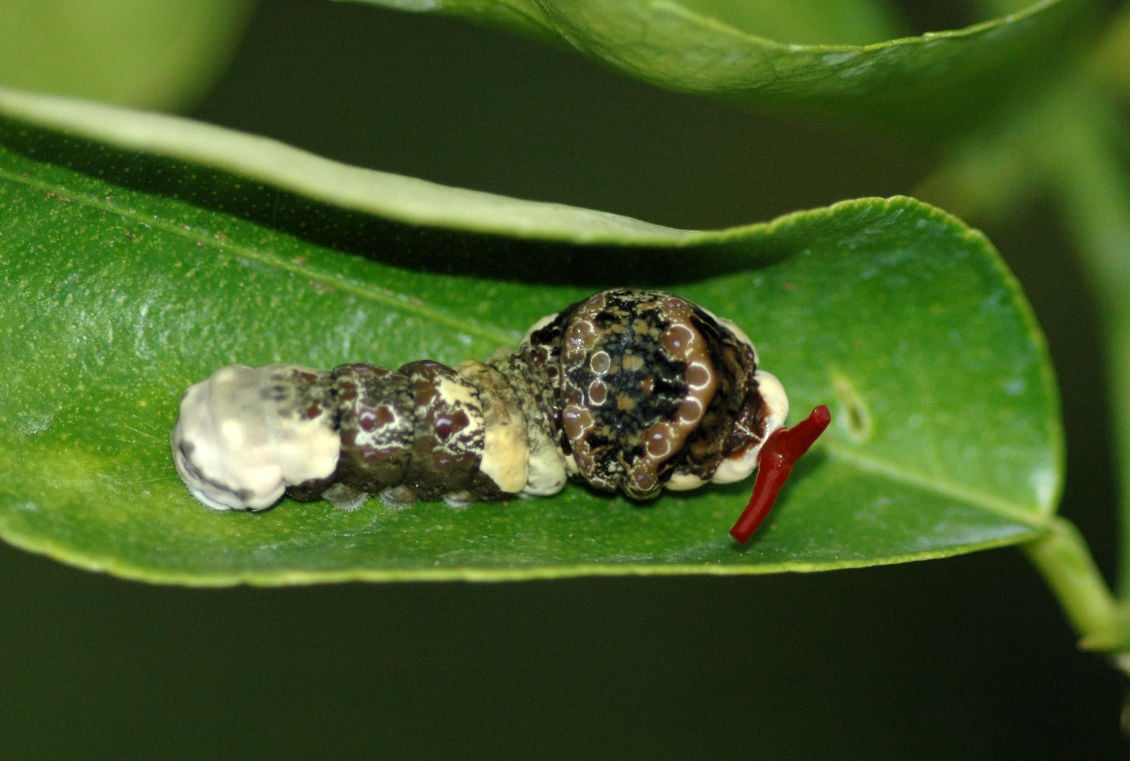
Orange dog caterpillars

Garden Sage: Papilio cresphontes

The giant swallowtail butterflies (Papilio cresphontes) that lay the eggs from which the orange dog caterpillars emerge are active throughout the citrus growing season. These caterpillars famously look like bird poop.

Courtesy: Lanare Sevi.

Q: I am finding orange dog caterpillars on my citrus now. Some are very small and some are almost two inches long. Why are they different sizes? Wouldn’t they all hatch at the same time?

A: The giant swallowtail butterflies (Papilio cresphontes) that lay the eggs from which the orange dog caterpillars emerge are active throughout the citrus growing season so the caterpillars you are seeing are likely from more than one egg laying event and did hatch at different times.

These caterpillars, which famously look like bird poop, molt through five instars or phenophases before they form a chrysalis or pupa, from thence into beauty. The rate at which they grow is related to the availability of food and the air temperature. Since your caterpillars are all on the same plants with the same conditions, it is safe to say they are all growing at the same rate.

If you’re curious like me, you can monitor their growth as a science experiment to see how long it takes for them to pupate. If the idea of sharing your observations with others in the interest of science gives you a thrill (also like me), there is a program on the Internet and an app for your smartphone called Nature’s Notebook.

There is a workshop on how use this application at Brandi Fenton Memorial Park from 9 a.m. to noon Friday, Sept. 25. Register at the Pima County website, ow.ly/Sd21w.

Peter L. Warren is the urban horticulture agent for the Pima County Cooperative Extension and the University of Arizona. Questions may be emailed to plwarren@ cals.arizona.edu

Cochineal scale insects

Garden Sage: Cochineal scale on prickly pear cactus

Cochineal scale insects suck sap from prickly pear cacti, and can reduce plant vigor.

Courtesy of H. Zell

Q: I have a backyard prickly pear with a cochineal infestation. Does that need to be treated? Do these guys ever go away on their own? Are they even actually a problem for the cactus?

A: Cochineal scale insects (Dactylopius species) suck sap from prickly pear cacti and large populations can reduce the vigor of the plants. Treating them is optional. They are noticeable due to the cottony wax the females generate to shelter themselves and their egg masses and this waxy material protects them from the environment and insecticides to some degree. The eggs hatch into nymphs (called crawlers) that feed for about three weeks before settling and becoming immobile. The crawler stage is when they spread their population on cactus plants. Once settled, they produce the waxy material that shelters them from predators and the weather. Multiple generations are produced each year. While these insects utilize the plant for food, the damage is usually negligible. If a plant is seriously colonized and showing signs of decline, you can prune off the worst pads and discard them (always prune at the joints). Blast the remaining portion of the plant with a high-pressure hose. This should expose and weaken the insects. Then spray the exposed scale with an insecticidal soap or horticultural oil. These low toxicity insecticides will minimize harmful effects on beneficial insects. Treating them is best done when the crawlers are active since they are the weakest link in their life cycle. This often occurs in the late winter or early spring for the first generation of the year.

Prune, transplant branches of Yucca

Q: We live just above River Road with desert vegetation. A branch of five of what I think is Yucca elata, 3 to 4 feet high, has grown up close to the street edge and my mailbox. All branches look healthy. Would it be possible to separate the bunch, leave only the best one or two, and transplant the others? I hate to just cut down the three or four branches impinging on the street/mailbox since they all look nice.

A: It is possible to prune off the branches you want to transplant. It is important to let the cuttings harden off for about a week after you cut them and before you transplant them. Some people use a rooting hormone on the cut end before planting, although that is not required. Also you might want to cut the cuttings down to size if they are too large to stand up on their own when planted. Otherwise you can prop them up until they establish roots.

Peter L. Warren is the urban horticulture agent for the Pima County Cooperative Extension and the University of Arizona. Questions may be emailed to plwarren@cals.arizona.edu

Apple flea beetles can take a toll

Q: There are small insects about 2-3 millimeters long that are eating (and killing) our Mexican pink flowered Oenothera. I put a pan underneath the damaged leaves and knocked about five off. They have killed about three-quarters of my plants, mostly those in the sun. Part is behind a wall that only has eastern light in the early morning and also is under the place in the eaves where the water rushes off the roof and so far they look healthy, so I will be able to replant.

A: The insects in the photo are larvae of the apple flea beetle (Altica foliaceae). They are common across the United States. In the west they are commonly found on evening primrose. When populations of these beetles are high, as they often are in the late summer and into fall in southern Arizona, they can do a lot of chewing damage. While there are some insecticides available for managing leaf beetles, these insects can also be ignored this late in the growing season. Since the Mexican evening primrose is a tough plant that will grow back from the roots, you can simply cut it back to the stem. This also serves to reduce places for the beetles to spend the winter. If you desire to spray them regardless, the least toxic chemicals include insecticidal soap with pyrethrin and neem products.

Peter L. Warren is the urban horticulture agent for the Pima County Cooperative Extension and the University of Arizona. Questions may be emailed to plwarren@cals.arizona.edu

Alien-looking monster

Q: Now this is a bug! What the hell is it? Eerily beautiful and frightful at the same time.

A: What you have is a whip scorpion. The only whip scorpion found in the United States is the giant whip scorpion, Mastigoproctus giganteus. The giant whip scorpion is also commonly known as the vinegaroon. To encounter a giant whip scorpion for the first time can be an alarming experience so I understand your fright. What seems like a monster at first glance is really a harmless creature.

Whip scorpions are found in the southeastern oak zone of Arizona east across the southern U.S. to Florida. They have a substantial but flat body 2-3 inches in length, with large spined, arm-like pedipalps in front. They are arachnids but have no venom. Whip scorpions are predators, active at night. The whip-like tail is used in defense and individuals can squirt acetic acid (vinegar) produced from a gland in the rear, hence their nickname: vinegaroon.

Peter L. Warren is the urban horticulture agent for the Pima County Cooperative Extension and the University of Arizona. Questions may be emailed to plwarren@cals.arizona.edu

How to plant an ocotillo

Ocotillo planting

Newly planted ocotillo cacti brighten the media along Ina Road west of Thornydale Road. 

Ron Medvescek / Arizona Daily Star 2014

Q: I am planning on planting ocotillo before the end of this monsoon season; any advice/instruction?

A: Ocotillos are planted much like any other shrub. Select a spot that will allow for the mature size of the plant and in an area with like plants that have similar water needs to make irrigation simpler. Dig the hole to be as deep as the roots but no deeper so it won’t be planted too deep. Fill the hole with native soil and water. If the watering makes the soil sink a bit around the planting hole, you can add more soil and maybe a few rocks around the edge for stabilization.

If this is a small plant now that should be all you need. If the plant is much larger and not able to stand on its own from the start, you might need to stake it. Three stakes around the plant are best, tying each one to a large cane.

Don’t make the ties so tight that there is no room to move a bit in the wind because a little movement is how the plant will develop its own stabilization over time. Typically stakes are left in for one year although it may require a bit longer depending on the size of the plant and the growing conditions.

Peter L. Warren is the urban horticulture agent for the Pima County Cooperative Extension and the University of Arizona. Questions may be emailed to plwarren@cals.arizona.edu

Praying mantids are highly predacious

Q: Can you tell me about the cute praying mantis that has been on our sesame plant for several months now.

A: Praying mantids are highly predacious and feed on a variety of insects, including moths, crickets, grasshoppers and flies. They lie in wait with the front legs in an upraised position. They intently watch and stalk their prey. They will eat each other. Praying mantids are often protectively colored to the plants they live on. This camouflage facilitates their predaceous behavior. Mantids are usually found on plants that have other insects around. Some mantids live in grass. Winged adults may be attracted to black lights in late summer and early fall.

Many fish and predatory aquatic insects eat larvae and pupae. Bats, birds and spiders eat flying adults. The adult female usually eats the male after or during mating. Mantids have a grasping response that is incredibly rapid, so that you see it before it catches the insect and when the insect is in its front legs. The motion is barely a blur if it is perceived at all. Mantids are active predators and consume other insects.

They are good garden predators, but are cannot keep up with the population growth of some insect populations and do not discriminate between beneficial and harmful garden insects.

Peter L. Warren is the urban horticulture agent for the Pima County Cooperative Extension and the University of Arizona. Questions may be emailed to plwarren@cals.arizona.edu

Caterpillar can shock and awe as an adult moth

Q: I found a very strange looking caterpillar crawling across my patio. I would like to know where it came from and if it is a problem.

A: The caterpillar you found is Sphingicampa hubbardi and is also known as Hubbard’s small silk moth or the mesquite moth. It is a Southwestern species in the Saturniidae family of silkworm moths found from extreme eastern California, southern Nevada, and southern Arizona into west Texas. They feed on honey mesquite and some species of acacia and related legumes. They are not common enough to be considered a pest. The adult moths have gray front wings covering bright red hind wings that they likely use to shock and awe predators while they make their escape.

Peter L. Warren is the urban horticulture agent for the Pima County Cooperative Extension and the University of Arizona. Questions may be emailed to plwarren@ cals.arizona.edu

Fasciation, an abnormal growth

Q: We’ve had this plant in our yard for at least seven or eight years, and this year it sprouted this unusual branch. It’s about 1.25-inches wide and the thickness of a normal “round” branch. We have never seen this before. Is this normal? Or is there something wrong with this plant?

A: The odd branch is not normal but it’s also not a big deal. We call it fasciation and it is abnormal growth in which the growing tip becomes elongated perpendicularly to the direction of growth producing flattened, ribbon-like or crested tissue. Some plants have mutations like this periodically and are prized aesthetically for this feature.

You might occasionally see saguaro cacti with this fasciation. We have one on campus near Old Main that draws a lot of attention. Viruses, mites, or environmental factors sometimes cause the mutations.

Peter L. Warren is the urban horticulture agent for the Pima County Cooperative Extension and the University of Arizona. Questions may be emailed to plwarren@cals.arizona.edu.

Calcium deficiency for tomato

Q: We planted two different kinds of tomatoes in a planter. The larger variety is thriving. The smaller variety has tomatoes that grow in green and no problems, but as they begin to ripen, the end farthest from the stem turns black.

A: The problem you described is called blossom end rot and it is associated with a calcium deficiency.

While the occurrence of blossom end rot may indicate calcium deficiency, in reality, the soil may have adequate calcium. However, for various reasons the plant may not be able to take up enough calcium to supply the rapidly developing fruit. As a result, efforts to manage this problem fall into two categories: pre-plant and post-plant.

Prior to planting, the main preventative measure is to have a soil test done to determine if there is adequate calcium. Limestone (a source of calcium) should only be applied if soil test results recommend it. When limestone is needed, best results are achieved when the limestone is worked into the soil 2 to 3 months prior to planting.

After tomatoes are planted, you can minimize the potential for blossom end rot by doing the following:

Once transplants become established, encourage the production of a large root system by keeping plants a little on the dry side for a few weeks (until they begin to flower and set fruit). A large root system is better able to take up the calcium needed for the healthy development of the tomato fruit.

After fruit set begins, keep soil evenly moist. (Avoid extreme fluctuations in moisture levels. Do not overwater!)

Apply a layer of mulch to help maintain even moisture and keep soil cooler.

Do not over fertilize. Especially avoid high-nitrogen fertilizer as it can cause problems with the uptake of calcium.

Do not cultivate closer than 1 foot to plants to avoid damaging roots.

If tomatoes develop blossom end rot, spray the foliage with calcium chloride or calcium nitrate when symptoms first appear. Follow the instructions on the label. Removing fruit with symptoms is also recommended.

The good news is that tomato plants self-adjust after the first fruit are set, and later fruit are typically not affected by this disorder.

Peter L. Warren is the urban horticulture agent for the Pima County Cooperative Extension and the University of Arizona. Questions may be emailed to plwarren@cals.arizona.edu.

Living with chuckwallas

Q: I have at least four chuckwallas living in my backyard. I have identified them using photos on the Internet. They range in size from 6 to 14 inches. They are eating the leaves of my vegetable garden. How do I make them leave my yard?

A: The chuckwalla (Sauromalus obesus) is a resident lizard in these parts so your yard is also its yard. You can’t stop them; you can only hope to contain them. Your best bet in the case of any four-legged varmints eating your vegetable garden is to exclude them using a barrier so they cannot access your vegetables. Since these are relatively large lizards, hardware cloth and PVC pipe, or a reasonable facsimile thereof, can be used to fashion an enclosure they cannot penetrate that you can lift off when tending your garden.

Peter L. Warren is the urban horticulture agent for the Pima County Cooperative Extension and the University of Arizona. Questions may be emailed to plwarren@cals.arizona.edu

Caring for lime tree

Lime tree

A utility lamp under the canopy of a young lime tree covered with a sheet helps protect tree from cold weather. Photo by Dean Knuth/Arizona Daily Star 

Dean Knuth/Arizona Daily Star, 2008

Q: I planted a Bearss Lime tree about five years ago. When we had the bad freeze a few years ago it froze. Since then it has come back and has grown very well. However it never produces. I fertilized this year. It had blossoms but no limes. Can you suggest a remedy? I also water it regularly.

A: It seems you have the basic care strategy down but maybe it could be tweaked to be more effective. To start, we recommend fertilizing citrus three times per year: January/February, April/May and August/September. The amount of fertilizer you use should be based on the type, age and size of the tree. We have a chart you can use by searching for “University Arizona citrus fertilizer” on the Internet.

Watering should be done every seven to 10 days to a depth of 36 inches in the summer. In the spring and fall you can back off to watering every 10 to 14 days and in the winter, water every 14 to 21 days. This is for citrus planted in the ground. If your tree is in a container, you will have to water more often and base that frequency on how fast the soil dries out.

Bees and the wind will accomplish most of the pollination of citrus flowers. If you are not seeing any bees on your citrus flowers that could be a problem. Making sure you have an attractive habitat for bees by planting other flowering plants nearby is helpful as is providing a water source. Also keep in mind that citrus produce more blossoms than fruit.

Peter L. Warren is the urban horticulture agent for the Pima County Cooperative Extension and the University of Arizona. Questions may be emailed to plwarren@cals.arizona.edu.

Watering and pruning an olive tree

Q: I have two mature olive trees in my back yard. They do not fruit. I would like to know how much to water them especially now in the hot Tucson summer. Also both have sprouted suckers and I am not sure how or when to prune these.

A: Olive trees need water every seven to 14 days to a depth of 24 to 36 inches during the summer. In the spring and fall you can back off to every 10 to 21 days and in the winter every 14 to 21 days.

You can prune suckers any time. The way you prune them is close to the branch they are growing from without leaving a large stub or going too close to the branch so as to make a cut flush with the branch surface. There is a nice publication at the UA that provides illustrations of these cuts. You can search for it by using the publication number AZ1499. If the suckers are coming from under ground, prune at the ground level.

Peter L. Warren is the urban horticulture agent for the Pima County Cooperative Extension and the University of Arizona. Questions may be emailed to plwarren@cals.arizona.edu.

Holes in tomatillos

Q: My tomatillos are full of holes and I can’t figure out what happened. What should I do to prevent this next time?

A: The culprit that damaged your tomatillos is the tomato fruitworm (Heliothis zea) aka the corn earworm. This is a common pest of these plants across the U.S.

Spinosad (many brands) works well on moth larvae like the tomato fruitworm, but it does nothing once larvae are already within the fruit. In your case, they are already finished and moved on to pupate in the soil. If you start seeing fruitworms in tomatoes or tomatillos, start applying spinosad every five to seven days through harvest. Focus on fruits higher up and on the outside of the plant where females prefer to lay eggs. Spinosad may be applied up to one day before harvest. Since your tomatillos are already affected, make note of when you started seeing the damage so you can be prepared a few weeks in advance for the next crop.

If you have any corn still in the silking stage, you can prevent corn earworm larvae from entering the corn by spraying (or rubbing) the silk with one part Bacillus thuringiensis (many brands) to 20 parts pure oil (mineral, corn, or soybean). Start this treatment when pollination is almost complete, which is when the silk tips have begun to wilt and turn brown.

Peter L. Warren is the urban horticulture agent for the Pima County Cooperative Extension and the University of Arizona. Questions may be emailed to plwarren@cals.arizona.edu.

Deep water trees

Q: I have a fig tree and a pomegranate that I planted in 2012 in water harvesting basins. They both were thriving and last year I got great harvests from both with large and juicy fruits. They got supplemental water but mostly they got water two times a day from drip irrigation for 30-40 minutes in the a.m. and p.m. This year the fig got a lot of fruit but they were small and sort of dry, the pomegranate also got fruit but they are small and lots of them have split right in the middle and they have not reached maturity. The fig’s leaves were also turning yellow with some brown tips and falling off.

A: These trees do better with deep, infrequent watering instead of a little bit each day. The brown leaf tips are a sign of insufficient water and possibly salt damage from underwatering. The cure is to provide more water to wash the salt through the root zone. The small fruit and splitting could be attributed to the watering issue as well.

I am not sure how long ago you switched to the new watering schedule. It might take a while for the trees to show a lot of progress. This being their third year in the ground should have been the year they take off but they might have been set back a bit by the lack of water in the recent past. I say keep up the new watering schedule and see how they do.

Peter L. Warren is the urban horticulture agent for the Pima County Cooperative Extension and the University of Arizona. Questions may be emailed to plwarren@cals.arizona.edu.

Palo verde tree

Q: I’m pretty sure my palo verde tree is suffering from major beetle damage. Many branches are dead, it barely leafed out, and there are many holes in the ground that are very deep. I will take advantage of the holes and do deep watering, but what else can I do to save it?

A: I think you need to have your tree pruned to remove the dead and damaged branches. I recommend using an ISA-certified arborist so the quality of the work is more or less guaranteed. The International Society of Arboriculture has a web site (www.isa-arbor.com) that allows you to search for arborists in your area. The palo verde beetles you collected are very commonly seen during the monsoon season and not a big concern. If the tree is healthy, it should be able to withstand a few beetles. They likely made the holes you are using. Good irrigation is critical to maintaining the health of your tree and watering is best done with a drip irrigation system on a timer so you can accomplish it on a schedule and more efficiently. Desert trees like this need a good soak once every two to three weeks in the summer down to about 24 to 36 inches. It’s important to put your irrigation emitters around the root zone near the outside of the crown of the tree so it reaches the absorbing roots.

Peter L. Warren is the urban horticulture agent for the Pima County Cooperative Extension and the University of Arizona. Questions may be emailed to plwarren@cals.arizona.edu

Bugs on sunflower leaves

Q: What are these little gray buggers on my sunflower leaves?

A: They are lace bugs, small plant bugs that suck plant sap from the leaves. They are often found on the underside of leaves. The grayish ones are the adults and the smaller, blackish ones are the nymphs. The smallest black spots are their frass (poop). On sunflowers, we just let them be because they might damage the leaves but the flowers are unaffected and the plants seem to tolerate them to some extent. Other plants are not as tolerant. If you wanted an organic solution you could try insecticidal soap, horticultural oil, or a pyrethroid such as PyGanic.

Peter L. Warren is the urban horticulture agent for the Pima County Cooperative Extension and the University of Arizona. Questions may be emailed to plwarren@cals.arizona.edu

Oleander not flowering

Q: About 1 ƒ years ago I purchased four white flowering oleander plants—the tall not the petite variety. They have been deep watered regularly, fed in May and have only grown about 1/16th of an inch. They have original leaves, have flowered but have no new growth or leaves. My hope was these would grow quickly in front of my screened in porch. I have other oleanders in the back and side yards that are huge, some of which I have planted. I wonder if the soil is old as I have lived here 31 years and the home was built in 1968. There had been huge juniper trees that died over the years. Perhaps this area of soil is not rich enough to support new growth. I’ve considered moving the oleanders and putting in birds of paradise.

A: Many woody plants will take up to three years to grow a lot after planting so I think you should give it more time. Another factor could be the roots of your old junipers. If they were cut down recently and simply cut at the soil level, the stump and roots are still in the ground. That means the roots will decompose over time and in the process take nitrogen from the surrounding soil for that process, leaving less for your new plants. Not knowing the exact situation with your junipers, I am doing a little guesswork here so it would be good to have more information about the timing of their demise and the planting of your oleanders. Having your soil tested is a good idea if you are still concerned about this. There are a few labs in the area that will test it and you can call the Pima County Extension Office to ask for their contact information.

Peter L. Warren is the urban horticulture agent for the Pima County Cooperative Extension and the University of Arizona. Questions may be emailed to plwarren@cals.arizona.edu

June bugs in fig tree

Q: We recently came back to Tucson from a week in San Diego to find about a hundred or more June bugs on our mature fig tree. We have lived here for over 20 years and this has never happened before. Is there any reason the bugs would be swarming on the figs at this time? Is there any safe way to get rid of them?

A: These insects are attracted to ripe figs and other fruit. They feed on the juice as adults and live in the soil as grubs. Often they attack fruit that has been damaged by birds pecking holes. We occasionally have a large population of beetles and they don’t always show up on the same plants each year.

There are some organic pesticides you can use but they are not very effective against the adult beetles. In addition, since there are so many of them, you can’t get them all and they fly away when you try. I suggest picking the fruit if it is ripe and protecting it with bags if it is not ready to be picked and you plan to eat it.

Peter L. Warren is the urban horticulture agent for the Pima County Cooperative Extension and the University of Arizona. Questions may be emailed to plwarren@cals.arizona.edu

Battling catepillars

Q: I have many Penstemon parryi seedlings that have been growing through the summer. Within the last two weeks they have begun to develop “burned” scale patches on the leaves that are accompanied by black “seedy” areas. The black beads could be the seeds for future plants, except that these haven’t ever bloomed. The black beads don’t appear to be adult insects, but could be eggs. Do you have any idea what’s going on?

A: Very small caterpillars, the chalcedon checkerspot (Euphydryas chalcedona) most likely, are eating your Penstemon plants and the black “seeds” are actually caterpillar poop or frass as we call it when it comes out of insects.

The plants will likely be OK regardless and you are supporting a healthy butterfly population but if you see active caterpillars chewing your plants to the ground you can spray the leaves with Bacillus thuringiensis, aka Bt. This organic compound will make the plant poisonous to the caterpillars that eat it and will not harm other organisms on the plant. There are multiple strains of Bt, so if you choose to buy some, make sure you are getting the strain designed to kill caterpillars.

Peter L. Warren is the urban horticulture agent for the Pima County Cooperative Extension and the University of Arizona. Questions may be emailed to plwarren@cals.arizona.edu.

Harvest mesquite pods

Q: We have tons of mesquite pods and they are a huge pain. A yard guy we met said he could spray the tree next April and that would take care of it. Then I read that spraying doesn’t work well on Mesquites because the timing has to be accurate and the pods mature over too broad a time period. Also, our tree is huge and I worry about the spray harming nearby plants. What do you say?

A: The spraying doesn’t work well on most trees, it is costly and time consuming, and it could harm surrounding plants and other organisms, depending on the chemical used and if not done correctly.

There are many factors at play including timing, environmental conditions, and making thorough applications. Due to the gradual development you mentioned, it might take repeat sprays to do a sufficient job. It would likely be more environmentally sound and cheaper to hire someone to rake the pods. Another alternative is to harvest the pods before the monsoon begins and have them milled into mesquite flour. Mesquite flour is a popular alternative to wheat flour among local and heritage foodies and a nice gluten free alternative for those that require one in their diets. Milling events are available in various locations during the harvest season and they charge a nominal fee to grind them for you.Check out DesertHarvesters.org for one group that does this and instructions on how to harvest.

Peter L. Warren is the urban horticulture agent for the Pima County Cooperative Extension and the University of Arizona. Questions may be emailed to plwarren@cals.arizona.edu.

Lighting up the night

Q: What are the luminescent critters found in the Tucson region? Back East there are fireflies or lightning bugs, but I have not seen them here.

While taking a predawn hike in Sabino Canyon several years ago, we spotted a small wingless luminescent crawling insect on the roadway. It was about a half inch long with a termite-like appearance, and put off a light bluish light. A few dark nights ago looking out past our back fence line on the ground I spotted my second luminescent critter, I think. It was an LED-like spot of white-bluish light that persisted for several minutes. Our home is at about 2,750 feet in elevation in north Tucson. Any suggestions as to what we are seeing? Sober on both occasions.

A: Lightning bugs are one of my favorites from back east. We used to feed them to toads and watch them light up in their bellies, making the toads glow. What we have in the West are a couple dozen other species, although none as common as the ones back East.

What you were likely seeing are the immature beetles of one of these species. According to retired bugman Carl Olson, now is a great time for people to see the larval stage that usually has an eerie green light. Most of the ones seen in Rincons and Catalinas are pink as you will see in his photo of Microphotis dilatatus from the Vail area.

Peter L. Warren is the urban horticulture agent for the Pima County Cooperative Extension and the University of Arizona. Questions may be emailed to plwarren@cals.arizona.edu.

What to do with galls

Q: I am starting to see some odd growths on parts of my oleander hedge. I understand they are galls but I am not sure what to do about them.

A: Oleander (Nerium oleander) is one of the most popular evergreen shrubs in Arizona and the gall disease you are seeing is widespread. Oleander gall is caused by the bacterium Pseudomonas syringae savastanoi.

The galls occur on twigs, branches, leaves, flowers, and seedpods. Initially galls appear as small protuberances that subsequently develop into wart-like growths with roughened, fissured surfaces. Galls vary in size but average about a half to 1 inch in diameter. Large galls are usually made up of several small galls that have grown together.

Galls are the result of the growth and multiplication of the bacterium. The bacteria enter and infect oleanders through leaf and blossom scars, wounds produced by pruning, frost injury, and natural openings. Rain, sprinkler water, and pruning tools can spread bacteria from diseased to healthy plants.

When purchasing oleanders, examine them carefully to be sure they are free of galls. The vast majority of nursery stock is free from disease but prevention is always the most effective method of disease control. For diseased oleanders, prune out infected plant parts and apply disinfection solution (a 10 percent solution of household bleach) to each cut surface.

Always dip pruning tools in the disinfectant solution between cuts to reduce the possibility of spreading the bacteria. Pruning operations should be conducted during the dry seasons to avoid infection of wounds. Avoid sprinkler irrigation. Severe infection of large shrubs is difficult to control by selective pruning. If the entire shrub is cut down, the new succulent growth is extremely susceptible to infection. In certain situations, removal of the diseased plant and replanting may be the best method of control.

Peter L. Warren is the urban horticulture agent for the Pima County Cooperative Extension and the University of Arizona. Questions may be emailed to plwarren@cals.arizona.edu.

Bird of paradise

Question: I have a front yard without a fence or wall. I’d like to line it with bird of paradise bushes. Can I use a cutting to start them growing or do I have to use seed? And if so, when would be the best time to plant?

Answer: You can propagate bird of paradise (Caesalpinia species) by seeds, cuttings, simple layering or dividing plants. Softwood cuttings can be taken in the spring and early summer. Sever the stem between the leaf joints or nodes, just below a node. You may want to use a rooting hormone to encourage the roots to develop. I have a publication on these plants in case you are deciding which variety to plant. You can look for the publication by searching online for the publication number “AZ1634.”

Peter L. Warren is the urban horticulture agent for the Pima County Cooperative Extension and the University of Arizona. Questions may be emailed to plwarren@cals.arizona.edu.

Rose bush woes

Question: I have 13 rose bushes in my backyard against the side concrete wall that were planted two years ago. The first and second years they really grew and blossomed nicely. But this year, for whatever reason, all the petals are dropping off and most of the bushes are now bare. Because of the warm weather this winter, they seem to have bloomed much earlier than usual (in March). I am wondering if they will have a second blooming season this year before “winter,” and what could be causing the petals to fall off. They are very delicate, it seems.

Answer: A common problem with most plants is lack of water. Plants often lose parts when they are too dry, and yours are most likely receiving additional heat radiation from the wall. Roses typically require water every three to five days in the summer, every five to seven days in the spring and fall, and every 14 to 21 days in the winter. And you should be watering to a depth of 18 to 24 inches.

Roses also need to be fertilized. It is better to apply small amounts of a slow-release fertilizer every six weeks during the growing season rather than a heavy application once a year. The first application of slow-release fertilizer should be applied after the roses have been pruned in January or February and repeated every six weeks until June.

March is about right for roses to begin blooming in Tucson if you pruned them in late January. At our office, the Rose Demonstration Garden maintained by the master gardeners started blooming in late March and bloomed into April. Some of them are still blooming. Yours will likely have a second bloom in the fall if you prune them again in mid-September. For more details, check out our publication available on the Internet by searching for “roses AZ1305” with a search engine.

Peter L. Warren is the urban horticulture agent for the Pima County Cooperative Extension and the University of Arizona. Questions may be emailed to plwarren@cals.arizona.edu.

Desert broom annoys

Question: What can I use to finally get rid of these stubborn desert broom weeds once and for all?

Answer: Desert broom (Baccharis sarothroides) is typically seen as an invasive native shrub but opinions differ on its status as a weed or just part of the desert flora. The phrase “invasive native” seems like an oxymoron but this plant has a habit of moving into disturbed areas as new construction or other changes to the desert soil occur, so it is certainly an opportunistic native plant. My predecessor, George Brookbank, has written that it can be used as a hedge because it can reach 10 feet in height and is almost always green. It also provides habitat for birds and other organisms.

There are cultivated varieties used in landscape plantings that are prostrate in form. Even these are reported to revert to the native species when they reseed. The way to get rid of them is to use an integrated approach. Since they propagate by wind-blown seed, you will start to see new seedlings in the spring. Pull these up as you find them. Once they become established their roots go deep and are harder to remove. Mature plants can be cut down near the soil surface. Spraying or painting the freshly cut stump with glyphosate herbicide may stop the regrowth. If it comes back from the stump, spraying the new green growth with the same herbicide will allow the active ingredient to translocate to the root zone, where it may kill the plant. Repeated applications may be necessary.

There is no way to eradicate these plants; we can only hope to contain them as landscape plants or manage them away from desired locations. As with any pesticide, make sure you read the label before you apply and follow all safety precautions listed to protect yourself and the environment.

Peter L. Warren is the urban horticulture agent for the Pima County Cooperative Extension and the University of Arizona. Questions may be emailed to plwarren@cals.arizona.edu.

Tree tobacco

Q: Here is a picture of a new plant sprouting up in my yard. Is it a weed or something nice? Will it grow tall? Leave it or yank it? Thanks.

A: It is called tree tobacco (Nicotiana glauca). Tree tobacco is a slender, erect, straggling shrub or small tree growing 6 to 20 feet tall. Tree tobacco produces sprays of nodding, tubular bright yellow flowers and is a prolific seed producer. Opinions differ on its status as a weed or ornamental. It is a bit stinky and the plant parts are toxic to animals like some other plants in the Solanaceae plant family so you should keep children and pets away from it. I have a friend that likes the yellow flowers they produce and keeps it around for that reason.

Peter L. Warren is the urban horticulture agent for the Pima County Cooperative Extension and the University of Arizona. Questions may be emailed to plwarren@cals.arizona.edu.

Tarry-looking seepage on mesquites

Q : Recently I noticed, on two mesquite trees, a tarry-looking seepage coming out, and in some cases dripping onto the ground. What is it, and what if anything should be done about it? The only thing I can think of regarding care of the trees that might have some bearing on the matter is that they were not watered this spring, and in fact have been without significant (added) water for several months, and have looked a bit less robust than usual this spring in terms of leaf output.

A: What you are seeing is called bacterial wetwood or slime flux. Slime flux is caused by the infection of sapwood by several bacteria and is a problem with mature mesquites. The disease-causing microorganisms are found in the soil and probably gain entry above or below the soil line through wounds or pruning cuts. After several years, affected areas will exhibit a water-soaked appearance (wet wood). Gas is produced by the bacteria (and possibly yeasts) that force out a foul smelling liquid from cracks and wounds. The liquid is dark brown to black in color.

Infected trees live many years and slime flux is more of a nuisance that requires periodically a strong, hard stream of water to prevent staining of patios and cars. Seriously infected branches may need removal if they present a safety hazard. The old remedy of placing drainage tubes into the infected areas is not recommended, and may in fact, present more entry sites for the disease.

Regarding the water schedule, I recommend a good soak of the root zone out near the edge of the crown of the tree every three weeks during the growing season down to about 36 inches. Of course you can hold off during the monsoon season if you get good rains and during the winter as well.

Peter L. Warren is the urban horticulture agent for the Pima County Cooperative Extension and the University of Arizona. Questions may be emailed to plwarren@cals.arizona.edu.

Propagating a toothpick cactus

Q: After 12 years my toothpick cactus has finally yielded five flowers for the first time. I am wondering if I could propagate a toothpick cactus, and if so how do I do it?

A: You can propagate the toothpick cactus (Stetsonia coryne) by seed or cuttings. For cuttings you simply cut off a section from the top of a stem using a sharp knife and at a 45-degree angle to protect the parent plant from water collecting on the wound. The size can be anywhere from three inches up to six feet. Square off the cutting, dust with sulfur and/or a rooting compound and leave in a dry airy place to form a callus. This can take one to four months, depending on the weather. August through October is a good time of year to do this part. Next, pot the cutting using standard cactus mix containing 50 percent pumice or perlite and 50 percent peat or compost.

Plant it deep enough that it won’t fall over, filling in with fine gravel to hold it steady. Water once a month or so to keep the mix from completely drying out but avoiding the risk of rot. Leave the pot in a bright spot.

The cutting should root in a month or two although some take longer. Once the cutting is showing signs of active growth you can remove it from the pot and transplant it to another larger one or to the ground where you want it to grow. There is no hurry if you use a one- or two-gallon pot. They can grow in that for up to a year.

Peter L. Warren is the urban horticulture agent for the Pima County Cooperative Extension and the University of Arizona. Questions may be emailed to plwarren@cals.arizona.edu.

How to encourage ocotillo blooms

Ocotillo

Container grown ocotillos are often available at gardening stores. Jeffry Scott/Arizona Daily Star. 136863.

Jeffry Scott/Arizona Daily Star, 2007

Q: I have two ocotillos that I planted myself about seven years ago. Both are oddly shaped but growing well from their original size of about 1 foot. They grow 6 to 10 inches a year, green up at the appropriate time but neither has ever bloomed in the spring. They are not on drip but one is near a drip line and the other is not. I water them very occasionally. I have tried fertilizing and not fertilizing. It seems to have no effect. What can I do to encourage blooming? The tallest branches on them are about 7 to 8 feet tall.

A: Ocotillos (Fouquieria splendens) are tough plants and can usually be counted on for blooms in the spring. Because these plants have the ability to put on leaves when there is sufficient water and drop them when it is dry we call them drought deciduous. Their ability to produce flowers is likely also related to available water so you can keep an eye on how often they leaf out to see if they are doing well.

The main factors for blooming are the age of the plant and the number and length of branches that are reproductively active. These are obviously not something we can control so your best bet is to make sure it is otherwise healthy by watering appropriately. That means every 14 to 21 days down to 24 to 36 inches in the spring, summer, and fall. In winter, you can skip the irrigation and let nature take its course. These plants do fine without fertilizer in their native habitat unless you are planting it in a container.

Peter L. Warren is the urban horticulture agent for the Pima County Cooperative Extension and the University of Arizona. Questions may be emailed to plwarren@cals.arizona.edu.

Protecting pineapple

Q: About three years ago, I lopped off the top of a pineapple purchased at a local grocery store and planted it. In April, my first pineapple began to grow. It appeared to be growing at a good rate, when it began to yellow. When checked, I found that something (bird or bug) had drilled several holes into it, causing it to die. Do you know what caused the damage and how I can avoid it in the future?

A: From the photo you sent, I suspect it is bird damage. Insects will come to the holes made by birds for the juice so you may find them there as well. The best way to prevent this is to exclude the birds once the fruit begins to develop. You can accomplish this with hardware cloth around the whole plant or you can enclose the individual fruit in a breathable bag as people do with peaches and grapes.

Peter L. Warren is the urban horticulture agent for the Pima County Cooperative Extension and the University of Arizona. Questions may be emailed to plwarren@cals.arizona.edu.

Vines challenge native oak in Oracle

Q: I live in Oracle and have a native oak with ivy growing up the trunk. I am wondering if it is a threat to the tree. I also have a mature netleaf hackberry covered by a native grape and another oak with a passion vine rapidly climbing to the top. Should I try to control any of these vigorous vines?

A: English ivy (Hedera helix) is in the ginseng family Araliaceae and it is the most troublesome ivy for trees and other landscape plants in a large part of the U.S. It is an aggressive plant that can rob trees and other plants of resources by climbing over them to seek sunlight and invading their root zones with their own to seek water.

However, it doesn’t typically do well in the desert. The trouble for English ivy here is the hot temperatures and dry, salty soil we typically have in southern Arizona. Your location in Oracle is probably just cool enough to allow it to survive in the shade with sufficient water. I doubt it would kill the tree but it could reduce its vigor. So with suitable habitat for English ivy and if it is doing very well, I would recommend cutting it back or down from the tree. Severing it at the base is probably all you need to do to keep it in check. Otherwise, you have a nice specimen of a vine that isn’t often seen here. The native Arizona grape vine (Vitis arizonica) is not typically a species we call a weed and worry about managing but if you find it growing so vigorously it covers a desirable tree or shrub, you could cut it back or out. Like many other vines, it seeks the high ground to get sunlight and can shade out other plants. Passion vine (Passiflora foetida) is often considered a desirable ornamental vine with beautiful flowers that is great for attracting butterflies so I wouldn’t worry about that one unless it compromises a tree you like better.

Peter L. Warren is the urban horticulture agent for the Pima County Cooperative Extension and the University of Arizona. Questions may be emailed to plwarren@cals.arizona.edu.

Battling leafcutter ants

Q: Our yard backs up to the desert and every late summer for the past few years leafcutter ants raid our yard at night, stripping leaves off our banksiae rose and lantana. The have recently begun to attack a mature desert willow and it’s now almost bare. At one point the anthill was in our back yard and I used insecticide on the pile so that now they’ve moved into the desert. But they climb the fence with ease even while carrying leaves. I don’t want to spread poison in the desert but am worried our tree will not survive. (The lantanas and banksiae are hardy and always come right back). Do you have suggestions to keep the ants out?

A: Leafcutter ants are difficult to manage but one thing that slows them down is making the area less hospitable. A product called tanglefoot is a sticky substance you can spread on the base of the plants you are trying to protect and in your case maybe the wall they climb. Also diatomaceous earth is something you can spread on the ground surrounding the plants. The diatomaceous earth is abrasive and can injure the ants and the sticky stuff does just what you might think. They get stuck and can’t move much like Roach Motels that let insects check but not check out.

Milkweed bugs harmful to predators

Q: I saw lots of these bugs at the community garden this morning. They are massed on the open pods of a vine-like plant that has grown up the chain-link fence. The pods are about 3 inches long, brown-gray, and with with a tail or point. When open, they release a mass of cotton-like fluff. What the heck are these?

A: They are milkweed bugs (Oncopeltus fasciatus), and the plant is climbing milkweed vine (Funastrum cynanchoides). In the photo you sent, I see mostly nymphs. These young bugs do not have fully developed wings. Instead, they show wing buds, the two small, black, miniature, wing-shaped parts on their backs. There is one adult in the photo, showing fully developed wings with a black stripe across the middle of the body.

Like monarch and queen butterfly larvae, these milkweed bugs are protected from predators by ingesting the milky sap from this plant. The sap contains cardiac glycosides that can harm predators. Their red color gives the warning to potential predators that they are hazardous.

Since these insects stick with that plant, and that plant is probably not what you are growing in your community garden on purpose, what you do about them is a matter of preference. Some consider the milkweed a weed, while others like to attract butterflies.

Peter L. Warren is the urban horticulture agent for the Pima County Cooperative Extension and the University of Arizona. Email questions to tucsongardensage@gmail.com

ID grubs to determine how to manage them

Q: I saw lots of these bugs at the community garden this morning. They are massed on the open pods of a vine-like plant that has grown up the chain-link fence. The pods are about 3 inches long, brown-gray, and with with a tail or point. When open, they release a mass of cotton-like fluff. What the heck are these?

A: They are milkweed bugs (Oncopeltus fasciatus), and the plant is climbing milkweed vine (Funastrum cynanchoides). In the photo you sent, I see mostly nymphs. These young bugs do not have fully developed wings. Instead, they show wing buds, the two small, black, miniature, wing-shaped parts on their backs. There is one adult in the photo, showing fully developed wings with a black stripe across the middle of the body.

Like monarch and queen butterfly larvae, these milkweed bugs are protected from predators by ingesting the milky sap from this plant. The sap contains cardiac glycosides that can harm predators. Their red color gives the warning to potential predators that they are hazardous.

Since these insects stick with that plant, and that plant is probably not what you are growing in your community garden on purpose, what you do about them is a matter of preference. Some consider the milkweed a weed, while others like to attract butterflies.

Q: We are rejuvenating an in-ground garden, the Desert Meadows Park in Green Valley, to create a demonstration garden for folks with limited space, resources and physical limitations. The bed we were given has a major grub infestation. Any information on how to manage the grubs would be appreciated. The Green Valley Garden Club’s website has a good section on the Desert Meadows Park.

A: I visited the Desert Meadows Park during a recent trip to Green Valley. It’s a very nice place, and you all have done a great job with it. Grubs are always a potential problem, but sometimes not a big deal. There are a wide variety of beetle grubs we might find in a garden. Common types are the whitish, C-shaped scarab beetles.

There are a few species in this family you might find, so identifying the species is helpful, and counting the number you find per square foot is how we determine if treatment is necessary. Often in a garden plot, you can manually remove them and feed them to your chickens or toss them into an open area where other birds are likely to find them.

Identification of scarab grubs is based on the size sometimes, and examining the back end for patterns of hairs. Not everyone likes to get that close to the butt end of a grub, so I can help if needed. Once you know the identity, the life-cycle information will help determine the host plants they feed on and when the best time of year is to manage them.

Peter L. Warren is the urban horticulture agent for the Pima County Cooperative Extension and the University of Arizona. Email questions to tucsongardensage@gmail.com

Hornworms in search of a place to pupate

Q: We’ve had this guy around for the last few days. What is he? A luna moth perhaps? What should we look for in coming days?

A: It’s a hornworm, Manduca rustica (aka rustic sphinx moth), to be precise. They are commonly seen crawling around this time of year looking for a place to pupate in the soil. They are basically harmless and not considered a pest species.

The adult moth might not emerge until spring, and they fly at night, so the adults aren’t seen as often as the caterpillars. The luna moth (Actias luna) is one of my favorites, and is found east of the Great Plains, so I am guessing you lived elsewhere once upon a time.

Q: I found the cocoon featured in the attached photo; not sure what it is. Can you ID it for me and describe its adult form? It’s fun living out in the Amado countryside; strange things come around almost daily.

A: Your pupa is that of a hornworm, a sphinx-moth-to-be. They have a very distinct shape, as you can see, and you can probably make out the shape of their wings imprinted on the side.

There are many species of hornworms, or sphinx moths. Some of the most common and recognizable are the tomato and tobacco hornworms that eat our tomato plants in the garden.

I suspect yours is one of those two, and you can keep it comfortable until it emerges to find out. We also tend to see a lot of white-lined sphinx moths, because they fly during the day and act a bit like hummingbirds when they visit flowers to consume nectar.

They are a bit smaller, and their yellow caterpillars are sometimes seen crawling en masse to pupation sites.

Another species not found here, the death’s-head sphinx moth, was a star in the movie “Silence of the Lambs,” and played a critical role in both the pupal stage and as an adult moth in helping solve the crime.

Peter L. Warren is the urban horticulture agent for the Pima County Cooperative Extension and the University of Arizona. Email questions to tucsongardensage@gmail.com

Honeysuckle problems

Q: I have a Mexican honeysuckle that I planted last April. It has been doing fine up until now. The leaves in the center of the plant are turning yellow. I fertilized the plant when I planted it and it has been on my drip irrigation system. I don’t see any insect problem. Any idea why the leaves are turning yellow?

A: Several things including overwatering, underwatering, nutrient deficiencies, and viruses can cause yellowing leaves. From the photo you sent, I see the newer growth looks much better than the older growth. I suspect the recent rains may be attributed to the improved health of the plant and I recommend you adjust your watering schedule to once every 14 to 21 days for the spring, summer, and fall, making sure the water reaches a depth of 24 inches each time.

Peter L. Warren is the urban horticulture agent for the Pima County Cooperative Extension and the University of Arizona. Questions may be emailed to plwarren@cals.arizona.edu

Fearsome black soldier fly is beneficial

Q: I am new to the area but have done extensive gardens and compost. Since I have scaled down my garden to a small area I invested in a compost tub. Adding to my kitchen and yard scraps, I put leaf litter from under a large Texas Ranger. Low and behold I found these 1-inch segmented worms, which are not the common earthworm. I looked it up on the Internet and they appear to be Black Soldier fly larvae or “Hermetia illucens.”

It stated they are very good for composting flesh, very quickly. My question is: they are in my compost bin and I don’t perceive they are harmful and will break down the plant matter, because I have not added any flesh, bones or oils to the bin, but if I add them to a planting bed along with my compost, will they eat young shoots or roots?

I have not seen any earthworms that I am familiar with; do they not survive in this soil/climate? Do I need to introduce them? If so, where would be a good place to get some? I love the feel of a good rich soil with sand for good drainage.

A: The soldier fly larvae feed on decaying organic matter including compost so they are naturally found in compost and do no harm to the compost or the gardens it is spread into. Overall they are a beneficial species and should be welcomed rather than feared.

Earthworms are great in the cooler months but they can’t take the heat in the summer of the desert. Some people keep their earthworms in a bin indoors during the hottest months or all year round. Kept properly, they don’t smell bad and you can use their compost as needed in your garden. If you decide to leave them outdoors, you will need to provide shade and some cooling effect to allow them to survive.

Peter L. Warren is the urban horticulture agent for the Pima County Cooperative Extension and the University of Arizona. Questions may be emailed to plwarren@cals.arizona.edu

Mesquite twig girdler

Question: I occasionally run across a dead branch on some of my mesquite trees. The dead branch sticks out like a sore thumb, and on closer inspection, there is a ring around the branch etched into the bark. The foliage in front of the ring is dead, but behind everything appears fine. First, do you know what causes this? Second, should I be concerned. And third, should I be preventing this and how? Right now, all I do is prune the branch out.

Answer: The ring etched in the bark is the work of the mesquite twig girdler (Oncideres rhodosticta). This beetle is in the family Cerambycidae that are commonly referred to as long-horned beetles due to their long antennae. The adults aren’t commonly seen on the trees although they are attracted to lights at night if you want to find them. The female chews a ring in the stem and deposits her eggs further out on the stem. The eggs hatch in the stem and the larvae feed on the dying wood in the stem caused by the girdle cutting off nutrients to the end of the branch. The larvae will overwinter in the wood and adults will emerge in the spring. Research has shown the damage has no affect on the health of mesquite trees and it is simply nature’s way of pruning. So the good news is you don’t have to do anything to prevent these beetles from chewing on your trees.

Peter L. Warren is the urban horticulture agent for Pima County Cooperative Extension and the University of Arizona. Questions may be emailed to tucsongardensage@gmail.com

Caterpillar not common enough to be a pest

Q: I found a very strange looking caterpillar crawling across my patio. I would like to know where it came from and if it is a problem.

A: The caterpillar you found is Sphingicampa hubbardi and is also known as Hubbard’s small silk moth or the mesquite moth. It is a Southwestern species in the Saturniidae family of silkworm moths found from extreme eastern California, southern Nevada, and southern Arizona into west Texas. They feed on honey mesquite and some species of acacia and related legumes. They are not common enough to be considered a pest. The adult moths have gray front wings covering bright red hind wings that they likely use to shock and awe predators while they make their escape.

Peter L. Warren is the urban horticulture agent for the Pima County Cooperative Extension and the University of Arizona. Questions may be emailed to plwarren@ cals.arizona.edu

Harvest mesquite pods

Q: We have tons of mesquite pods and they are a huge pain. A yard guy we met said he could spray the tree next April and that would take care of it. Then I read that spraying doesn’t work well on Mesquites because the timing has to be accurate and the pods mature over too broad a time period. Also, our tree is huge and I worry about the spray harming nearby plants. What do you say?

A: The spraying doesn’t work well on most trees, it is costly and time consuming, and it could harm surrounding plants and other organisms, depending on the chemical used and if not done correctly.

There are many factors at play including timing, environmental conditions, and making thorough applications. Due to the gradual development you mentioned, it might take repeat sprays to do a sufficient job. It would likely be more environmentally sound and cheaper to hire someone to rake the pods. Another alternative is to harvest the pods before the monsoon begins and have them milled into mesquite flour. Mesquite flour is a popular alternative to wheat flour among local and heritage foodies and a nice gluten free alternative for those that require one in their diets. Milling events are available in various locations during the harvest season and they charge a nominal fee to grind them for you.Check out DesertHarvesters.org for one group that does this and instructions on how to harvest.

Peter L. Warren is the urban horticulture agent for the Pima County Cooperative Extension and the University of Arizona. Questions may be emailed to plwarren@cals.arizona.edu.

Tarry-looking seepage on mesquites

Q : Recently I noticed, on two mesquite trees, a tarry-looking seepage coming out, and in some cases dripping onto the ground. What is it, and what if anything should be done about it? The only thing I can think of regarding care of the trees that might have some bearing on the matter is that they were not watered this spring, and in fact have been without significant (added) water for several months, and have looked a bit less robust than usual this spring in terms of leaf output.

A: What you are seeing is called bacterial wetwood or slime flux. Slime flux is caused by the infection of sapwood by several bacteria and is a problem with mature mesquites. The disease-causing microorganisms are found in the soil and probably gain entry above or below the soil line through wounds or pruning cuts. After several years, affected areas will exhibit a water-soaked appearance (wet wood). Gas is produced by the bacteria (and possibly yeasts) that force out a foul smelling liquid from cracks and wounds. The liquid is dark brown to black in color.

Infected trees live many years and slime flux is more of a nuisance that requires periodically a strong, hard stream of water to prevent staining of patios and cars. Seriously infected branches may need removal if they present a safety hazard. The old remedy of placing drainage tubes into the infected areas is not recommended, and may in fact, present more entry sites for the disease.

Regarding the water schedule, I recommend a good soak of the root zone out near the edge of the crown of the tree every three weeks during the growing season down to about 36 inches. Of course you can hold off during the monsoon season if you get good rains and during the winter as well.

Peter L. Warren is the urban horticulture agent for the Pima County Cooperative Extension and the University of Arizona. Questions may be emailed to plwarren@cals.arizona.edu.

Giant mesquite bugs

Q: Can you identify this insect? It’s beautiful, gentle and somehow makes me think of an acoustic guitar. There are perhaps 30 of them in the main crook of a tree at my home.

Ar: These giant mesquite bugs (Thasus neocalifornicus) are a common sight in desert southwest landscapes, particularly on mesquite trees during May-August. These large bugs commonly aggregate in family groups and look impressive that way with their brightly colored nymphs. Despite their name, they may also be found on other garden and landscape plants.

They cause no significant plant damage, are harmless to humans, and do not have a venomous bite or sting so enjoy these bright highlights on our mesquite trees.

Peter L. Warren is the urban horticulture agent for the Pima County Cooperative Extension and the University of Arizona. Questions may be emailed to plwarren@cals.arizona.edu

Related to this collection

Arizona Daily Star
  • Facebook
  • Twitter
  • Bluesky
  • YouTube
  • Instagram
  • Arizona Daily Star Store
  • This is Tucson
  • Saddlebag Notes
  • Tucson Festival of Books

Sites & Partners

  • E-edition
  • Classifieds
  • Events calendar
  • Careers @ Lee Enterprises
  • Careers @ Gannett
  • Online Features
  • Sponsored Blogs
  • Get Healthy

Services

  • Advertise with us
  • Register
  • Contact us
  • RSS feeds
  • Newsletters
  • Photo reprints
  • Subscriber services
  • Subscription FAQ
  • Licensing
  • Shopping
© Copyright 2026 Arizona Daily Star, PO Box 26887 Tucson, AZ 85726-6887
Terms of Use | Privacy Policy | Advertising Terms of Use | Do Not Sell My Info | Cookie Preferences
Powered by BLOX Content Management System from bloxdigital.com.
  • Notifications
  • Settings
You don't have any notifications.

Get up-to-the-minute news sent straight to your device.

Topics

News Alerts

Breaking News