

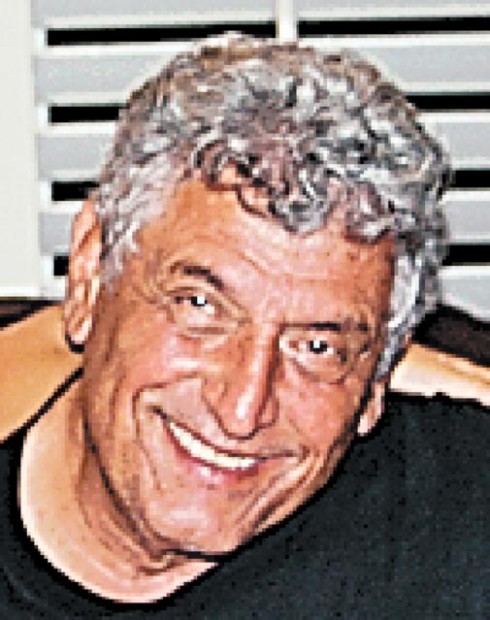
Jerold Cartin was a lawyer, a marriage counselor and a social worker all rolled into one 6-foot-1-inch, 230-pound, broad-shouldered frame.
An attorney by trade, Cartin was on track to become one of Arizona's best litigators, taking on several high-profile cases almost immediately after graduating from the University of Arizona's law school.
But a 1977 collision with a drunken driver changed the direction of his life and the way he practiced law.
After the accident, Cartin became more determined than ever to stand up for anyone he thought got a raw deal. He took cases not for the money, but because they were interesting. Much of his work was pro bono.
He was a man large in stature and personality — gregarious, family-oriented, quick-witted — traits that weren't dampened by the diagnosis two months ago of esophageal cancer that had spread throughout his body.
People are also reading…
Six weeks later, June 5, the man who once took the California state bar exam — one of the toughest in the country — on a dare and passed on the first try, died. He was 67.
Cartin was born in Toledo, Ohio, and raised in nearby Lima. His father owned clothing stores and his mother was a secretary. A lifelong sports fan, Cartin played basketball and ran track in high school. After graduating in 1959, he and a friend drove cross-country to attend the UA. Cartin was on a mission to become either a doctor or a lawyer, said his wife of 26 years, Phyllis.
Friends and family aren't sure why Cartin chose law over medicine. It could have been because he missed the deadline to start medical school and didn't want to wait another semester. Or it might have something to do with a small explosion he caused.
"He almost blew up the chemistry lab," his wife said.
However, former Zeta Beta Tau fraternity brother Gary Abromovitz swears Cartin got good grades in science. The men were roommates while in law school and went on to be friends for nearly 50 years.
"He had a memory that was unbelievable," Abromovitz said. "He was one of the few guys I ever knew who could watch a baseball game on television with a law book in hand and he could absorb it all.
"He was tall, he was like a Robert Mitchum lookalike. The guy had tremendous good looks. He could reach people. I thought he would he would have been one of the best trial lawyers in the state until the accident."
The wreck radically changed the course of Cartin's life. Before that, he was on the fast track to becoming a top litigator.
"He walked into my office back in the '60s when he was a junior in law school and he wanted a job as a law clerk and we hired him. He seemed like a nice young man. He did such a good job his senior year that when he graduated we hired him," said Russell Russo, a partner in the law firm that eventually added Cartin's name: Russo, Cox, Dickerson and Cartin.
Cartin represented several high-profile defendants soon after passing the bar, including John Lee Sellers, who was on trial in 1969 for bludgeoning his mother with a hammer.
He also represented a couple of stooges recruited by a rogue FBI agent in 1968 to bomb the Tucson home of Mafia chief Joseph "Joe Bananas" Bonanno and a ranch owned by Peter "Horseface" Licavoli, a reputed leader of the Mafia from Detroit.
"If you talk to the judges on the bench, they all knew Jerry because he was such a good lawyer," Russo said. "He was respected by everyone in the legal profession. He was quite a lawyer with quite a reputation."
Then came the accident.
In April 1977, Cartin and his first wife were on their way to a family celebration when a teenage drunken driver slammed into their car. Cartin was ejected through a window. The impact was so strong that the engine of the 17-year-old's car broke loose — it was found 200 feet away, Russo said.
Though the drunken driver walked away without a scratch, Cartin's wife suffered myriad broken bones and the attorney was comatose for nearly a week. He suffered broken bones, damaged organs and brain injuries that affected his memory, cognitive abilities and vision.
"It took him a number of years until he got back into practice as a sole practitioner," Russo said.
Cartin's will was strong, but the emotional hits kept coming. A year after the accident, Cartin's father died and, in 1979, he and his first wife divorced.
"It was a very painful time for him. He lost his family. He lost his father and he lost his memory," said Phyllis, who met Cartin in 1979 and married him in 1983.
In 1981, Cartin opened his own private practice.
"He had a real problem with injustice. He used to say his clients were the butcher, the baker, the candlestick maker. He was kind of a Don Quixote fighting windmills," his wife said.
It wasn't unusual for her husband to take cases pro bono. It was something he did even while a partner in his previous firm.
"I'd sometimes get on him because you can't make a living with pro bono cases," Russo said. "But he'd take them on because it was the right thing to do. If it was a good cause, he didn't care if he got paid or not."
In private practice, Cartin dealt with corporate whistle-blower cases, property disputes and citizenship issues.
It was the rapport Cartin developed with clients that in large part influenced Pima County Superior Court Judge Charles Sabalos to go to law school. He was 17 when he met Cartin.
"He was a newly admitted 26-year-old lawyer. He represented my mother in a complicated Social Security case," Sabalos said. "He refused to accept compensation because, and I remember this vividly, he said he enjoyed representing her and he found the case interesting and that was enough reward for him."
Soon afterward, Cartin represented Sabalos' teenage brother.
"He proved in a civil trial my brother's civil rights were violated by a local corporation that was represented by one of the largest and most highly respected law firms in Tucson," Sabalos said. "Again, he wouldn't accept payment because he felt that my brother needed the money more than he did, and he said it was satisfying to help the little guy."
Cartin still was practicing law at the time of his cancer diagnosis, more often than not talking couples out of divorce and into marriage counseling. But the Tony Bennett lookalike also had interests outside the courtroom.
He enjoyed spending time with his sons and their families, kibitzing over coffee at his favorite bagel shop, playing golf with friends and chatting — versus exercising — at the gym.
In the 1980s, he became active with MADD — Mothers Against Drunk Driving. And, over the years, he and his wife took in troubled teens who were struggling with school and with life.
"He was a good lawyer and an even finer man," Sabalos said. "He was a mensch."
the series
This feature chronicles the lives of recently deceased Tucsonans. Some were well-known across the community. Others had an impact on a smaller sphere of friends, family and acquaintances. Many of these people led interesting — and sometimes extraordinary — lives with little or no fanfare. Now you'll hear their stories.